RS-1_instruction manual.pdf - 第88页
Part 1 B asic O peration Chapter 1 Overv iew of the Machine 1- 70 (3 - 1) 10 - key This is a key di splay for e ntering a nu m eric v alue. When you hav e to enter a character other tha n a numeric v al ue, y ou can invo…
Part 1 Basic Operation Chapter 1 Overview of the Machine
1-69
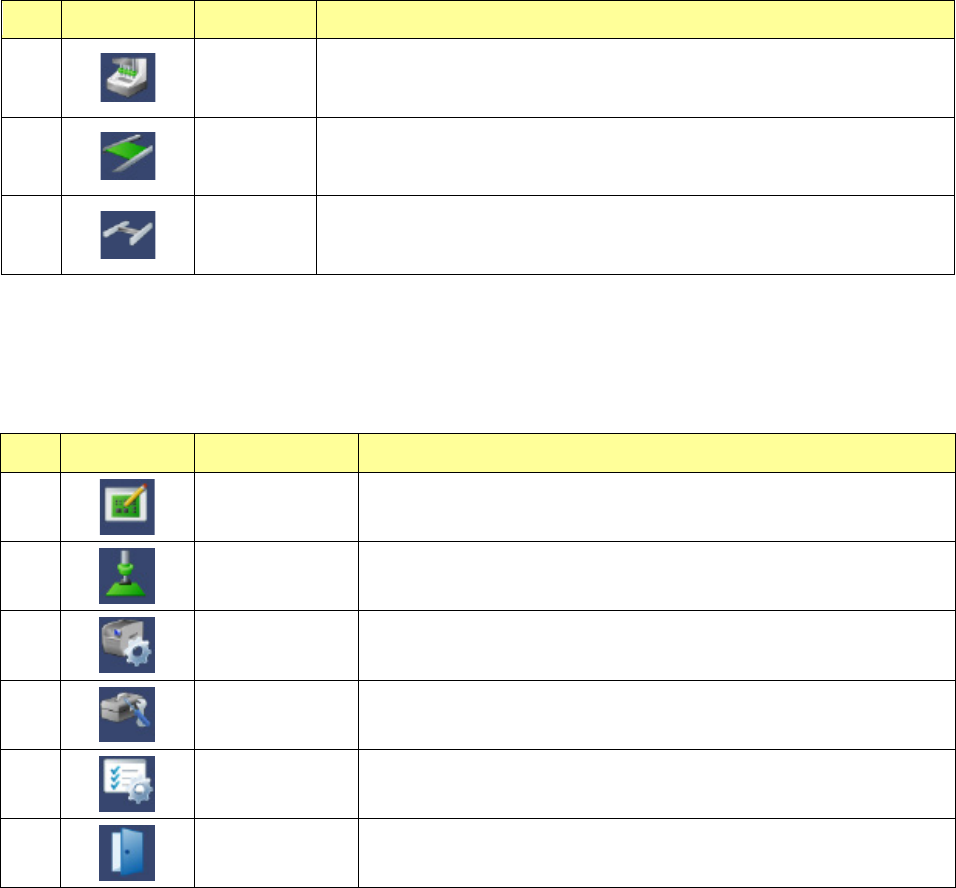
1) Function buttons for the maintenance information
Some menus may not be selected depending on the application that is started up at the
present.
See Chapter 11 “Self Check” for details.
2) Production control, during PWB production
Some menus may not be selected depending on the application program that is started up at
the present.
The menu for starting up the application that is already started up is disabled on the screen.
3) Software keyboard
When you select the software keyboard tab, the software keyboard appears on the screen.
No. Icon Name Overview
1
Head
This icon opens the component replacement information screen where the
head is displayed in preference to other parts.
If the machine has anything to notify an operator, a warning mark is displayed
above the icon.
2
Conveyor
This icon opens the component replacement information screen where the
conveyor is displayed in preference to other parts.
If the machine has anything to notify an operator, a warning mark is displayed
above the icon.
3
XY
This icon opens the component replacement information screen where the
XY-axes are displayed in preference to other parts.
If the machine has anything to notify an operator, a warning mark is displayed
above the icon.
No. Icon Name Overview
1
Program Editor
Quits the application that is started up at the present to start up the
Program Editor.
2
PWB Production
Quits the application that is started up at the present to start up the PWB
Production.
3
Machine Setup
Quits the application that is started up at the present to start up the
Machine Setup.
4
Manual Control
Quits the application that is started up at the present to start up the
Manual Control.
5
Option Setting
Quits the application that is started up at the present to start up the
Operation Options.
6
Exit
Quits the application that is started up at the present.
Part 1 Basic Operation Chapter 1 Overview of the Machine
1-70
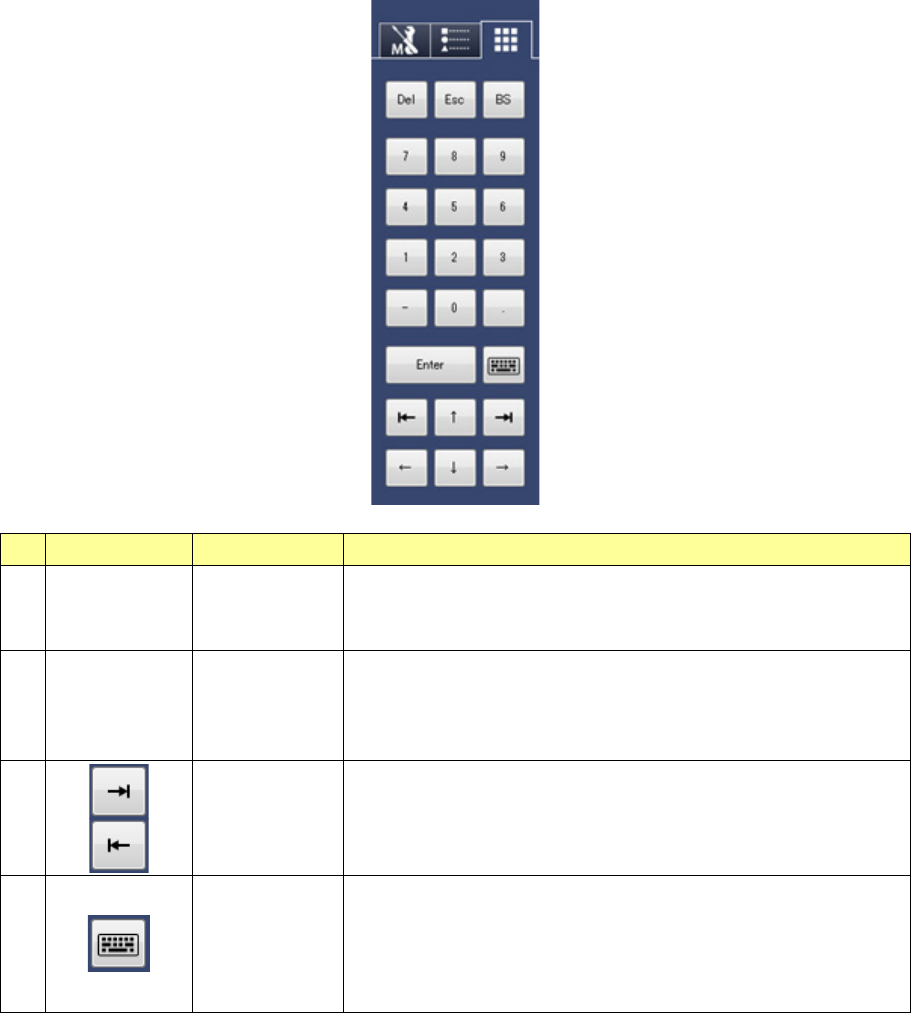
(3-1) 10-key
This is a key display for entering a numeric value.
When you have to enter a character other than a numeric value, you can invoke the full keyboard
window also. (This tab cannot be switched to the display for either alphabet characters or moving
buttons any longer.)
No.
Button
Name
Overview
1
-
Character keys
Performs an operation of a key of the displayed keyboard for
the focused text box or Editor screen.
Numeric value entry keys (-, ., 0, 1, 2, 3, 4, 5, 6, 7, 8, 9)
2
-
Other keys
Performs an operation of a key of the displayed keyboard for
the focused text box or Editor screen.
Del, Esc, BS (Back Space) key, Enter key,
Movement keys (
↑
,
↓
,
←
,
→
)
3
Tab keys Performs an operation of the forward or backward Tab key.
4
Invoking of the
full keyboard
Displays the full keyboard window specialized for entry of
alphabet characters.
When you press this button while the full keyboard is being
displayed on the screen, the keyboard is moved to the default
position (the center of the application area).
Part 1 Basic Operation Chapter 1 Overview of the Machine
1-71
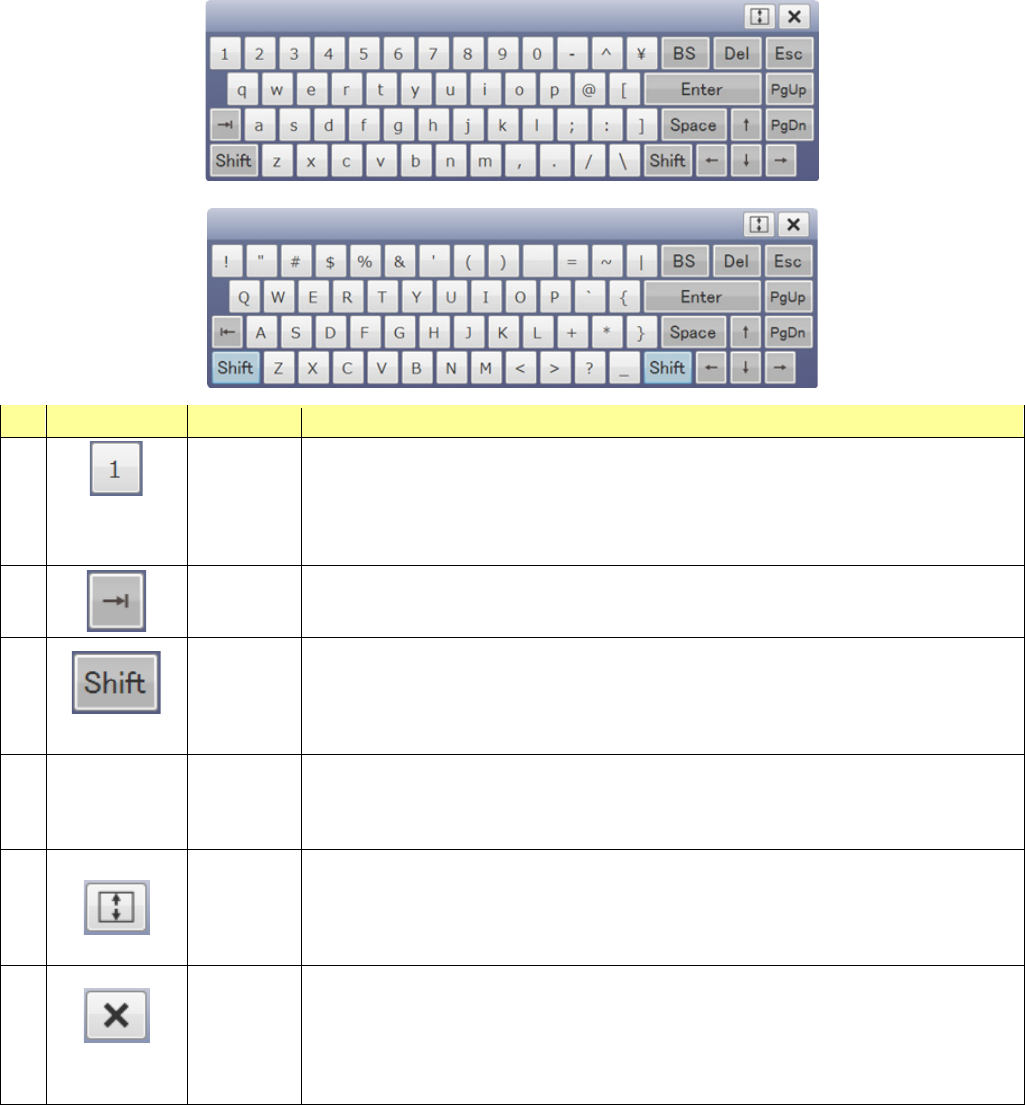
(3-2) Full keyboard
This is for displaying keys that enter alphabet characters. Invoke it from the 10-key displayed on
the information area to display it on the screen.
This window is transparent so that you can see an error message or any other message overlapped
with the full keyboard.
The corresponding button allows you to move the keyboard to the bottom or the top of the screen.
In addition, when you drag its upper section, you can move it to the desired position of the entire
screen.
<When the keyboard is displayed normally>
<When the <Shift> key is selected>
No.
Button
Name
Overview
1
Button displayed
in the standard
color
Character
keys
Buttons displayed in the standard color allow you to enter the characters displayed on the
buttons. The entered character varies depending on whether the <Shift> key is pressed
or not: for example, a numeric value is entered, the uppercase/lowercase character is
entered or a symbol is entered. “¥
” is entered as a backslash symbol. Even though you
press the “0” key when the <Shift> key is pressed, no character is entered.
2
Tab key
Performs an operation of the Tab key.
Normally, it operates in the for
ward direction. When the <Shift> key is pressed, it operates
in the reverse direction.
3
(Check box)
Shift key
When you press this key once, it is put in the pressed state, and changes the display and
function of each of the No. 1 and 2 keys.
Until you press this key again, this state is not
canceled automatically even though you press any other keys. (This is applied to when
you switch the displayed screen to another one or close it to display the same screen
again also.)
4 -
Other keys
Performs an operation of the displayed key of the keyboard.
Note that these keys are not affected by the <Shift> key operation. (You cannot select
any range.)
BS, Del, Esc key, Enter key, Space key, PgUp/PgDn key, movement keys (
↑
,
↓
,
←
,
→
)
5
Screen
movement
key
Moves the full keyboard to the top or bottom of the screen. The destination positon is
decided according to the current keyboard position.
When the keyboard is located on the top of the screen, it is moved to the default positon.
When it is
located on the bottom of the screen, it is moved to the position above the input
range displayed in the operation area.
6
Close button
Hides the full keyboard. When you display the full keyboard from the information area
again, it is moved to the position at which the keyboard was located when the keyboard
was hidden.
The full keyboard is not closed automatically when the entry is valid
ated. It is closed only
when you press the Close button, when the information area is not displayed or when the
main unit software is shut down.