RS-1_instruction manual.pdf - 第8页
vi CA UTION A lthough the drive D of thi s machine is used t o install sof tware or store data on it, its capa city is limited. 1. Secure free space of the driv e D. Secure at l east 50 0 MB fr ee space of t he drive D. …
v
Matters of Caution for Safe Use of RS-1 Series
DANGER
1. A product of laser class 3B is used as a coplanarity sensor.
Exposure of an eye or skin to a laser beam is very dangerous.
Never look straight at a laser beam. When the machine is turned on, never look
into the laser irradiating port of the coplanarity sensor.
2. Since the main axis operates at low speed in Maintenance mode even while the
safety cover opens, never put your face or hand into its movable range.
CAUTION
1. To prevent damage to human bodies, do not operate the machine, with the safety cover or
equipment removed.
2. To prevent damage to human bodies, make sure that hair, clothes, etc., will not be caught by the
conveyor chain. Also, keep off gloves.
3. To prevent damage to human bodies, turn off power supply during maintenance (greasing,
adjustment, and daily inspection).
4. To prevent damage to human bodies, use an earth leakage breaker for the power line.
<Safety cover>
1. When opening/closing the safety cover, pay attention to the following items.
- When opening the cover, push it up fully, and then release it only after “locking” the lock arm
located on your left hand.
If the cover is released in a non-locked status, it may fall.
- When closing the cover, release the locked status and then close the cover.
- (During a release operation, take care not to get hurt due to falling of the cover.)
- Do not apply an excessive load to the cover, handle, etc.
- When a head unit is on rear side of a main unit, it occasionally come in contact with an X-
axis unit
when a safety cover on rear side is opened and closed. At that time, open and close the safety
cover after moving the head unit to front side of the main unit.
CAUTION
1. Windows 7 (including the Ethernet communication function) is adopted as the Operating System
of this machine.
If you install on this machine any software not designed for this machine, we cannot guarantee
that the machine functions properly. If you move or rename a file stored in the SSD or
compress or
copy a file or a folder, we cannot guarantee that either.
• Should the machine not operate properly due to any operation above, replace your SSD with a
new one, and so your data may be lost.
CAUTION
The Enhanced Write Filter (EWF) component is used and the drive C is used as ROM to protect the
Operating System (OS).
1. Do not store any file onto the drive C.
When you try to store a file onto the drive C used as ROM, the file storing operation is emulated
with the main memory. Therefore, when you save a file onto the drive C, the main memory is
used and it weigh
s down the system. When you repeat saving data on the drive C, the amount of
the memory becomes insufficient and the system displays an error, so you may have to restart this
machine.
2. When you have to change any information of the OS, update the drive C. See Section 1.10
“Updating the Drive C” of this Instruction Manual for how to update the drive C.
Operations that require modification of the OS information are as follows:
- Upgrading of the RS-1 Series system
- Addition of a printer
- Setting of the network (such as settings of the IP address and a work group)
- Addition of a user
- Changing of the Explorer settings
• When you change the OS information, you have to restart this machine after updating the drive C.
vi
CAUTION
Although the drive D of this machine is used to install software or store data on it, its capacity is
limited.
1. Secure free space of the drive D.
Secure at least 500 MB free space of the drive D.
If the free space capacity is below 500 MB, delete unnece
ssary files (such as the old version main
unit software, log files and unnecessary production programs) to secure the free space.
• If you continue to use the machine although the free space is not sufficient, the software
operates unstably, for example, an application error occurs or an I/O error occurs, so the
machine cannot operate normally.
CAUTION
1. ATX power supply and battery are incorporated into this machine to protect a production program
and any other data at power failure. To prevent a battery built into the ATX from degrading, do
not leave this machine without turning it on for six months or longer.
• Only when the main circuit breaker and main switch are set to ON, this machine is assumed to
be turned on.
For the safe operation of machinery
Table of Contents
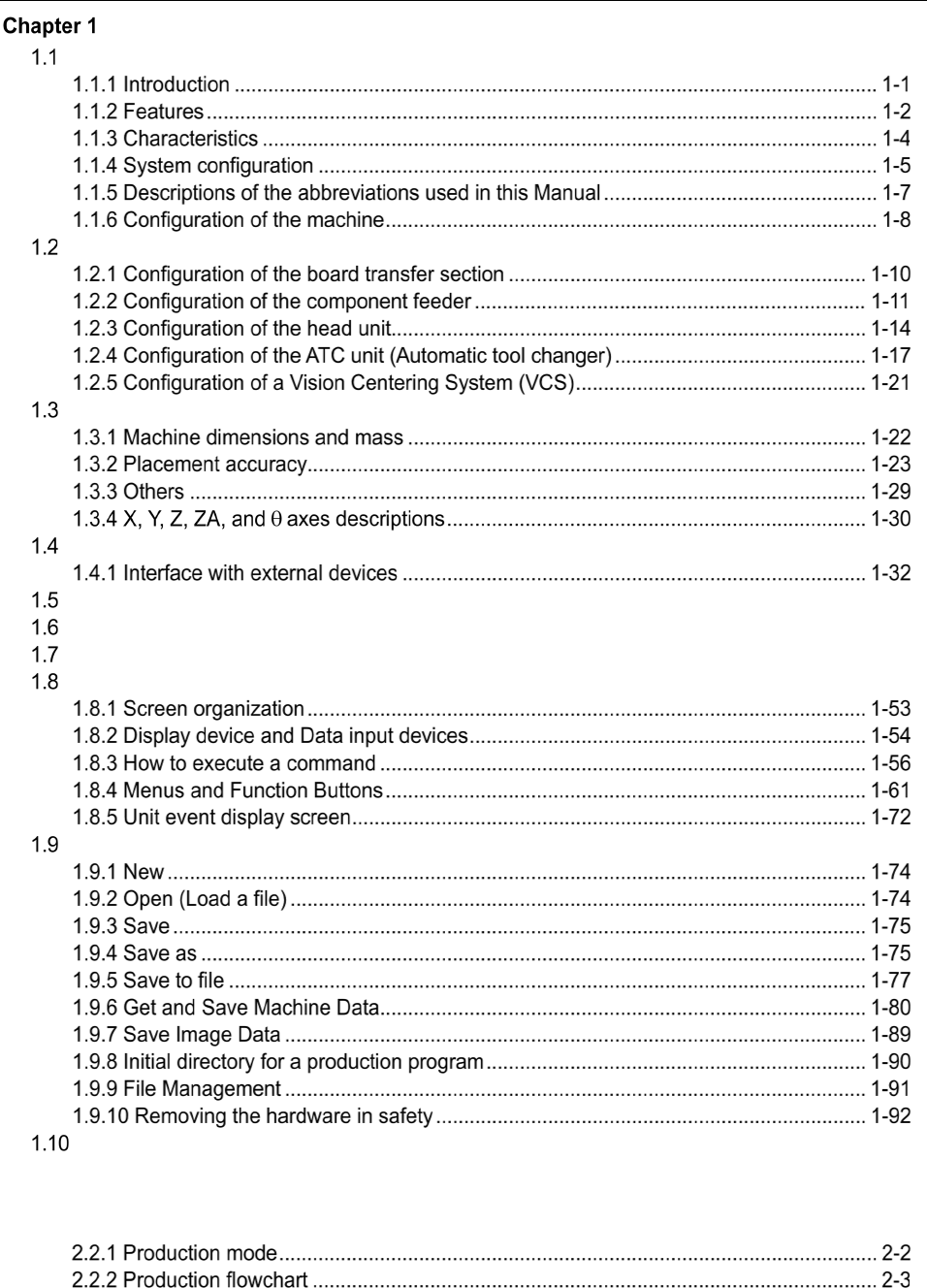
Part 1 Basic Operation
Overview of the Machine ............................................................................................... 1-1
General ................................................................................................................................................. 1-1
Configuration of the machine ......................................................................................................... 1-10
Mechanical specifications ................................................................................................................ 1-22
Electrical specifications .................................................................................................................... 1-31
Applicable components and packaging styles ............................................................................. 1-35
Printed circuit board specifications ................................................................................................ 1-44
Centering system ............................................................................................................................. 1-48
Basic Operations .............................................................................................................................. 1-53
Operating a File ............................................................................................................................... 1-74
Updating the Drive C .................................................................................................................... 1-93
Chapter 2 Production 2-1
2.1 Flowchart for production ..................................................................................................................... 2-1
2.2 Overview ............................................................................................................................................... 2-2