RS-1_instruction manual.pdf - 第375页
Part 1 B asic O peration Chapter 4 Cr eating a Produc tion Progra m 4- 40 Otherw ise, three ch oices sho w n above ar e di spl ayed. When you se lect the [Ed it] command, t he “Area B ad Mark ” screen appe ars in Edit mo…
Part 1 Basic Operation Chapter 4 Creating a Production Program
4-39
• Mark ID: Enter the Mark ID.
When you omit it, the system automatically assigns a mark ID.
• Linked placement: The number of placement data records that refer to a mark group when you
open the “Area Mark” screen is displayed here. You cannot edit any data.
• Mark 1(2, 3) X: Enter the X coordinate of a mark. The coordinate value can be obtained
with teaching operation.
• Mark 1 (2, 3) Y: Enter the Y coordinate of a mark. The coordinate value can be obtained
with teaching operation.
• Mark Name: The name of the mark is entered. The mark name can be taught or copied
from the mark data.
• Mark 1(2, 3) TI: The mark taught data obtaining status is displayed here. When the focus
is located here, you can teach the mark or copy it from the mark data.
The above items cannot be edited when the screen is opened by the [Browse] command. When
the screen is opened by the[Browse] command, they are displayed in the line selection mode.
• Select: The system selects a mark group on which the focus is located on the list
(that is, sets it into Placement data), and returns to the “List” screen of the
Placement data.
• OK: The system stores the edited data, and returns to the “List” screen of the
Placement data. Any mark group is not selected.
• Cancel: The system discards your editing, and returns to the “List” screen of the
Placement data.
When you quit the “Area Mark” screen with touching the “List” tab of the “Placement” data screen,
the system returns to the “List” screen without setting any link to the Placement data.
Since an area mark is affixed nearer a component placement position than a BOC
mark, it improves the accuracy of component placement. However, it takes a long
time to recognize a mark, so production is delayed.
CAUTION
If there is any CAD data (designed value) on a mark, NEVER teach the X
and Y coordinates. Should you do this, a component placement position
will be deviated.
The placement coordinates of the component that uses area marks have no
relation with the BOC marks. The BOC mark in this case works as the
reference coordinates for searching area marks. Therefore, if a component
is not placed on the specified position, modify the corresponding area
mark(s) or coordinates of the component placement position (X, Y) directly.
(8) AreaBM (Area bad mark)
Select whether to set an area bad mark for a component placement position on the pop-up list box.
When you enter the Placement ID, “No” (a mark is not to be used) is set in the “Mark” field by
default.
“No” or a mark ID (up to eight half-sized characters) is displayed in the “Mark” field on the screen.
To change the setting, touch the input field to open the pop-up menu, and then select the desired
command.
No.
An area bad mark is not to be used.
Edit
Opens the “Area Bad Mark” screen.
Browse
Opens the “Area Bad Mark” screen. (You cannot edit any data on this screen.)
To change the setting, touch the input field to open the pop-up menu. Then, select the desired
mark, and enter data.
If you open the pop-up menu when two or more lines are selected, the [Edit] command is not
displayed on the pop-up menu.
Part 1 Basic Operation Chapter 4 Creating a Production Program
4-40
Otherwise, three choices shown above are displayed.
When you select the [Edit] command, the “Area Bad Mark” screen appears in Edit mode.
When you select the [Browse] command, you cannot edit any data on the “Area Bad Mark” screen
When you select the [Edit] command or the [Browse] command on the pop-up menu, or when you
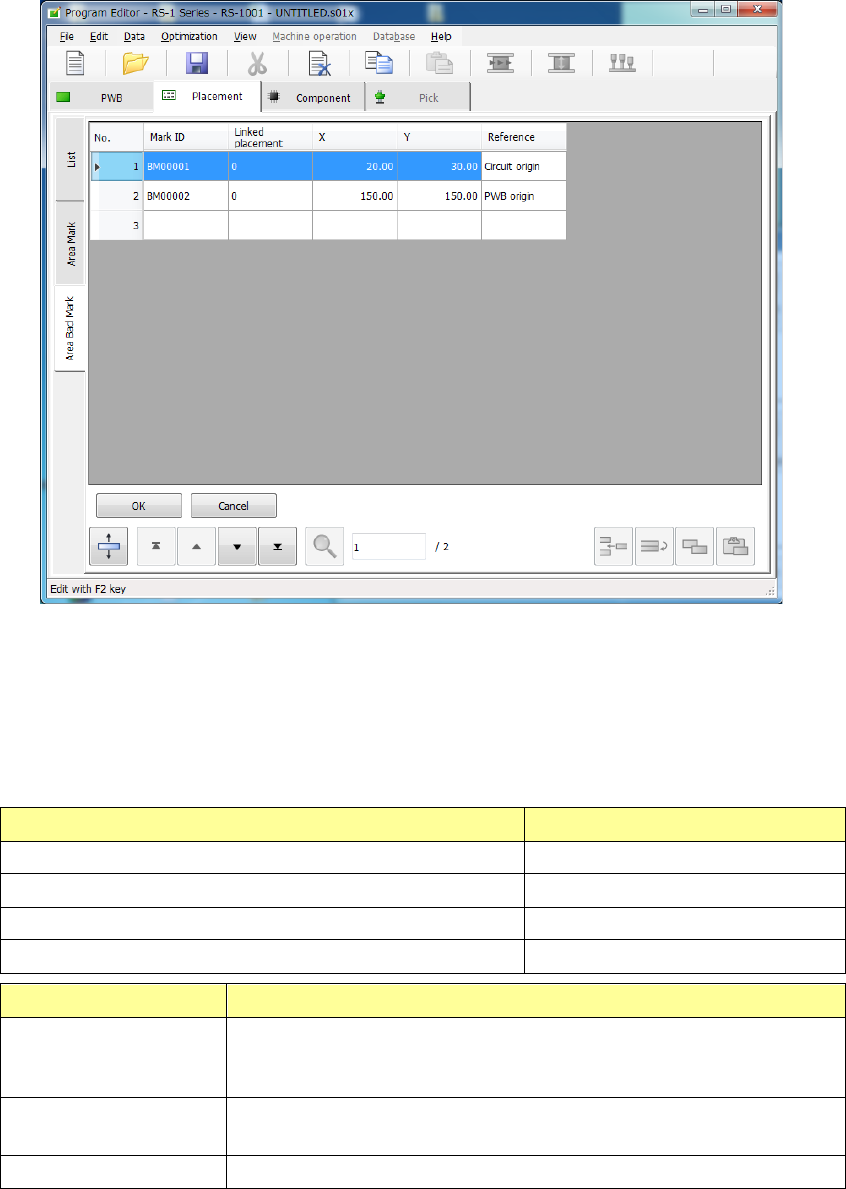
select the “Area Bad Mark” tab, the “Area Bad Mark” editing screen appears.
The area bad marks already registered appear in the area bad mark list.
Select an area bad mark to be used among them.
To register a mark anew, move the focus to a line in which no data is entered yet and enter the
X-coordinate and Y-coordinate of the mark and the reference.
The “Area Bad Mark” editing screen can be opened by the following methods. The processing
varies depending on the display mode.
Operation Screen mode
[Edit] is selected in the area bad mark pop-up menu. Edit/selection mode
[Browse] is selected in the area bad mark pop-up menu Selection mode
The “Area Bad Mark” tab is selected. Edit mode
The cell is double-clicked at mark. Selection mode
Screen mode Contents of processing
Selection mode The area bad mark data to be used by the placement data is registered.
The cursor on the list is displayed in a line selection status. The <OK>
button is indicated in light color.
Edit mode
The coordinates of the area bad mark can be entered and registered.
The <Select> button is not displayed.
Edit/selection mode Selection and editing can be performed simultaneously.
Part 1 Basic Operation Chapter 4 Creating a Production Program
4-41
• Mark ID: Enter a mark ID. When you omit it, the system automatically assigns an
ID to the mark.
• Linked placement: Displays the number of placement data records that refer to the
area bad marks when you open the “Area Bad Mark” screen. You cannot
edit this item.
• X: Enter the X coordinate of the mark. The coordinate value can be obtained
with teaching operation.
• Y: Enter the Y coordinate of the mark. The coordinate value can be obtained
with teaching operation.
• Reference: Select the reference position of the coordinate system. Select “Circuit origin”
or “PWB origin.”
To change the setting, touch the input field to open the pop-up menu.
Select the desired reference position to enter it.
If you select any position on the pop-up menu when the cursor is located in
the “Reference” field and two or more lines are selected, the same value is
entered in all of the selected records.
PWB origin
Circuit origin
Set the coordinates viewed from the board origin.
Set the coordinates viewed from the circuit origin.
Note: You can select the [Circuit origin] command for a single-circuit board also. In this
case, set the coordinates viewed from the board origin.
When you open the pop-up menu with selecting the [Browse] command, any item described
above cannot be edited. When you open the menu with the [Browse] command, the screen
is displayed in Line Selection mode.
If you select any position on the pop-up menu when the cursor is located in the “Reference”
field and two or more lines are selected, the same position is entered in all of the selected
records.
• OK: Saves the edited data and returns to the “Placement” data list screen.
At that time, the use of mark group is not set.
• Cancel: Discards your editing and returns to the “Placement” data list screen.
When you double-click or press the Placement list tab to quit this “Area Bad Mark” screen,
the system redisplays the “Placement” data list screen without setting any link to the
Placement data.
The color of a bad mark should be able to be distinguished from that of a board, and
its diameter should be 2.5 mm or more. Note that when you use a bad mark, the
cycle time becomes longer by the mark recognition time.
(9) Skip
Specify whether to skip a component placement position displayed on this data screen.
“No” (a position is not skipped) is selected by default.
To change this setting, touch the input field to open the pop-up menu. Select the desired setting
to enter it.
If you select any item on the pop-up menu when the cursor is located in the “Skip” field and two or
more lines are selected, the same setting is entered in all of the selected records.
Yes
Skips the selected position.
No
Does not skip the selected position.