RS-1_instruction manual.pdf - 第686页
Part 2 D etaile d Descript ion of E ach Functi on Chapter 7 Operation Option 7- 11 No. Menu item Descripti on Status Operatio n and detaile d explanation 11 Method of di splaying the worst fe eder during productio n Spec…

Part 2 Detailed Description of Each Function Chapter 7 Operation Option
7-10
No. Menu item
Description
Status Operation and detailed explanation
4
Make no inquiry about
saving at the end of
production.
Specify the execution of the inquiry about production program saving at the end
of the production condition screen.
The saving check dialog does not appear at the end of the production
condition screen.
5
Specify “No non-stop
production” at non-stop
production as the default.
In the production start pre-processing dialog displayed by pressing the
<START> switch (when there is a non-stop production file), specify the default
of the “Non-stop production”/”No non-stop production” radio button.
In the production start pre-process dialog (when there is a non-stop
production file), the default of the “Non-stop production”/”No
non-stop production” radio button is set to “No non-stop production”.
“Non-stop production” is set.
6
Specify “Production after
re-clamp” at non-stop
production as the default.
Specify the default of production operation when there is a non-stop production
file and production operation (“Production after PWB carrying-in”/”Production
after re-clamp” can be initially selected when the PWB pre-start dialog is
displayed.
“Production after re-clamp” is selected.
“Production after PWB carrying-in” is selected.
7
Specify “Production after
PWB carrying-in” at
non-non-stop production
as the default.
Specify the default of production operation when the production operation
(“Production after PWB carrying-in”/”Production after re-clamp”) can be initially
selected at no- non-stop production when the production pre-start dialog is
displayed.
“Production after PWB carrying-in” is selected.
“Production after re-clamp” is selected.
8
Include “no components”
in the number of pick
errors.
Specify whether “no components” is included in the number of pick errors or
pick ratio.
The number of pick errors of production management information is
displayed by adding the number of no components (pick retry over).
The number of pick errors of production management information is
displayed without adding the number of no components (pick retry
over).
9
Display a pick error at a
start of production.
Specify whether a check dialog is displayed when there is a feeder with a lower
pick ratio at a start of production.
A check dialog is displayed if there is a feeder with a lower pick ratio
than the set value at a start of production.
A check dialog is not displayed if there is a feeder with a lower pick
ratio than the set value at a start of production.
10
Subdivide a temporary
stop error due to “no
components.”
Regarding a head resulting in an error in the temporary stop dialog due to “no
components”, display whether it is laser head or vacuum head.
The “judgment” item is displayed in the temporary stop dialog due to
“no components” and the no component judgment is displayed.
The “judgment” item is not displayed in the temporary stop dialog
due to “no components”

Part 2 Detailed Description of Each Function Chapter 7 Operation Option
7-11
No.
Menu item
Description
Status
Operation and detailed explanation
11
Method of displaying
the worst feeder during
production
Specify the display method of the worst feeder on the production execution
screen.
Pick ratio (number of pick
successes)/total number of picks
Tot al number of errors
Three worst feeders are
displayed from the pick ratio
obtained by the number of pick
successes/total number of picks.
Three worst feeders are displayed from
the total number of pick errors.
12 Information of coplanarity
Specify how to output coplanarity information.
You can specify this menu item only when the menu item “When Copla
check fails” is set to “Pause.”
No output
The machine does not output any
coplanarity information.
Only error electrode information
The machine outputs only information
on an electrode(s) at which an error
occurred.
All electrode information
The machine outputs information on all
electrodes.
Part 2 Detailed Description of Each Function Chapter 7 Operation Option
7-12
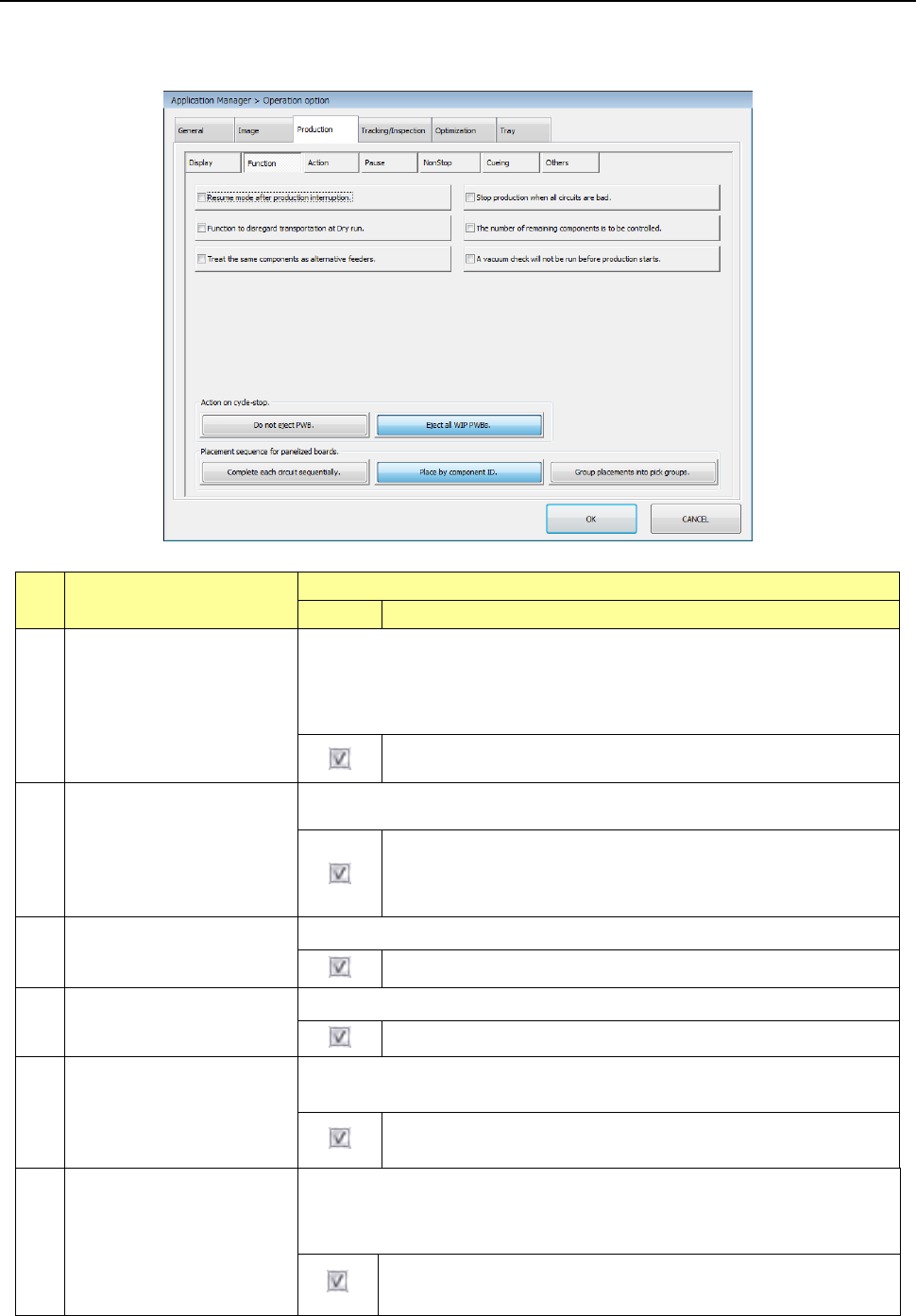
7.4.2 Function
When you press the <Function> button, the screen for setting the function options for PWB
production appears.
No. Menu item
Description
Status
Operation and detailed explanation
1
Resume mode after
production interruption.
Specify whether to display the message that asks a user to resume the
production when he/she interrupts the production (by pressing the <Pause>
key).
When production is aborted abnormally (due to an asynchronous event or
production error), the system always creates a continuous production file.
The system creates a continuous production file when the current
production is interrupted.
2
Stop production when all
circuits are bad.
Specify whether to interrupt the current production if the system recognizes all
circuits as bad marks.
The machine aborts production although it has not produced the
preset number of PWBs possibly because an error occurs: the
wrong bad mark information, sensor adjustment failure or
malfunction and so on.
3
Ignore transport at dry run.
Specify whether to perform a transport operation at dry run production.
No transport operation is performed at dry run production.
4
Manage the residual
number of components.
Specify whether to manage the residual number of components.
The residual number of components is performed.
5
Consider the same
component as an alternate
feeder.
Specify the same component as an alternate feeder at production in the order
of inputs.
When there is an alternate feeder, components are picked up from
the alternate feeder at occurrence of “no components.”
6
A vacuum check will not
be run before production
starts.
A vacuum check will not be run before production starts.
* When you
enable this function, be sure to run a “Filter stain check”
of the “Self-diagnosis function” once a month.
The system does not run a vacuum check that is to be run
before production starts.