RS-1_instruction manual.pdf - 第378页
Part 1 B asic O peration Chapter 4 Cr eating a Produc tion Progra m 4- 43 Area check The syste m checks that a component plac ement position is with i n a PW B (for a sing le - pla ne PWB) or within a circuit ( for a mul…
Part 1 Basic Operation Chapter 4 Creating a Production Program
4-42
(10) Trial
Specify whether to perform a trial run or not. If you specify the component placement position(s)
within the trial-run range on the production condition screen when setting the conditions for
trial-run, a trial run is conducted for only the placement data whose “Skip” item is set to “Yes.”
“No” (any trial-run is not conducted) is selected by default.
To change this setting, touch the input field to open the pop-up menu. Select the desired setting
to enter it.
If you select any setting on the pop-up menu when the cursor is located in the “Trial” field and two
or more lines are selected, the same setting is entered in all of the selected records.
Yes Conducts a trial run.
No Does not conduct a trial run.
(11) Layer
“Layer 4” is selected by default. To change the setting of this item, touch the input field to open
the pop-up menu. Select the desired layer to enter it.
If you select any layer on the pop-up menu when the cursor is located in the “Layer” field and two
or more lines are selected, the same layer is entered in all of the selected records.
When you execute the Optimization function, the component placement order is automatically
decided regardless of the input order.
The component placement order is optimized on the same layer. (If components run out during
PWB production, the system cannot proceed to production on the next layer until the system
finishes production on the layer whose number is smaller.)
Layer 1
Layer 2
Layer 3
Layer 4
Layer 5
Layer 6
Layer 7
First layer
Second layer
Third layer
Forth layer
Fifth layer
Sixth layer
Seventh layer
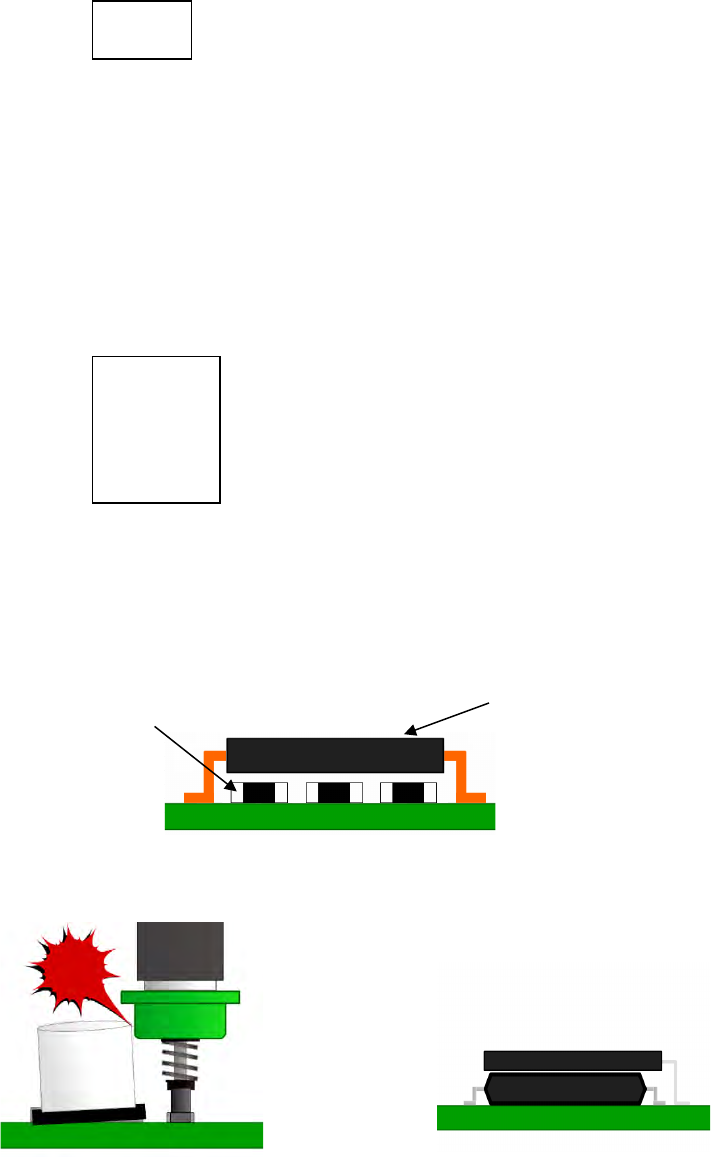
Example: If the system places QFP components and a chip component as shown in the right
figure, it has to place a chip component first.
In this example, when you specify the layer 4 for a chip component, and the layer 5
for a QFP, the system places a chip component whose layer number is smaller first,
and then a QFP.
<Placing QFP on the chip.>
・Layers are also used for adjacent placement/laminated placement.
<A component is placed near a tall one.> <IC components are stacked.>
Chip component (layer 4)
QFP(layer 5)
Part 1 Basic Operation Chapter 4 Creating a Production Program
4-43
Area check
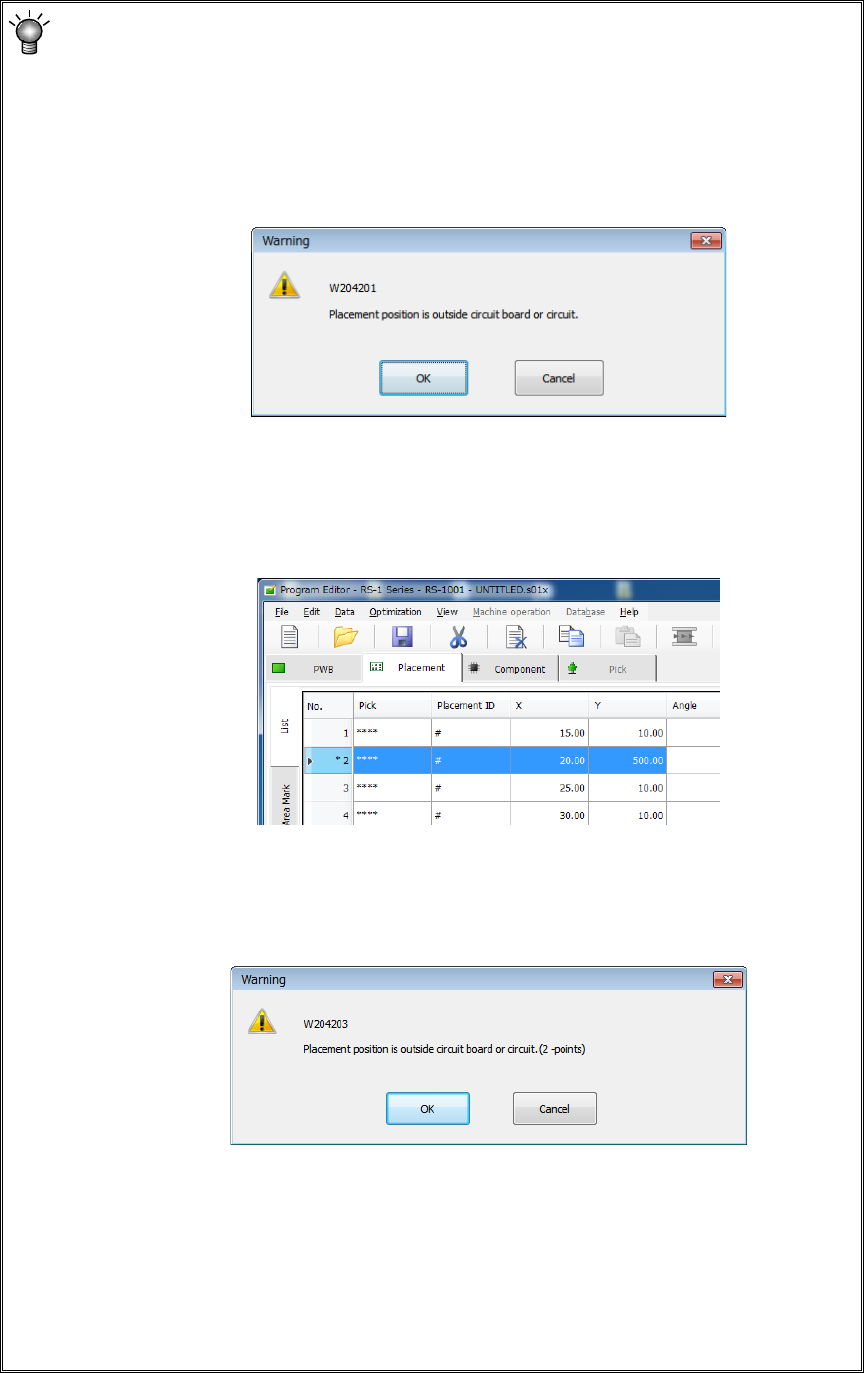
The system checks that a component placement position is within a PWB (for a
single-plane PWB) or within a circuit (for a multi-plane PWB) at the following timing:
1) At data entry
The system checks the component placement area when you enter or change
the placement coordinate X or Y.
If an error occurs, the system displays the following warning message.
• <OK>: The system validates data you entered, and displays an asterisk
mark (*) left to the placement data number indicating the range over
error (see the figure below). When you enter a value within the
range, this mark disappears.
• <Cancel>: The data you entered becomes invalid, and the system allows you
to enter data again.
2) When you switch the displayed data screen
When you switch the displayed data screen (for example, by selecting
component data), the system checks the component placement area.
If an error occurs, the system displays the following warning message.
• <OK>: The system resume switching the displayed data screen.
• <Cancel>: The system stops switching the displayed data screen.
* If the area check error occurs, check the data entered on the “Placement” data
screen. If you do not find any problem on this screen, check each entry on the
“PWB” data screen.
(Check the settings of “Reference hole position,” “PWB layout offset,” “First
circuit position,” “Circuit layout offset” and each coordinate entered on the “Circuit
layout” screen especially.)
Part 1 Basic Operation Chapter 4 Creating a Production Program
4-44
4.3.5 Component data
On the "Component" data screen, enter the detailed information on the "Component name" that
was entered on the "Placement" data screen.
Therefore, data will be created for the number of component names entered on the "Placement"
data screen.
4.3.5.1 Viewing the component data screen
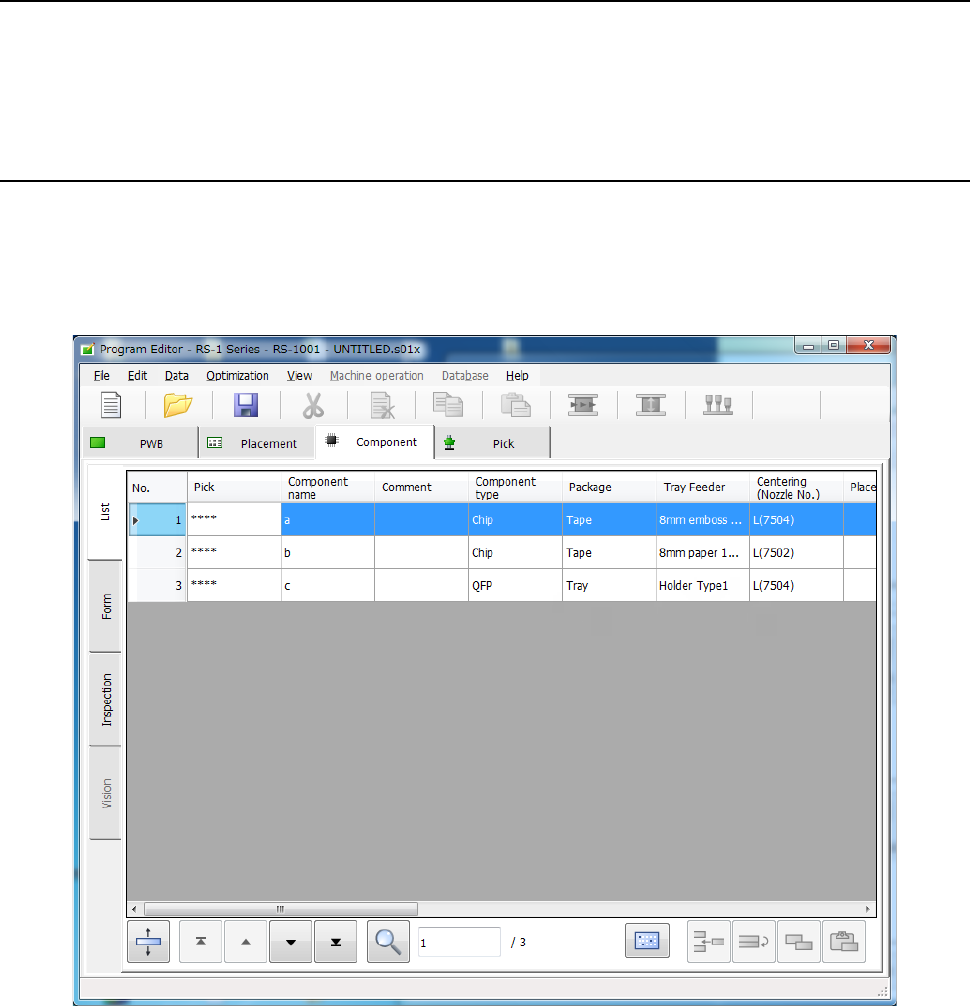
Two types of component data screens are provided: “List” screen and “Form” screen.
On the “List” screen, the system displays a list of the summary information of two or more
components.
You cannot enter any data on this screen, but you can check how you have completed component
data.
Each item can be used as a sort key to sort data and display it on the “List” screen of the
“Component” data screen.