RS-1_instruction manual.pdf - 第507页
Part 1 B asic O peration Chapter 4 Cr eating a Produc tion Progra m 4- 172 (1) Operation ① C onvey or operation Y ou can select a board tr ansport oper ation amon g l oading of a board, eject ing of a board, releasing of…
Part 1 Basic Operation Chapter 4 Creating a Production Program
4-171
4.5.2.5 PWB control
This command loads and/or ejects a board.
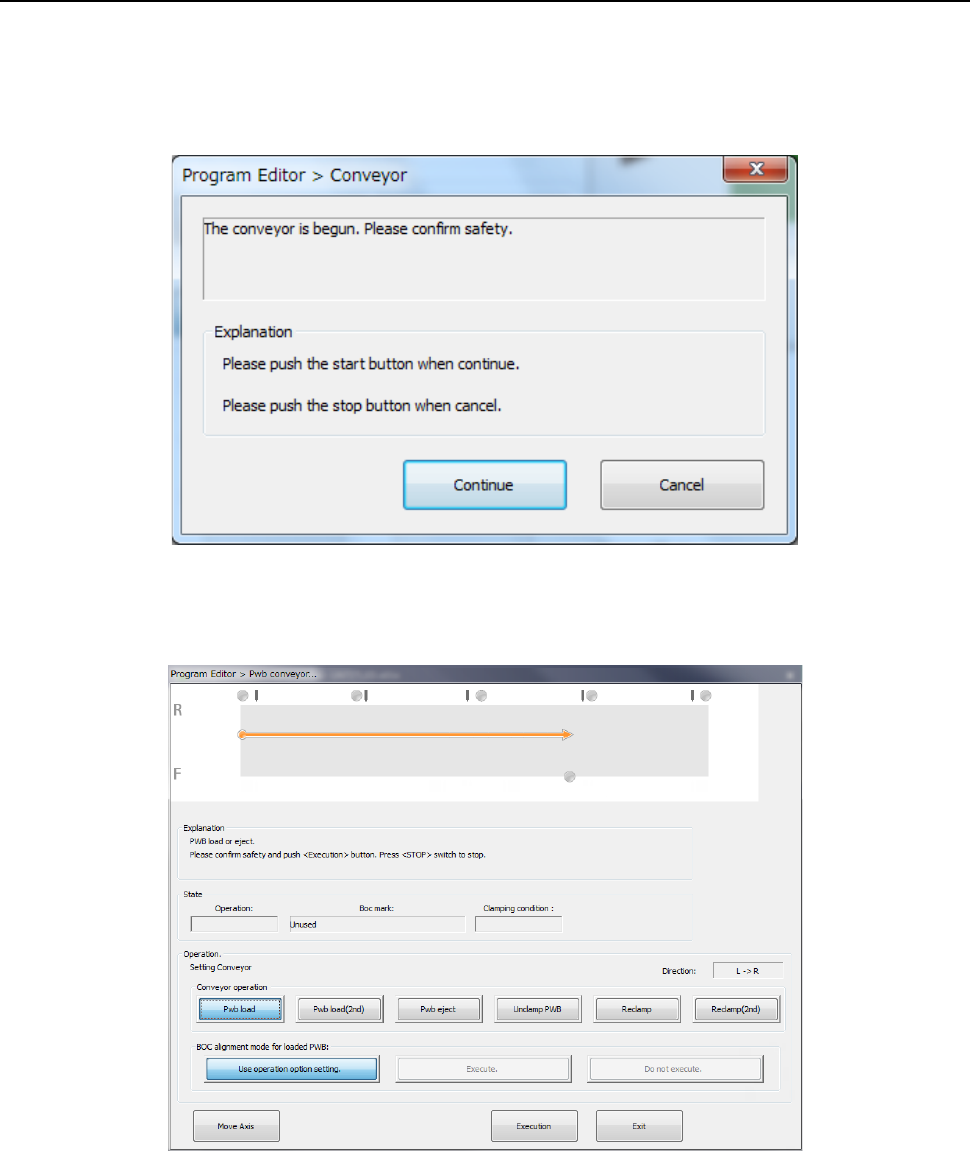
If the safety cover opens after this command is selected from the menu, the following dialog box
appears on the screen because the system has to move the axes to the safe positions.
Check the safety, and then press the <START> switch.
After the axes move to the safe positions, the following “Pwb conveyor” dialog box appears on the
screen.
Part 1 Basic Operation Chapter 4 Creating a Production Program
4-172
(1) Operation
① Conveyor operation
You can select a board transport operation among loading of a board, ejecting of a board,
releasing of the clamped board and re-clamping of a board by selecting the corresponding
button: <Pwb load>, <Pwb eject>, <Unclamp PWB> and <Reclamp>.
The <Pwb load> button is selected at start-up.
② Display of the conveyor operation
The specified board transport operation and the transporting condition changed with the
operating station are shown graphically.
③ BOC alignment mode for loaded PWB
Select whether to perform BOC alignment operation immediately after a board is loaded to
the machine.
<Use operation option setting.> : Determines whether to recognize a BOC mark according to
the setting of the Operation option.
<Execute.> : Always recognizes a BOC mark.
<Do not execute.> : Does not recognize any BOC mark.
④ State
Information obtained during board transportation is displayed here.
The board transport direction, usage of a BOC mark and the clamping condition are
displayed also.
⑤ Move Axis
This button moves the axis to the waiting position.
⑥ Execution
When you press the <Execution> button, the system performs the operation selected with
the “Conveyor operation” button: <Pwb load>, <Pwb eject>, <Unclamp PWB> and
<Reclamp>.
⑦ Exit
This button quits the “Pwb conveyor” dialog box.
To execute board transport operation, press the <START> switch (or <Execution> button).
To finish the operation, press the <Exit> button.
To abort the operation for some reason during board transportation, press the <STOP>
switch to stop it.
(2) Condition of the board transport path
① Pwb load
This button loads a board to the buffer that clamps it, and then clamps it.
The clamping position varies depending on the settings of the setup screen and/or the
external size of a board.
If any board is already located at the clamping position, a new board is loaded only after it is
ejected.
② Pwb load (2nd)
This button clamps a board for the second time.
③ Pwb eject
This button ejects a board from the clamping position.
The board transport speed is reduced immediately before a board reaches the OUT sensor
when it is ejected, and the OUT sensor detects it when it is transported at low speed.
When a board is ejected from the clamped condition, it is ejected at low speed.
④ Unclamp PWB
This button releases the clamped board if the board is clamped.
⑤ Reclamp
When a board is located at the clamp position, this button re-clamps it at the stopper
position.
⑥ Reclamp (2nd)
When a board is located at the clamp position, this button re-clamps it at the second clamp
position.
Part 1 Basic Operation Chapter 4 Creating a Production Program
4-173
4.5.2.6 Transport conveyor
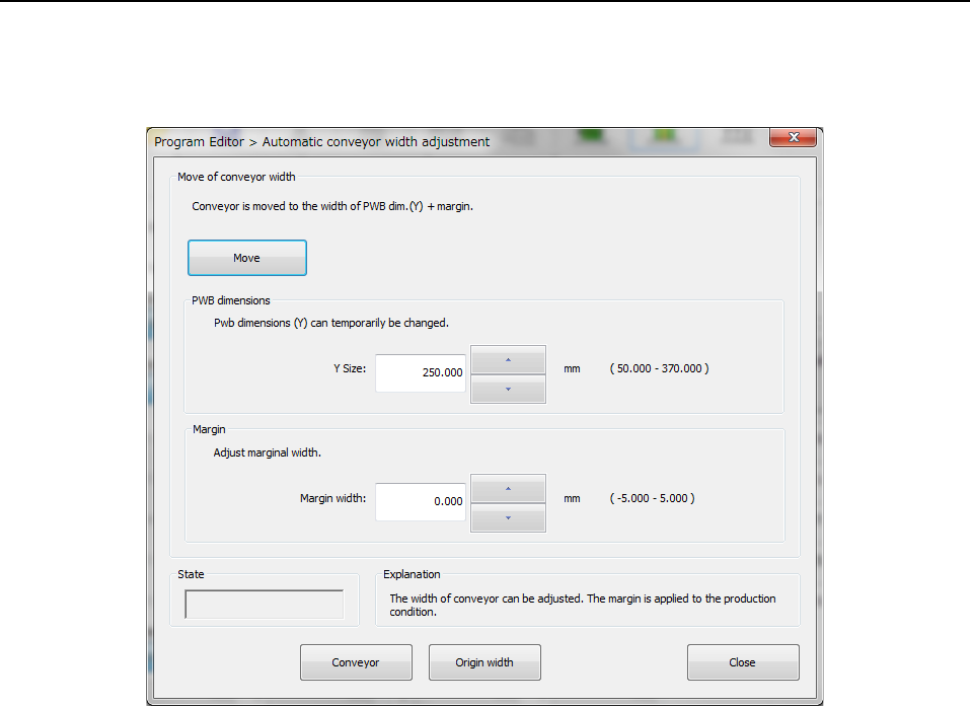
This command allows you to adjust the board transport width.
After you select this command from the menu, the following dialog box appears.
Automatic conveyor width adjustment
(1) Move
This button changes the board transport width to the “PWB dimensions” + “Margin.”
(2) PWB dimensions
Enter the outer dimensions of a board. The “PWB dimensions (Y)” of the PWB data is
entered here by default.
(3) Margin
Enter the margin between a board and the conveyor rail.
(4) State
The operation condition of the board transport path is displayed here when a board is
transported or when the automatic board width adjustment unit returns to the origin.
(5) Conveyor
This button starts up the “Pwb conveyor” dialog box.
(6) Origin width
This button returns the automatic board width adjustment unit to the origin.
(7) Close
This button quits the “Automatic conveyor width adjustment” dialog box.