semi合集-English.pdf - 第1015页
SEMI E140-0305 © SEMI 2005 1 SEMI E140-0305 GUIDE TO CALCULATE COST OF OWNERSHIP (COO) METRICS FOR GAS DELIVERY SYSTEMS This guide was technically approved b y the Global Me trics Committee and is th e direct responsibil…
SEMI E137-1104 © SEMI 2004 7
17 Inspection Procedures
17.1 The customer should inspect external surfaces of
the SME, separate subassemblies, and/or support
components for cleanliness after removal of the inner
wrapping.
17.1.1 If the SME, separate subassemblies, or support
components fail the cleanliness inspection, supplier
should reclean the failed areas and pass a cleanliness
reinspection prior to start of installation.
17.2 The customer should provide the supplier with a
completed copy of their cleanliness inspection results.
18 Related Documents
Lin, Steve and Graves, Sarah, “Comparing The
Molecular Contamination Contribution Of Clean
Packaging Films,” Micro, October, 1998. p. 95.
http://www.micromagazine.com/archive/98/10/graves.h
tml
Nappi, John J. Jr., “A Guide to Ultra Clean Film
Packaging,” Cleanroom News, Vol. 7, No. 1, August
2003. http://www.liberty-ind.com/newsletter_0503.htm
NOTICE: SEMI makes no warranties or
representations as to the suitability of the standards set
forth herein for any particular application. The
determination of the suitability of the standard is solely
the responsibility of the user. Users are cautioned to
refer to manufacturer's instructions, product labels,
product data sheets, and other relevant literature,
respecting any materials or equipment mentioned
herein. These standards are subject to change without
notice.
By publication of this standard, Semiconductor
Equipment and Materials International (SEMI) takes no
position respecting the validity of any patent rights or
copyrights asserted in connection with any items
mentioned in this standard. Users of this standard are
expressly advised that determination of any such patent
rights or copyrights, and the risk of infringement of
such rights are entirely their own responsibility.
Copyright by SEMI® (Semiconductor Equipment and Materials
International), 3081 Zanker Road, San Jose, CA 95134. Reproduction of
the contents in whole or in part is forbidden without express written
consent of SEMI.
SEMI E140-0305 © SEMI 2005 1
SEMI E140-0305
GUIDE TO CALCULATE COST OF OWNERSHIP (COO) METRICS FOR
GAS DELIVERY SYSTEMS
This guide was technically approved by the Global Metrics Committee and is the direct responsibility of the
North American Metrics Committee. Current edition approved by the North American Regional Standards
Committee on December 10, 2004. Initially available at www.semi.org February 2005; to be published
March 2005.
1 Purpose
1.1 The purpose of this guide is to provide standard cost of ownership (COO) metrics for evaluating unit production
cost effectiveness of gas delivery systems in the semiconductor industry.
1.2 This guide also illustrates how to apply the COO metrics to gas delivery systems. Users should be able to
calculate the COO for any piece of gas delivery equipment using this guide.
NOTE 1: A spreadsheet (Microsoft® Excel) has been provided as an illustrative example.
1.3 The guide establishes a well-defined procedure to facilitate an understanding of equipment-related costs by
providing definitions, classifications, algorithms, methods, and default values necessary to build a full or constrained
COO calculator.
2 Scope
2.1 This guide defines a COO metric that can be applied to any gas delivery system. Some terms are specialized to
integrated circuit wafer and device production, but may be adapted for other applications.
NOTICE: This guide does not purport to address safety issues, if any, associated with its use. It is the
responsibility of the users of this guideline to establish appropriate safety and health practices and determine the
applicability of regulatory limitations prior to use.
3 Limitations
3.1 Effective building of a COO model requires identification of constraints and data values. Example data is
provided in this document and may be updated periodically. Where possible, use direct values for inputs rather than
deriving them from secondary models or using example values.
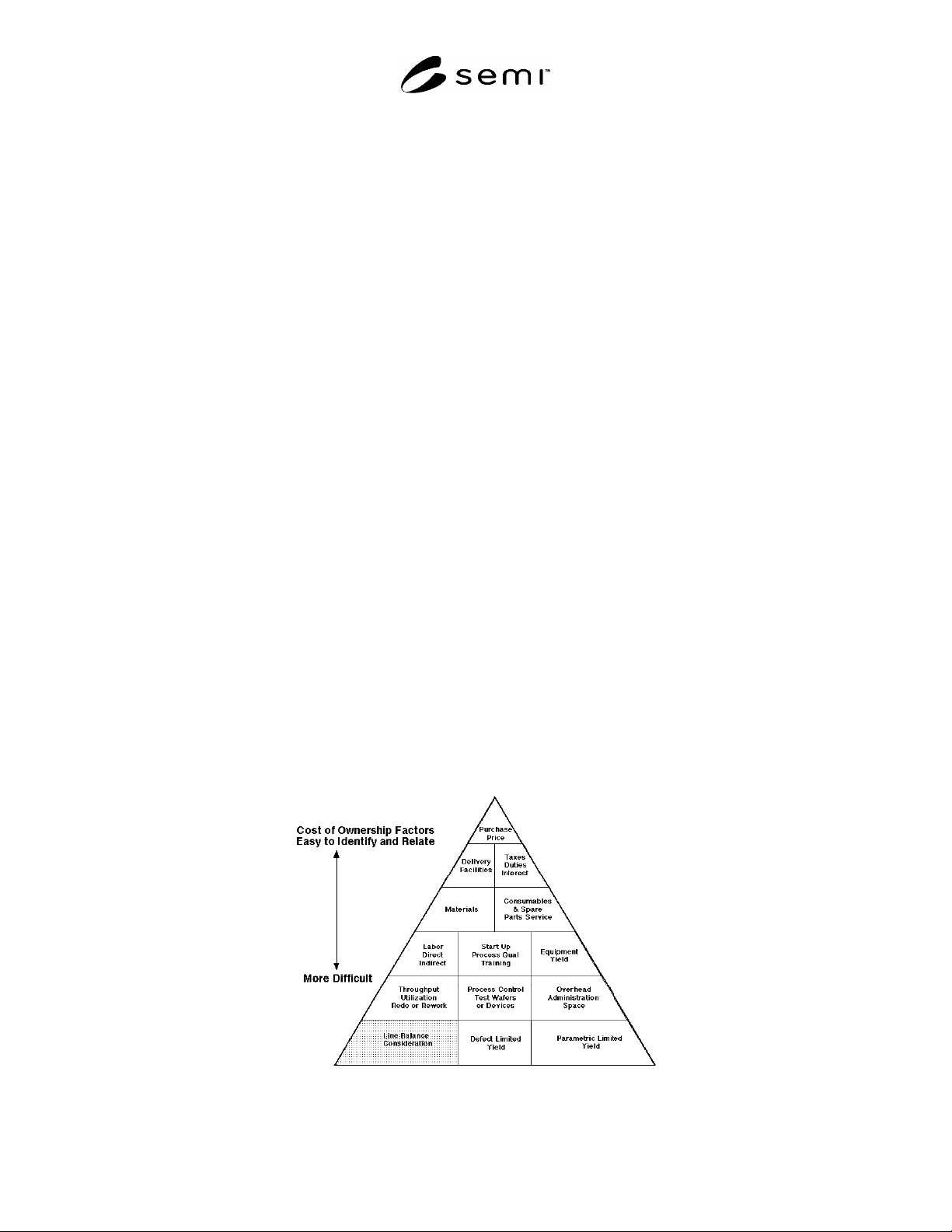
3.2 Certain factors are more difficult than others to accurately determine. Figure 1 depicts the relationship of some
of the COO factors to ability to collect and validate information. The accuracy of a COO calculation may be prone
to a variety of errors or omissions.
Figure 1
Relationship of Cost Factors to Difficulty of Collection and Validation
SEMI E140-0305 © SEMI 2005 2
3.3 A COO calculation may have more detail than presented explicitly in this guide. The structure of the guide,
however, allows for these situations.
4 Referenced Standards
4.1 SEMI Standards
SEMI E10 — Specification for Definition and Measurement of Equipment Reliability, Availability, and
Maintainability (RAM)
SEMI E35 — Guide to Calculate Cost Of Ownership (COO) Metrics for Semiconductor Manufacturing Equipment
NOTICE: Unless otherwise indicated, all documents cited shall be the latest published versions.
5 Terminology
5.1 Abbreviations and Acronyms
5.1.1 COO — Cost of ownership
5.1.2 CYL — Cost of yield loss
5.1.3 DLY — Defect limited yield
5.1.4 ER — Equipment required (integer number)
5.1.5 EY — Equipment yield
5.1.6 PLY — Parametric limited yield
5.1.7 PRY— Product yield
5.1.8 PU — Production utilization (total)
5.1.9 TP — Throughput
5.2 Definitions
5.2.1 baseline cost of ownership — a constrained version of cost of ownership (COO) that only includes equipment
yield [i.e., defect limited yield and parametric limited yield are not included].
5.2.2 comprehensive cost of ownership — cost of ownership (COO) calculated with no constraints.
5.2.3 constrained cost of ownership — cost of ownership (COO) version with a set of defined restrictions to
facilitate comparisons or to remove ambiguity.
5.2.4 consumable — part of the piece of equipment that is worn out by the process operation of the piece of
equipment and requires replacement after less than one year of operation.
5.2.5 cost footprint — the area (A) of the smallest horizontal rectangle that contains all of the shadow footprint and
half of the easement space around the piece of equipment. This is calculated as:
DeDsDeWeWsWtA
2/12/1 (1)
DsDeWsWe
4/1
where:
De = Depth of the piece of equipment
Ds = Combined depth of the piece of equipment and easement space
We = Width of the piece of equipment
Ws = Combined width of the piece of equipment and easement space
5.2.6 cost of ownership (COO) — full cost of embedding, operating, and decommissioning in a factory environment
equipment needed to accommodate the required volume of production units.