semi合集-English.pdf - 第3673页
SEMI PR8-0703 © SEMI 2003 3 6.1.2 Figure 1 shows a conceptual model of the relationship bet ween applications that can utilize this interface for data acquisition and the host system that uses the SECS/GEM interface to p…

SEMI PR8-0703 © SEMI 2003 2
overlap, and may not be compatible with, any such
specifications once completed.
3.2 This proposed standard document provides a
textual specification of the interface, and is intended for
human comprehension and understanding of the
capabilities supported by this specification only. For
the technologies in use, it is best to utilize machine-
readable XML Schema and WSDL documents for
implementation to ensure interoperability in the factory
environment. The corresponding schema and WSDL
documents can be obtained through SEMI separately
from this document.
3.3 This proposed standard applies to semiconductor
production equipment. Other types of equipment have
not been examined.
4 Referenced Standards
4.1 SEMI Standards
SEMI E5 — SEMI Equipment Communications
Standard 2 Message Content (SECS-II)
SEMI E30 — Generic Model for Communications and
Control of Manufacturing Equipment (GEM)
4.2 Other Standards
Extensible Markup Language (XML) 1.0, W3C
Recommendation, October 6, 2000
(http://www.w3.org/TR/REC-xml)
Hyper Text Transfer Protocol (HTTP) 1.1, Internet
Engineering Task Force (IETF) RFC 2616, June 1999
(http://www.w3.org/Protocols/rfc2616/rfc2616.html)
Simple Object Access Protocol (SOAP) 1.1, W3C Note,
May 08, 2000 (http://www.w3.org/TR/SOAP)
Uniform Resource Identifiers (URI): Generic Syntax,
IETF RFC 2396, August 1998
(http://www.ietf.org/rfc/rfc2396.txt)
Uniform Resource Name (URN) Syntax, IETF RFC
2141, May 1997 (http://www.ietf.org/rfc/rfc2141.txt)
Web Service Definition Language (WSDL) 1.1, W3C
Note, March 15, 2001 (http://www.w3.org/TR/wsdl)
XML Schema , W3C Recommendation, May 02, 2001
(http://www.w3.org/TR/xmlschema-0,
http://www.w3.org/TR/xmlschema-1,
http://www.w3.org/TR/xmlschema-2)
5 Terminology
5.1 Abbreviations and Acronyms
5.1.1 DCP — Data Collection Plan
5.1.2 EDA — Equipment Data Acquisition
5.1.3 FDC — Fault Detection and Classification
5.1.4 HTTP — Hypertext Transfer Protocol
5.1.5 OEE — Overall Equipment Effectiveness
5.1.6 SEMI — Semiconductor Equipment and
Materials International
5.1.7 SOAP — Simple Object Access Protocol
5.1.8 URI — Universal Resource Identifier
5.1.9 W3C — World Wide Web Consortium
5.1.10 XML — Extensible Markup Language
5.2 Definitions
5.2.1 data acquisition message — any message sent
from an off-equipment software client to the equipment
via an interface supported by the equipment that
supports the reporting, configuration, activation, or de-
activation of automatic or ad-hoc collection of data
such as alarms/exceptions, events, sampling of time-
varying data, etc.
5.2.2 EDA Interface — an interface provided by
semiconductor production equipment that enables setup
of data collection plans and collection of data
independent of the equipment’s SECS/GEM interface.
5.2.3 process message — any message sent from an
off-equipment software client to the equipment via an
interface supported by the equipment that causes
physical movement, initiates, pauses, or aborts
processing, directly affects the course of processing, or
that results in the modification of state information
maintained by the equipment that directly affects
processing.
6 Overview
6.1 Interface Scope
6.1.1 The interface described by this proposed standard
only supports the acquisition of data from equipment.
Process messages will continue to remain in the domain
of the SECS/GEM interface to the equipment. This
means that any application that requires the use of
process messages in order to achieve its objectives will
continue to be required to send those messages through
the SECS/GEM interface.
SEMI PR8-0703 © SEMI 2003 3
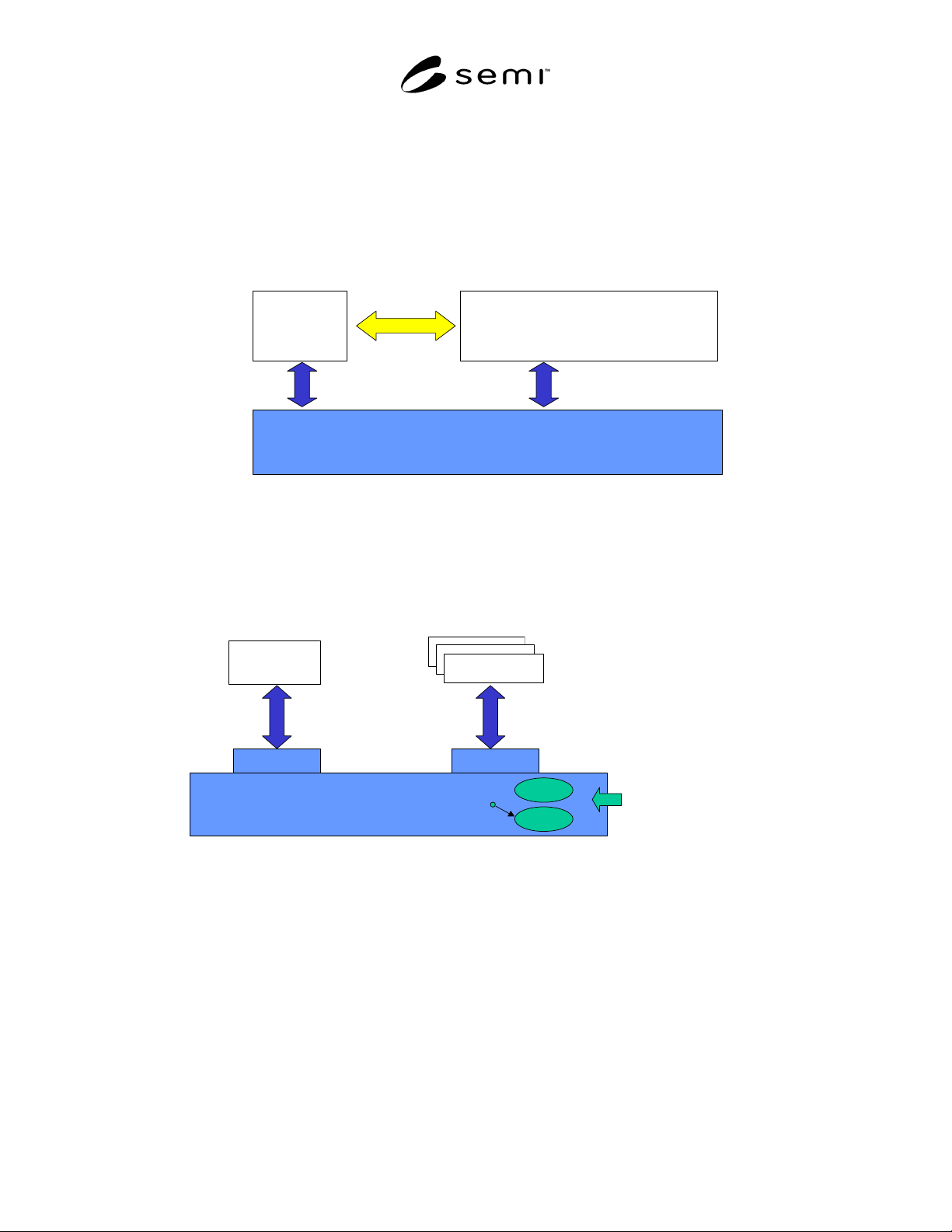
6.1.2 Figure 1 shows a conceptual model of the relationship between applications that can utilize this interface for
data acquisition and the host system that uses the SECS/GEM interface to perform process control tasks. If process
messages must be sent to the equipment based on data obtained via the EDA interface, the host system must be
integrated with those components that utilize the EDA interface, so the corresponding process messages can be sent
to the equipment via SECS/GEM.
Host System
SECS/GEM
Diagnostic, Equipment Health
Monitoring, OEE, and other systems
EDA
Equipment data clients set up and control
the flow of data from the equipment, perform
analysis, and send/receive control
messages to/from host when necessary
messages
Host uses control/process
j
ob, GEM, etc. to control
equipment actions and
execution
Equipment
p
rocess and data acquisition
messages
data acquisition messages only
Figure 1
Control and Data Interfaces to the Tool
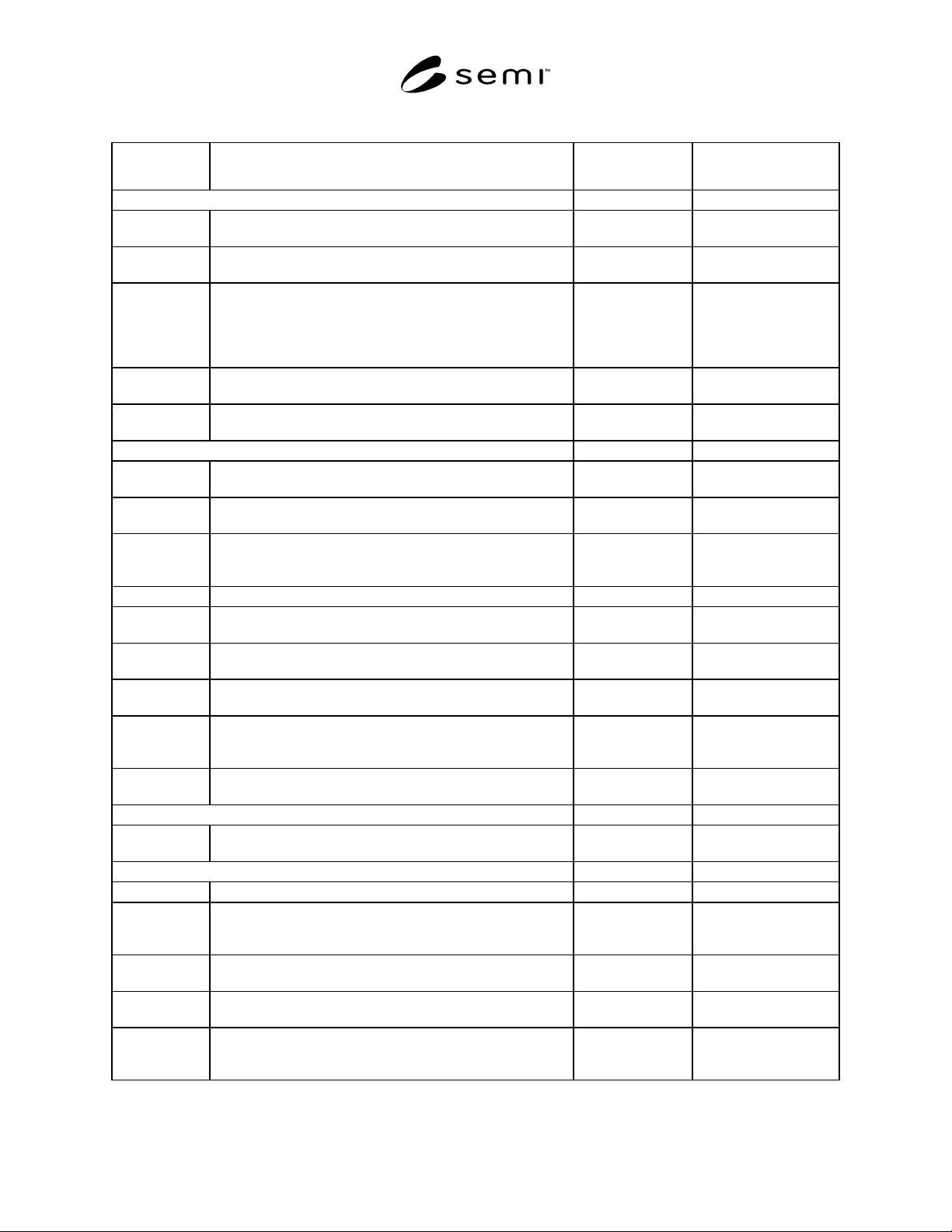
6.1.3 Figure 2 shows a conceptual picture of the capability supported by this specification. Note that some data
acquisition messages can be sent to the equipment via the SECS/GEM interface, if the equipment has been so
configured. This capability is in place to facilitate factory architectures in which all data management operations
must be centralized at the SECS/GEM host during the period when systems based on this specification are in
development.
Host System
EDA Client
•
Data management services
•
SECS
-
II / HSMS
Equipment
SECS Port
EDA Port
EDA Client
EDA Client(s)
• Data management services
-
• Data delivery services
SECS
EDA
Configure
data management
to take place via
either SECS or EDA
port
Figure 2
EDA Interface Features
6.2 Interface Features
6.2.1 This section itemizes interface features. Not all features require implementation from suppliers. The
“Implementation Required” column indicates whether the feature must be implemented in order to be in compliance
with this proposed standard. “Optional” in the Implementation Required column indicates that the feature is not
required for compliance with the standard, but shall be considered for advanced implementations, and need not be
implemented except at the supplier’s discretion. The column entitled “Supported by Interface Definition” indicates
whether the feature is supported via the SECS/GEM or XML/SOAP message specifications defined in this
document. A “-“ (dash) in the supported by interface definition column indicates that the feature is supported
outside of the interface, whereas a “!”(checkmark)
indicates that the feature is supported through the interface.
SEMI PR8-0703 © SEMI 2003 4
Table 1 EDA Interface Features
Covered in
Section #
Feature Description
Supported By
Interface Definition
Implementation
Required
General Interface
7.1.3 Messages are communicated via Ethernet using HTTP on top o
f
TCP/IP as the message transport.
! !
7.1.9 Messages are represented as XML data within SOAP
envelopes.
! !
7.7.3.2 Data collection events, state model transitions, equipment
exceptions, and parametric data defined by existing software
standards (such as SEMI E30, E40, E87, E90, E94, etc…) that
are made available through the SECS/GEM interface are
supported.
!
Optional
7.7.3.2 Transmission of milestones or tasks during subsystem
processes, actuator operations, is supported.
!
Optional
7.7.2 A time resolution of 0.01 seconds is supported in messages
requiring a timestamp.
!
Optional
Data Collection Management
7.6.2.7 Ability to list the names of, and activate/de-activate data
collection plans via the EDA interface is supported.
! !
7.6.2.6 Ability to list the names of, and activate/de-activate data
collection plans via the –SECS/GEM interface is supported.
! !
7.4.1 Equipment configuration is provided to switch listing/activation
of data collection plans to either the SECS/GEM or the EDA
interface.
-
!
7.4.4 Multiple data collection clients are supported.
!
Optional
7.7.4 Ability to warn clients of equipment performance degradation
is supported.
! !
7.9 The equipment shall provide a method for the user to modify,
add and delete data collection plans.
-
!
7.9 The equipment shall provide a method for the user to view the
contents of the data collection plans.
-
!
7.6.2.2 The equipment shall provide the names of Data Collection
Plans available for selection/activation by applications through
the interface.
! !
7.6.2.6.1 Data transmission will continue independent of the SECS/GEM
communication state of the equipment.
-
!
Security
7.4.2, 7.6.2 Ability to specify the URI of data consumers and data managers
at the equipment is supported.
-
!
Metadata
7.8 Equipment metadata is accessible to off-tool clients. -
!
7.8 Metadata shall include the equipment’s physical structure down
to the level of each individual sensor/actuator that can be
included in a data collection plan.
-
!
7.8 Metadata shall include the names and definitions of any
parameters that can be included in a data collection plan.
-
!
7.8 Metadata shall include the possible exceptions or errors that can
be included in data collection plans.
-
!
7.8 Metadata shall include what transitions from SEMI standard
and equipment supplier defined state models are available
through the EDA port.
-
!