semi合集-English.pdf - 第1762页
SEMI E42-0704 © SEMI 1995, 2004 31 Table 4.1 Recipe Namespac e Attribute Definition Attribute Name Definition Access Rqmt Form ObjType The object type. RO Y Text = "RNS" ObjID The name of the namespace . RO Y T…
SEMI E42-0704 © SEMI 1995, 2004 30
4.4 Member Agents — A namespace that contains
recipes used by multiple agents is called shared.
Otherwise, it is called dedicated or non-shared. Figure
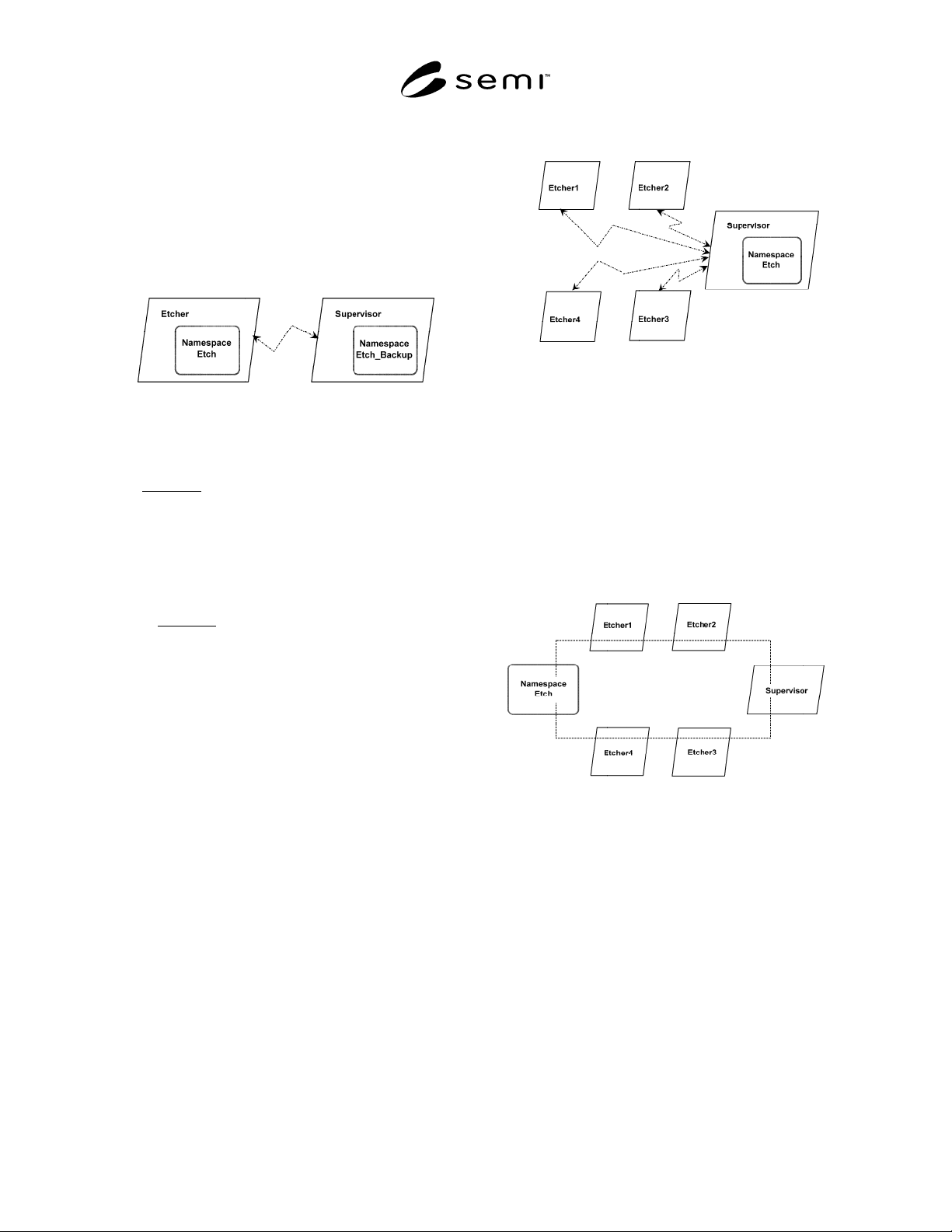
4.2 illustrates two dedicated namespaces, one provided
by an etcher and one by its host. This terminology is
introduced for clarification and descriptive purposes
only.
Figure 4.2
Host Backup of Equipment Namespace
The Members
attribute of the namespace contains the
names (object identifiers) of the agents that use the
recipes in the namespace, and these agents are called
member agents (members) of the namespace. The
namespace manager uses this information as it may
require assistance from a member agent to verify a
recipe.
If the Members
attribute of the namespace contains
multiple agent names, then the namespace is shared.
Otherwise, it may be non-shared or not yet completely
set up. If it is empty (null), the namespace has not been
completely set up and is not fully functional, as certain
operations, including recipe verification, require it to
have content.
4.5 Illustrations — This section provides illustrations
of several possible configurations of a centralized
namespace.
Figure 4.2 illustrates an etcher that has its own local
namespace and that communicates with its supervisor
over an RS-232 line. The supervisor in this example
maintains a separate namespace, providing backup for
recipes of particular significance.
Figure 4.3 illustrates a supervisor with four diskless
subordinates. In this configuration, the supervisor
provides recipes for all four subordinates from a
centralized namespace.
Figure 4.3
Namespace Provided by Supervisor
Figure 4.4 illustrates four executing agents on a
common network with a supervisory agent and a sixth
agent providing a centralized namespace. Each
executing agent is able to access the namespace
independently of the supervisor.
Figure 4.4
Shared Network Access
Figures 4.3 and 4.4 both represent examples of shared
centralized namespaces.
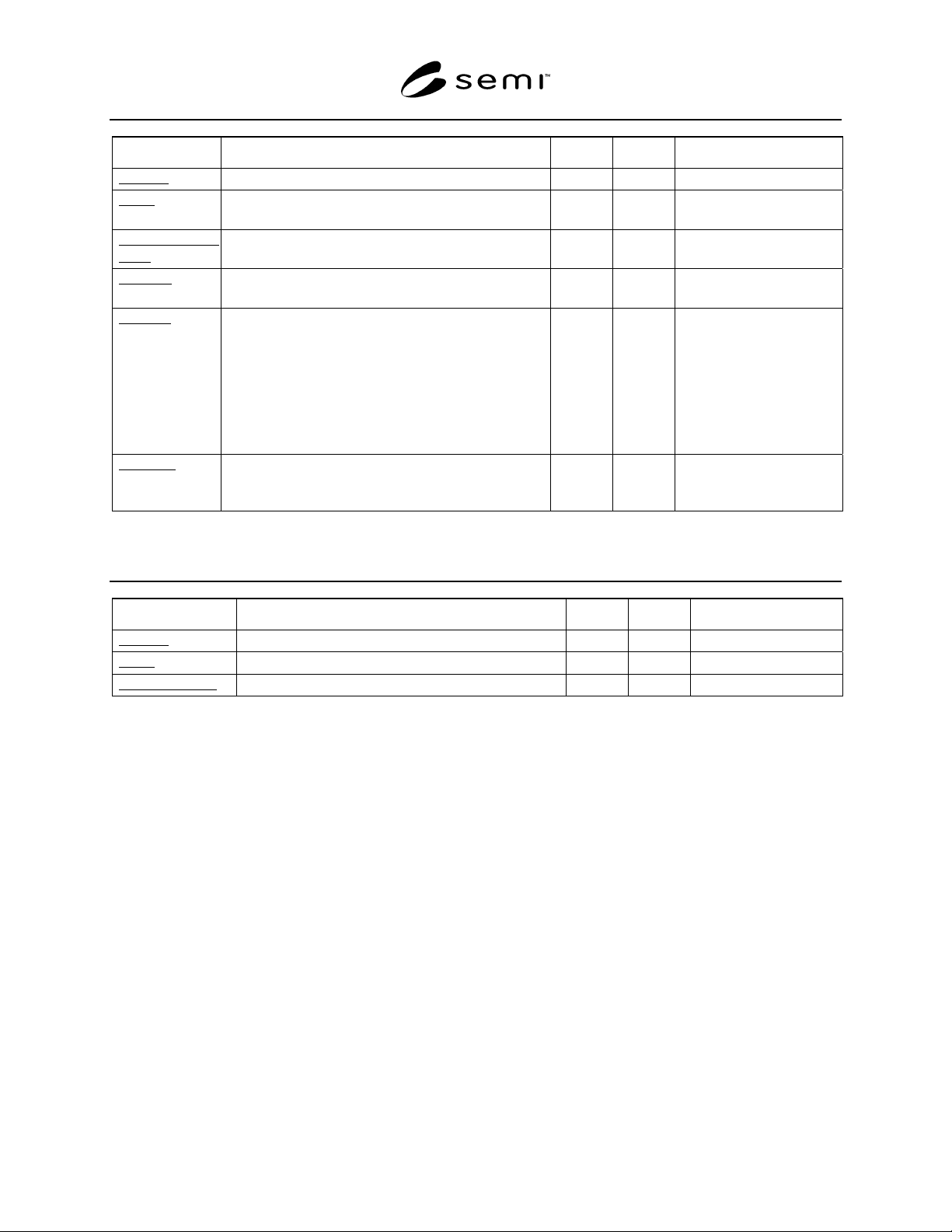
4.6 Attribute Definition Tables — Table 4.1 defines the
attributes of the recipe namespace.
SEMI E42-0704 © SEMI 1995, 2004 31
Table 4.1 Recipe Namespace Attribute Definition
Attribute Name Definition Access Rqmt Form
ObjType The object type. RO Y Text = "RNS"
ObjID The name of the namespace. RO Y Text. A name of "Default" is
prohibited.
RecipeReadOnly-
Level
The level of approval at which recipes are read-only. RW Y Unsigned integer.
Members The names of agents capable of verifying and executing
the recipes in the namespace.
RW Y List of agent names
(identifiers).
SynchOn Level of synchronization (see Section 9.5). Required if
synchronization is supported.
RW N Unsigned integer:
Either 0 = Disabled, or any
combination (sum) of:
1 = changes in body
2 = new execution recipe
8 = changes in last value
16 = new derived object
form execution recipe
SynchFail Specifiers for execution recipes for which an attempt to
synchronize failed. Required if synchronization is
supported.
RW N List of formatted text.
Table 4.2 defines the attributes of the recipe namespace manager objects. The name (identifier) of the manager is
not generally of interest, as the namespace specifier is more commonly used. However, it is important for the
manager to be accessible through Object Services.
Table 4.2 Recipe Namespace Manager Attribute Definition
Attribute Name Definition Access Rqmt Form
ObjType The object type. RO Y Text = "RNS_Mgr"
ObjID The manager's name. RO Y Text.
NamespaceName The name of the namespace managed. RO Y Text.
5 Distributed Recipe Namespace
A distributed recipe namespace is a recipe namespace that utilizes the storage capacity of multiple agents for
recipe storage. Recipes are stored in special recipe namespace segments provided by the different agents. These
segments are distributed recipe namespace segments and are supervised by the distributed recipe namespace
manager.
This section defines the different objects that together provide the distributed recipe namespace capability: the
distributed recipe namespace, the distributed recipe namespace manager, the distributed recipe namespace
segment, and the distributed recipe namespace recorder. Detailed descriptions of operations are contained in
Section 10.
Throughout this document, the acronym DRNS refers to the term "distributed recipe namespace" and is used
primarily to differentiate a DRNS subtype object from its supertype.
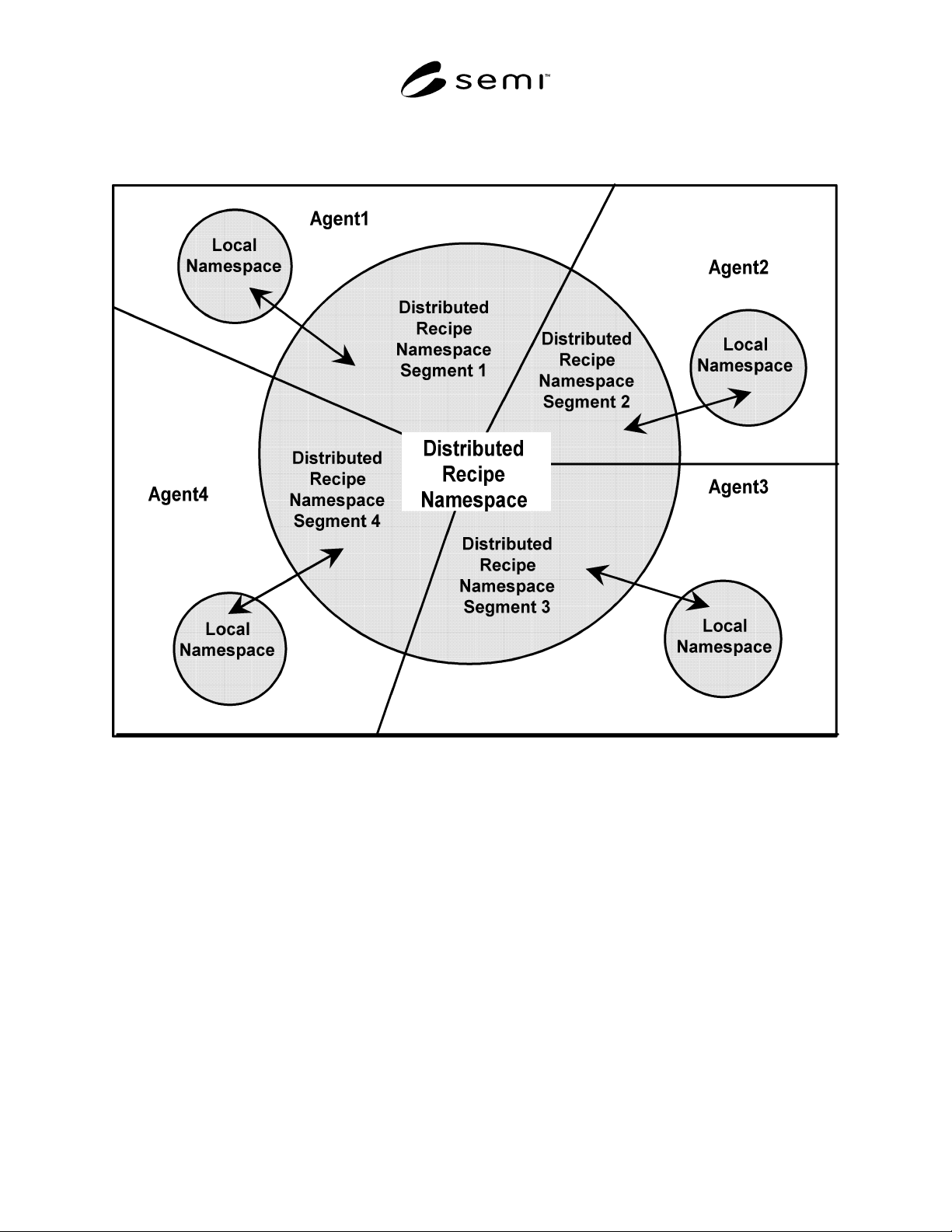
5.1 Motivations — The distributed recipe namespace capability provides a method for using the storage capacity of
multiple agents, as illustrated in Figure 5.1. This reduces the storage requirements of a centralized factory system,
improves performance by allowing recipes to be used by those agents, and provides a centralized management of the
namespace to ensure that the uniqueness of the recipe identifier is properly maintained.
SEMI E42-0704 © SEMI 1995, 2004 32
Figure 5.1 illustrates a distributed recipe namespace with four segments, each provided by a different agent, and
each agent also having a local namespace.
Figure 5.1
Illustration of Agents, Segments, and Local Namespaces