semi合集-English.pdf - 第1018页
SEMI E140-0305 © SEMI 2005 4 (e.g., carriers that stick out from the piece of equipment or equipm ent load ports that prot rude only when the piece of equipment is being loaded). 5.2.25 spare part — prepurchase d invent …
SEMI E140-0305 © SEMI 2005 3
5.2.7 cost of yield loss (CYL) — a unit lost at the end of a given step represents the loss of the cost of the starting
unit and the manufacturing to that point. In addition, units leaving a step may be lost at some later step. Calculating
CYL therefore requires knowing the accumulated cost of manufacturing before the unit is lost. Therefore, CYL
should be tracked as a separate cost for factory optimization.
5.2.8 default or default value — a value to be used if actual data are not available. Also called example value.
Where possible, actual data should be used in COO calculations.
5.2.9 defect limited yield (DLY) — the fraction of units that are not lost from defects added by the equipment. For
wafer processing, defect yield is usually derived from a model.
5.2.10 easement space — the floor space that must remain clear to the rear and sides of the piece of equipment (but
not in front of the load face plane). This includes safety aisles, ergonomic maintenance access space, component
removal space, and room for doors to swing out.
5.2.11 equipment required (ER) — the integer number of pieces of equipment required to obtain the production
throughput required for the step.
5.2.12 equipment throughput — see throughput.
5.2.13 equipment yield (EY) — the percentage of units received by the piece of equipment that can be passed to the
next step based on any criteria such as damaged units, or units determined to be defective by inspection or test.
Inclusion of equipment yield results in a decreasing population of units flowing through the factory. At later steps,
equipment will process fewer units than the full factory unit starts. For test equipment, validly rejected units are
scrap, but not a component of equipment yield.
5.2.14 fixed costs — costs incurred once and usually associated with the acquisition and incorporation of a piece of
equipment into the factory.
5.2.15 lifetime — the time over which the fixed and recurring costs are spread on an annualized basis.
5.2.15.1 production lifetime — the number of years a piece of equipment is used for manufacturing.
5.2.15.2 tax lifetime — the number of years as defined in compliance with local tax or accounting depreciation
practices.
5.2.16 material — bulk gas, specialty gas, or general or specialty chemical used in the process. Includes monitor
units consumed in the support of the piece of equipment.
5.2.17 monitor unit — test or filler unit (e.g., wafer or device) consumed in the support of the piece of equipment.
Also called test unit.
5.2.18 operational uptime (OU) —the percentage of time the piece of equipment is in a condition to perform its
intended function during the period of operations time. This calculation is intended to reflect overall operational
performance for a piece of equipment (SEMI E10).
5.2.18.1 Discussion — As defined, OU has components attributable to both the unit manufacturer and to the
equipment supplier.
5.2.19 parametric limited yield (PLY) — the fraction of units that are not lost from device parameters being outside
the required range.
5.2.20 product yield (PRY) — the fraction of units that pass through the factory and result in good product. Product
yield for units is the composite of all sources of yield loss.
5.2.21 recurring cost — cost that is incurred on an ongoing basis based on time and/or usage.
5.2.22 repair part — component to service the piece of equipment purchased at the time of repair.
5.2.23 service contract — an agreement for the supplier to provide equipment service or maintenance under
specified terms and conditions beyond that which is supplied with the piece of equipment.
5.2.24 shadow footprint — the area of the floor space directly under every part of the piece of equipment during its
operation. This area includes any temporary projections from the piece of equipment during loading or processing
SEMI E140-0305 © SEMI 2005 4
(e.g., carriers that stick out from the piece of equipment or equipment load ports that protrude only when the piece of
equipment is being loaded).
5.2.25 spare part — prepurchased inventory of a part maintained to service the piece of equipment.
5.2.26 supplier — provider of equipment or services to the unit manufacturer. Also called equipment vendor or
equipment manufacturer.
5.2.27 test unit — see monitor unit.
5.2.28 throughput (TP) — the number of units (e.g., wafers, devices) per hour the piece of equipment delivers to the
factory, including all input, output, and internal overhead operation. TP includes all test or monitor units processed,
since the cost of these nonproduct units is accounted for directly.
5.2.29 unit — any wafer, die, packaged device, or piece part thereof (includes product and nonproduct units).
5.2.30 volume requirement — the number of units required to be processed by the equipment in a specific time
period, normally units per week.
5.2.31 yield — see product yield.
6 Description of COO Model
6.1 COO Model Calculation — The formula for calculating COO is given in Equation 2.
COO = (F$ + R$ + Y$) / (L × TP × PRY × OU) (2)
where
F$ = annualized fixed costs, $
R$ = annualized recurring costs, $
Y$ = annualized yield costs (CYL), $
L = lifetime of piece of equipment, yrs
TP = throughput, units/yr
PRY = product yield, dimensionless
OU = operational uptime, dimensionless
6.1.1 F$ is calculated by summing the fixed cost categories F
ij
in Table 1 in SEMI E35.
6.1.2 R$ is calculated by summing the recurring cost categories R
ij
in Table 2 in SEMI E35.
6.1.3 Y$ is calculated by summing the recurring scrap cost categories in Table 3 in SEMI E35.
6.1.4 The parameters L and TP are input directly into the model.
6.1.5 The model calculates PRY from user inputs on numbers of wafers lost due to EY, DLY, and PLY.
6.1.6 The model calculates OU from inputs for scheduled and unscheduled maintenance (including assists), standby
time, qualification time, engineering time, and the scheduled production hours.
6.1.6.1 While the cost terms used specific currency units of dollars as an example, any currency may be used as
long as it is applied consistently throughout the model.
SEMI E140-0305 © SEMI 2005 5
RELATED INFORMATION 1
COST OF OWNERSHIP
NOTICE: This related information is not an official part of SEMI E140 and was derived from North American
Metrics Committee. This related information was approved for publication by full letter ballot on December 10,
2004.
R1-1 Sample Input to Model
R1-1.1 To effectively illustrate use of the COO model, it was run with a hypothetical set of input data. This input
data is listed in Table 1. When studying this example, the user should remember that parameter values are for the
gas delivery system only, not the entire process piece of equipment.
R1-2 Sample Model Output
R1-2.1 The model calculates each term in the numerator of Equation 2 and then sums these results and divides by
the denominator to get COO. To enhance the user’s understanding of the components of COO, Tables 2, 3, 4, and 5
and the spreadsheet show interim results. For the set of inputs listed in Table 1, F$ are shown in Table 2, R$ are
shown in Table 3, and Y$ are shown in Table 4. Each of these terms is calculated from the cost factors listed in
SEMI E35. The italicized rows in Tables 2, 3, and 4 correspond to these cost factors and show the subtotal for that
cost factor. The breakdown for each cost factor is shown in the rows below it.
R1-2.2 Tables 2, 3, and 4 show costs for years 1 through 7. The last year is based on user input. It is the longest of
useful life or depreciable life. In the example shown, depreciable life was set to 7 years and useful life was set to 5
years. The depreciable life was deliberately made longer than the useful life to illustrate the feature of the
spreadsheet that allows these two parameter values to differ. This often occurs in practice since a piece of
equipment is sometimes “obsoleted” before it is fully depreciated. The user can enter any value up to 10 for these
two parameters.
R1-2.3 Table 5 shows the COO results.
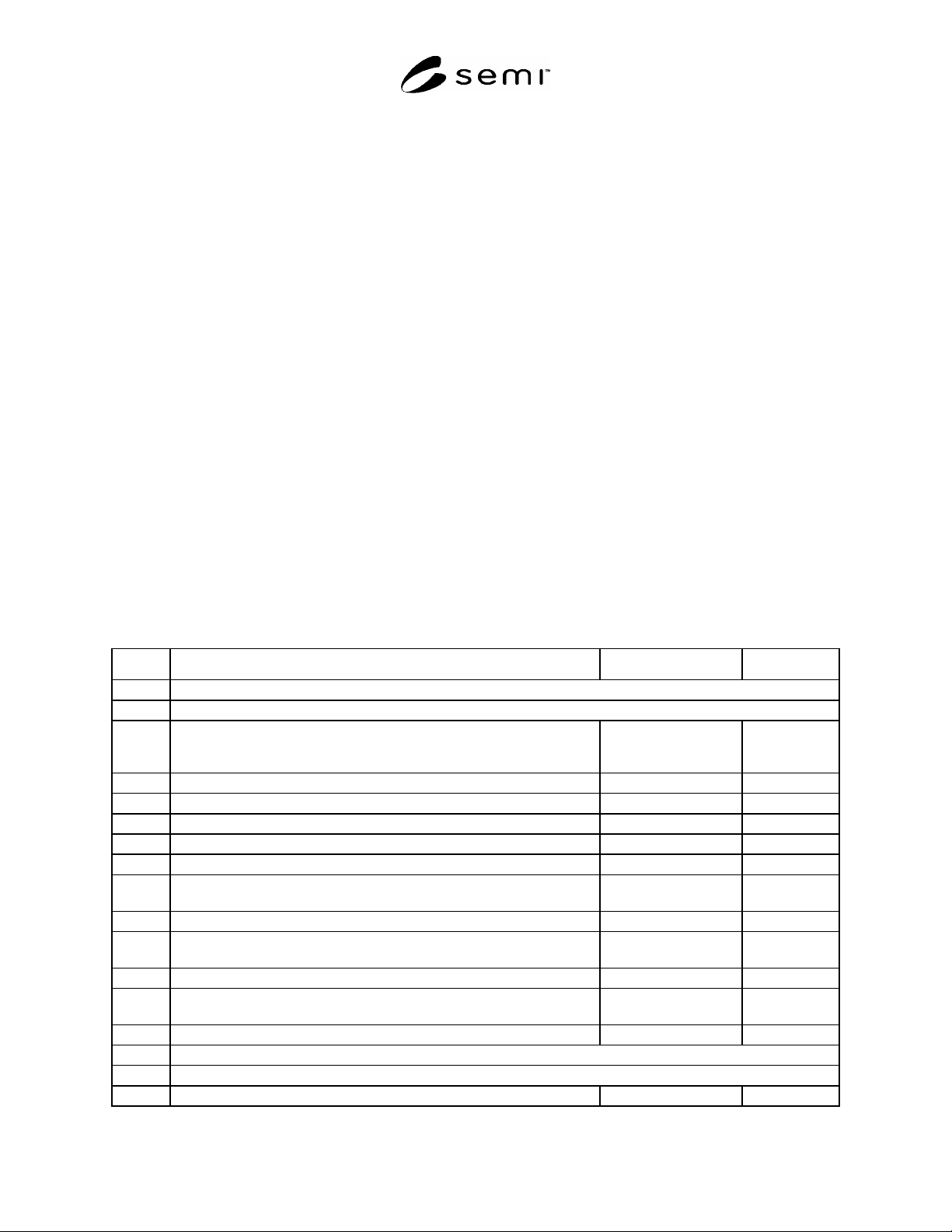
Table 1 Input Data for COO Model
Row
#1
Parameter Units Example Value
TA8 This Section Contains Equipment Procurement Cost Data
TA10 Equipment Cost Data
TA11 For Straight Line Depreciation, input SLN. For Fixed Declining Balance
Depreciation, input DB. For Double Declining Balance Depreciation, input
DDB.
not applicable SLN
TA12 Floor Space Rental Rate $/m
2
/yr 2691
TA13 Gas Box (or Stick or Component) Purchase Price $ 100,000
TA14 Gas Box (or Stick or Component) Depreciable Life (Must be 10 or Less) yrs 7
TA15 Gas Box (or Stick or Component) Scrap Value $ 1,000
TA16 Gas Box (or Stick or Component) Useful Life (Must be 10 or Less) yrs 5
TA17 Cost Foot Print or Floor Space Required for Gas Box (or Stick or
Component)
m
2
0.23
TA18 Support Equipment Purchase Price $ 5,000
TA19 Support Equipment Depreciable Life (must be same as Gas Box
Depreciable Life for purposes of COO)
yrs 7
TA20 Support Equipment Scrap Value $ 100
TA21 Support Equipment Useful Life (must be same as Gas Box Useful Life for
purposes of COO)
yrs 5
TA22 Floor Space Required for Piece of Support Equipment m
2
0.093
TA23 This Section Contains Data Specific to the Process Equipment and Costs Specific to a Particular Fab
TA25 Equipment-Specific Data
TA26 Equipment Throughput wafers/hr 33