semi合集-English.pdf - 第320页
SEMI E49.2-1104 © SEMI 1995, 2004 2 3 Limitations 3.1 For t h e purpos es of this docum ent, qualification recommendations are lim it ed to the purity and mechanical integrity of Assemblies as outlined in the purpose and…

SEMI E49.2-1104 © SEMI 1995, 2004 1
SEMI E49.2-1104
GUIDELINE FOR THE QUALIFICATION OF POLYMER ASSEMBLIES
USED IN ULTRAPURE WATER AND LIQUID CHEMICAL SYSTEMS IN
SEMICONDUCTOR PROCESS EQUIPMENT
This guideline was technically approved by the Global Liquid Chemicals Committee and is the direct
responsibility of the North American Liquid Chemicals Committee. Current edition approved by the North
American Regional Standards Committee on August 16, 2004. Initially available at www.semi.org
September 2004; to be published November 2004. Originally published in 1995; last published February
1998.
NOTICE: This document was rewritten in its entirety in 2004, and is a replacement for the previous versions of
both E49.2 & E49.3.
NOTICE: Paragraphs entitled NOTE are not an official part of this document and are not intended to modify or
supercede it.
1 Purpose
1.1 The objective of this document is to provide a
guideline by which the purity and mechanical integrity
of all ultrapure water and liquid chemical Assemblies
shipped to end users may be qualified. It is also the
purpose of this guideline to complement the following:
SEMI F57: Provisional Specification For Polymer
Components Used in Ultrapure Water and Liquid
Chemical Distribution Systems and;
SEMI E49.7: Purity Guide For the Design and
Manufacture of Ultrapure Water and Liquid
Chemical Systems in Semiconductor Process
Equipment
NOTE 1: As with any SEMI guide, the practices outlined
herein are recommendations, not specifications. Users of this
document should recognize that alternate practices are not
excluded as long as they produce results that are equivalent to
those produced using the recommendations outlined here and
meet the requirements of the end user.
2 Scope
2.1 To ensure the purity and mechanical integrity of
ultrapure water and liquid chemical Assemblies the
following tests and quality guidelines are
recommended:
Hydrostatic Pressure Tests – See Table 1, Section
9.1, and Section 9.2.
Ultrapure Water Flush Test – See Table 1 Section
9.1, and Section 9.3.
Particle Test – See Table 1, Section 9.1 and Section
9.4
Ionic and Metallic Contamination Tests – See
Table 1, Section 9.1, and Section 9.5
Certification – See Section 10 for defining,
establishing, executing, and maintaining a
certification program.
Traceability – See Section 11 for the
responsibilities for suppliers to verify compliance
with SEMI F57, SEMI E49.7, and this document.
2.2 Typical semiconductor process equipment with
ultrapure water and liquid chemical delivery
Assemblies includes, but is not limited to the following:
Wafer Handling Equipment
Wafer Cleaning Systems
Chemical Filtration/Mixing Skids provided by
OEM
Wet Clean Stations
Wafer Scrubbers
CMP
Photolithography coaters and developers
Ion Implanters
Metrology equipment
Ancillary equipment provided with the process
equipment.
NOTICE: This standard does not purport to address
safety issues, if any, associated with its use. It is the
responsibility of the users of this standard to establish
appropriate safety and health practices and determine
the applicability of regulatory or other limitations prior
to use.

SEMI E49.2-1104 © SEMI 1995, 2004 2
3 Limitations
3.1 For the purposes of this document, qualification
recommendations are limited to the purity and
mechanical integrity of Assemblies as outlined in the
purpose and scope. Qualification recommendations are
not intended to address any other operational
parameters (for example, flow capacity, flow rates,
reliability, chemical compatibility etc.).
3.2 This guideline does not define the purity
performance requirements of individual components,
which may be addressed by SEMI F57. Nor does this
document provide guidelines for the design and
manufacture of Assemblies, which may be addressed by
SEMI E49.7.
3.3 Facility distribution systems are also outside the
scope of this guideline.
3.4 Stainless steel or other non-polymeric Assemblies
are outside the scope of this document. Refer to SEMI
E49.4, SEMI E49.5, and SEMI E49.6 for information
on stainless steel components and Assemblies
.
3.5 This guideline is not intended to apply to
Assemblies used in the delivery of liquids that do not
contact the wafer’s surface, for example drainage and
cooling Assemblies.
4 Referenced Standards
4.1 SEMI Standards
SEMI C59 Specifications and Guidelines for
Nitrogen
SEMI E49.4 Guide for High Purity Solvent
Distribution Systems in Semiconductor Manufacturing
Equipment
SEMI E49.5 Guide for Ultrahigh Purity Solvent
Distribution Systems in Semiconductor Manufacturing
Equipment
SEMI E49.6 Guide For Subsystem Assembly and
Testing Procedures – Stainless Steel Systems
SEMI E49.7 Purity Guide For the Design and
Manufacture of Ultrapure Water and Liquid Chemical
Systems in Semiconductor Process Equipment
SEMI F57 Provisional Specification For Polymer
Components Used in Ultrapure Water and Liquid
Chemical Distribution Systems
SEMI F61 Guide for Ultrapure Water System Used
in Semiconductor Processing
4.2 ASTM Standards
1
ASTM D4327 Standard Test Method for Anions in
Water by Chemically Suppressed Ion Chromatography
ASTM D5997-96 Standard Test Method for On-
Line Monitoring of Total Carbon, Inorganic Carbon in
Water by Ultraviolet, Persulfate Oxidation, and
Membrane Conductivity Detection
4.3 Other Standards
Hydrostatic Pressure and Leak Testing of Polymer
Piping Systems Used in High-purity Water
Applications
2
5 Terminology
5.1 See Section 4 of SEMI E49.
5.2 For the purposes of this document, an “Assembly”
or “Assemblies” is defined as a combination of two or
more ultrapure water or liquid chemical delivery
components and is always capitalized when used in this
manner.
5.3 For the purposes of this document Assemblies
shipped to end users are those Assemblies sent to
semiconductor manufacturers which will not undergo
any additional testing, cleaning, or other qualification
processes. The semiconductor manufacturer may
perform additional testing outside the tests outlined by
this document.
5.4 For the purposes of this document “supply chain”
is defined as those manufacturers involved in producing
components, integrating or assembling components,
and testing Assemblies.
5.5 For the purposes of this document components
include but are not limited to all product covered by
SEMI 57 as well as product not covered by SEMI F57
such as pumps, storage tanks, drums, pressure vessels,
filter housing, sensors, monitors, or ultra-filtration, and
pumps.
5.6 NIST is the National Institute of Standards and
Technology.
1 American Society for Testing and Materials, 100 Barr Harbor
Drive, West Conshohocken, Pennsylvania 19428-2959, USA.
Telephone: 610.832.9585, Fax: 610.832.9555, Website:
www.astm.org
2 Mayer, Burkhart, Rydzewski, UltraPure Water Journal, May/June
2002, pp. 27-40
SEMI E49.2-1104 © SEMI 1995, 2004 3
6 Performance Guidelines
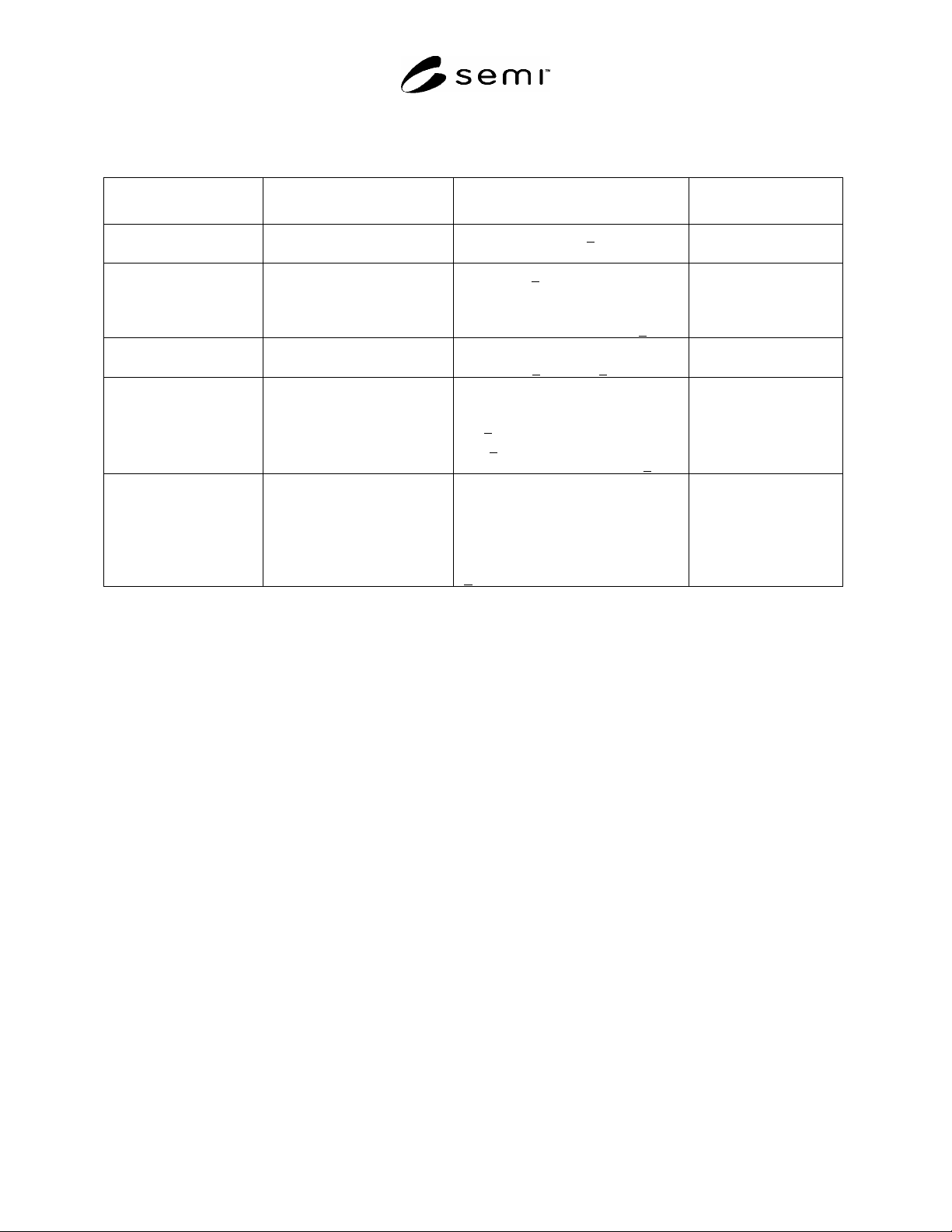
Table 1 Overview of Recommended Tests
Test Frequency Performance Guideline Test Method/Reporting
of Results
Hydrostatic Pressure Every Assembly shipped to
the end user
No visible leakage & < 5% pressure
decay
Section 9.1
Section 9.2
Ultrapure Water Flush Every Assembly shipped to
the end user
Resistivity: > 18 meg ohm-cm @
25°C (77°F)
Allowable TOC adders (ppb): <
7.5
Section 9.1
Section 9.3
Particle Periodic testing – see Section
10.7 and 10.8
Allowable Particle adders
(particles/L >
0.1 µm) : < 120
Section 9.1
Section 9.4
Ionic Contamination Periodic testing – see Sections
10.7 and 10.8
Allowable ionic adders (ppb):
F-: <
7.5
Cl-: <
0.40
NO
2
-, Br-, NO
3
-, HPO
4
=, SO
4
=
<
0.05
Section 9.1
Section 9.5
Metallic Contamination Periodic testing – see Sections
10.7 and 10.8
Allowable metallic adders (ppb):
Al, Ba, B, Ca, Cr, Cu, Fe, Pb, Li, Mg,
Mn, Ni, K, Na, Sr, and Zn:
<
0.02
Section 9.1
Section 9.5
NOTE 2: Table 1 provides an overview of the tests recommended within this document and associated performance criteria. For
detailed explanations of testing frequency, test methods, and some examples of tests, refer to the sections identified within the
table.