semi合集-English.pdf - 第6840页
SEMI S2-0703a E © SEMI 1991, 2004 69 RELATED INFORMATION 9 LASER CHECKLIST NOTICE: The RI below will be withdrawn upon July 1, 2006 publication and replaced by the new sections, figures, and Tables in Delayed Re visions …

SEMI S2-0703a
E
© SEMI 1991, 2004 68
RELATED INFORMATION 8
DOCUMENTATION OF NON-IONIZING RADIATION (SECTION 25 AND
APPENDIX 5) INCLUDING RATIONALE FOR CHANGES
NOTICE: This related information is not an official part of SEMI S2 and was derived from practical application by
task force members. This related information was approved for publication by vote of the responsible committee on
October 21, 1999.
R8-1 The user of this table is responsible for obtaining
the current revision of the standards cited for
Occupational Exposure Limits (OEL).
R8-2 The emission values in Appendix 5 that are not to
be exceeded were chosen based on a review of all
known international standards as well as a
consideration for best available control technology (i.e.,
lowest values currently achievable for each radiation
type). Where a general public limit existed, 20% of this
value was selected. Where there was no public limit,
the value selected is generally 20% of the OEL value
(instantaneous field strength measurement peak). The
latter case would have the occupational and general
public levels the same. Where there was an
occupational exposure limit specified in a standard, the
maintenance emission limit was set at 20% of this level.
R8-3 Most health standards differentiate between
“occupational” and “general public” exposure criteria.
IEEE C95.1 differentiates between “controlled access”
and “uncontrolled access” exposures. According to
C95.1 “controlled access” environments are those
where “locations where there is exposure that may be
incurred by persons who are aware of the potential for
exposure as a concomitant of employment, by other
cognizant persons, or as the incidental result of
transient passage through areas where analysis shows
the exposure levels may be above those shown in Table
2 but do not exceed those of Table 1, and where the
induced currents may exceed the values in Table 2, Part
B, but do not exceed the values of Table 1, Part B.”
According to C95.1, “uncontrolled access”
environments are “locations where there is the exposure
of individuals who have no knowledge or control of
their exposure. The exposure may occur in living
quarters or workplaces where there are no expectations
that the exposure levels may exceed those shown in
Table 2 and where induced currents do not exceed those
in Table 2, Part B.” Task force members advise that
C95.1 “controlled access” and other “occupational
exposure” standards should be applied to personnel
performing maintenance and service of equipment and
that “uncontrolled access” or other “general public”
standards should be applied to equipment operators
during routine work and to other locations. These IEEE
definitions are particularly relevant to broadcast
facilities as well as normal industrial environments such
as fabs. Task force members recommend that
uncontrolled access limits be applied to fetal exposure.
R8-4 As with the rationale in the Ionizing section, the
operator is considered a member of the general public
or to be in an uncontrolled area. Maintenance or service
technicians should be trained to know how to control
the hazardous energy and protect themselves from the
hazard and its adverse effects.
R8-5 References
1. 1996 TLVs and BEIs Threshold Limit Values for
Chemical Substances and Physical Agents Biological
Exposure Indices, ACGIH, Cincinnati, OH
2. Guidelines on Limits of Exposure to Broad-Band
Incoherent Optical Radiation (0.38 to 3 M), Health
Physics Vol. 73, No. 3 (September), pp.539-554, 1997
3. ICNIRP 1994 “Guidelines on Limits of Exposure
to Static Magnetic Fields”, Health Physics Vol 66 (1)
(January), pp. 100-106, 1994
4. IEEE Standard for Safety Levels with Respect to
Human Exposure to Radio Frequency Electromagnetic
Fields, 3 kHz to 300 GHz, C95.1-1991, Piscataway,
New Jersey
5. Interim Guidelines on the Limits of Exposure to
50/60 Hz Electric and Magnetic Fields, IRPA/ICNIRP
Guidelines, Health Physics Vol. 58, No. 1(January), pp.
113-122, 1990

SEMI S2-0703a
E
© SEMI 1991, 2004 69
RELATED INFORMATION 9
LASER CHECKLIST
NOTICE: The RI below will be withdrawn upon July 1, 2006 publication and replaced by the new sections,
figures, and Tables in Delayed Revisions Section 1. The EH&S Committee has voted that implementation of
the information is OPTIONAL before the effective date.
NOTICE: This related information is not an official part of SEMI S2 and was derived from practical application by
task force members. This related information was approved for publication by vote of the responsible committee on
October 21, 1999.
Laser Manufacturer: __________________________________
Model #: __________________________________
Serial #: __________________________________
Laser Hazard Classification: (During Operation)
1. Classification Number (e.g. 1, 2, 3a, 3b, 4): ________
2. Classification Standard(s) (e.g. FDA/CDRH, IEC, JIS, etc.): ________
NOTE R9-1: If any laser contained in the equipment is Class 2, 3a, 3b or 4 laser system or product, the vendor should make
available upon request a hazard evaluation to include the following information for each laser in the equipment (where
applicable):
Laser Parameters
1. Laser medium type (HeNe, Nd:YAG, CO
2
, Argon, Excimer, GaAs, etc.): __________
Note: For Excimer lasers, specify gases: _______________
2. Wavelength(s) in nanometers (nm): _______________
3. Continuous Wave
A. Peak Power in Watts (W): ________
B. Available Power in Watts (W): ________
C. Irradiance in Watts/square centimeter (W/cm
2
): _ ________
4. Pulse Characteristics
A. Duration of Pulse in Seconds (s): ________
B. Energy per Pulse in Joules (J): ________
C. Frequency of Pulses (Pulse Repetition Frequency) in Hertz (Hz): ________
D. Average Power in Watts (W): ________
E. Radiant Exposure in Joules/square centimeter (J/cm
2
): ________
F. Q-Switch controlled pulses ( ) Yes ( ) No
5. Beam Parameters
A. Emerging beam diameter in millimeters (mm): ________
B. Expanded beam diameter in millimeters (mm): ________
C. Beam divergence in milliradians (mr): ________
D. Collecting optics type: ________
E. Focal length in millimeters (mm): ________
SEMI S2-0703a
E
© SEMI 1991, 2004 70
Laser Control Measures
1. Identify protective measures required during maintenance. __________________
____________________________________________________________________
2. Laser Controlled Area required for Maintenance procedures? ( ) Yes ( ) No
3. Laser Controlled Area required for Service procedures. ( ) Yes ( ) No
4. If a Nominal Ocular Hazard Distance (NOHD) is used as a control measure, then provide the NOHD
calculations. See IEC 60825-1 for NOHD calculations.
NOTE R9-2: Attach a diagram of the laser beam path and the irradiance/radiant exposure at each significant point.
Personnel Protective Equipment (PPE) (for laser radiation hazards in excess of the MPE)
1. Optical Density (OD) of PPE required during maintenance activities: ___________
2. OD of PPE required during service activities: ___________
3. Recommended PPE manufacturer and model #: ______________________________
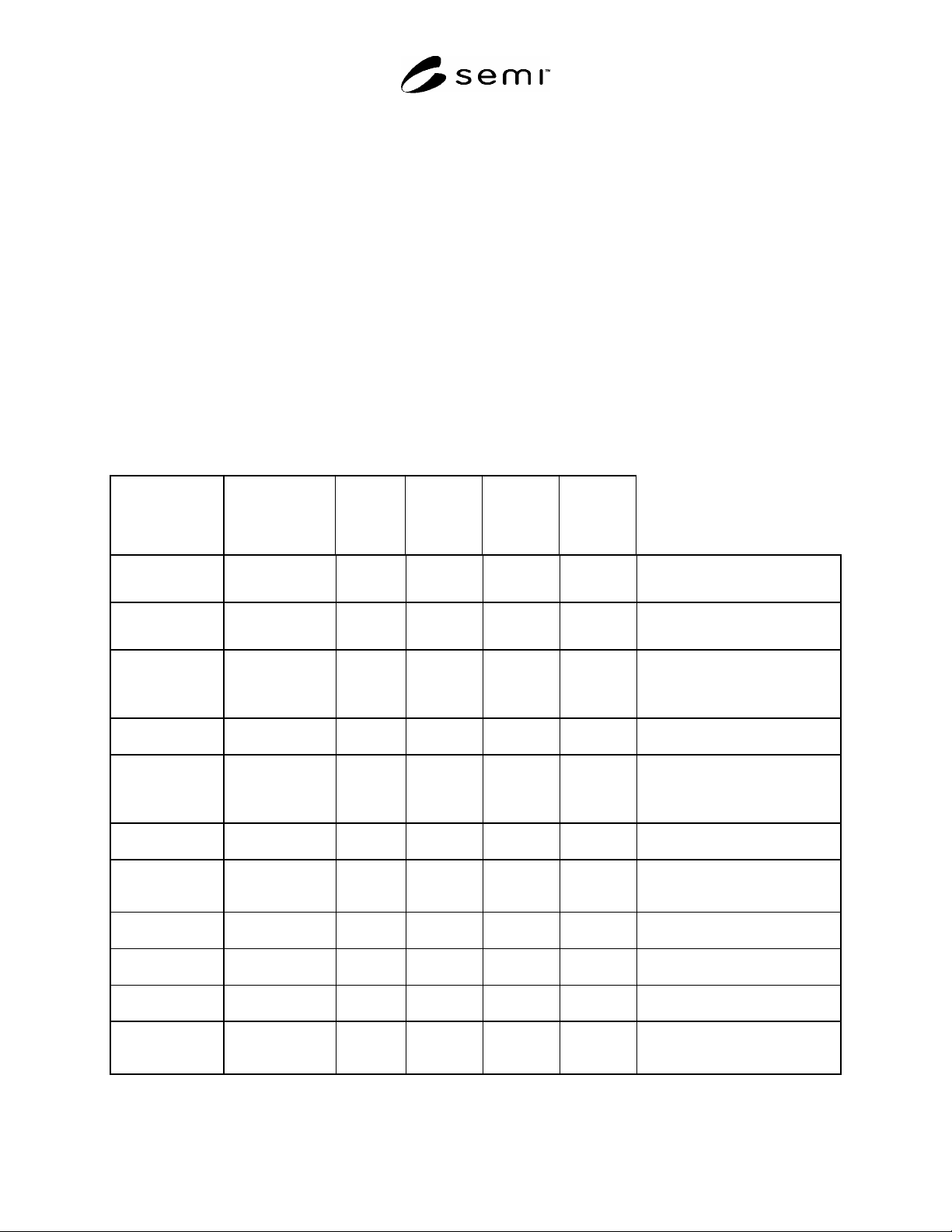
Table R9-1 Equipment Safety Features
Equipment
Safety Features
(not an inclusive
list)
USA
Europe
Japan
21 CFR
1040.10
EN
60825-1
JIS 6802
Paragrap
h
Paragrap
h
Paragrap
h
Examples
1. Protective
Housing
( ) Yes
( ) No
(f)(1) 4.2 4.2.1 Aluminum or steel enclosures,
windows that provide adequate
attenuation, optical fibers or
beam tubes.
2. Safety Interlocks ( ) Yes
( ) No
(f)(2) 4.3 4.2.2 See Section 11 of SEMI S2.
3. Remote
Interlock
Connector
( ) Yes
( ) No
(f)(3) 4.4 4.2.3 Usually a 12 to 24 volt set of
contacts available to the user to
integrate additional room control
measures.
4. Key Control ( ) Yes
( ) No
(f)(4) 4.5 4.2.4 A key that is not removable in
the operations mode.
5. Laser Radiation
Emission
Warning
( ) Yes
( ) No
(f)(5) 4.6 4.2.5 A light or indicator that warns
the user of the emission through
the aperture.
6. Beam
Attenuator
( ) Yes
( ) No
(f)(6) 4.7 4.2.6 Shutters, beam blocks or water-
cooled beam dumps
7. Location of
Controls
( ) Yes
( ) No
(f)(7) 4.8 4.2.7
8. Viewing Optics ( ) Yes
( ) No
(f)(8) 4.9 4.2.8 Must block all hazardous
wavelengths to acceptable levels.
9. Scanning
Safeguard
( ) Yes
( ) No
(f)(9) 4.10 4.2.9 Shuts down if the scanning
mechanism (such as a rotating
mirror or galvanometer) fails.