semi合集-English.pdf - 第1405页
SEMI E30-1103 © SEMI 1992, 2003 79 8 GEM Compliance This section defin es compliance to the GEM standard. It describes the fundame ntal GEM requirem ents and additional GEM capabilities. It p rovides references to other …

SEMI E30-1103 © SEMI 1992, 2003
78
STREAM 10: Terminal Services
S10,F1 Terminal Request (TRN) S,H<-E
S10,F2 Terminal Request Acknowledge (TRA) S,H->E
S10,F3 Terminal Display, Single (VTN) S,H->E
S10,F4 Terminal Display, Single Acknowledge (VTA) S,H<-E
S10,F5 Terminal Display, Multi-block (VMN) M,H->E
S10,F6 Terminal Display, Multi-block Acknowledge (VMA) S,H<-E
S10,F7 Multi-block Not Allowed (MNN) S,H<-E
STREAM 14: Object Services
S14,F1 GetAttr Request S,H <-> E
S14,F2 GetAttr Data M,H <-> E
STREAM 15: Recipe Management
S15,F1 Recipe Management Multi-block Inquire S,H <-> E
S15,F2 Recipe Management Multi-block Grant S,H <-> E
S15,F21 Recipe Action Request M,H <-> E
S15,F22 Recipe Action Acknowledge M,H <-> E
S15,F27 Recipe Download Request M,H -> E
S15,F28 Recipe Download Acknowledge M,H <- E
S15,F29 Recipe Verify Request M,H -> E
S15,F30 Recipe Verify Data M,H <- E
S15,F31 Recipe Upload Request S,H -> E
S15,F32 Recipe Upload Data M,H <- E
S15,F35 Recipe Delete Request M,H -> E
S15,F36 Recipe Delete Acknowledge M,H <- E
S15,F49 Large Recipe Download Request S,H -> E,reply
S15,F50 Large Recipe Download Acknowledge S,H <- E
S15,F51 Large Recipe Upload Request S,H -> E,reply
S15,F52 Large Recipe Upload Acknowledge S,H <- E
S15,F53 Recipe Verification Send M,H <- E,reply
S15,F54 Recipe Verification Acknowledge S,H -> E
SEMI E30-1103 © SEMI 1992, 2003
79
8 GEM Compliance
This section defines compliance to the GEM standard.
It describes the fundamental GEM requirements and
additional GEM capabilities. It provides references to
other sections of the standard where detailed
requirements are located. This section also defines
standard terminology and documentation that can be
used by equipment suppliers and device manufacturers
to describe compliance with this standard.
The GEM standard contains two types of specifications:
— fundamental GEM requirements and
— requirements pertaining to additional GEM
capabilities.
The fundamental GEM requirements form the
foundation of the GEM standard. The additional GEM
capabilities provide functionality required for some
types of factory automation or functionality applicable
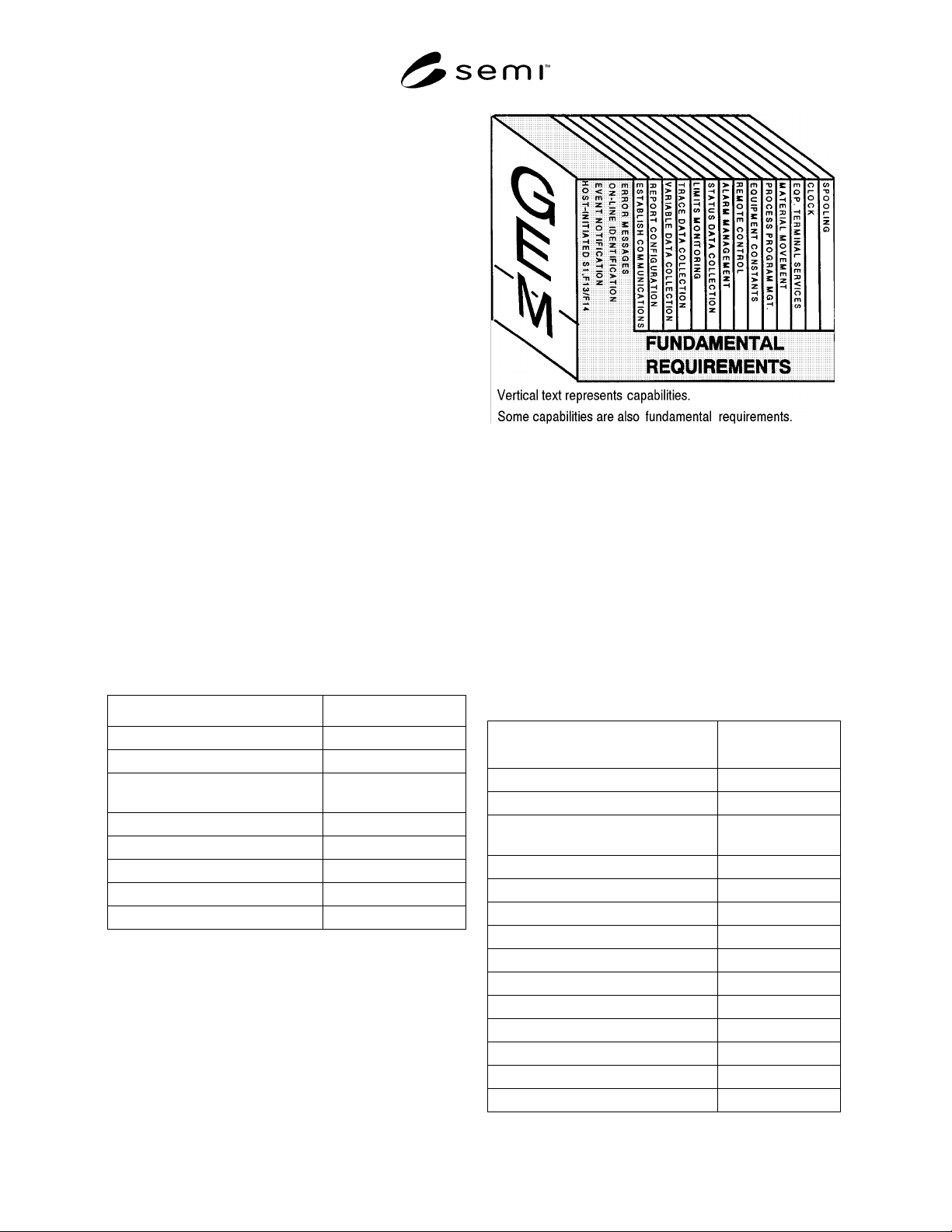
to specific types of equipment. Figure 8.1 illustrates the
relationship of the fundamental GEM requirements and
the additional GEM capabilities.
8.1 Fundamental GEM Requirements — All
equipment shall comply with the fundamental GEM
requirements listed in Table 8.1. Compliance to these
requirements involves precise and complete adherence
to all sections of the GEM standard referenced in Table
8.1.
Table 8.1 Fundamental GEM Requirements
Requirement Section References
State Models 3.0, 3.1, 3.3
Equipment Processing States 3.4
Host-Initiated S1,F13/F14
Scenario
4.1.5.1
Event Notification 4.2.1.1
On-line Identification 4.2.6
Error Messages 4.9
Control (Operator-Initiated) 4.12 (except 4.12.5.2)
Documentation 8.4
In addition, compliance requires adherence to the
portions of the following sections that are applicable to
the fundamental GEM requirements:
— Variable data items (GEM, Section 5)
— SECS-II data item restrictions (GEM, Section 5)
— Collection events (GEM, Section 6)
Figure 8.1
GEM Requirements and Capabilities
8.2 GEM Capabilities — The following table lists all
GEM capabilities and the sections of the GEM standard
where they are specified. These sections contain the
detailed requirements for implementing a GEM
capability. Requirements for an individual capability
include any referenced portions of the document. As an
example, the Alarm Management capability requires
implementation of the status variables
“AlarmsEnabled” and “AlarmsSet” as defined in
Section 5.
Table 8.2 Section References for GEM Capabilities
Capability Section
References
Establish Communications 4.1, 3.2
Event Notification 4.2.1.1
Dynamic Event Report
Configuration
4.2.1.2
Variable Data Collection 4.2.2
Trace Data Collection 4.2.3
Limits Monitoring 4.2.4
Status Data Collection 4.2.5
On-line Identification 4.2.6
Alarm Management 4.3
Remote Control 4.4
Equipment Constants 4.5
Process Program Management 4.6
Material Movement 4.7
Equipment Terminal Services 4.8
SEMI E30-1103 © SEMI 1992, 2003
80
Capability Section
References
Error Messages 4.9
Clock 4.10
Spooling 4.11
Control (Operator-Initiated) 4.12 (except
4.12.5.1)
Control (Host-Initiated) 4.12.5.1
8.3 Definition of GEM Compliance — The term “GEM
Compliance” is defined with respect to individual GEM
capabilities to indicate adherence to the GEM standard
for a specific capability. Equipment is GEM-compliant
for a specific GEM capability if, and only if, the
following three criteria are met:
— The fundamental GEM requirements are satisfied.
— The capability is implemented to conform with all
applicable definitions, descriptions, and
requirements defined for the capability in this
standard.
— The equipment does not exhibit behavior related to
this capability that conflicts with the GEM behavior
defined for the capability.
For example, equipment that provides SECS-II
messages for management of process programs must
precisely implement the GEM Process Program
Management capability to be “GEM-Compliant for
Process Program Management.”
Equipment may supply additional functionality not
specified in the GEM standard by using any messages
defined in the SECS-II standard as long as the
additional functionality does not conflict with
compliance to GEM capabilities.
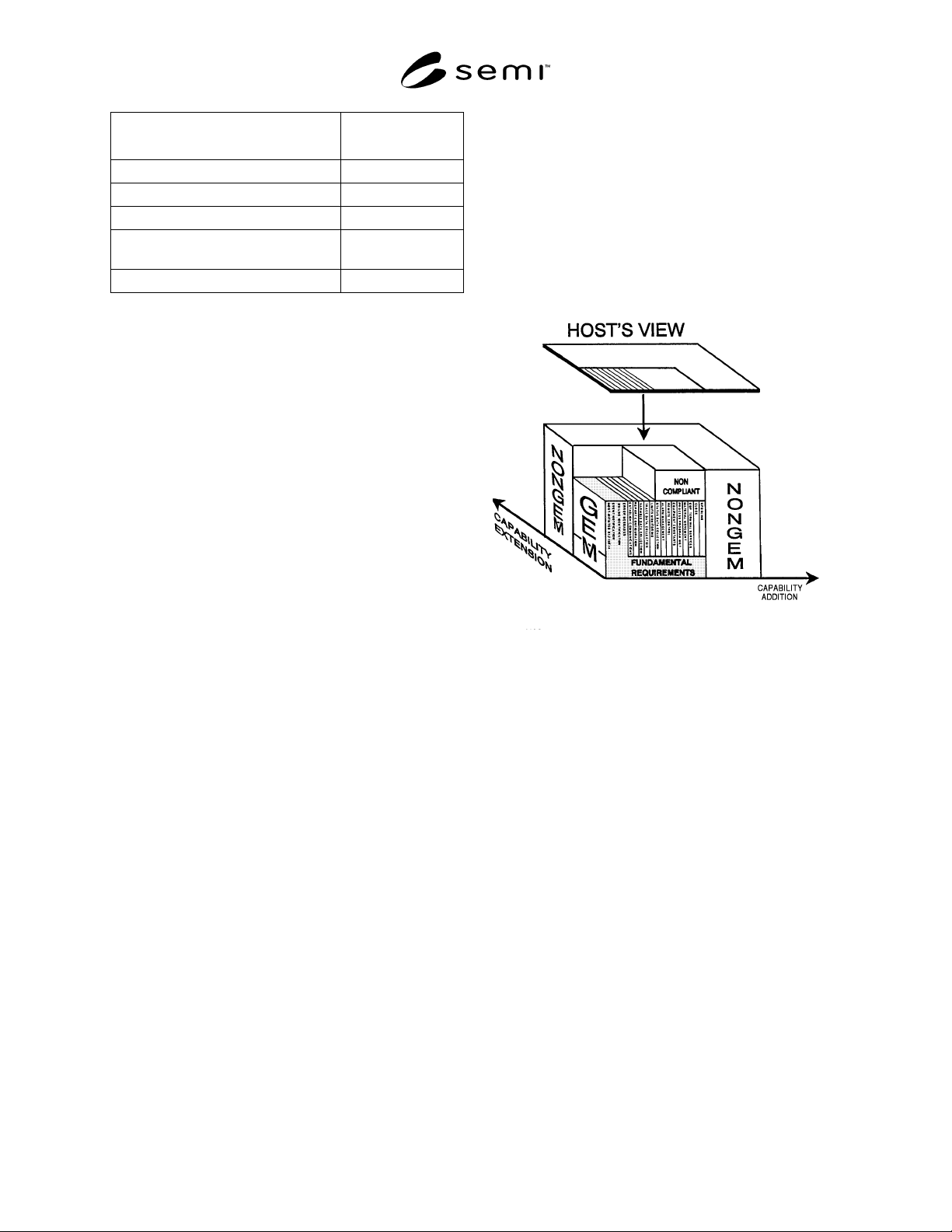
Figure 8.2 illustrates the host view of equipment
communications in relationship to the components of
the GEM standard. The GEM capabilities are built upon
the fundamental GEM requirements and present GEM-
compliant behavior to the host when they are not
obstructed by conflicting functionality. Additional non-
GEM capabilities and non-obstructing extensions to
GEM capabilities provide additional functionality while
maintaining GEM behavior from the host view.
One additional term is defined to facilitate discussion of
GEM capability. Equipment is “Fully GEM Capable” if
and only if it meets the following two criteria:
— The equipment supplies all the GEM capabilities
listed in Section 8.2.
— Every implemented GEM capability is GEM-
Compliant.
8.4 Documentation — This section describes
documentation requirements in addition to those
specified in Sections 3 and 4 of this standard. All
documentation of the SECS-II interface shall be
supplied as a single volume, including Message
Documentation, a Compliance Statement and the
documentation required by Sections 3 and 4.
Figure 8.2
Host View of GEM
8.4.1 Message Documentation — The equipment
supplier shall provide message documentation in
conformance with Chapter 8 (Message Documentation)
of SEMI E5.
8.4.2 GEM Compliance Statement — The SECS-II
interface documentation provided by an equipment
supplier shall address GEM compliance. This
documentation shall include a GEM Compliance
Statement that accurately indicates for each capability
whether it has been implemented and whether it has
been implemented in a GEM-compliant manner. The
format for this statement is supplied as Table 8.3.
The table consists of three columns. The first column
lists the requirements and capabilities. The other two
columns pose questions to the supplier:
Implemented: Does the equipment provide functionality
that is similar to that defined for the GEM requirement
or capability?
GEM-Compliant: Has that requirement or capability
been implemented in a GEM-compliant manner?