semi合集-English.pdf - 第1674页
SEMI E39-0703 © SEMI 1995, 2003 16 information in Status, indicatin g the error and the attribute. 11.5.10 ObjStatus — This is a required parameter in the response message. It is a structure that consists o f an acknowle…
SEMI E39-0703 © SEMI 1995, 2003 15
Parameter Definition Form
names that are supported by an
object type.
ServiceParameterName Parameter name. Text.
ServiceParameterValue Parameter value. Any. Varies depending on the parameter.
Status Error information. (List of) Structure composed of ErrorCode and ErrorText.
11.5 Get and Set Attributes — The GetAttr and SetAttr
services are provided for reading and setting values of
an object' s attributes. They address attribute values of
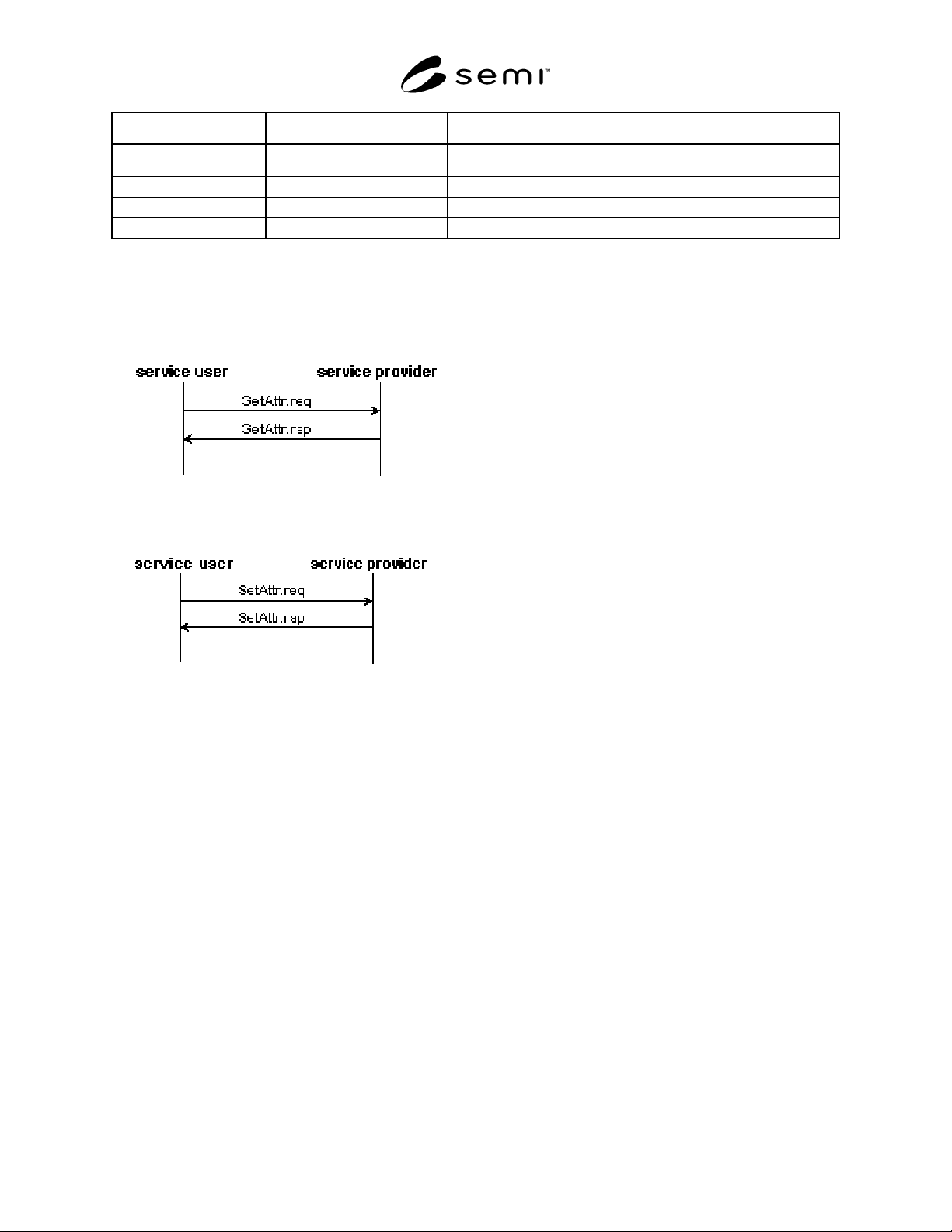
instances of objects. Figures 7 and 8 show the message
flow for the GetAttr service.
Figure 7
GetAttr Message Flow
Figure 8
SetAttr Message Flow
11.5.1 GetAttr and SetAttr allow access to attributes of
objects that are owned by another object and are
capable of addressing multiple levels of ownership
(object hierarchy).
11.5.1.1 For example, GetAttr may be used as a “get
directory” request to find the identifiers of all instances
of one or more owned objects.
11.5.2 GetAttr and SetAttr may be used for objects that
use a complex identifier, such as recipes with separate
attributes for name and version.
11.5.3 GetAttr and SetAttr allow searching for those
instances of an object that satisfy certain conditions
through the specification of one or more qualifiers or
filters. Only attributes of those instances of the desired
object type that satisfy the conditions defined in the
filters are returned by the service provider.
11.5.3.1 The filter is familiar to users of file services as
a convenient way to obtain a partial directory of files,
such as files with a date later than a specified date. This
is particularly useful when the list of contents may be
quite long.
11.5.4 The attribute value (all or a part of the list of
ObjSetting) returned by the GetAttr service may be
invalid if the acknowledge code of ObjStatus indicates
a failure. In that case; the value(s) requested by the
invocation of GetAttr service may be unknown, invalid
or unavailable by any reason (e.g. corresponding
hardware status, lack of privilege, mutual exclusion or
other requirement not fulfilled by the application).
Supplier shall document all conditions or timing
requirements of any attributes if they are not always
available.
11.5.5 The attribute value (all or a part of the list of
ObjSetting) replied by the SetAttr service may be still
unchanged if the acknowledge code of ObjStatus
indicates a failure. In that case; the attribute value may
be unchangeable, inhibited or blocked internally by any
reason (e.g. corresponding hardware status, lack of
privilege, mutual exclusion or other requirement not
fulfilled by the application. The object providing the
SetAttr service shall identify whether or not it is valid
to change or set an attribute value. Supplier shall
document all conditions and timing requirements of
each attribute if they are not always allowed to be set.
11.5.6 Object Specifier — This parameter is used for
specifying an owner object and may be omitted from
the message. When included, it is a formatted text
string that conforms to the description in Section 9. An
object specifier is rejected by service providers that do
not use owner or owned objects.
11.5.7 Filter — This is a optional list of qualifications
to be applied to specifed attribute and may be omitted
from the message. When included, the complete filter is
formed by a logical AND of each attribute qualification
in the list.
11.5.8 Requested Attribute — The final parameter in
the GetAttr service gives the names of one or more
attributes of interest. These are the attributes whose
values shall be returned in the response, in the order
requested.
11.5.9 Settings — In the SetAttr service, a list of one or
more attribute name/value pairs is specified. This is the
set of desired attribute values. SetAttr rejects any
attempt to set a read-only attribute and returns
SEMI E39-0703 © SEMI 1995, 2003 16
information in Status, indicating the error and the
attribute.
11.5.10 ObjStatus — This is a required parameter in
the response message. It is a structure that consists of
an acknowledge code and a list of status parameters.
The acknowledge code is used to indicate errors that
apply to the response as a whole. A status parameter is
a structure consisting of a code indicating a specific
error and accompanying text providing additional
information. Text is often used to inform a person of
the results of an operation.
11.5.11 Tables 4 and 5 define the parameters for the
GetAttr and SetAttr services, respectively.
Table 4 GetAttr Service
Parameter Req/Ind Rsp/Conf Description
ObjSpec C - The object specifier, used to specify the owner of the target object.
ObjType M - The type of the target object.
(List of)
ObjID
C - The identifier of the target object. If present, identifiers are treated as a pre-filter
of the form “ObjID = <identifier>”, where the individual identifiers are joined
with logical OR’s.
(List of)
AttrFilter
C - An attribute filter to be applied to the target object. If both AttrFilter and ObjID
are omitted, attributes are requested for all instances of the target object type.
(List of)
AttrName
C - The name of a desired attribute. If the name is “ObjType,” and if ObjType
(above) is omitted, then the object type of all subordinate objects is requested.
If omitted, then all public attributes of the target object are requested.
(List of)
ObjSetting
- M Attributes that match the specified characteristics, per qualifying object
instance. Setting value may not be valid if corresponding ObjStatus shows a
failure.
ObjStatus - M Information concerning the success or failure of the request.
Table 5 SetAttr Service
Parameter Req/Ind Rsp/Conf Description
ObjSpec C - The object specifier, used to specify the owner of the target object.
ObjType M - The type of the target object.
(List of)
ObjID
C - The identifier of the target object. If present, is treated as a primary filter of the
form “ObjID = <identifier>”.
(List of)
AttrSetting
M - An attribute’s name and desired value.
(List of)
ObjSetting
- M The attributes’ resulting values. Requested setting value(s) may have not
changed if corresponding ObjStatus shows a failure.
ObjStatus - M Information concerning the success or failure of the request.
11.6 GetType — GetType is a service that is directed at object types rather than object instances. It is used to ask an
owner object for the object types that it owns.
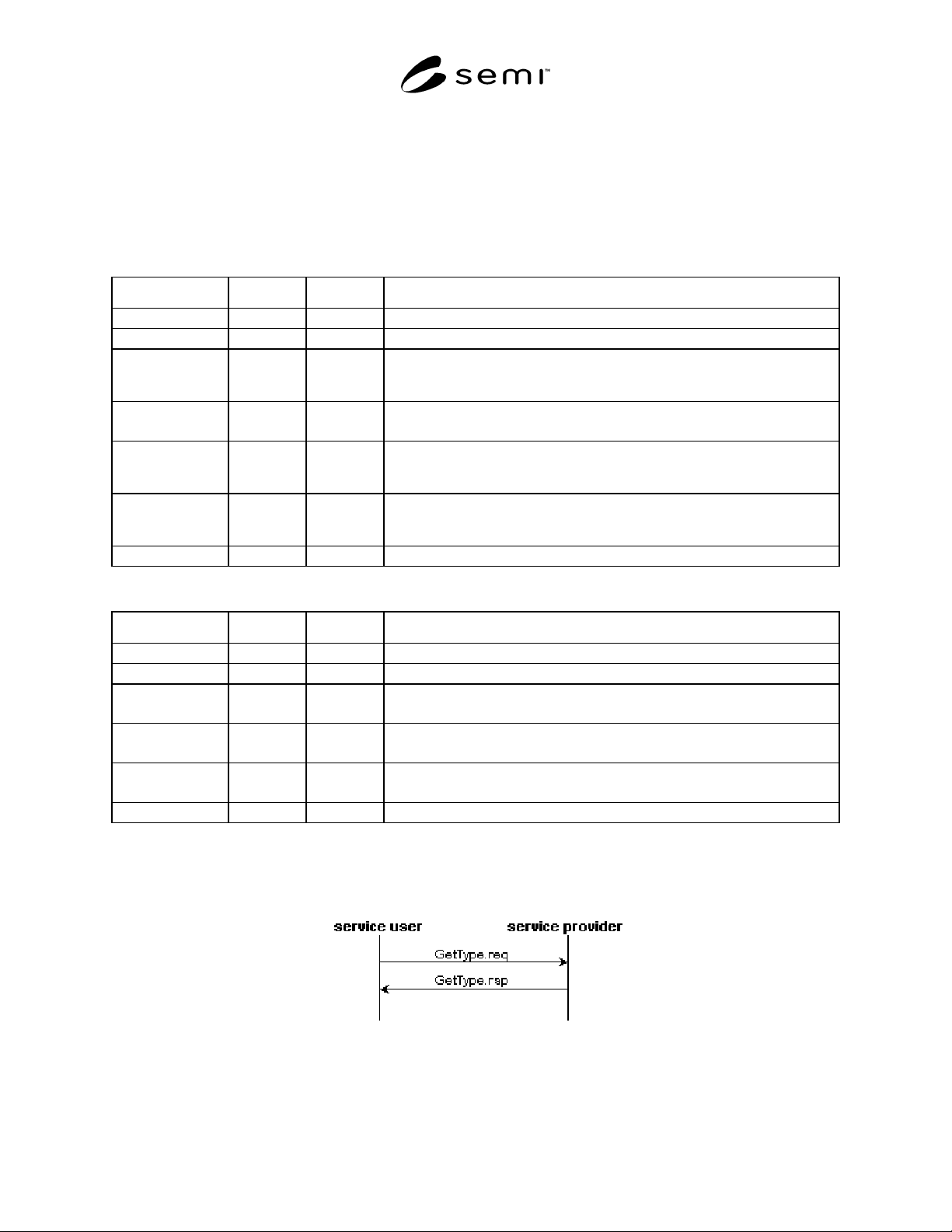
11.6.1 Figure 9 shows the message flow for the GetType service.
Figure 9
GetType Message Flow
SEMI E39-0703 © SEMI 1995, 2003 17
11.6.2 Comments for the ObjSpec and ObjStatus parameters of GetAttr and SetAttr also apply to the parameters for
the GetType service.
11.6.3 Table 6 defines the parameters for the GetType service.
Table 6 GetType Service
Parameter Req/Ind Rsp/Conf Description
ObjSpec C - The object specifier, used to specify the owner of the target object.
(List of)ObjType - M The types of objects owned by the service provider.
ObjStatus - M Information concerning the success or failure of the request.
11.7 GetAttrName — GetAttrName is a service that is directed at object types rather than object instances. It is used
to ask for the names of the attributes of one or more objects owned by the service provider.
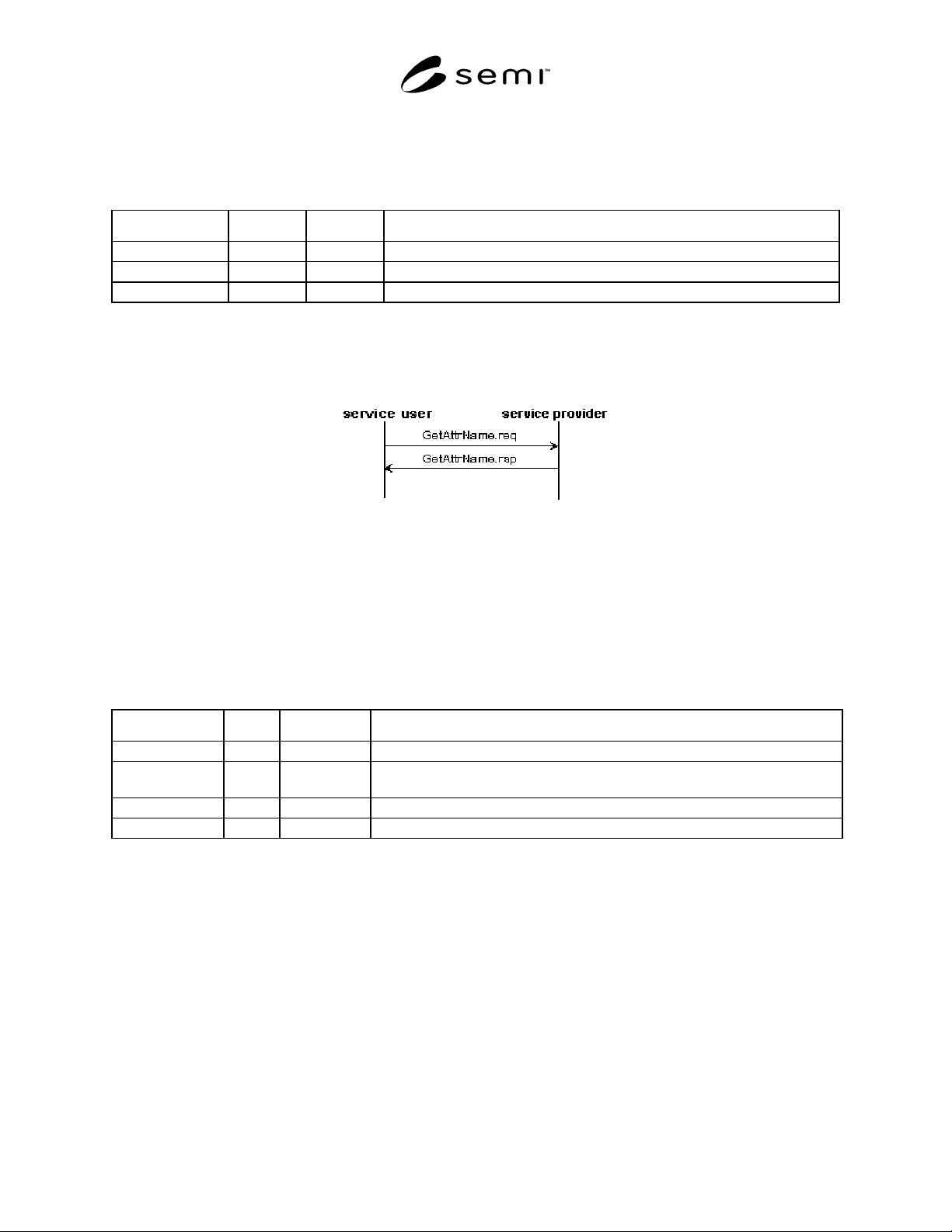
11.7.1 Figure 10 shows the message flow for the GetAttrName service.
Figure 10
GetAttName Message Flow
11.7.2 Wild characters may be used in the object types requested.
11.7.3 Comments for the ObjSpec and ObjStatus parameters of GetAttr and SetAttr also apply to the parameters for
the GetAttrName service.
11.7.4 Table 7 defines the parameters for the GetAttrName service.
Table 7 GetAttrName Service
Parameter Req/Ind Rsp/Conf Description
ObjSpec C - The object specifier, used to specify the owner of the target object.
(List of)ObjType M - The type of the target object owned by the service provider. ObjType may use wild
characters.
(List of)AttrName - M The names of the attributes of each of the target object(s).
ObjStatus - M Information concerning the success or failure of the request.
12 Additional Services
12.1 Additional services described in this section may have some restrictions when invoked. In some cases,
services that are invoked may report a failure. For example: the owner of an object shall not delete the object during
its lifecycle or while it is valid and required by another agent. Existence of an object may depend on preconditions,
provided parameters, state of another object, corresponding operation, context of application, etc. Supplier shall
document any restrictions or information regarding the validity of the additional services listed below.
12.1.1 This section defines the services required for additional operations defined in Section 10. These services are
listed in Table 8.