semi合集-English.pdf - 第2294页
SEMI E81-0600 © 1999, 2 000 31 Cont rol / Request or Spec Resourc e M ateri al Requestor Job Subj ob Spec Resource Materi al Cont rol Subj ob Spec Resource M at eri al Cont r ol Figure 17 Hierarchical Job Control Pattern…
SEMI E81-0600 © 1999, 2000 30
configured to be limited to specific factory resources
that it can call on to perform work.
7.3.4.7.4 The job requestor has an interface so the
Job/Job Supervisor can report overall job progress. The
Job Requestor interface includes the methods
requesting that it be notified that a job has started,
completed, or been terminated. The requestor or other
components can subscribe to job state change events
and other events for a more detailed job status.
7.3.4.7.5 The Job Supervisor interface provides high
level information about the jobs it is currently
managing. The details of any specific job are provided
by the Job itself, not the Job Supervisor. From the Job
Supervisor, the Job Requestor is able to
• request activity,
• locate jobs that meet certain criteria,
• request lists of all jobs being performed, and
• control all the jobs as a group (e.g. “abort all
jobs”), but not individually (not “abort job X”—
this would be a responsibility of the Job interface).
NOTE 13: Much thought should be given to the use of these
“all jobs” commands since they can cause a great deal of harm
if not designed and used properly.
7.3.4.7.6 The Job interface is the sole source of all
public information about a job. It also provides all
specific control of the job (pause, abort, etc.).
7.3.4.8 Hierarchical Job Structure
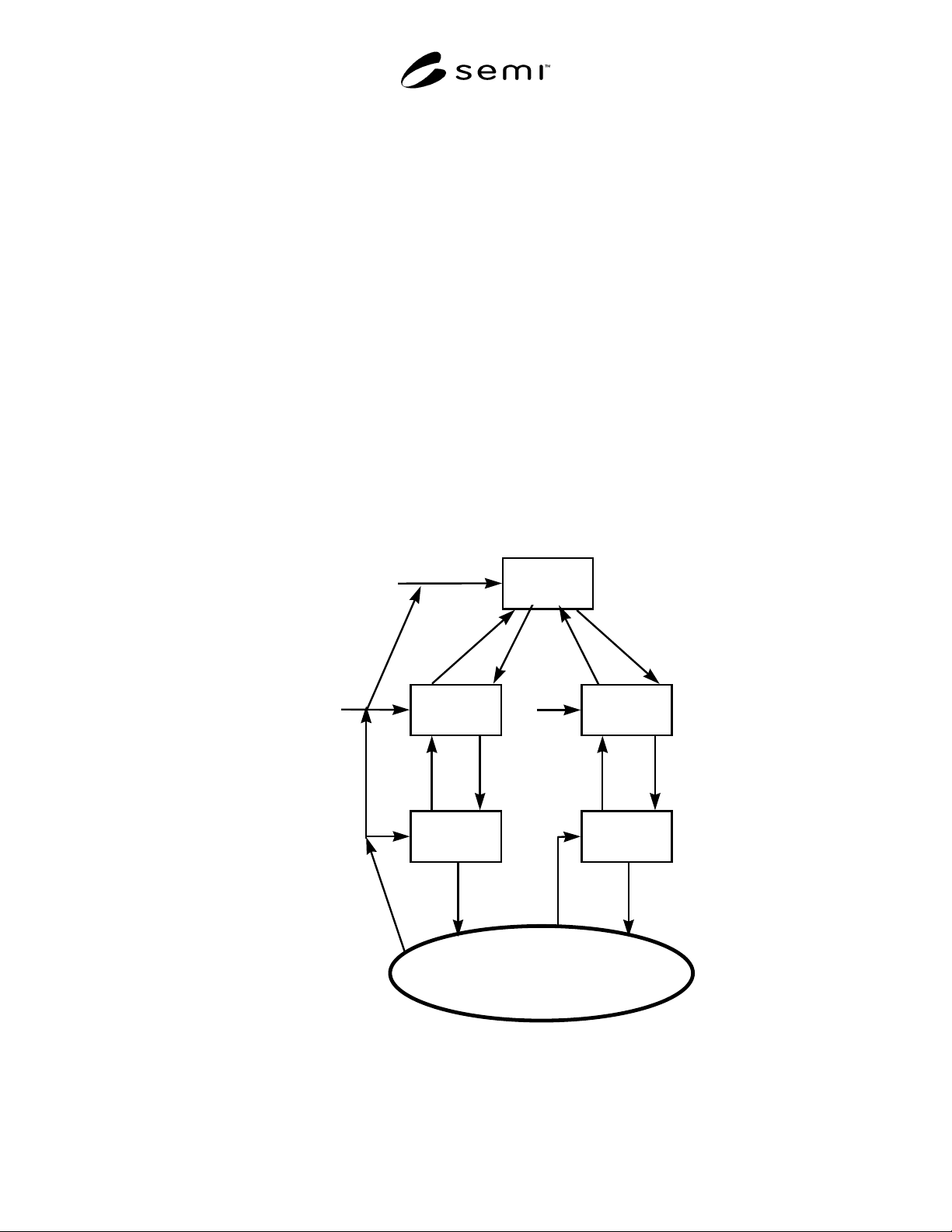
7.3.4.8.1 The factory and task hierarchy of Figure 11
and Figure 12 results in a multi-level (hierarchical) job
control structure, with a given Job/Job Supervisor
requesting work through other (sub)Jobs. As Figure 16
illustrates, higher level job controllers specify and
request work from any number of lower level job
controllers and monitor job progress through status and
external feedback. At the lowest level, job control
results in directly manipulating equipment actuators
based on real-time sensor feedback. (Note, this lowest
level of job control is outside the MES scope of the
CIM Frameworkit is within the scope of the
equipment control.) The job request, status, and
feedback information are all candidates for storage in
job history.
Job
Control
Job
Control
Job
Status
Job
Request
External Feedback
(e.g. sensor data
or operator input)
Actuation
Sensor Feedback
Job
Status
Job
Request
Job
Control
External Feedback
(e.g. sensor data
or operator input)
Job
Control
Job
Control
Job
Status
Actuation
Job
Request
Job
Request
Job
Status
Feedback
Feedback
Physical Processes
Figure 16
Hierarchical Job Control
SEMI E81-0600 © 1999, 200031
Control/
Requestor
Spec
Resource Material
Requestor
Job
Subjob
Spec
Resource Material
Control
Subjob
Spec
Resource Material
Control
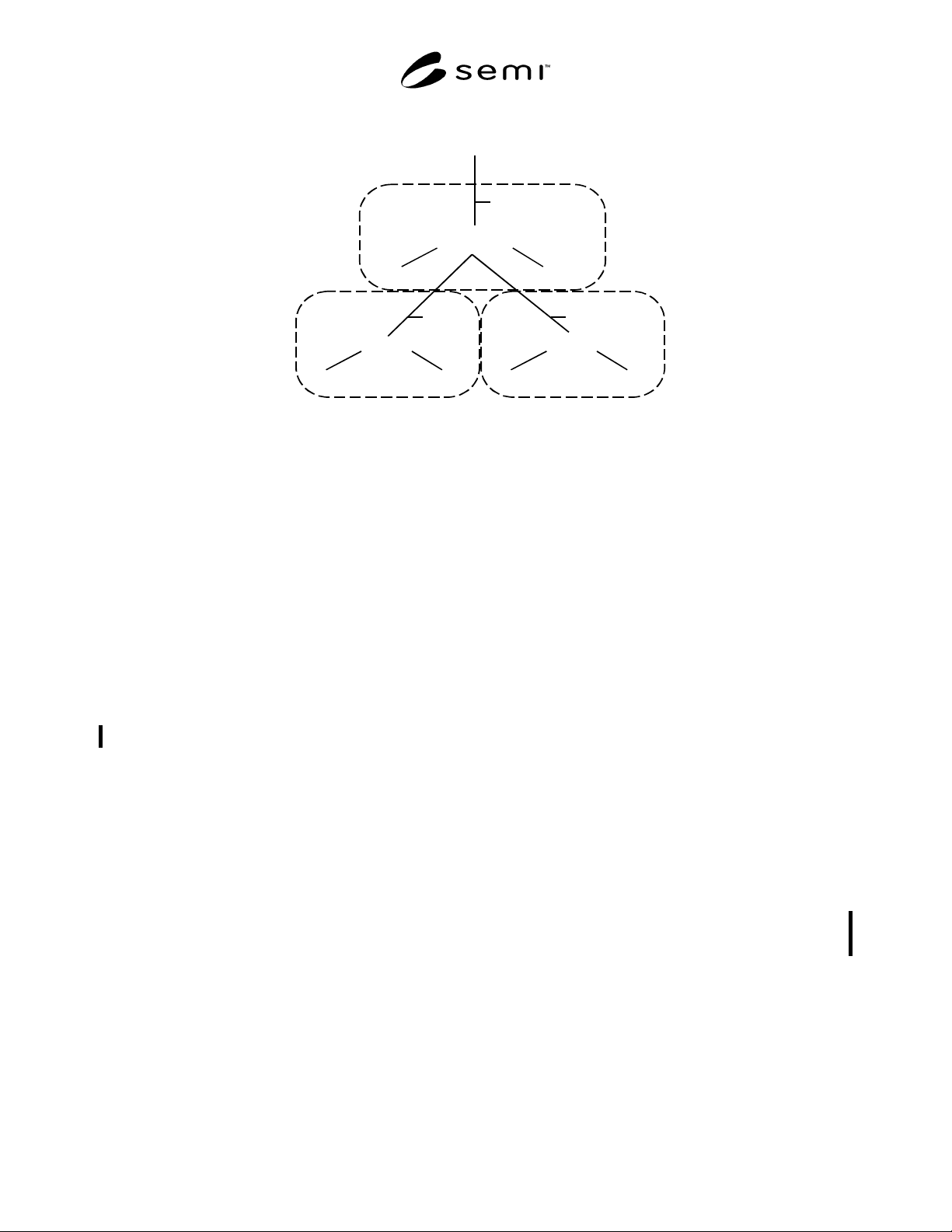
Figure 17
Hierarchical Job Control Pattern
7.3.4.8.2 Placing the job structure template of Figure
13 into the job control hierarchy of Figure 16 results in
the hierarchical job control pattern of Figure 17.
7.3.4.8.3 At each level, the job control
• Receives job requests with associated job
specifications,
• Decomposes the job into subjobs,
• Defines resource relations between the job and
subjob (e.g., selects and schedules resources for
subjobs within the scope of the job supervisor, such
as machines assigned to an area or process
chambers in a production machine),
• Defines material relations between the job and
subjob (e.g. how lots are assigned to transport
groups and process groups, including decisions on
batching, splits, joins, etc.),
• Requests the subjobs and provides associated
subjob specifications,
• Monitors subjob progress,
• Reports job progress to the job requestor and other
interested functions,
• Records job history.
7.3.4.9 CIM Framework Job Structure Summary
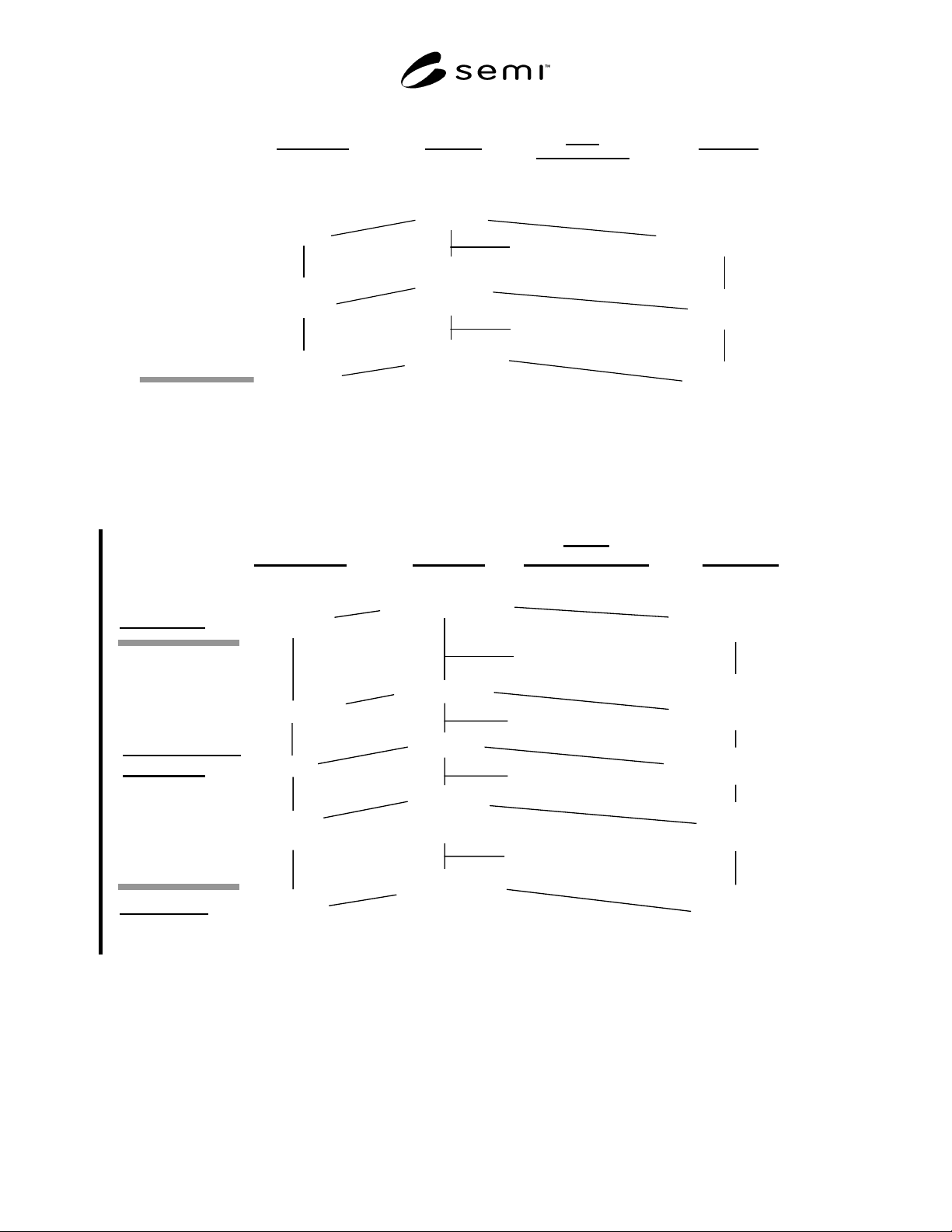
7.3.4.9.1 Figure 18 shows the job hierarchy pattern
applied to the material movement resources of Figure 7.
Figure 19 shows the pattern of Figure 17 applied to the
material processing resources of Figure 7 (branching to
multiple lower-level resources is not shown). Figure 20
summarizes how the CIM Framework components
come together into an integrated manufacturing
execution system.
• The product material hierarchy and genealogy is
modeled in the Product Management components
of the CIM Framework Specification.
• The task specification hierarchy is modeled in the
Specification Definition and Recipe Management
components.
• The resource hierarchy is modeled in the Factory
Operations (for Factory and Area levels),
Equipment Tracking and Maintenance, Durables
and Consumables Management, and Factory Labor
components.
• The control hierarchy is modeled in the Factory
Operations (Factory Jobs), Production Machine
(Production Machine Jobs), Material Transport and
Storage (Transport Jobs), and the maintenance job
supervision aspects of the various Resource
Tracking and Maintenance specializations
(Maintenance Jobs).
SEMI E81-0600 © 1999, 2000 32
Resource Control
Task
Specification
Material
MES Factory,
Area
Transport
and Storage
Resources
Factory Job,
Area Job
Transport
Job
Transport
and
Storage
Jobs
Product Group,
Lot,
Process Group
Transport
Group
Container
Destination
Destination
Transport
Machine
Equipment
Manufacturing
Execution
Figure 18
Hierarchical Job Control - Material Transport Aspects
Equipment
Enterprise
Manufacturing
Execution
Resource Control
Task
Specification Material
MESFactory
Area
Production
Machine
Process
Resource
Factory Job
Area Job
Production
Machine
Job
Process
Resource
Job
ProductGroup,
Lot, LotFamily,
Inventory Region
Inventory Region,
Process Group
Process
Group
Product Request,
ProductSpec.,
ProcessDefinition
Process Operation
Sequence
Process Operation
Sequence
Process Operation
Spec,
Process Operation
Enterprise Job
Enterprise
Order,
OrderItem
Process
Resource
Group
Figure 19
Hierarchical Job Control - Material Processing Aspects