semi合集-English.pdf - 第7055页
SEMI S17-0701 © SEMI 2001 3 5.18 station — th e destination point wh ere an unmann ed transport vehi cle is prog ra mme d to stop for load/un load operation (also kn o wn as a con trol point). 5.19 travel — the autom ate…

SEMI S17-0701 © SEMI 2001 2
4 Referenced Standards
NOTE 2: Unless otherwise indicated, all documents cited
shall be the latest published versions.
4.1 SEMI Standards
SEMI E15.1 — Specification for 300 mm Tool Load
Port
SEMI E23 — Specification for Cassette Transfer
Parallel I/O Interface
SEMI E84 — Specification for Enhanced Carrier
Handoff Parallel I/O Interface
SEMI S2 — Environmental, Health, and Safety
Guideline for Semiconductor Manufacturing Equipment
SEMI S8 — Safety Guidelines for Ergonomics
Engineering of Semiconductor Manufacturing
Equipment
4.2 ANSI Standard
1
ANSI/RIA R15.06 — Industrial Robots and Robot
Systems - Safety Requirements
4.3 CENELEC Standards
1
EN775 — Manipulating Industrial Robots – Safety
4.4 ISO Standards
2
ISO 10218 — Manipulating Industrial Robots – Safety
5 Terminology
5.1 automated operation — system operation under
full pre-programmed control of the computer controller.
5.2 automatic guided vehicle (AGV) — a floor based
vehicle, with or without robotic manipulators, used for
transporting loads and operating without the need for
assistance by factory personnel. AGVs travel without
mechanical guidance.
5.3 bumper — a shock absorber for a UTV. A
bumper is typically equipped with a contact switch or
sensor on it. And if the bumper switch or sensor is
activated, the UTV will stop immediately.
5.4 EMO — an actuator (e.g., button) which, when
activated, places the equipment into a safe shutdown
condition, without generating any additional hazard to
personnel or the facility.
5.5 E-Stop — emergency stop feature provided to stop
all moving parts but not necessarily isolating or
controlling all energy sources.
1 American National Standards Institute, 11 West 42nd St., 13th
Floor, New York, NY 10036
2 International Organization for Standardization (ISO), 1 rue de
Varembe, Case postale 56, CH-1211 Geneve 20, Switzerland
5.6 end user customer — as related to UTVs, the
company operating the factory in which the UTVs are
installed.
5.7 fault-tolerant — designed so that a reasonably
foreseeable single point failure does not result in an
unsafe condition.
5.8 floor-traveling vehicle — a vehicle that
automatically travels on the factory floor to a specified
station where a load/unload operation is performed
automatically or manually. Floor-traveling vehicles
include automatic guided vehicles (AGV) and rail
guided vehicles (RGV).
5.9 hoist — the assembly on a space-traveling vehicle
that performs the load/unload operation by transferring
a load [e.g., carrier(s), pod(s)] to and from an overhead
vehicle.
5.10 interbay transport — moveme nt of loads [e.g.,
carrier(s), cassette(s), reticle(s)] between functional
work areas or bays.
5.11 intrabay transport — movement of loads [e.g.,
carrier(s), cassette(s), reticle pod(s)] within a functional
work area or bay.
5.12 load — load is the object to be transported by
UTV. Load includes a carrier (cassette, box, pod, etc.)
and its contents.
5.13 load/unload operation — the action necessary to
move a load [e.g., carrier(s), cassette(s) reticle pod(s)]
to and from a vehicle. This operation may involve
hoisting, manual, or robotic manipulation to transfer
loads between a vehicle and semiconductor
manufacturing equipment (such as process equipment
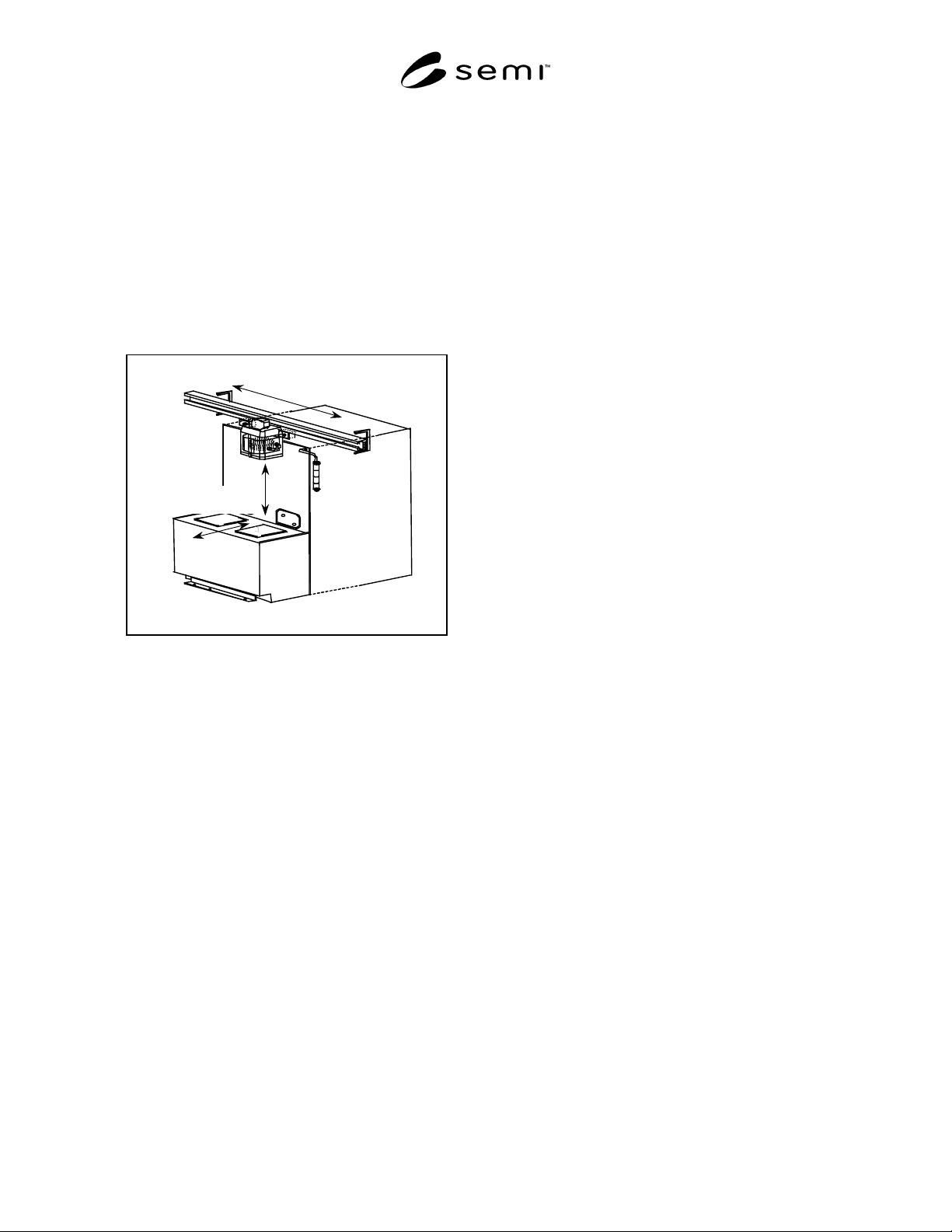
or stockers). See Figure 1.
5.14 manual operation — defined as any control
outside of automated operation.
5.15 overhead hoist transport (OHT) — a rail guided
vehicle and hoist used to transport material above the
factory floor over the heads of factory personnel.
5.16 rail guided vehicle (RGV) — a floor-based
vehicle, with or without robotic manipulators, used to
transport loads and operating on a guide rail without the
need for assistance by factory personnel.
5.17 space-traveling vehicle — a vehicle that
automatically travels through space, such as in the
region just below a factory ceiling, to a specified station
where a load/unload operation is performed
automatically or manually. Space-traveling vehicles
include interbay overhead transport vehicles and
intrabay overhead hoist transport vehicles (OHT).
SEMI S17-0701 © SEMI 20013
5.18 station — the destination point where an
unmanned transport vehicle is programmed to stop for
load/unload operation (also known as a control point).
5.19 travel — the automated motion of a vehicle along
a rail or programmed path from one station to another
station. Travel does not include load/unload operation.
See Figure 1.
5.20 unmanned transport vehicle (UTV) — a vehicle
used to automate the movement of production material
within semiconductor factories. There are two types of
UTVs, floor-traveling vehicles and space-traveling
vehicles.
Travel
Station to Station
Load/Unload
Overhead or Floor Vehicle
Figure 1
Delineation of Travel vs. Load/Unload
6 Equipment Evaluation
6.1 Equipment Evaluation for both Floor-Traveling
and Space-Traveling Vehicles — All UTV equipment
should be evaluated against the following referenced
provisions.
6.2 All UTV equipment should be evaluated against
appropriate sections of SEMI S2 for environmental,
safety, and health considerations.
6.2.1 Evaluations to the provisions in the following
sections of SEMI S2 are applicable to declare
conformance to this document.
a) Electrical Design
b) Emergency Shutdown
c) Automated material handlers (This Automated
material handlers section only applies to the
robotics portion of UTV equipment, when
provided.)
d) Hazard Warning Labels
e) Seismic Protection
f) Documents provided to User
6.2.2 At the discretion of the evaluator, additional
provisions in SEMI S2 may be considered for
evaluation based on the functionality of the UTV
equipment.
6.3 All UTV equipment should be evaluated against
SEMI S8 for ergonomic considerations.
6.4 All UTV equipment should be evaluated against
the applicable Electro Magnetic Compatibility (EMC)
regulations of the proposed installation site.
6.5 In addition to the provisions referenced in Section
6.1, UTV equipment should also be evaluated to the
provisions contained in the following sections of this
document.
7 Clearances and Interfaces
7.1 Body Shape of both Floor-Traveling and Space-
Traveling Vehicles — The body of a UTV should be
free of any dangerous parts such as sharp edges and
protrusions. The UTV body surface should have a
smooth finish.
7.2 Minimum Clearance for Floor-Traveling Vehicles
— Where passageways are used for emergency egress,
they should be provided on at least one side of the
UTV. International, national or local codes,
regulations, and laws should be used to determine
passageway width.
7.3 Minimum Clearance for Space-Traveling Vehicles
— The lowest part of the space-traveling vehicle,
including the load, should maintain a minimum
clearance of 2135 mm (7 feet) above the walking floor.
NOTE 3: Some end user customers may request a higher
minimum clearance, or a minimum clearance between the
space-traveling vehicle and the top of other equipment, to
accommodate clearances specified by SEMI E15.1.
7.4 Interfaces with Building Structures for both Floor-
Traveling and Space-Traveling Vehicles
UTV
suppliers should provide for optional vehicle interfaces
with building structures like doors, elevators, and walls.
7.4.1 If UTVs are required to operate in conjunction
with building structures, such as automatic doors or
elevators, UTVs should be capable of communicating
with the facility to assure safe door opening/closing.
7.4.2 If it is necessary for a UTV to travel through a
building firewall, the firewall pass through should be
specified and/or designed to maintain the fire rating of
the wall in the event of a fire.

SEMI S17-0701 © SEMI 2001 4
8 Emergency Shutdown
8.1 Emergency Shutdown for both Space-Traveling
and Floor-Traveling Vehicles — In addition to the
emergency shutdown provisions of SEMI S2, UTV
equipment should also conform to the following
provisions.
8.1.1 The UTV should be equipped with an emergency
off (EMO) circuit that, when activated, immediately
stops the operation and motion of the UTV, including
both travel and load/unload operation. The EMO circuit
should be activated whenever the following actions
occurs:
a) An EMO button on the UTV is pressed.
b) An EMO at a fixed floor location is pressed.
NOTE 4: See Section 9.2 for handheld remote control.
8.1.2 Once an EMO circuit has been activated, the
UTV should not move under its own power until the
cause of the emergency condition has been resolved and
the system has been reset by a human operation. The
system should not reset or restart automatically.
8.2 Position of EMO Buttons on Floor-Traveling
Vehicles — Structure-mounted EMO buttons should be
located for easy accessibility by factory personnel.
8.2.1 Vehicle-mounted EMO Buttons should be
accessible and visible from all sides of the vehicle,
typically on the four-corners of a floor-traveling
vehicle.
8.3 Position of EMO Buttons for Space-Traveling
Vehicle Systems
EMO buttons should be located for
easy accessibility by factory personnel, for example:
• Near control panels or operator terminals including
handheld vehicle remote controls.
• Near process equipment load ports or stations.
• On walls or other fixed locations in the factory area
where space-traveling vehicles operate.
NOTE 5: Some end user customers may request EMO buttons
included on the space-traveling vehicle.
8.3.1 Since space-traveling vehicle EMO buttons are
typically remote from the vehicles, space-traveling
systems should provide a method of determining the
location of the activated EMO button. This will ensure
that the emergency condition can be identified and
resolved prior to resetting the system per Section 8.1.2.
9 Manual Operation
9.1 Manual Movement of both Space Traveling and
Floor-Traveling Vehicles — When the EMO is
activated, the UTV should be capable of brake release
to allow for release of a potentially trapped person.
9.1.1 The UTV should be equipped with a manual
movement function that permits a human operator to
maneuver the vehicle in the event of a problem. In the
event of a problem, manual movement of all vehicle
functions including travel and load/unload
should be
allowed.
9.2 Manual/Remote Operation of both Space-
Traveling and Floor-Traveling Vehicles — Except for
EMO and E-Stop, any control of a vehicle outside of
automated operation should be exclusive. Other
devices should not override vehicle control or cause
movement of more than one vehicle at a time.
EXCEPTION:Those controls that do not cause motion.
9.2.1 Manual control of a vehicle motion that could
present a hazard if control is lost should be controlled
with an enabling type switch, such that movement is
enabled only when a switch is continuously held
(pressed) by an operator.
9.2.1.1 Handheld remote controls should have an E-
Stop or EMO function to allow operators to stop
movement that could cause risk to themselves or others.
If remote control is wireless, this function should not be
marked or labeled as an EMO.
9.2.1.2 During handheld remote control operation, the
UTV should stop any vehicle motion that could create a
hazard if power or the communication signal is lost.
10 Vehicle Travel
10.1 Collision Avoidance for both Space-Traveling
and Floor-Traveling Vehicles — UTVs should provide
for protection of persons in the same traveling space
from injury. Damage to property or equipment from
traveling vehicles should also be prevented.
10.1.1 The UTV system supplier should provide
documentation specifying safe practices for working
within traveling space of the UTVs, to include
documented administrative procedures necessary to
work safely while performing maintenance on or near
operating UTV systems.
10.1.2 UTVs should be equipped with non-contact
approach sensing system so those vehicles do not
inadvertently contact people or other obstacles during
the traveling motion of the UTV. Non-contact
approach sensing systems should consist of either
electromechanical (preferred) or solid-state devices and
components and be designed to be fault-tolerant.
10.1.2.1 If an overhead vehicle is provided with a
fault-tolerant contact sensing system (such as a bumper
switch), as primary safety protection for people, the