semi合集-English.pdf - 第1665页
SEMI E39-0703 © SEMI 1995, 2003 7 object-orie nted technolo gies and those using traditional technologies. Object inform ation models provide a powerful m ethod for describing rela tionshi ps that can be intuitively unde…
SEMI E39-0703 © SEMI 1995, 2003 6
5.3.1.3 Request messages are initiated by a service
consumer or subscriber. Request messages ask for data
or an activity from the provider. Request messages
expect a specific response message (no presumption on
the message content).
5.3.2 Service Parameter Dictionary — A service
parameter dictionary table defines the parameters for
one or more services, as shown in the following table:
Parameter Form Description
Parameter X Data type A parameter called X is B in A.
5.3.2.1 A row is provided in the table for each
parameter of the service. The first column contains the
name of the parameter. This is followed by columns
describing the form and contents of the corresponding
primitive.
5.3.2.2 The Form column is used to indicate the type of
data contained in a parameter. (See Section 4.2.4 for
definitions.)
5.3.2.3 The Description column in the Service
Parameter Dictionary table describes the meaning of the
parameter, the values it can assume, and any
interrelationships with other parameters.
5.3.2.4 To prevent the definition of numerous
parameters named “XxxList,” this document adopts the
convention of referring to the list as “(List of) Xxx.” In
this case, the definition of the variable Xxx will be
given, not of the list. The term “list” indicates a
collection (or set) of zero or more items of the same
data type. Where a list is used in both the request and
the response, the list order in the request is retained in
the response. A list must contain at least one element
unless zero elements are specifically allowed.
5.3.3 Service Message Definition — A service message
definition table defines the parameters used in a service,
as shown in the following table:
Parameter Req/Ind Rsp/Conf Description
Parameter X (see below) (see below) A description of the
service.
5.3.3.1 The columns labeled Req/Ind and Rsp/Conf
link the parameters to the direction of the message. The
message sent by the initiator is called the “Request.”
The receiver terms this message the “Indication” or the
request. The receiver may then send a “Response,”
which the original sender terms the “Confirmation.”
5.3.3.2 The following codes appear in the Req/Ind and
Rsp/Conf columns and are used in the definition of the
parameters (e.g., how each parameter is used in each
direction):
• “M” — Mandatory Parameter — must be given a
valid value.
• “C” — Conditional Parameter — may be defined
in some circumstances and undefined in others.
Whether a value is given may be completely
optional or may depend on the values of other
parameters.
• “U” — User-Defined Parameter
• “-” — The parameter is not used.
• “=” — (for response only) Indicates that the value
of this parameter in the response must match that in
the primary (if defined).
6 Background
6.1 During the development of proposals for several
other service standards, it was discovered that they
shared a common need for terminology and services
related to objects. Originally each proposal included a
service-specific message for getting the values of an
object' s attributes, and some also provided a service-
specific message for setting these values.
6.1.1 The decision was made to eliminate this
redundancy through provision of a standard to provide
those definitions and services used by the other separate
service standards.
7 Applicable Documents
SEMI Book of Standards, Equipment Automation/
Software Volumes 1 and 2
5
ISO/TR 8509:1987,
6
Information Processing Systems,
Open Systems Interconnection — Service Conventions
William Stallings, Networking Standards, A Guide to
OSI, ISDN, LAN, and MAN Standards, Addison-Wesley
Publishing Company
8 Basic Concepts and Behavior
8.1 This section defines the concepts and behavior that
are common to public objects.
8.1.1 Object-oriented analysis is a widely accepted
tool, both for applications that are implemented using
5 This set of documents may be obtained from SEMI, 3081 Zanker
Road, San Jose, CA 95134.
6 International Organization for Standardization, ISO Central
Secretariat, 1, rue de Varembé, Case postale 56, CH-1211 Geneva 20,
Switzerland. Telephone: 41.22.749.01.11; Fax: 41.22.733.34.30
Website: www.iso.ch

SEMI E39-0703 © SEMI 1995, 2003 7
object-oriented technologies and those using traditional
technologies. Object information models provide a
powerful method for describing relationships that can
be intuitively understood.
8.1.2 For those unfamiliar with object-oriented
terminology, a brief discussion of terms is provided in
the Appendix.
8.2 Object Attributes — An object attribute is a data
value that is held by all instances of a given object type.
For communication purposes, public attributes are
assigned a logical name that is unique for that object.
An object' s attributes may be individually referenced
either by an enumerated numeric value or by a reserved
attribute name that conforms to the use of text defined
in Section 8.1.1.
8.2.1 An attribute that can be requested or referenced
through formal public services is a public attribute.
Other attributes may exist in specific implementations
but are invisible through public services and are called
private attributes.
8.2.2 Specific attributes may be designated as
fundamental for a specific object. These shall be
supported by all implementations that use or reference
the specified object. Attributes that are not fundamental
are optional.
8.2.3 Use of Text — Values defined as text, when
given in ASCII, are subject to certain restrictions. This
includes object attribute values, attribute names, and
service parameters.
8.2.3.1 Text in ASCII is restricted to the characters
between 20
16
and 7E
16
, excluding the question mark
“? ”, the asterisk “*”, and the tilde “~ ”.
8.2.3.2 The question mark and asterisk are reserved for
use as “wild characters” in filters and searches, while
the tilde is reserved to allow systems that cannot use
spaces to convert spaces to tildes for internal use.
8.2.3.3 Text used in specific contexts may have
additional restrictions.
8.2.3.4 Unless otherwise stated, case is not significant
for purposes of comparison. However, case is used to
improve readability and should be preserved whenever
possible.
8.2.4 Object Type — An object always knows its type.
For this reason, the attribute for object type, ObjType
,
is required for all public objects. ObjType
is a text
string containing the formal classification of an object.
The text string shall conform to the convention defined
in Section 8.1.1, with the additional restriction that the
“greater than” symbol “>” and the colon “:” are also
excluded. The text string shall not start or end with a
space.
8.2.4.1 Object types (the values for ObjType
) for
standardized objects are reserved. Types reserved are
specific to individual standards.
8.2.5 Object Identifier — Every instance of an object
shall have one or more attributes that together uniquely
distinguish that instance from all other instances of
objects of the same object type. An object may have
more than one identifier. The identifier(s) are defined as
part of the object definition.
8.2.5.1 ObjID
is a text-based fundamental attribute of
all public objects and provides an attribute of a known
form to serve as an identifier for an object of any type.
The text string shall conform with the convention
defined in Section 8.1.1 and with the additional
restriction that the “greater than” symbol “>” and the
colon “:” are also excluded. The text string shall not
start or end with a space.
8.2.5.2 From the point of view of objects such as
managers, aggregates, and containers that have
responsibilities for other objects (see Sections 9.1 and
9.2) the combination of ObjType
and ObjID for these
other objects shall be unique. For example, if several
process chambers have a single vacuum pump, each
process chamber may have direct access to at most one
ObjType
:ObjID> combination of “Pump:Vacuum”.
However, the combination is not required to be unique
across the different chambers. The host differentiates
between the several vacuum pumps by their belonging
to different aggregations.
8.2.5.3 The object definition for each object shall
specify the particular identifier used for general access.
For objects that normally use an identifier with a
numeric value as an identifier (such as “handle,”
described below), the value of ObjID
is a numeric text
string set to the value of that attribute.
8.2.5.4 An object may also have other identifiers in
addition to ObjID.
8.2.6 Object Handle — An object' s handle is an
attribute with a numeric value that is assigned by the
application that created the object. The handle may be
used for the object' s identifier. It is generally intended
for local use and may or may not be defined as a public
attribute in the object' s formal definition.
8.2.6.1 Where used, the handle may be guaranteed to
be unique only within a specific context and within a
single association between service-provider and
service-user for a specific service resource. The handle
may or may not be persistent beyond a certain context
within that association or beyond it. Persistence of the
handle is specified as part of the definition of the object
and is beyond the scope of OSS.
SEMI E39-0703 © SEMI 1995, 2003 8
8.3 Object Definition — An object definition includes
an attribute definition table described in Section 5.3.
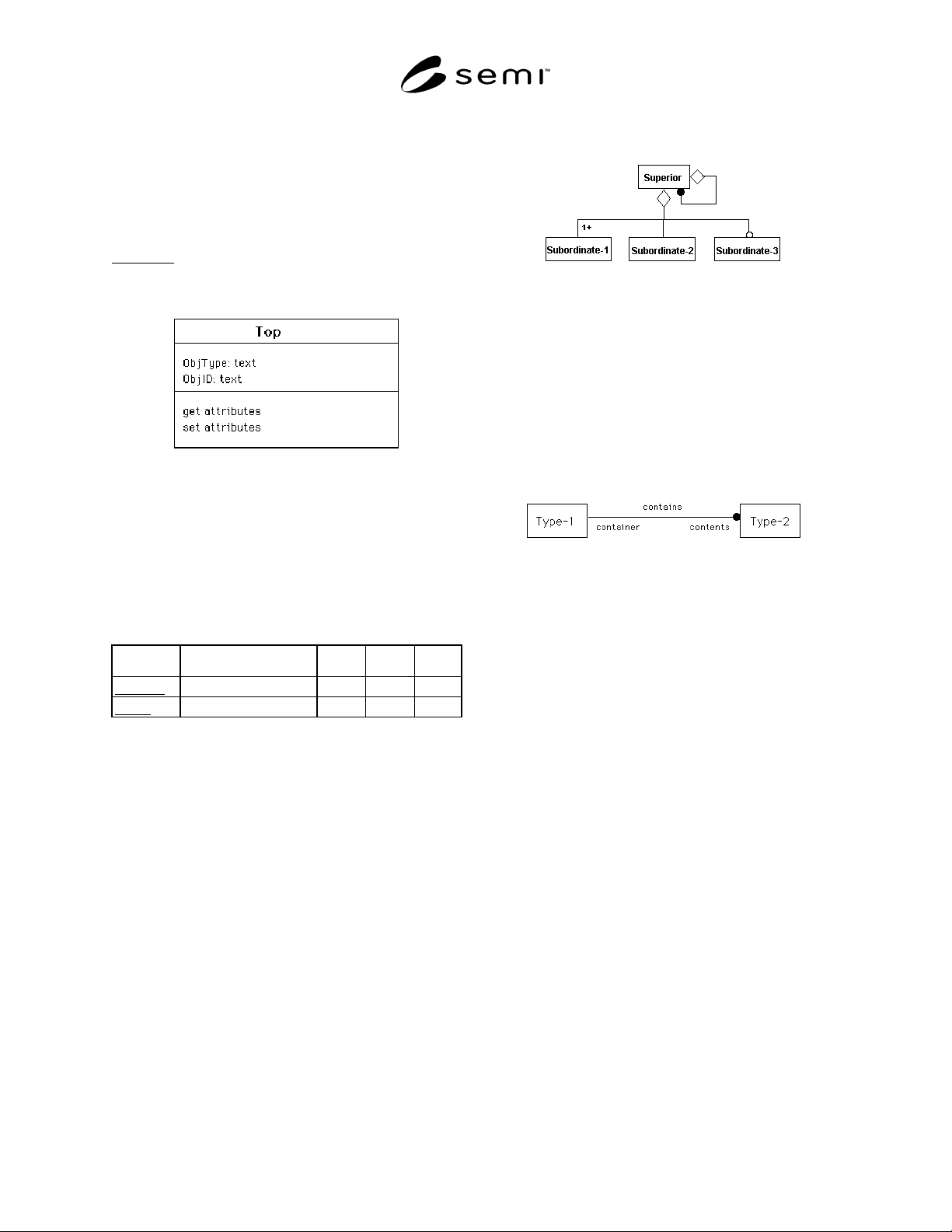
8.3.1 The object that is the super-type of all public
objects is called the top object. The attributes and
operations of the top object, shown in Figure 1, are
fundamental requirements for all public objects. That is,
all objects shall respond to the object attributes
ObjType
and text strings, and all public objects shall
recognize and respond to the operations get attributes
and set attributes.
Figure 1
Top Object
8.3.2 Formal definition of an object shall include a
table defining the object' s public attributes. The Object
Attribute Definition table for the top object is given in
Table 1 below. It contains the two fundamental
attributes required of all public objects.
Table 1 Top Object Attribute Definition
Name Definition Access Req Form
ObjType The object type. RO Y Text
ObjID The object' s identifier. RO Y Text
8.3.3 Access refers to the ability to read and write the
value of the attribute through OSS services. An
object’s type and identifier may not be changed through
OSS services. However, it may be possible for the
service user to assign a value for the object' s identifier
at the time the object (instance) is created. This depends
on the object and the services provided.
9 Object Relationships
9.1 This section addresses relationships between
objects that affect communications, either by restricting
communications or through information concerning
relationships.
9.2 Object Hierarchy — Certain objects may be
specified as aggregation objects or as container objects
when they are defined.
9.2.1 An aggregation object is composed of other
objects called the components of the aggregation. This
is illustrated in Figure 2. Components may be of one or
more different types, or they may be of the same type.
Figure 2
Aggregation with Two Component Types
9.2.2 Container objects contain other objects, of the
same or different types, but are not made up of them.
9.2.3 Figure 3 shows two object types that are
associated with a relationship called “contains.” The
solid circle indicates that Type-1 may contain zero or
more objects of Type-2 type. An example of a common
container type is a file directory.
Figure 3
Container and Contents
9.2.4 An aggregation loses some degree of integrity if
certain of its components are missing, while a container
retains full integrity even if it has no contents. An
automobile is an aggregation of many components,
some of which are themselves aggregations. An
automobile may also have contents (driver, passengers,
belongings) which are removable and not considered as
components. Other examples of container objects
include lists, dictionaries, and libraries. A container that
has no contents is said to be empty.
9.2.5 The aggregation or container is called the
superior object and its components or contents are
called subordinate objects.
9.2.6 In addition to the relationships of “is composed
of” (roles: aggregate/component) and “contains” (roles:
container/contents), the other hierarchical relationship
that occurs naturally in factories and in control systems
is that of “supervises” (roles: supervisor/supervised).
This denotes a control relationship where the
supervised object accepts part or all of its directions
from the supervisor. The supervisor, in turn, has
responsibilities that it delegates to the supervised. The
supervisor typically will also have a relationship of “is
composed of” or “contains” with its supervised
subordinates.