semi合集-English.pdf - 第3509页
SEMI E134-0305 © SEMI 2004, 2005 62 R1-1.2.5 Along with such events, the eq uipment must also ma ke available sufficient data with th ose events to completely describe the new context, as well as providin g a way for con…
SEMI E134-0305 © SEMI 2004, 2005 61
RELATED INFORMATION 1
DATA COLLECTION CONTEXT
NOTICE: This related information is not an official part of SEMI Exxx and was derived from the work of the
originating committee. This related information was approved for publication by full letter ballot procedures.
R1-1 Overview
R1-1.1 This Related Information discusses some of the key requirements and expectations of the equipment for
applications that make use of Data Collection Management services for performing near-real-time analysis of time
series (trace) data from equipment. The essential goal is for the equipment to provide sufficient, correct, and timely
contextual data to such applications in order to facilitate correct and timely analysis of trace data.
R1-1.2 Typical Analysis Application Example
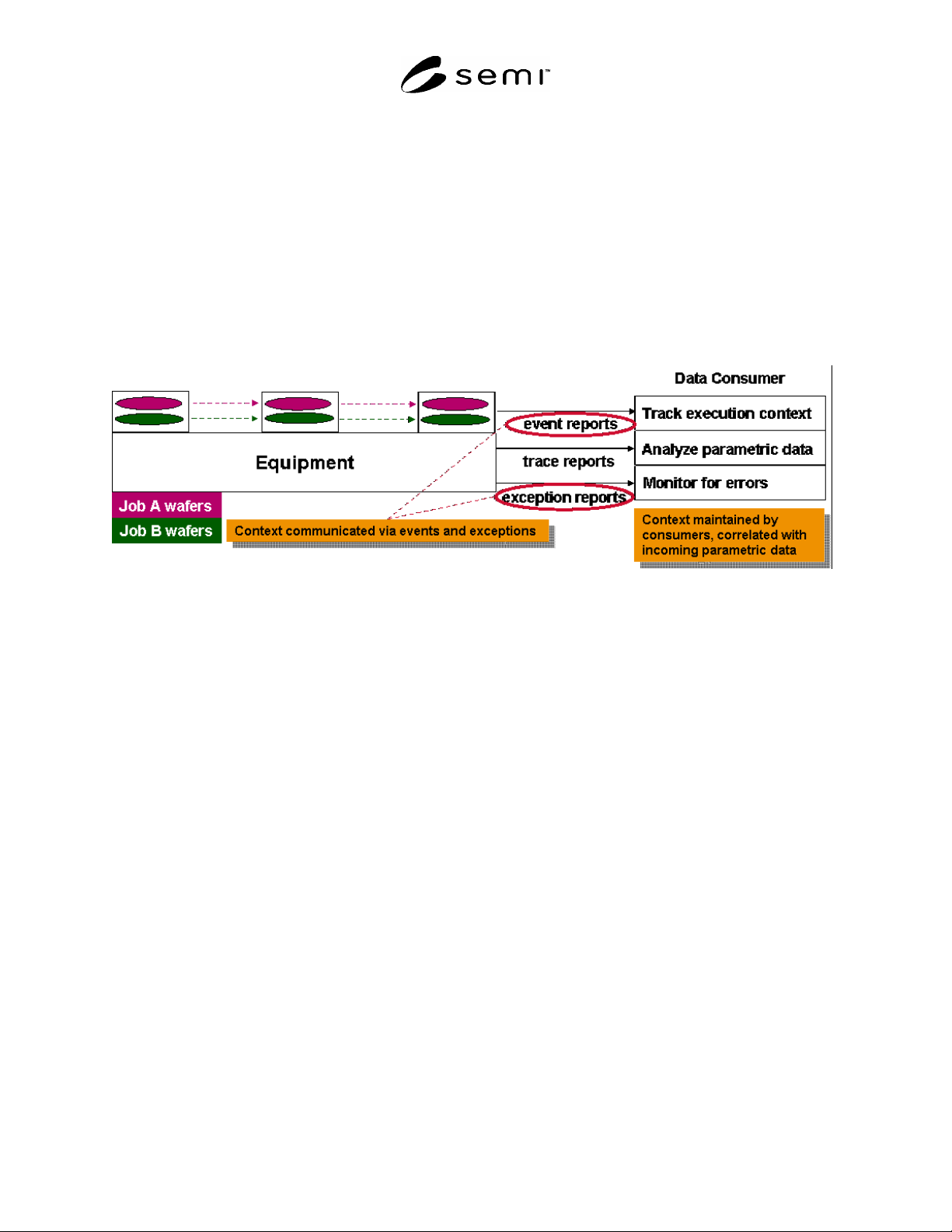
Figure R1-1
Typical Time-Series Data Analysis Example
R1-1.2.2 Consumers that collect trace data from the equipment need to be able to quickly make sense of incoming
data in order to determine the proper analysis and/or limits to apply. In addition to the raw low level data values
from sensors, actuators, and other devices of interest, applications need to be able to quickly determine the executing
context associated with that data. The equipment needs to be able to provide sufficient context information to the
application to allow it to determine at all times:
What module is the data coming from?
What recipe is that module running?
What step is that recipe executing?
What material is in that module?
What job is responsible for that material?
R1-1.2.3 In addition to the information in Section R1-1.2.2 , typical consumers must also know the manufacturing
execution context (for example, whether this an engineering lot, an experimental run, a characterization, a rework
lot, a production run, a specific product, etc.) in order to properly analyze data from the equipment. While it is the
consumer’s responsibility to manage this manufacturing context data, it is the equipment’s responsibility to provide
the context information described in Section R1-1.2.2 .
R1-1.2.4 In many cases, this context data may consist of a non-trivial amount of descriptive information. It is
typically not practical for all of this contextual data to be provided with each TraceReport sent by the equipment.
Trace data may also be collected at rates up to, for example, 10Hz; much more frequently than the rate at which the
job-related context information changes. Because of this situation, it is normally sufficient for the equipment to
communicate context changes when they happen by defining events that are generated whenever any of the context
described in Section R1-1.2.2 changes (see Figure R1-1).
SEMI E134-0305 © SEMI 2004, 2005 62
R1-1.2.5 Along with such events, the equipment must also make available sufficient data with those events to
completely describe the new context, as well as providing a way for consumers to query the current context at any
time in an ad-hoc fashion. Additionally, some subset of this context data can be made available for inclusion with
each TraceReport, such as the id’s of the material at each location in the equipment.
R1-1.2.6 Some of this context data can be provided directly through the SEMI Data Collection Management and
related specifications. Specifically, the Data Collection Management specification requires that all parameters,
events, and exceptions have both a source and a name. The source can be used to specify the physical equipment
component that produces the parameter, event, or exception. This information can be made known to consumers,
for example, through the use of SEMI E120 (Common Equipment Model) and E125 (Equipment Self Description).
In this way, consumers are at all times aware of the physical equipment component from which the data, event, or
exception is coming.
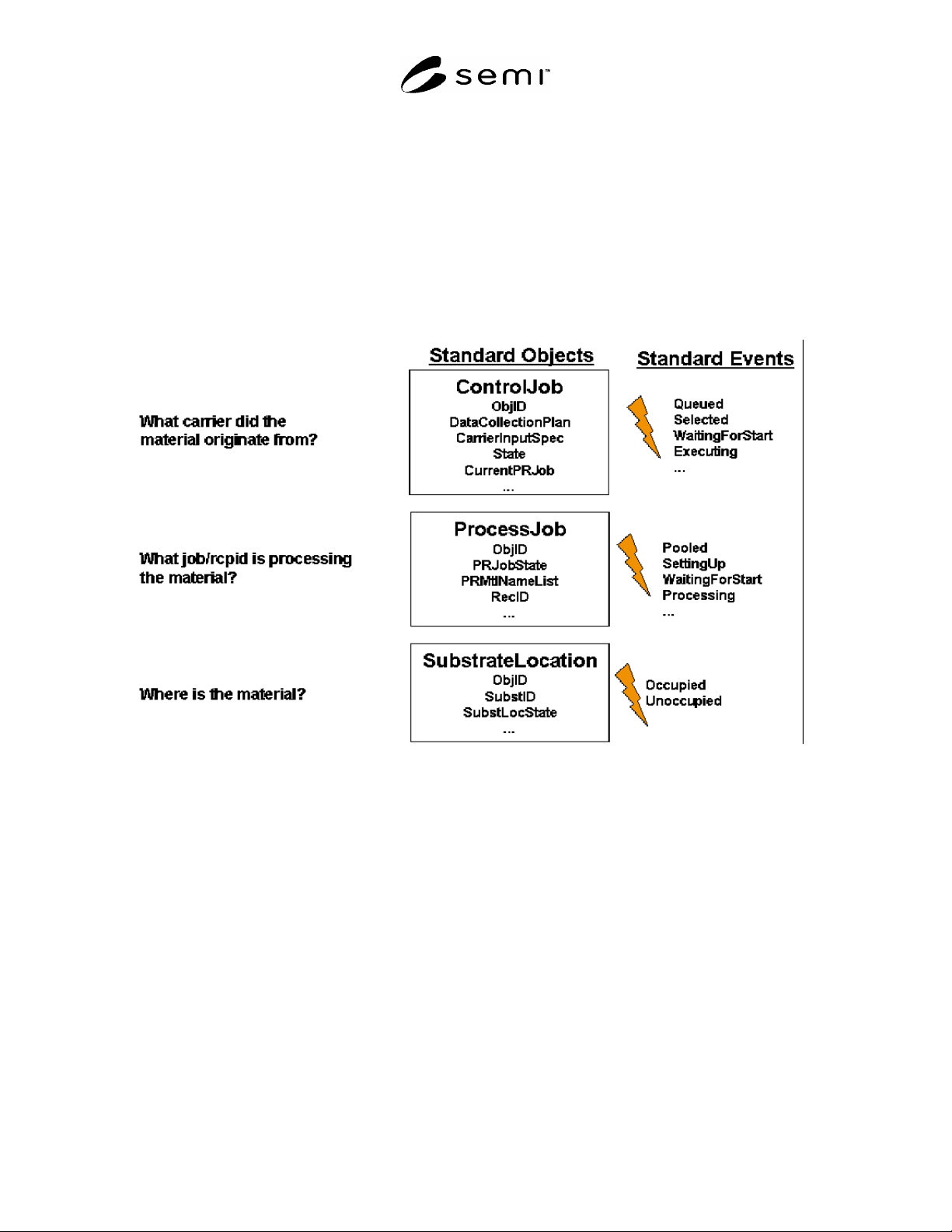
Figure R1-2
SEMI Standard Context Data
R1-1.2.7 Additional context data can be obtained from the SEMI 300mm standards (SEMI E40, SEMI E94, and
SEMI E90 data are shown as examples in Figure R1-2). However, at the time of this writing, some context data is
not available in standard form, yet is often essential for most analysis applications. For example, SEMI E40 does
not provide a means for consumers to determine which sub-recipes might be executing on each module of the
equipment, and does not provide a way for consumers to determine which recipe step is currently being executed on
each sub-recipe. This information is essential for fault detection applications, which need to analyze and apply
limits to process data that may change depending on which recipe step is being executed on which component of the
equipment. Unless and until this information becomes standardized, equipment suppliers will need to provide this
information to applications using proprietary events, exceptions and parameters.
R1-1.2.8 Putting the standards data together with equipment-specific data to cover the gaps, we can see how a
consumer can take an incoming Data Collection Management TraceReport and determine much of the processing
context. A typical example might involve the following high-level steps:
Inspect the self-descriptive information available from the equipment via SEMI E125 to identify the low-level
sensor/actuator and process Parameters from each SEMI E120 equipment component that are of significance to
the purpose of the analysis application (diagnostic, fault detection, etc.)

SEMI E134-0305 © SEMI 2004, 2005 63
Create a DataCollectionPlan that includes at least one TraceRequest at the desired frequency. The
TraceRequest should include a ParameterRequest for each Parameter of interest from the previous step.
Inspect the E125 data from the equipment to determine the SEMI standard carrier management, control job,
process job, and substrate tracking events, exceptions, and available Parameters that provide key material and
processing status context.
In the DataCollectionPlan created earlier, include an EventRequest and ExceptionRequest for each context
event and exception of interest. For each EventRequest, include a ParameterRequest for each context data
variable available for that event.
Inspect the E125 data from the equipment to determine the supplier-defined events and data that communicate
what sub-recipes and which steps are executing on which components of the equipment, and any other supplier-
specific context data of significance to the purpose of the analysis application.
In the DataCollectionPlan created earlier, include an EventRequest and ExceptionRequest for each context
event and exception identified in the previous step. For each EventRequest, include a ParameterRequest for
each context data variable available for that event.
Submit the DCP to the equipment using the DataCollectionManager “DefinePlan” operation, and activate using
the “ActivatePlan” operation to begin receiving trace data and context events/exceptions.
R1-1.2.9 Once such a DCP has been activated, consumers can begin tracking the location of each substrate on the
equipment, so that their physical locations are always known. Since timestamps of all data are referenced to the
tool, synchronization of the events and data can be correlated correctly.
R1-1.2.10 Events from the equipment that inform what recipes are executing on which modules, and which step is
currently executing can be tracked and stored by the consumer, so it is always known which module is executing
which step in which recipe on which substrate.
R1-1.2.11 By tracking Control and Process Job events and data, a consumer can always determine to which job a
given substrate at a given location belongs.
R1-1.2.12 The consumer is responsible for managing the manufacturing context of each job, and so knows which
analysis needs to be performed on data from material from those jobs.
R1-1.2.13 Finally, because the consumer knows what the contents of the DCP are, it is also known which physical
equipment component produces each trace data variable. So, the data from a TraceReport can be correlated to a
physical equipment component, for which the consumer already knows the material located at that component, the
recipe executing on the component, the step the recipe is executing, the job the material belongs to, and the
manufacturing context for that job. Provided all of this information is provided correctly and in a timely fashion, a
consumer can always determine which analysis and/or control limits need to be applied to each TraceReport.