semi合集-English.pdf - 第3491页
SEMI E134-0305 © SEMI 2004, 2005 44 collected data values for that trace interval. This TraceR eport shall be adde d to the DCP buffer according to the time at which the report was c o mpleted. This process is repeated a…

SEMI E134-0305 © SEMI 2004, 2005 43
Num Previous State Trigger New State Actions
32 Disabled A start trigger was detected. Enabled The DCP initiates trace activity for this
trace request. The DCP shall record the
specific trigger that was detected and
the time at which it was detected for
inclusion in the first TraceReport
generated (see Section 14.1.5).
33 (no state) The trace request is enabled WaitingForInterval The DCP collects and records the
requested trace data and buffers or
sends a new TraceReport. See Section
12.3.13 for further explanation. The
DCP continues waiting for the next
‘intervalInSeconds’ period to expire.
34 WaitingForInterval The period specified by
‘intervalInSeconds’ for this
trace request expires.
WaitingForInterval The DCP collects and records the
requested trace data in a corresponding
TraceReport. See Section 12.3.13 for
further explanation. The DCP
continues waiting for the next
‘intervalInSeconds’ period to expire.
35 Enabled The trace request is not
cyclical (‘isCyclical’ is false),
and the stop trigger for this
request was detected, or the
total number of requested
collected results was
obtained.
(no state) The trace terminates, and cannot be re-
enabled without deactivating and re-
activating the DCP.
36 (no state) The DCP is activated. TraceRequest-
Buffering
The DCP begins performing any trace
buffering required for this trace request.
37 (no state) The DCP is activated. NotBufferingTrace-
Results
The DCP determines whether this trace
request should be buffered. If this trace
request is not buffered, the trace
request remains in this state until the
trace terminates. See Section 12.3.8 for
further explanation.
38 NotBufferingTrace-
Results
The trace request’s
‘groupSize’ is > 1.
BufferingTrace-
Results
The DCP begins buffering collected
trace results. See Section 12.3.9 for
further explanation.
39 (no state) The DCP is activated. NotSendingTrace-
Results
The DCP waits for a buffered trace
report to become available for sending.
40 NotSendingTrace-
Results
A buffered trace report is
available for sending.
SendingTrace-Results The DCP sends the corresponding
DataCollectionReport to the consumer.
41 SendingTrace-Results A buffered trace report has
been sent to the consumer.
NotSending-
TraceResults
The DCP waits for a buffered trace
report to become available for sending.
42 TraceRequest-
Buffering
The trace request is not
cyclical (‘isCyclical’ is false),
and the stop trigger for this
request was detected, or the
total number of requested
collected results was
obtained.
(no state) The DCP performs no more activities
related to this trace request.
12.3.13 Reporting Trace Results — Trace results are reported as CollectedData within a TraceReport (see Section
14.1.5). In addition to the collected data values, the DCP shall record the time at which the data collection was
initiated (the time at which the TraceRequest’s ‘intervalInSeconds’ period expired).
12.3.13.1 If the DCP is buffered (‘intervalInMinutes’ attribute is > 0), and the TraceRequest is not buffered
(groupSize is 1), the DCP shall create a new TraceReport containing a single CollectedData entry with the

SEMI E134-0305 © SEMI 2004, 2005 44
collected data values for that trace interval. This TraceReport shall be added to the DCP buffer according to the
time at which the report was completed. This process is repeated at each trace interval until the trace terminates.
12.3.13.2 If the DCP is buffered (‘intervalInMinutes’ attribute is > 0), and the TraceRequest is buffered (groupSize
is > 1), the DCP shall add the results as a CollectedData entry to the trace buffer in the order it was obtained. This
process continues until a number of results equal to ‘groupSize’ has been collected. The DCP shall then create a
new DataCollectionReport containing a single TraceReport with a number of CollectedData entries equal to
‘groupSize’. This DataCollectionReport is then added to the DCP buffer according to the time at which the report
was completed. This process is repeated at each trace interval until the trace terminates.
12.3.13.3 If the DCP is not buffered (‘intervalInMinutes’ attribute is 0), and the TraceRequest is not buffered
(groupSize is 1), the DCP shall create a new DataCollectionReport containing a single TraceReport with a single
CollectedData entry for that interval and make the DataCollectionReport available for sending. This process is
repeated at each trace interval until the trace terminates.
12.3.13.4 If the DCP is not buffered, but the TraceRequest is buffered (groupSize > 1), the DCP shall add the
results as a CollectedData entry to the trace buffer in the order it was obtained. This process continues until a
number of results equal to ‘groupSize’ has been collected. The DCP shall then create a new DataCollectionReport
containing a single TraceReport with a number of CollectedData entries equal to ‘groupSize’. This
DataCollectionReport is then made available for sending. This process is repeated at each trace interval until the
trace terminates.
13 Operational Performance Monitoring
13.1 Operational Performance Conditions State Model
13.1.1 The purpose of the Operational Performance Conditions State Model is to define a consumer’s view of
equipment behavior when its ability to perform its intended function (including the production of data requested by
active DCPs) has become impaired due to resource overloading.
13.1.2 The equipment shall continuously monitor (at equipment-defined intervals) its operational performance
status according to its established criteria. Each time the performance is evaluated, the equipment shall store in non-
volatile memory the job and DCP identifiers that were active at the time the evaluation was initiated (see Section
15.1.6.1.1). The equipment shall use this information as the basis for replies to the GetCurrentPerformanceStatus
operation of the DataCollectionManager interface, and for the PerformanceWarning and PerformanceRestored
notifications sent via the DCPConsumer interface (see Section 15.1.5).
13.1.3 The equipment shall include the following minimum set of conditions in determining the performance
conditions to monitor:
Impairment of the equipment’s ability to properly control its components for their intended purpose.
Impairment of the equipment’s ability to process/measure/test material at its intended throughput rates.
Impairment of the equipment’s ability to deliver data from active DCPs to consumers.
13.1.4 If at any time the equipment determines that continuing to operate under degraded performance conditions
will endanger people, the equipment (including its ability to sustain the transmission of data, or the processing of
data collection management operations), or the material being processed, measured, or tested, the equipment shall
terminate all active DCPs, and notify each client accordingly, using the DCPDeactivation message (see Section
15.1.6.2).
13.1.5 Note that this specification does not define a mechanism for establishing operational performance thresholds,
or any technique for detecting when an equipment system’s operational performance is degrading. It is assumed that
equipment performance can be quantified, that it is possible to detect when such performance degrades below some
supplier-defined threshold, and that it is possible to identify which components of the equipment are affected by the
issue.
13.1.6 Normal — The equipment is operating within supplier-specified performance parameters.
13.1.7 BelowThreshold — One or more components of the equipment system is operating below supplier-specified
performance parameters.
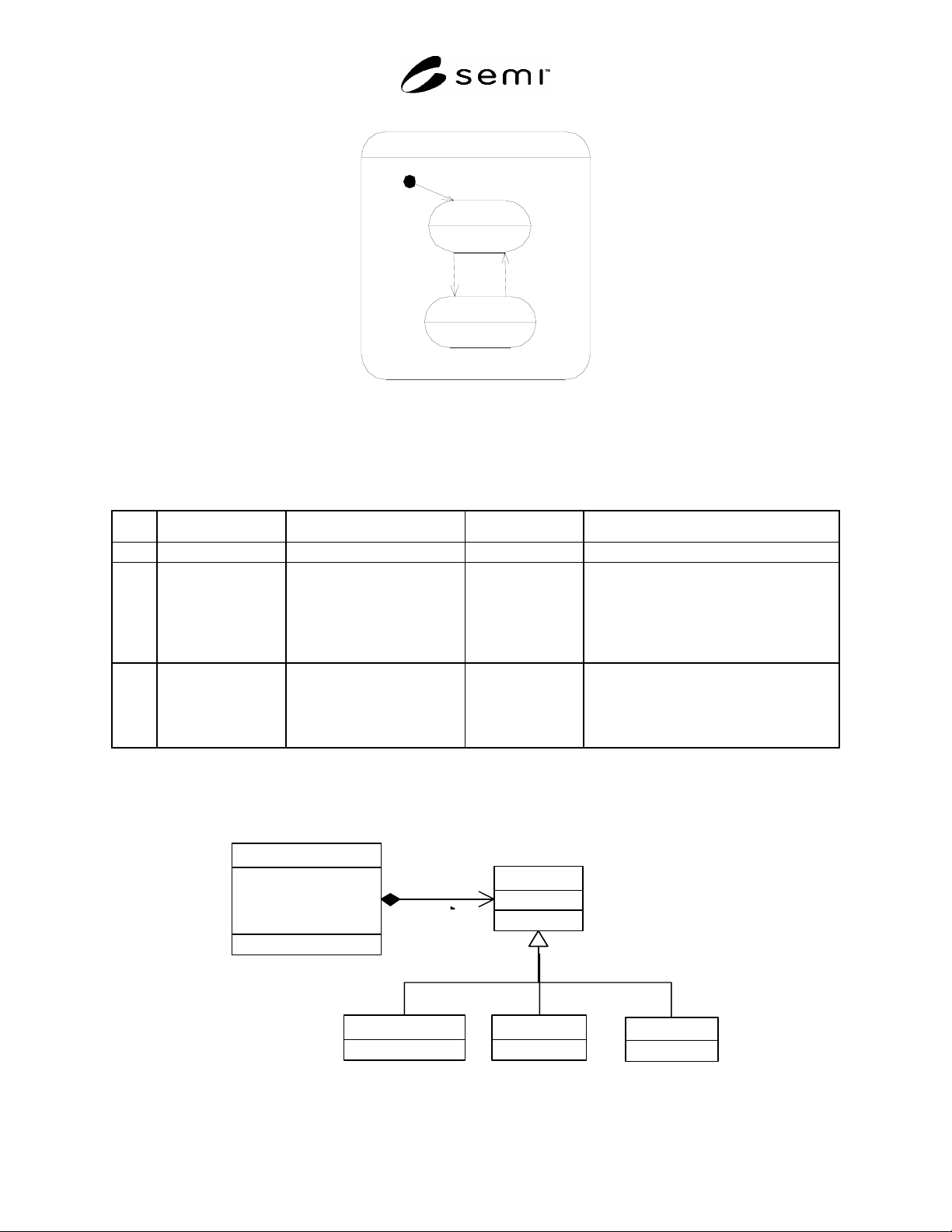
SEMI E134-0305 © SEMI 2004, 2005 45
Operat ionalPerformanceConditions
Normal
BelowT hreshold
H
1
2
3
Figure 23
Operational Performance State Diagram
13.1.8 OperationalPerformanceConditions Transition Table
Table 54 Operational Performance Conditions Transition Definition
Num Previous State Trigger New State Actions
1 (no state) The equipment initializes. Normal
2 Normal The equipment detects a
reduction in performance
below supplier-specified
parameters.
BelowThreshold The equipment notifies all consumers that
have the ManageOnlyAuthoredDCPs
privilege level or higher,that the equipment
is experiencing operational performance
problems, providing the information
described in Section 15.1.5.
3 BelowThreshold Normal The equipment notifies all consumers that
have the ManageOnlyAuthoredDCPs
privilege level or higher of the current
performance status, providing the
information described in Section 15.1.5.
14 Data Collection Report Formats
14.1 Data Collection Reports
planI d
bufferStartTime
bufferEndTime
reportTime
DataCollectionReport
ExceptionReport EventR epo rt
TraceReport
Report
1
reports
1..*
{ordered}
Figure 24
Data Collection Reports