semi合集-English.pdf - 第2522页
SEMI E88-1104 E © SEMI 1999, 2004 19 10.3 Variable Data Item Types 10.3.1 Equipment C onstants (EC V) — The value can be chan ged by the host using S2F15. The operat or may have the ability to change some or all of the v…
SEMI E88-1104
E
© SEMI 1999, 2004 18
Collection Event Name Event Description Required DVVALs or
Reports
IDReadError All carriers related to an ID error situation have been dispositioned. This
event occurs automatically when the stocker places the carrier that
experienced the ID error to the pickup port (See Section 13.3.3).
CarrierID
CarrierLoc
IDReadStatus
OperatorInitiatedAction The operator initiated an action from the Stocker Controller.
CommandID
CommandType
CarrierID
Source
Dest
Priority
10 Variable Data Items
10.1 The purpose of this section is to define the list of variable data item requirements for Stocker SEM equipment.
Values of these variables will be available to the host via collection event reports and host status queries.
10.2 Requirements
All variable data items and data item restrictions defined in SEMI E30 are required on Stocker SEM equipment
(according to the GEM capabilities required per Section 13).
All variable data items in the Stocker SEM Variable Data Item Dictionary for specific equipment classifications
are required for Stocker SEM equipment. The data item restrictions are also required.
Some SVs in the Variable Data Item Dictionary are referenced by an “i” subscript (e.g., CarrierID
i
). The “i”
subscript denotes a specific instance of the SV. This is necessary since there is usually more than one instance
of such an SV active in the system at the same time (e.g., if there are 20 carriers active at the same time then “i”
could range from 1 to 20 for CarrierID
i
). Variable Data Items containing the “i” subscript should not have
Variable IDs assigned to them.
All variable data items with a format of ASCII (A) shall be limited to printable characters in the decimal range
of 32 to 126, with the exception of the following non-permitted characters: “*” (decimal 42), “\”(decimal 92).
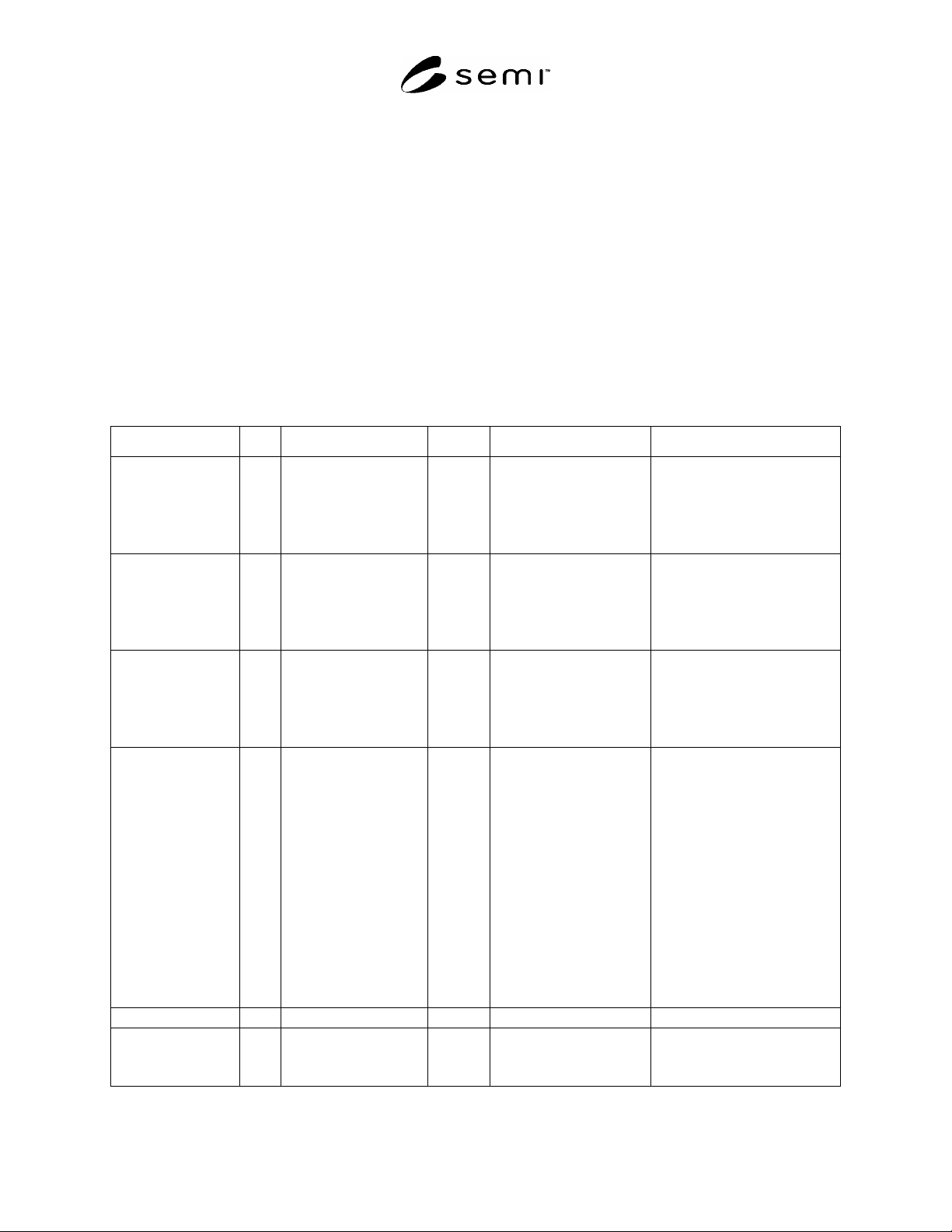
10.2.1 Variable data items are documented in the Stocker SEM Variable Data Item Dictionary using the following
format:
Variable Name Type Description Class Format Comments
Where:
Variable Name: A unique name for the variable data item.
Type: CV – meaning common variables, variables that are general to all vehicles.
CSV – meaning configuration specific variables.
Description: If class is DVVAL, then the description shall contain a statement of when data is valid in
terms of Stocker SEM events.
Class: The data type of the item.
Format: <SECS Message Language (SML) mnemonic>acceptable formats are SEMI E5 lists, ASCII,
floating point, unsigned integer or signed integer. A description of “ANY”, indicates that only
the above formats are acceptable and is left to the supplier to decide.
Comments: Any additional information pertinent to the variable name.
SEMI E88-1104
E
© SEMI 1999, 2004 19
10.3 Variable Data Item Types
10.3.1 Equipment Constants (ECV) — The value can be changed by the host using S2F15. The operator may have
the ability to change some or all of the values. The value of an equipment constant may be queried at any time by
the host using the S2F13/14 transaction or Stream 6 reports.
10.3.2 Status Variables (SV) — The values are valid at all times. A SV may not be changed by the host or operator,
but may be changed by the equipment. A host or operator command may change an equipment status thus changing
a SV. The value of status variables may be queried by the host at any time using the S1F3/4 or Stream 6 reports.
10.3.3 Data Variables (DVVAL) — These are variables which are valid upon the occurrence of a specific collection
event, and may or may not be valid at other times depending upon the equipment. An attempt to read a variable data
item when it’s invalid will not result in an error, but the data reported may not have relevant meaning.
10.3.4 Variable Data (V) — This is a class of variable data which includes all the previously defined types of
variables.
10.4 Variable Data Item Dictionary
Table 8 Variable Data Item Dictionary
Variable Name Type Description Class Format Comments
ActiveCarriers CV List current status of all
carrier information in
the SC database.
SV L,n
1. <CarrierInfo
1
>
.
.
n. <CarrierInfo
n
>
ActiveTransfers CV List current status of all
ACTIVE TRANSFER
commands.
SV L,n
1. <TransferCommand
1
>
.
.
n. <TransferCommand
n
>
ActiveZones CV List current status
associated with all zones
being used by the SC.
SV L,n
1. <ZoneData
1
>
.
.
n. <ZoneData
n
>
CarrierID CV Unique ID of the carrier. DVVAL A[1–64] If an Id is created by the
equipment (not obtained via an
id reader, the host interface, or
the user interface) it must be of
the following format:
UNKNOWNEqpNameSeq
Where:
UNKNOWN are the exact
characters “UNKNOWN”
EqpName is the value of the
EqpName ECV (truncated if
required)
Seq is a unique sequence
identifier determined by the
vendor.
CarrierID
i
CV Unique ID of the carrier. SV A[1–64] See comment for CarrierID.
CarrierInfo CV All database information
associated with a
particular carrier.
DVVAL L,2
1. <CarrierID>
2. <CarrierLoc>
SEMI E88-1104
E
© SEMI 1999, 2004 20
Variable Name Type Description Class Format Comments
CarrierInfo
i
CV All database information
associated with a
particular carrier.
SV L,2
1. <CarrierID
i
>
2. <CarrierLoc
i
>
CarrierLoc CV Unique location of the
carrier within the
stocker as reported by
the SC.
DVVAL A[1–64] It is important to note that this is
the unique location within the
stocker (i.e., 2 carriers cannot be
stored at the same CarrierLoc,
but 2 carriers can be stored at
the same ZoneName).
CarrierLoc
i
CV Unique location of the
carrier within the
stocker as reported by
the SC.
SV A[1–64] It is important to note that this is
the unique location within the
stocker (i.e., 2 carriers cannot be
stored at the same CarrierLoc,
but 2 carriers can be stored at
the same ZoneName).
CarrierLocationInfo
i
CV Carrier Location
Information
DVVAL L,3
1. <CarrierID
i
>
2. <CarrierLoc
i
>
3. <CarrierZoneName
i
>
CarrierLocations CV Carrier Location
Information for the
‘LOCATE’ host
command
DVVAL L,n
1. <CarrierLocationInfo
1
>
.
.
n. < CarrierLocationInfo
n
>
‘n’ number of carriers
CarrierState
i
CV The Carrier State SV U2 0 = None
1 = Wait In
2 = Transferring
3 = Completed
4 = Alternate
5 = Wait Out
CarrierZoneName CV The name of the zone
associated with the
carrier’s current
location.
DVVAL A[0–64] A location may not be
associated with a particular
zone. This would be the case if
ports are not assigned to a zone.
CarrierZoneName
i
CV The name of the zone
associated with the
carrier’s current
location.
SV A[0–64] A location may not be
associated with a particular
zone. This would be the case if
ports are not assigned to a zone.
CommandName CV Name of Host issued
remote command.
DVVAL A[1–20]
CommandID CV Remote Command ID DVVAL A[1–64] Used to subsequently refer to a
specified remote command
(e.g., to cancel a remote
command).
If a command is generated by
the Stocker Controller, the
commandid must begin with the
string ‘MANUAL’ followed by
any arbitrary sequence
identifier.
CommandID
i
CV Remote Command ID SV A[1–64] Used to subsequently refer to a
specified remote command
(e.g., to cancel a remote
command).