semi合集-English.pdf - 第4023页
SEMI F50-0200 © SEMI 2000 1 SEMI F50-0200 GUIDE FOR ELECTRIC UTILITY VOLTA GE SAG PERFORMANCE FOR SEMICONDUCTOR F ACTORIES This g u ide w as technica ll y a pproved by the Global Facilitie s Committee and is t he direct …

SEMI F49-0200 © SEMI 2000 8
8 Related Documents
8.1 SEMI Standards
Under development.
8.2 CENELEC Standard
2
EN 50082-2 — Electromagnetic compatibility -
Generic immunity standard, Part 2. Industrial
environments.
8.3 IEC Standard
3
IEC 61000-4-11 — Electromagnetic Compatibility
(EMC) - Part 4: Testing and Measuring Techniques -
Section 11: Voltage Dips, Short Interruptions and
Voltage Variations Immunity Tests
8.4 IEEE Standards
1
IEEE Std 493 — IEEE Recommended Practice for the
Design of Reliable Industrial and Commercial Power
Systems
IEEE Std 1250 — IEEE Guide for Service to
Equipment Sensitive to Momentary Voltage
Disturbances
NOTE 2: As listed or revised, all documents cited shall be the
latest publications of adopted standards.
NOTICE: SEMI makes no warranties or
representations as to the suitability of the guides set
forth herein for any particular application. The
determination of the suitability of the guide is solely the
responsibility of the user. Users are cautioned to refer
to manufacturer’s instructions, product labels, product
data sheets, and other relevant literature respecting any
materials mentioned herein. These guides are subject to
change without notice.
The user’s attention is called to the possibility that
compliance with this guide may require use of
copyrighted material or of an invention covered by
patent rights. By publication of this guide, SEMI takes
no position respecting the validity of any patent rights
or copyrights asserted in connection with any item
mentioned in this guide. Users of this guide are
expressly advised that determination of any such patent
rights or copyrights, and the risk of infringement of
such rights, are entirely their own responsibility.
2 European Committee for Electrotechnical Standardization
(CENELC), Rue de Stassart, 35, B - 1050 Brussels
3 International Electrotechnical Commission (IEC), 3 rue de
Varembé, PO Box 131, 1211 Geneva 20, Switzerland
Copyright by SEMI® (Semiconductor Equipment and Materials
International), 3081 Zanker Road, San Jose, CA 95134. Reproduction o
f
the contents in whole or in part is forbidden without express written
consent of SEMI.

SEMI F50-0200 © SEMI 20001
SEMI F50-0200
GUIDE FOR ELECTRIC UTILITY VOLTAGE SAG PERFORMANCE FOR
SEMICONDUCTOR FACTORIES
This guide was technically approved by the Global Facilities Committee and is the direct responsibility of the
North American Facilities Committee. Current edition approved by the North American Regional Standards
Committee on December 15, 1999. Initially available on www.semi.org February 2000; to be published
February 2000.
1 Purpose
1.1 This guide provides a framework for
semiconductor and flat panel display (FPD)
manufacturers and their electric utility service providers
to minimize the effect of voltage sag events on
semiconductor processing. In particular, this guide
focuses on electric utility power quality performance
goals that are complementary to voltage sag immunity
levels for semiconductor processing equipment and
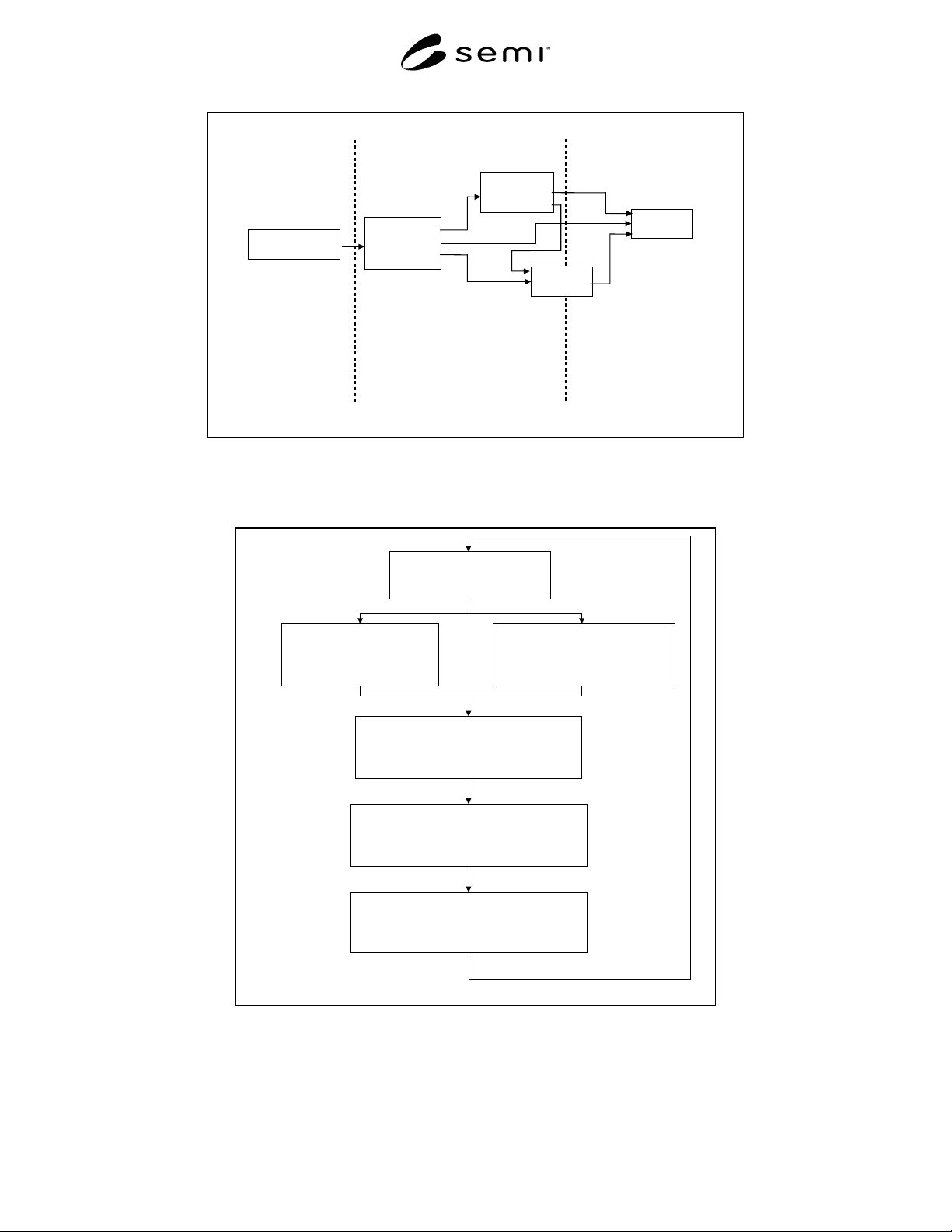
facilities infrastructure equipment (see Figure 1).
Recommendations for measuring and evaluating
voltage sag performance, evaluating utility system
enhancements, and implementation of a continuous
improvement process are included since no electric
utility industry standards exist.
1.2 Utility systems are designed, constructed, and
operated to meet utility industry regulations and
requirements. One important requirement for
semiconductor factories is power system reliability.
Utilities measure reliability in minutes of voltage
outages per customer per year. Semiconductor factories
require a high level of power system reliability, any
service outage is usually unacceptable. A second
important requirement is power quality. Power quality
relates to disturbed voltage waveforms, not outages.
When utilities implement measures to increase power
system reliability, power quality can be adversely
affected. The structured approach defined in this guide
can achieve high levels of power quality without
sacrificing power reliability.
1.3 The intent of this guide is to help semiconductor
manufacturers achieve both high levels of power
reliability and power quality from energy utility
providers. By becoming familiar with the cause and
effect relationships of voltage sag events on the utility’s
side of the electric meter, semiconductor manufacturers
and electric utilities can work together to pursue
efficient solutions for improved voltage sag ride-
through in semiconductor factories.
2 Scope
2.1 The scope of this guide extends beyond a
discussion of typical electric utility reliability and
quality improvement techniques to developing a
continuous improvement process for electric utility
voltage sag performance (depicted graphically in Figure
2). Factors in this process include the following:
• Define desired performance criteria by setting
goals for voltage sag event duration and magnitude
(see Section 6.1).
• Measure performance for both proposed and
existing semiconductor factory sites (see Section
6.2).
• Summarize voltage sag event data and identify the
impact on semiconductor processing and facilities
infrastructure equipment (see Section 6.3).
• Recommend improvements that include
consideration of cost, benefit, and risk.
Improvements can include corrective action to
eliminate system faults, changes to service
configurations, and power enhancements (see
Section 6.4).
• Select and implement improvements. Establish a
continuous improvement process (see Section 6.5).
2.2 For the purposes of this document, the term
Electric Utility refers to energy service providers (that
sell energy to semiconductor manufacturers) and/or
electric transmission and distribution providers (that
deliver energy through their power lines).
2.3 This guide does not purport to address safety
issues, if any, associated with its use. It is the
responsibility of the users of this guide to establish
appropriate safety and health practices and determine
the applicability of regulatory limitations prior to use.
SEMI F50-0200 © SEMI 2000 2
Utility Supplied
Power
Facilities
Electrical
Distribution
System
Infrastructure
Equipment
Process
Equipment
Support
Equipment
Utilit
y
Services
Facilities
Systems
Wafer
Processing
Systems
Power Monitoring
and Conditioning
Power Monitoring
and Conditioning
Ride-Through
Techniques
Covered in this
guide
for electric utility
voltage sag
performance
See industry guide for
semiconductor factory systems
voltage sag immunity.
See industry specification and
test method for semiconductor
processing equipment voltage
sag immunity.
Ride-Through
Techniques
Figure 1
Power Quality Interfaces
(See Related Documents section.)
Define Desired Performance
- Voltage Sag Magnitude/Duration
- Maximum Deviations per Year
Existing Sites
-
Define Monitor Protocol
- Monitor Performance
- Track and Report Events
Proposed Sites
- Define Site Selection Factor
- Monitor near Proposed Site
- Model Events
Summarize and Evaluate Dat
a
- Chart Data
- Correlate Events to Impact on Factory
- Categorize Events within Bins
Recommend Improvements
- Corrective Actions for System Faults
- Identify Service Configurations
- Review Enhancement Technologies
Select and Implement Improvements
-
Prioritize System Improvements
- Identify Action Plan and Define Expectations
- Implement Solutions
Figure 2
Continuous Improvement Process