semi合集-English.pdf - 第3571页
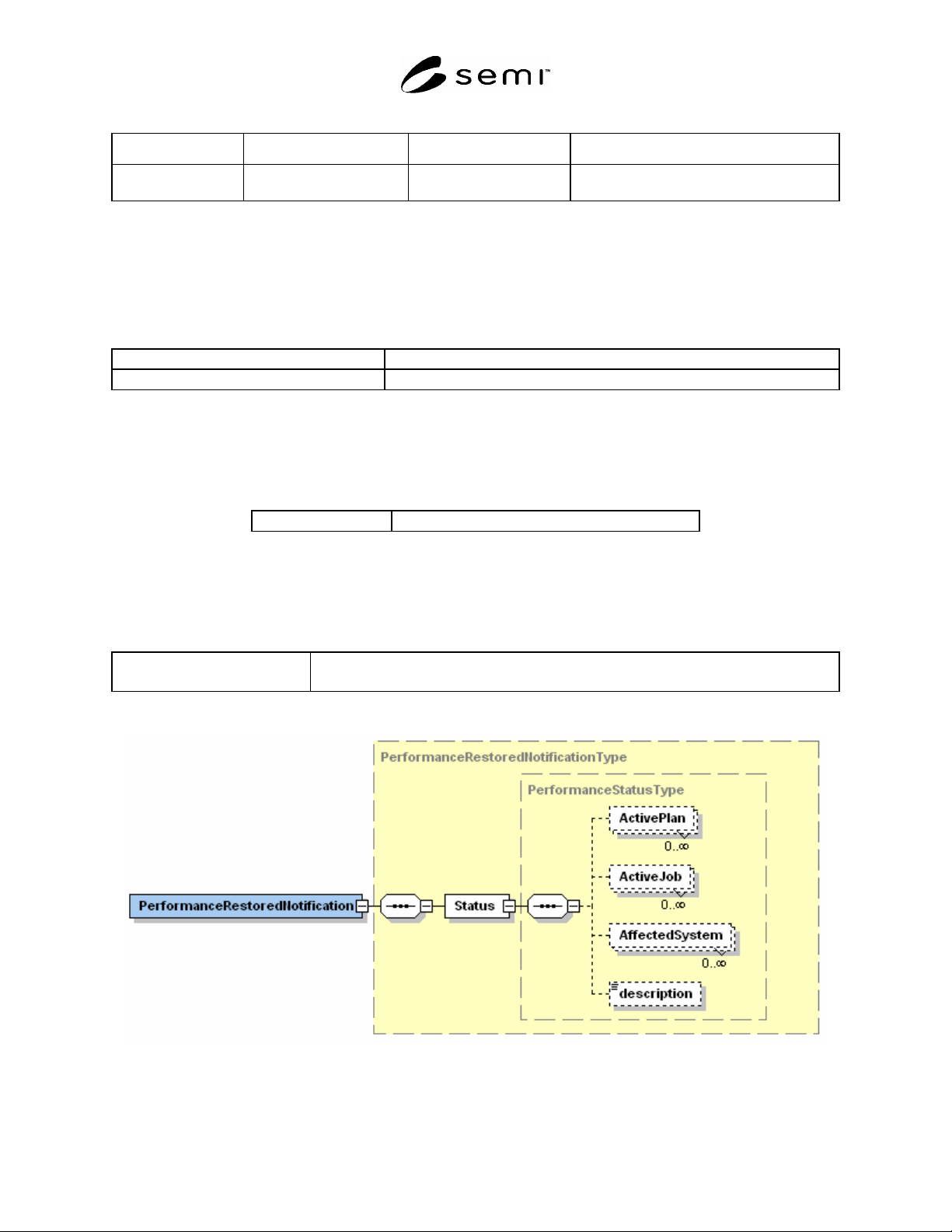
SEMI E134.1-0305 © SEMI 2005 58 7.3.7.4. 1 PerformanceResto redNotification — This global element acts as a top-level con tainer entity representing the SOAP body of a PerformanceResto red notification. As def ined in SE…
SEMI E134.1-0305 © SEMI 2005 57
Table 120 Translation Table for Input Arguments for the PerformanceWarning Operation
Argument Name Format XML Element or Attribute XML Name/Type
warning Structured data, of type
PerformanceStatus
Element Warning : dcm: PerformanceStatusType as
described in ¶7.2.20.4.3
7.3.7 PerformanceRestored
7.3.7.1 WSDL Operation Binding
7.3.7.1.1 See the operation binding for “PerformanceRestored” in E134-Client-Binding.wsdl. Key information is
shown for convenience in the following table.
Table 121 PerformanceRestored Operation Binding
SOAPAction
urn:semi-org:ws.E134-1.V0305.DCPConsumer-binding:PerformanceRestored
Input Headers (WSDL Message, Required) E132HashHeaderMessage, required
7.3.7.2 WSDL Operation
7.3.7.2.1 See the portType operation definition for “PerformanceRestored” in E134-Client-PortType.wsdl. Key
information is shown for convenience in the following table.
Table 122 PerformanceRestored PortType Operation
Input Message Name PerformanceRestoredNotification
7.3.7.3 WSDL Message(s)
7.3.7.3.1 See the message definitions for “E132HashHeaderMessage” and “PerformanceRestoredNotification” in
E134-Client-PortType.wsdl. Key information is shown for convenience in the following table.
Table 123 DCPConsumer Binding
Message Name
Schema
Element Name
E132HashHeaderMessage auth:E132HashHeader
PerformanceRestoredNotification dcm:PerformanceRestoredNotificationType
7.3.7.4 XML Schema Types
Figure 40
PerformanceRestoredNotification
SEMI E134.1-0305 © SEMI 2005 58
7.3.7.4.1 PerformanceRestoredNotification — This global element acts as a top-level container entity representing
the SOAP body of a PerformanceRestored notification. As defined in SEMI E134, this operation has one output
argument: the Status. This argument is modeled as an attributes named “Status” of complexType
“PerformanceStatusType”.
Table 124 Translation Table for Input Arguments for the PerformanceRestored Operation
Argument Name Format XML Element or Attribute XML Name/Type
status Structured data, of type
PerformanceStatus
Element Status: dcm: PerformanceStatusType as
described in ¶7.2.20.4.3
7.3.8 DCPDeactivation
7.3.8.1 WSDL Operation Binding
7.3.8.1.1 See the operation binding for “DCPDeactivation” in E134-Client-Binding.wsdl. Key information is shown
for convenience in the following table.
Table 125 DCPDeactivation Operation Binding
SOAPAction
urn:semi-org:ws.E134-1.V0305.DCPConsumer-binding:DCPDeactivation
Input Headers (WSDL Message, Required) E132HashHeaderMessage, required
7.3.8.2 WSDL Operation
7.3.8.2.1 See the portType operation definition for “DCPDeactivation” in E134-Client-PortType.wsdl. Key
information is shown for convenience in the following table.
Table 126 DCPDeactivation PortType Operation
Input Message Name DCPDeactivationNotification
7.3.8.3 WSDL Message(s)
7.3.8.3.1 See the message definitions for “E132HashHeaderMessage” and “DCPDeactivationNotification” in E134-
Client-PortType.wsdl. Key information is shown for convenience in the following table.
Table 127 DCPConsumer Binding
Message Name
Schema
Element Name
E132HashHeaderMessage auth:E132HashHeader
DCPDeactivationNotification dcm:DCPDeactivationNotificationType
7.3.8.4 XML Schema Types
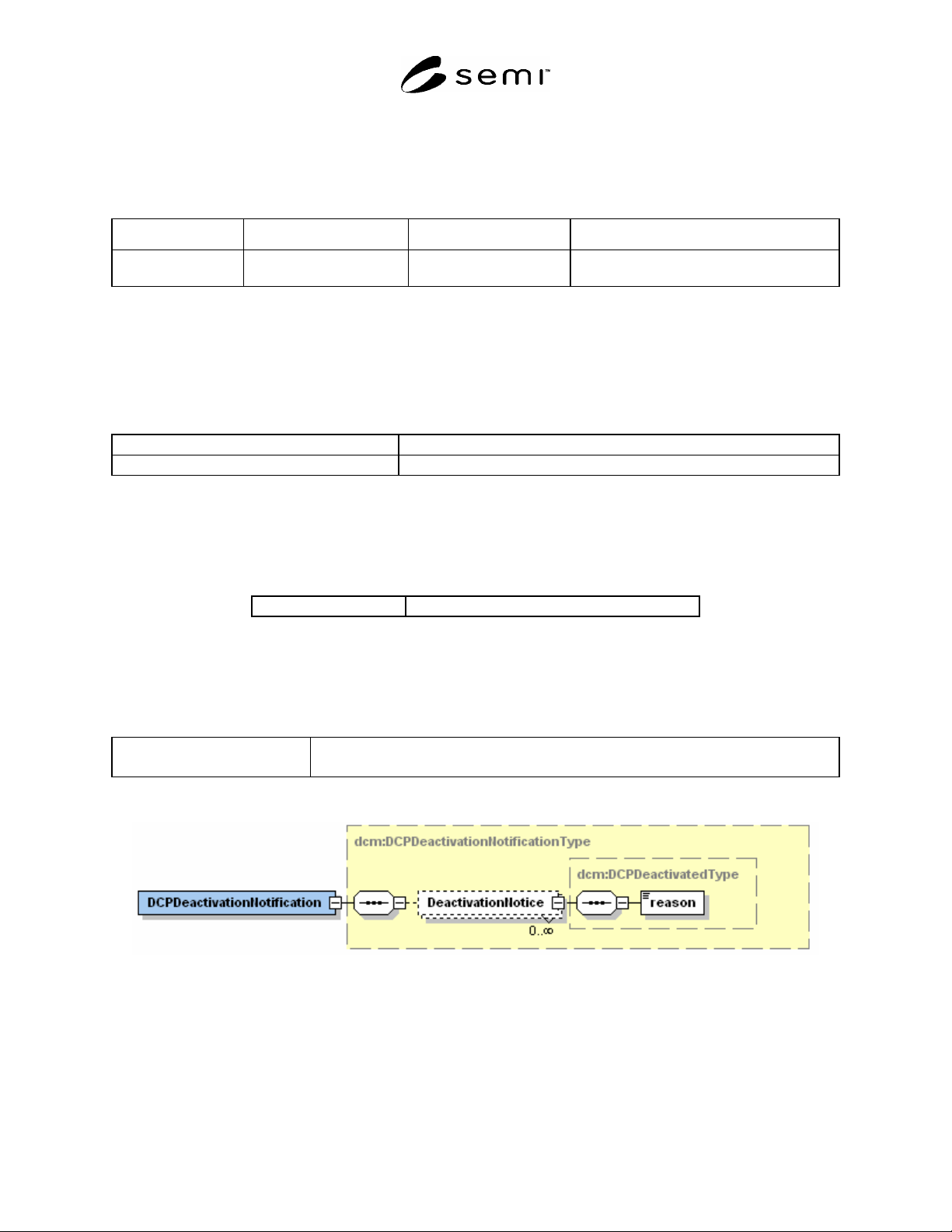
Figure 41
DCPDeactivationNotification
7.3.8.4.1 DCPDeactivationNotification — This global element acts as a top-level container entity representing the
SOAP body of a DCPDeactivation notification. As defined in SEMI E134, this operation has one output argument:
the Deactivation Notice. This argument is modeled as an attributes named “DeactivationNotice” of complexType
“DCPDeactivatedType”.
SEMI E134.1-0305 © SEMI 2005 59
Table 128 Translation Table for Input Arguments for the DCPDeactivation Operation
Argument Name Format XML Element or Attribute XML Name/Type
deactivationNotice List of one or more
structured data elements,
each of type
DCPDeactivated
Element DeactivationNotice:
dcm:DCPDeactivatedType as described in
¶7.2.16.4.3
7.3.9 DCPHibernation
7.3.9.1 WSDL Operation Binding
7.3.9.1.1 See the operation binding for “DCPHibernation” in E134-Client-Binding.wsdl. Key information is shown
for convenience in the following table.
Table 129 DCPHibernation Operation Binding
SOAPAction
urn:semi-org:ws.E134-1.V0305.DCPConsumer-
binding:DCPHibernation
Input Headers (WSDL Message, Required) E132HashHeaderMessage, required
7.3.9.2 WSDL Operation
7.3.9.2.1 See the portType operation definition for “DCPHibernation” in E134-Client-PortType.wsdl. Key
information is shown for convenience in the following table.
Table 130 DCPHibernation PortType Operation
Input Message Name DCPHibernationNotification
7.3.9.3 WSDL Message(s)
7.3.9.3.1 See the message definitions for “E132HashHeaderMessage” and “DCPHibernationNotification” in E134-
Client-PortType.wsdl. Key information is shown for convenience in the following table.
Table 131 DCPConsumer Binding
Message Name
Schema
Element Name
E132HashHeaderMessage auth:E132HashHeader
DCPHibernationNotification dcm:DCPHibernationNotificationType
7.3.9.4 XML Schema Types
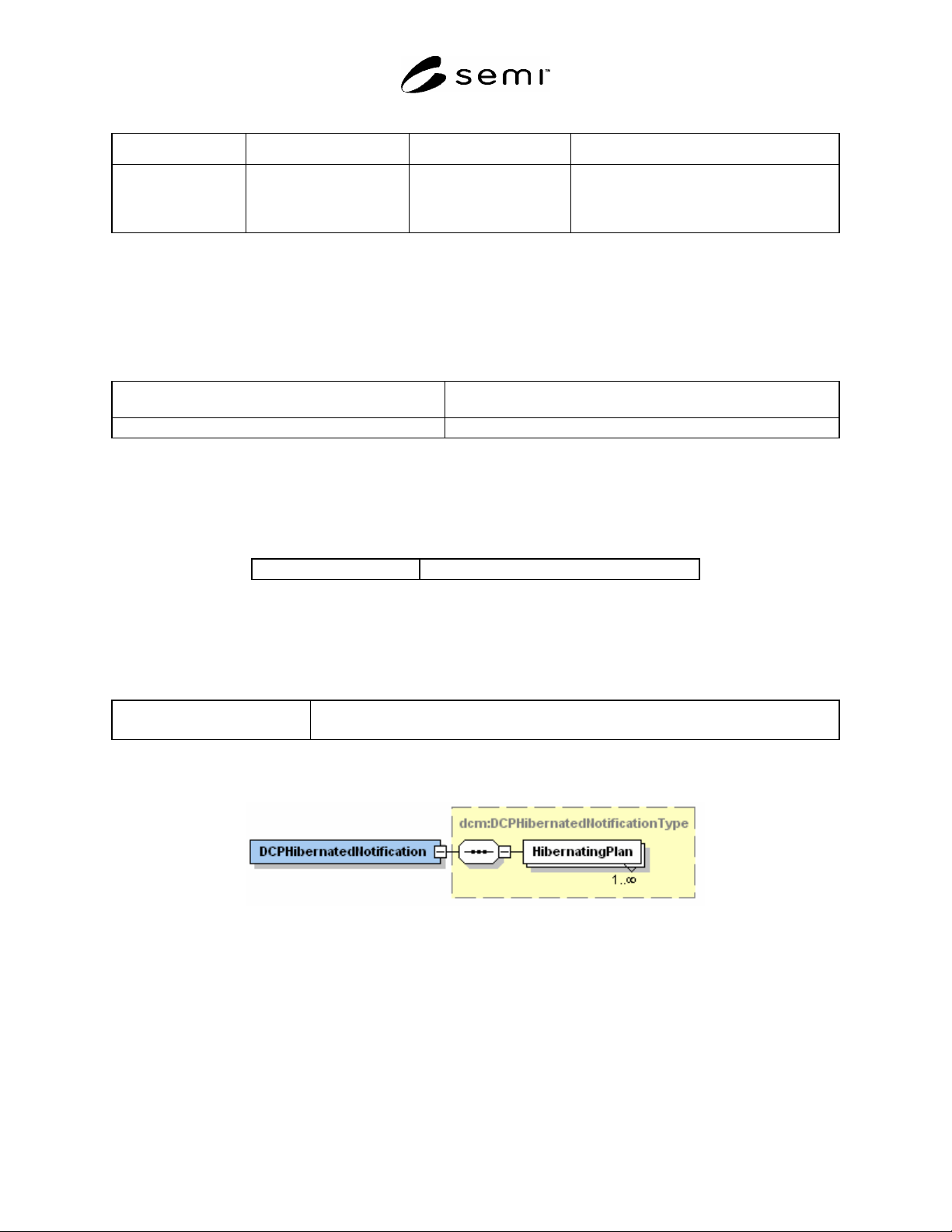
Figure 42
DCPHibernationNotification
7.3.9.4.1 DCPHibernationNotification — This global element acts as a top-level container entity representing the
SOAP body of a DCPHibernation notification. As defined in SEMI E134, this operation has one output argument:
the HibernatingPlans. This argument is modeled as a attributes named “HibernatingPlan” of complexType
“DCPHibernatedType”.