semi合集-English.pdf - 第4705页
SEMI C3.58-0303 © SEMI 2000, 2003 5 Figure 3 Determination of Organic Impurit ies in Octafluorocyclobutane 6.3.4.2 Obtain a conti nuous flow sample of the Octa fluorocyclo butane source. The sample system by which the oc…
SEMI C3.58-0303 © SEMI 2000, 2003 4
6.3.3 Operation Check — The instrument should be checked periodically for correct operation. The instrument
should be zeroed by flowing reference gas, which is dry octafluorocyclobutane (dried by use of an ultra dryer system
provided by the instrument manufacturer). Then the instrument should be calibrated by use of the internal moisture
generator (permeation tube) which has been certified by the manufacturer at some known moisture level. When not
in use the instrument should be purged with dry gas (i.e., helium or nitrogen).
6.3.4 Operation Procedures
6.3.4.1 Initiate flow of the reference gas to the instrument and allow 30 minutes for stabilization.
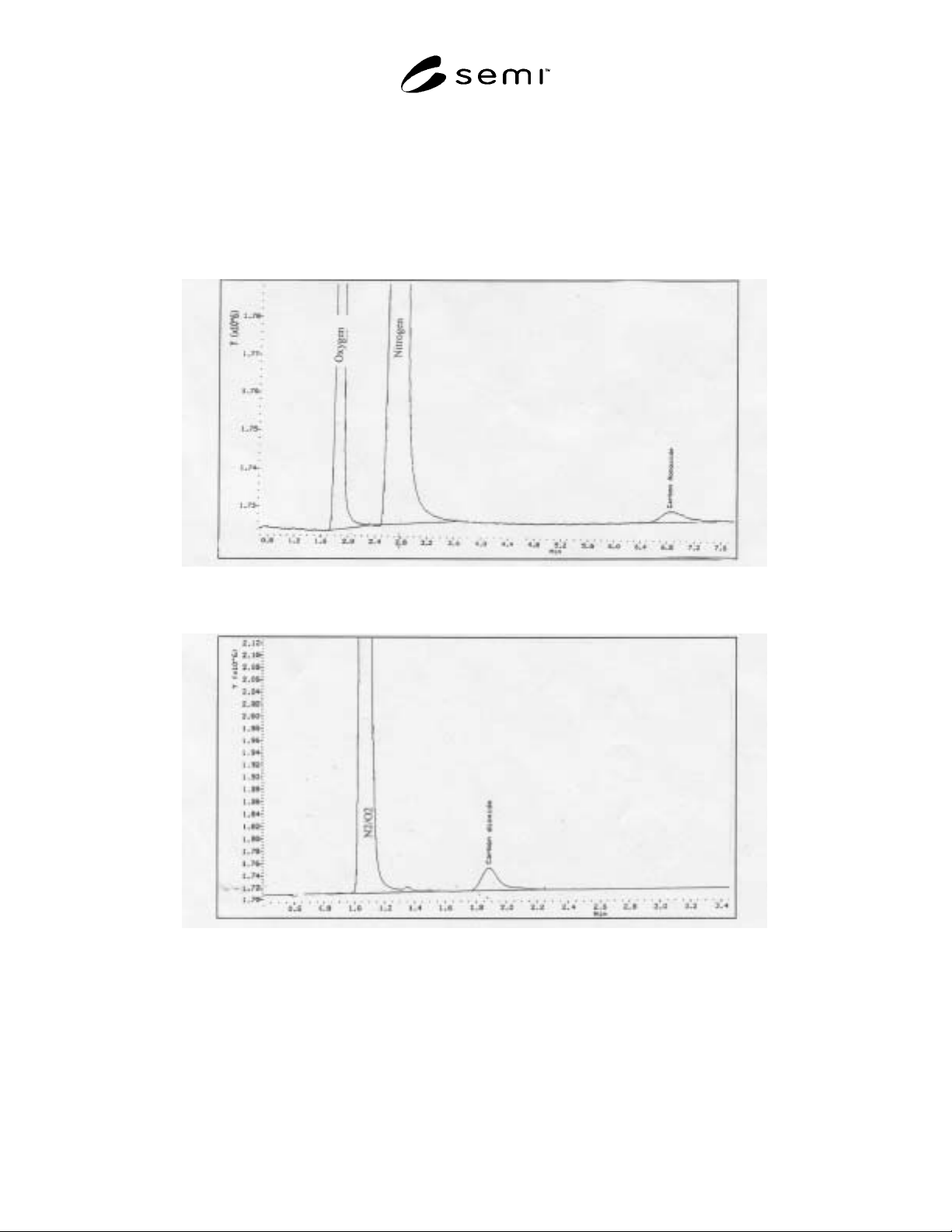
Figure 1
Nitrogen, Oxygen, and Carbon Monoxide Determination in Octafluorocyclobutane
Figure 2
Carbon Dioxide Determination in Octafluorocyclobutane
SEMI C3.58-0303 © SEMI 2000, 2003 5
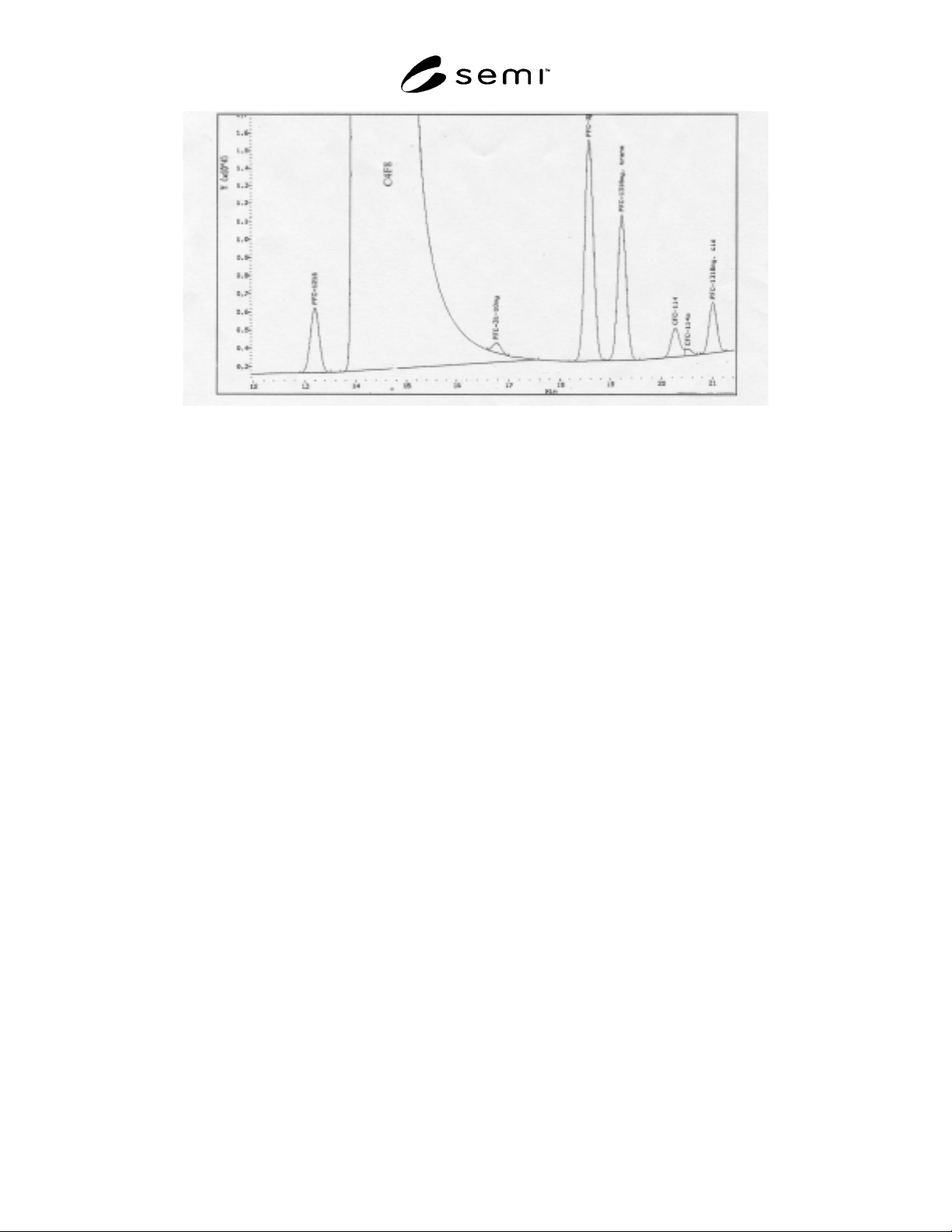
Figure 3
Determination of Organic Impurities in Octafluorocyclobutane
6.3.4.2 Obtain a continuous flow sample of the Octafluorocyclobutane source. The sample system by which the
octafluorocyclobutane is passed to the instrument should consist of electroplated stainless steel tubing, zero dead-
volume fittings, and be heated and purged with dry gas while not in use.
6.3.4.3 Allow the sample gas to flow through the sampling system and instrument until a stable reading is obtained.
NOTICE: SEMI makes no warranties or representations as to the suitability of the standard set forth herein for any
particular application. The determination of the suitability of the standard is solely the responsibility of the user.
Users are cautioned to refer to manufacturer’s instructions, product labels, product data sheets, and other relevant
literature respecting any materials or equipment mentioned herein. These standards are subject to change without
notice.
By publication of this standard, SEMI takes no position respecting the validity of any patent rights or copyrights
asserted in connection with any item mentioned in this standard. Users of this standard are expressly advised that
determination of any such patent rights or copyrights, and the risk of infringement of such rights, are entirely their
own responsibility.
Copyright by SEMI® (Semiconductor Equipment and Materials
International), 3081 Zanker Road, San Jose, CA 95134. Reproduction o
f
the contents in whole or in part is forbidden without express written
consent of SEMI.
SEMI C3.22-1000 © SEMI 1983, 2004 1
SEMI C3.22-1000 (Withdrawn 1104)
STANDARD FOR OXYGEN (O
2
), 99.5% QUALITY
This standard was technically approved by the Global Gases Committee and is the direct responsibility of the
North American Gases Committee. Current edition approved by the North American Regional Standards
Committee on July 11, 2004. Initially available at www.semi.org September 2004; to be published
November 2004. Originally published in 1983; previously published in 1993.
NOTICE: This document was balloted and approved
for withdrawal in 2004.
1 Description
1.1 Oxygen is a colorless, odorless and oxidizing gas.
It supports combustion.
2 Specifications
ASSAY: 99.5%
Impurities Maximum Acceptable
Level (ppm)*
Carbon monoxide and Carbon
dioxide (CO + CO
2
)
5
Nitrogen (N
2
) 100
Nitrous oxide (N
2
O) 2
Particles **
Total Hydrocarbons expressed as
Methane (THC)
25
Water (H
2
O) (v/v) 1
TOTAL IMPURITIES
INCLUDING RARE GASES
5,000
* An analysis of significant figures has not been considered. The
number of significant figures will be based on analytical accuracy and
the precision of the provided procedure.
** To be determined between supplier and user.
3 Physical Constants (for information only)
Metric Units US Units
Molecular weight 31.999 31.999
Boiling point at 1 atm -183°C -297.4°F
Density of gas at 25°C
(77°F) and 1 atm
1.309 kg/m
3
0.082 lb/ft
3
Specific gravity of gas at
21.1°C (70°F) and 1 atm
(air = 1)
1.1049 1.1049
Density of liquid at
boiling point
1142 kg/m
3
71.27 lb/ft
3
4 Analytical Procedures
4.1 Carbon Monoxide, Carbon Dioxide, and Nitrous
Oxide — This procedure is for the determination of
carbon monoxide, carbon dioxide and nitrous oxide in
oxygen using infrared spectrophotometry.
4.1.1 Detection Limits — 0.5 ppm (mole/mole) carbon
monoxide, 0.1 ppm (mole/mole) carbon dioxide, and
0.2 ppm (mole/mole) nitrous oxide.
4.1.2 Instrument Parameters
4.1.2.1 10 meter variable path infrared gas cell.
4.1.2.2 Grating infrared spectrophotometer.
4.1.2.3 Bourdon Vacuum Gauge.
4.1.3 Calibration Standards — 10 ppm (mole/mole)
carbon monoxide, 10 ppm (mole/mole) carbon dioxide
and 10 ppm (mole/mole) nitrous oxide, balance oxygen.
4.1.4 Operating Procedure
4.1.4.1 Pressurize the evacuated gas cell to 50 psia
with the calibration standard. Scan the following wave
numbers for absorbance: carbon monoxide 2172 cm
-1
,
nitrous oxide 2235 cm
-1
, and carbon dioxide 2360 cm
-1
.
4.1.4.2 Evacuate the cell and pressurize to 50 psia
with the oxygen sample. Scan the appropriate wave
numbers as in 4.1.4.1.
4.1.4.3 Compare the absorbance of the calibration
standard to that of the oxygen sample being tested.
Calculate the concentrations of carbon monoxide,
carbon dioxide and nitrous oxide, using the formula
below. The results may not exceed the specifications in
Section 2 of this Standard.
Sample Absorbance
Standard Absorbance
Concentration
of Standard
Concentration
of Sample
4.2 Nitrogen — This procedure is for the
determination of nitrogen in oxygen using a gas
chromatograph with a thermal conductivity detector.
4.2.1 Detection Limit — 10 ppm (mole/mole).
4.2.2 Instrument Parameters
4.2.2.1 Column: 5A molecular sieve, 4.6 m (15 ft) by
3.2 mm (1/8 in) ss or equivalent.
4.2.2.2 Carrier Flow: 30 mL/min helium.
4.2.2.3 Sample Volume: 2.0 mL.