semi合集-English.pdf - 第604页
SEMI E84-0305 © SEMI 1999, 2005 2 3.2 This s p ecification defines the signal s used to select a l oad port. The physical correspondence of the p arallel I/O interface to the load port is not defined in this docu ment. 3…

SEMI E84-0305 © SEMI 1999, 2005 1
SEMI E84-0305
SPECIFICATION FOR ENHANCED CARRIER HANDOFF PARALLEL I/O
INTERFACE
This specification was technically approved by the Global Physical Interfaces & Carriers Committee and is
the direct responsibility of the Japanese Physical Interfaces & Carriers Committee. Current edition approved
by the Japanese Regional Standards Committee on November 24, 2004. Initially available at www.semi.org
January 2005; to be published March 2005. Originally published June 1999; last published March 2004.
1 Purpose
1.1 Due to the migration to large wafer sizes, future semiconductor factories will use extensive automated material
handling systems (AMHS) to transfer wafer carriers, including FOUPs and open cassettes, of increasing weight. The
parallel input/output (PI/O) control signals between the production equipment and the AMHS must be better defined
for more reliable and efficient carrier handoffs (load/unload) at production equipment load ports.
1.2 The purpose of this specification is to enhance the capabilities of the parallel I/O interface defined in SEMI E23
in order to support improvements in the reliability and efficiency of carrier transfer. The enhanced capabilities
include continuous handoff, simultaneous handoff, and the capabilities of error detection on the interface.
NOTE 1: The specifications in this document shall be considered independent from the specifications in SEMI E23; therefore,
use of this specification does not require SEMI E23.
2 Scope
2.1 The scope of this specification is limited to communications associated with the material handoff operations
between the active equipment (for example, AMHS equipment including AGV, RGV and OHT) and the passive
equipment (for example, production equipment including process and metrology equipment; stockers, etc). This
scope also extends to interbay AMHS active equipment (i.e., OHS and stockers equipped with transfer devices) and
passive equipment (i.e., OHS and stockers not equipped with transfer devices). This specification defines the
enhanced parallel I/O interface signals used to handoff carriers between the production equipment and the AMHS.
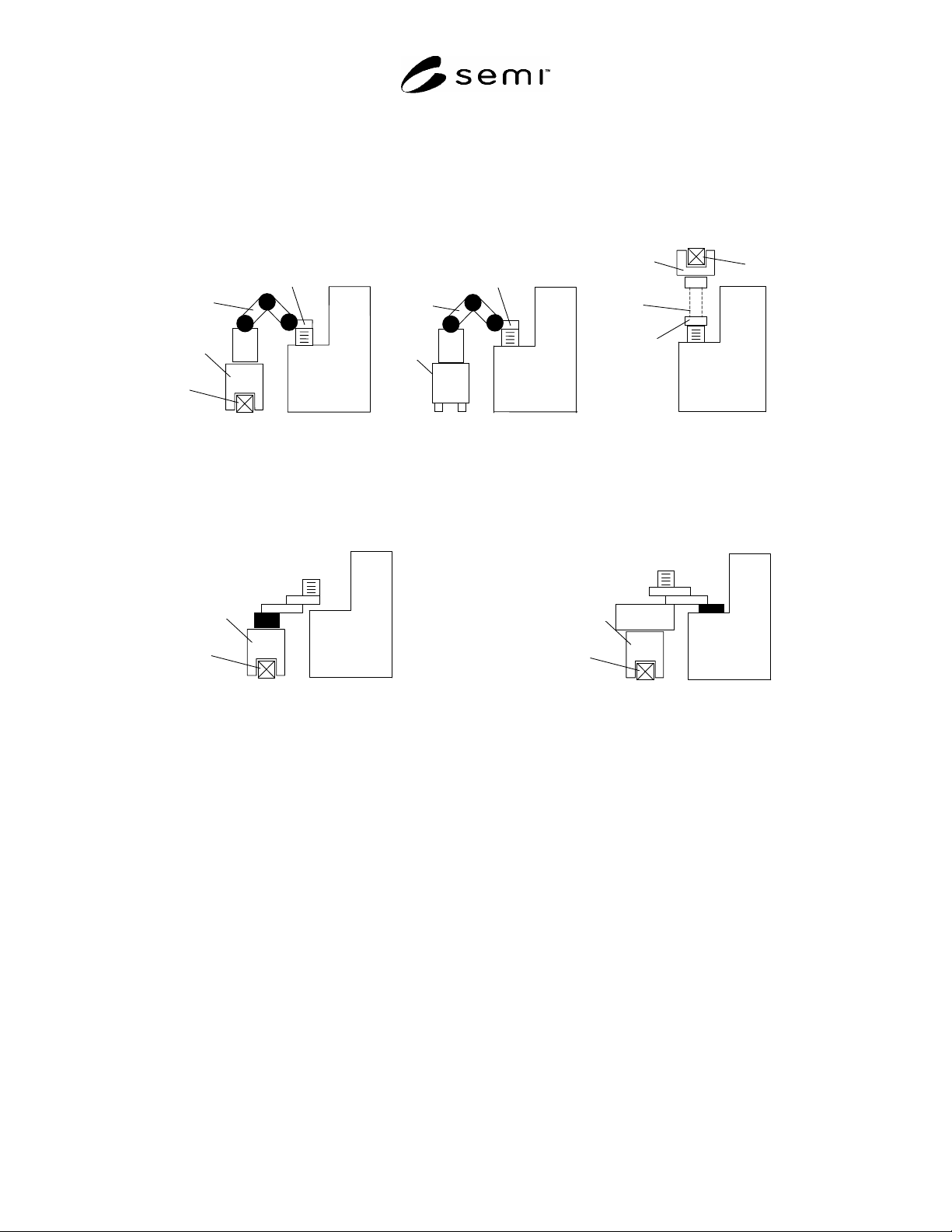
Figures 1 and 2 show examples of types of AMHS equipment.
2.2 This enhanced carrier handoff parallel I/O interface specification includes:
Signal definition including load port assignment signals (¶6.1),
Carrier handoff sequence definitions and time diagrams (¶6.2),
Error indication, detection, and recovery (¶¶6.3 and 6.4),
Connector type, signal, and pin assignment (¶6.4), and
Interface sensor unit size to be located at load port defined by SEMI E15.1 (applicable for systems designed to
handle 300 mm wafer carriers).
2.3 The enhanced carrier handoff parallel I/O interface controls the handoff of a carrier to and from the passive
equipment by the active equipment. This parallel I/O interface only controls the automated handoff operation of the
carrier. The handoff is the operation in which a carrier is transferred from one piece of equipment to another. Both
the active and passive equipment manage this operation. The factory level controller (i.e., host) does not manage the
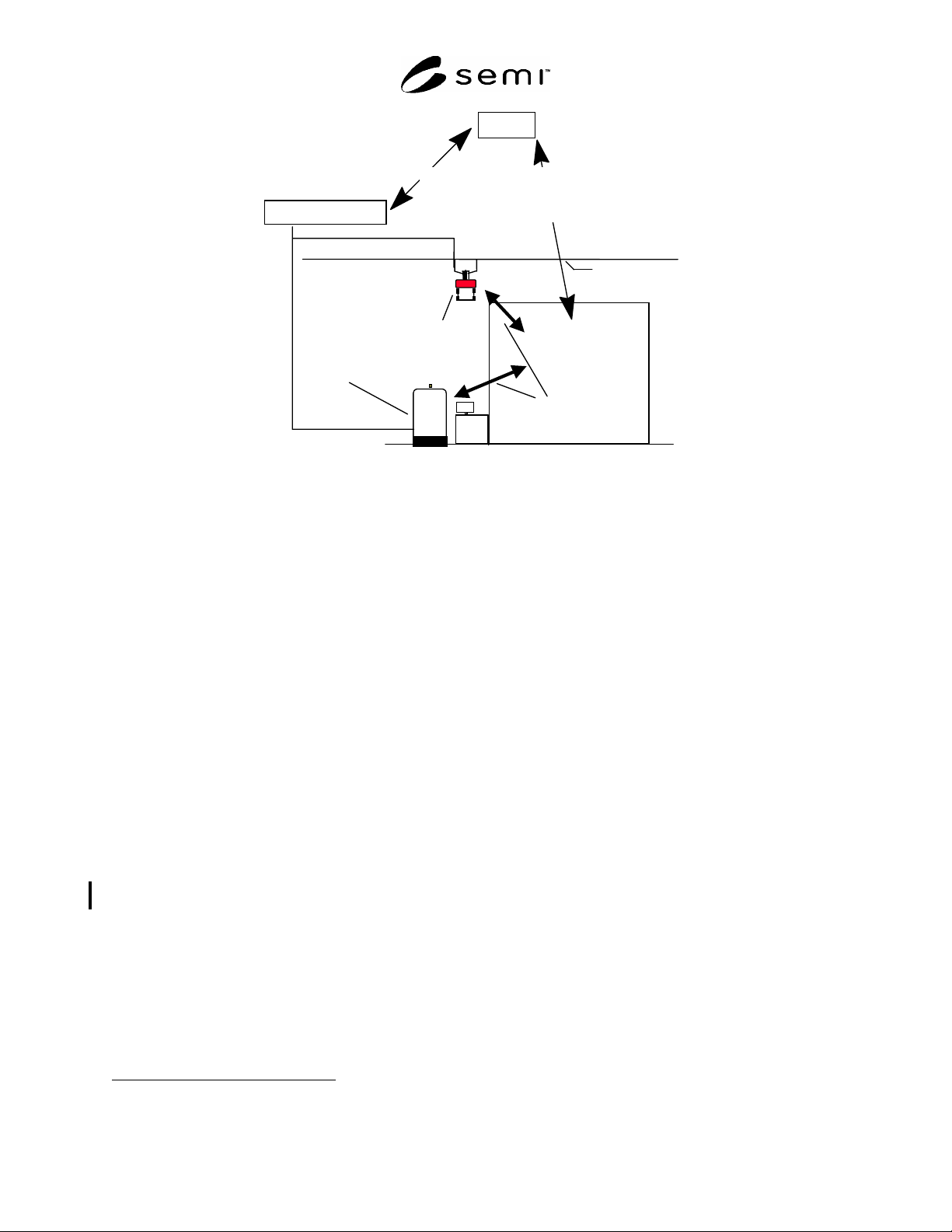
handoff operation. Figure 3 shows applications for the parallel I/O interface specified in this document.
NOTICE: This standard does not purport to address safety issues, if any, associated with its use. It is the
responsibility of the users of this standard to establish appropriate safety and health practices and determine the
applicability of regulatory or other limitations prior to use.
3 Limitations
3.1 Data for the material that is transferred (handed off) is managed through the equipment’s factory interface.
Material management by the factory level controller is outside the scope of this document.
SEMI E84-0305 © SEMI 1999, 2005 2
3.2 This specification defines the signals used to select a load port. The physical correspondence of the parallel I/O
interface to the load port is not defined in this document.
3.3 Error recovery procedures may need operator assistance and/or proprietary procedures specific to the
equipment. Therefore, error recovery procedures are not defined in this document.
3.4 Signal time diagrams apply to only one parallel I/O interface.
Rail
Hand
Arm
Vehicle
(RGV)
Active Passive
Rail Guided Vehicle (RGV)
Production
Equipment
Production
Equipment
Vehicle
(AGV)
Arm
Hand
Active Passive
Automated Guided Vehicle (AGV)
Hoist
Active
Vehicle
(
OHT
)
Rail
Hand
Production
Equipment
Overhead Hoist Transport (OHT)
Passive
Figure 1
Examples of Automated Material Handling System Equipment (RGV, AGV, and OHT)
Rail
Fork
Vehicle
(OHS)
Active Passive
Active Vehicle
Stocker
Rail
For
k
Vehicle
(OHS)
Passive Active
Passive Vehicle
Stocker
Figure 2
Examples of Interbay Automated Material Handling System Equipment (Stockers and OHS)
SEMI E84-0305 © SEMI 1999, 2005 3
Ceiling
Raised Floor
Production
Equipment
(side view)
Floor
running
AGV/RGV
A
utomated or Rail
Guided Vehicle (AGV/RGV)
AMHS Controller
HOST
Host/equipment
interface is outside the
scope of this standard.
Overhead Hoist Transports (OHT)
Parallel I/O Interface
Figure 3
Examples of Enhanced Carrier Handoff Parallel I/O Interface Applications
3.5 The installation positions of the parallel I/O interface and the connector on the active and passive equipment are
not defined.
3.6 The swap handoff will be considered beyond the scope of the standard for interbay AMHS equipment (i.e.,
OHS, stockers). During a swap handoff, loading and unloading occur simultaneously on the same loadport.
4 Referenced Standards
4.1 SEMI Standards
SEMI E1.9 — Mechanical Specification for Cassettes Used to Transport and Store 300 mm Wafers
SEMI E15.1 — Specification for 300 mm Tool Load Port
SEMI E23 — Specification for Cassette Transfer Parallel I/O Interface
SEMI E30 — Generic Model for Communications and Control of Manufacturing Equipment (GEM)
SEMI E47.1 — Provisional Mechanical Specification for Boxes and Pods Used to Transport and Store 300 mm
Wafers
SEMI E87 — Specification for Carrier Management (CMS)
4.2 ISO Standard
1
ISO 2110:1989 — Information technology — Data communication — 25-pole DTE/DCE interface connector and
contact number assignments
NOTICE: Unless otherwise indicated, all documents cited shall be the latest published versions.
5 Terminology
5.1 Definitions
5.1.1 access mode — a mode in which passive equipment knows which AMHS equipment (i.e. RGV, AGV, and
OHT/OHV) or operator is permitted to make a material handoff. In the case of interbay AMHS, this is a mode in
1 International Organization for Standardization, ISO Central Secretariat, 1, rue de Varembé, Case postale 56, CH-1211 Geneva 20, Switzerland.
Telephone: 41.22.749.01.11; Fax: 41.22.733.34.30 Website: www.iso.ch