semi合集-English.pdf - 第3245页
SEMI E127-0705 © SEMI 2003, 2005 46 18.3.2 ClientDisconn ect Service — This service is used by a current clie nt to gracefully terminate a connection. Table 31 defi nes the param eters for the ClientDi sconnect se rvice.…
SEMI E127-0705 © SEMI 2003, 2005 45
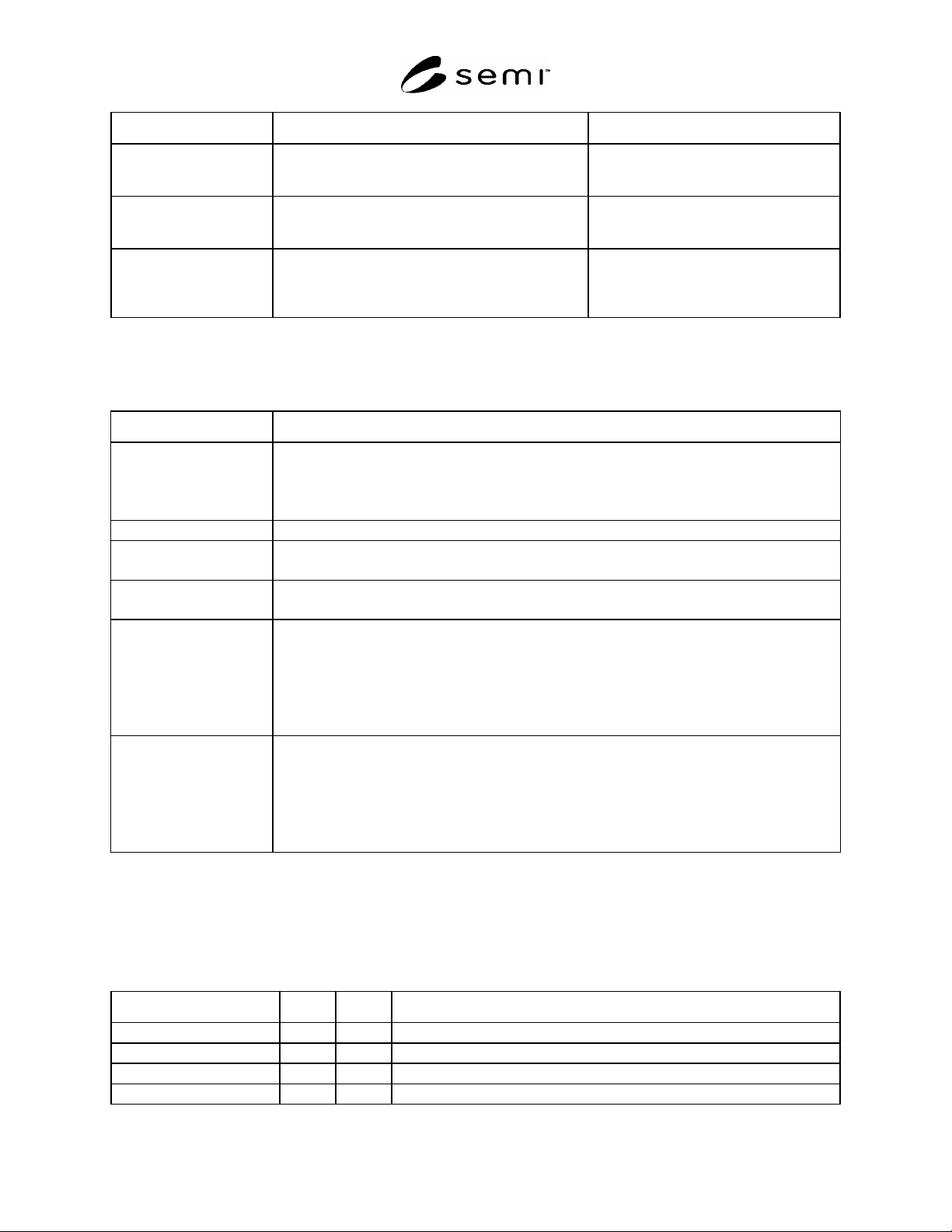
Name Definition Form
ClientDelete The minimum number of tables the client wants to be
able to be able to store prior to being notified by the
event TableStorageCapacityWarning.
Non-negative integer. A value of zero
disables this rule.
MaximumTablesStored Maximum number of tables the client wants stored;
beyond that they are to be deleted on a first-in, first out
basis.
Non-negative nteger. A value of zero
disables this rule.
RetentionTime The minimum time that a table shall be retained in
storage. The table may not be deleted before this
period of time has passed unless Automatic Rollover is
forced to delete it to make room for a new table.
Long integer for number of hours to retain
tables. A value of zero disables this rule.
18.2.3 Valid ErrorCode enumerations are shown in Table 29. The actual format for ErrorCode is communication
protocol-dependent.
Table 29 Valid ErrorCode Enumerations
Service Valid Logical Values
ClientConnect Client Already Connected
Duplicate ClientID
Invalid ClientType
IncompatibleVersions
ClientDisconnect Unrecognized ClientID (Client not currently connected)
XfrCommand Rejected/Unrecognized Command
Rejected/Parameter Error
XfrCommand
XfrVerify
Failed (Completed Unsuccessfully)
Failed (Unsafe) – External intervention required
XfrVerify Sensor-Detected Obstacle
Material Not Sent
Material Not Received
Material Lost
Hardware Failure
Transfer Cancelled
All other services Action performed – no errors
Action will be performed at earliest opportunity
Action can not be performed now
Action failed due to errors
Unrecognized command
At least one parameter has an error
18.3 Message Detail
18.3.1 ClientConnect Service — This service is used by a prospective client to request a connection as a Control
Client or Data Client. If the request is as a Control Client, and there is already a Control Client connected, the IMM
shall reject the request. The IMM shall also reject the request if a client with the same ID is already connected or if
the required interface version can not be supported. Table 30 defines the parameters for ClientConnect.
Table 30 ClientConnect Service Parameters
Parameter Req/Ind
R
sp/Con
f
Description
ClientID M M(=) Identifier for the requestor.
ClientInterfaceVersion M — Identifies the version of the communication interface required by the client.
ClientType M — Indicates type of connection (control or data).
ClientConnectStatus — M Indicates the success or the specific errors.
SEMI E127-0705 © SEMI 2003, 2005 46
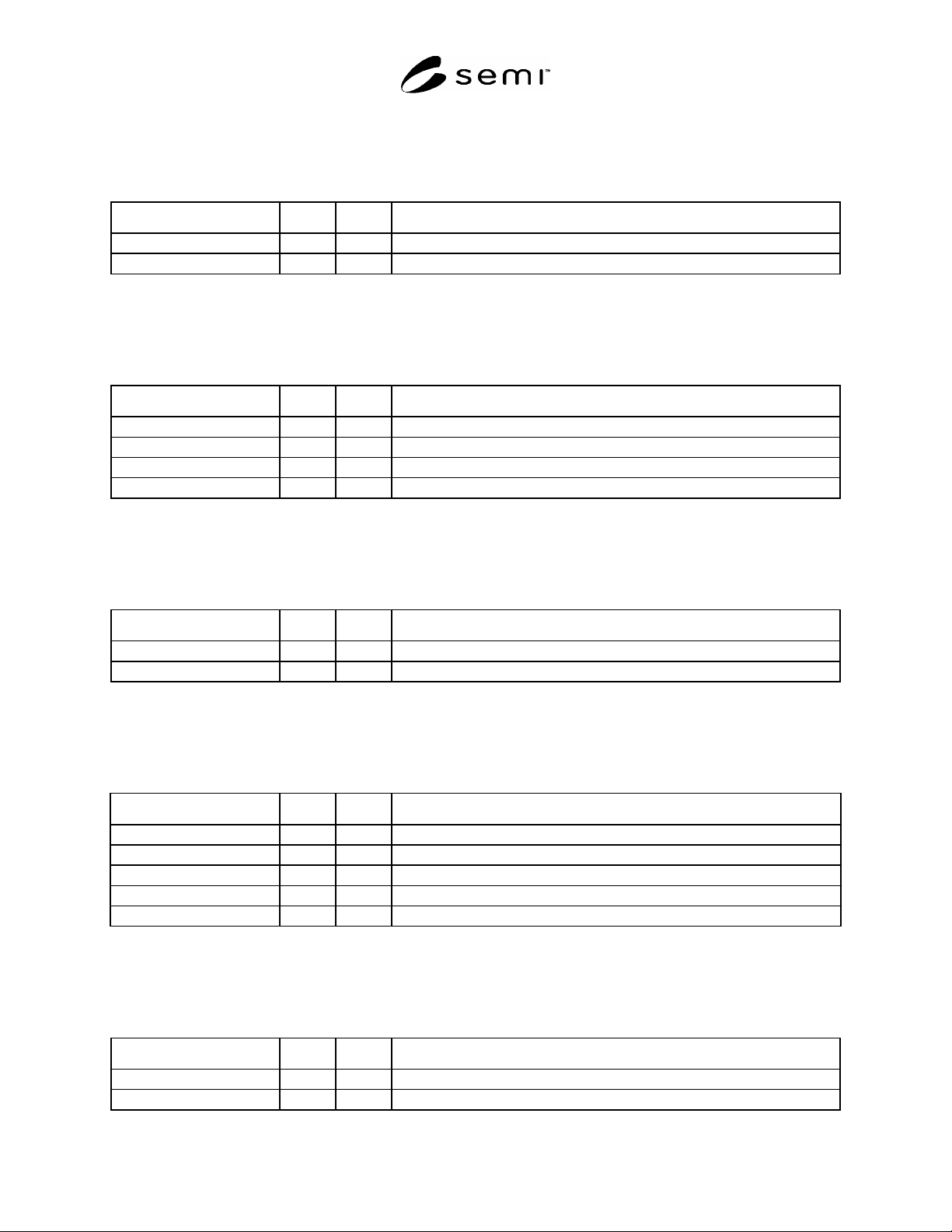
18.3.2 ClientDisconnect Service — This service is used by a current client to gracefully terminate a connection.
Table 31 defines the parameters for the ClientDisconnect service.
Table 31 ClientDisconnect Service Parameters
Parameter Req/Ind
R
sp/Con
f
Description
ClientID M M(=) Identifier for the requestor.
ClientConnectStatus — M Indicates the success or the specific errors.
18.3.3 RequestRetentionConditions — A client may request its current set of retention conditions for a Raw Data
Table Object or Converted Data Table Object by sending the RequestRetentionRules request at any time. Table 32
defines the parameters for the RequestRetentionConditions service.
Table 32 RequestRetentionConditions Service Parameters
Parameter Req/Ind
R
sp/Con
f
Description
ClientID M M(=) Identifier for the requestor.
TableType M — Identifies the type of table affected.
(list of 0+) retention rules — M Current list of rules, or empty list if no rules.
Status — M Status of request.
18.3.4 ChangeService — The Control Client may request a change in the IMM Service state at any time. The
actual state change from IN SERVICE to OUT OF SERVICE may be delayed until a currently active process job
completes. Parameters for the Service service are defined in Table 33.
Table 33 Parameters for ChangeService
Parameter Req/Ind Rsp/Con
f
Description
ServiceState M — New Service state requested.
Status — M Status of request.
18.3.5 SetAutoTableSend — A client may enable or disable the automatic sending of any or all of the IMM Data
Table subtypes through the SetAutoTableSend service. Table 34 defines the parameters of the SetAutoTableSend
service.
Table 34 SetAutoTableSend Service Parameters
Parameter Req/Ind
R
sp/Con
f
Description
ClientID M M(=) Identifier for the requestor.
AutoSendRawData M — Enables or disables automatic sending for Raw Data Tables.
AutoSendConvertedData M — Enables or disables automatic sending for Converted Data Tables.
AutoSendCalibrationData M — Enables or disables automatic sending for Calibration Data Tables.
Status — M Status of request.
18.3.6 SetRetentionConditions — A client may set, change, or clear its current set of retention conditions at any
time through the SetRetentionConditions service. Table 35 defines the parameters of the SetRetentionConditions
service.
Table 35 SetRetentionConditions Service Parameters
Parameter Req/Ind
R
sp/Con
f
Description
ClientID M M(=) Identifier for the requestor.
TableType M — Identifies the type of table affected.
SEMI E127-0705 © SEMI 2003, 2005 47
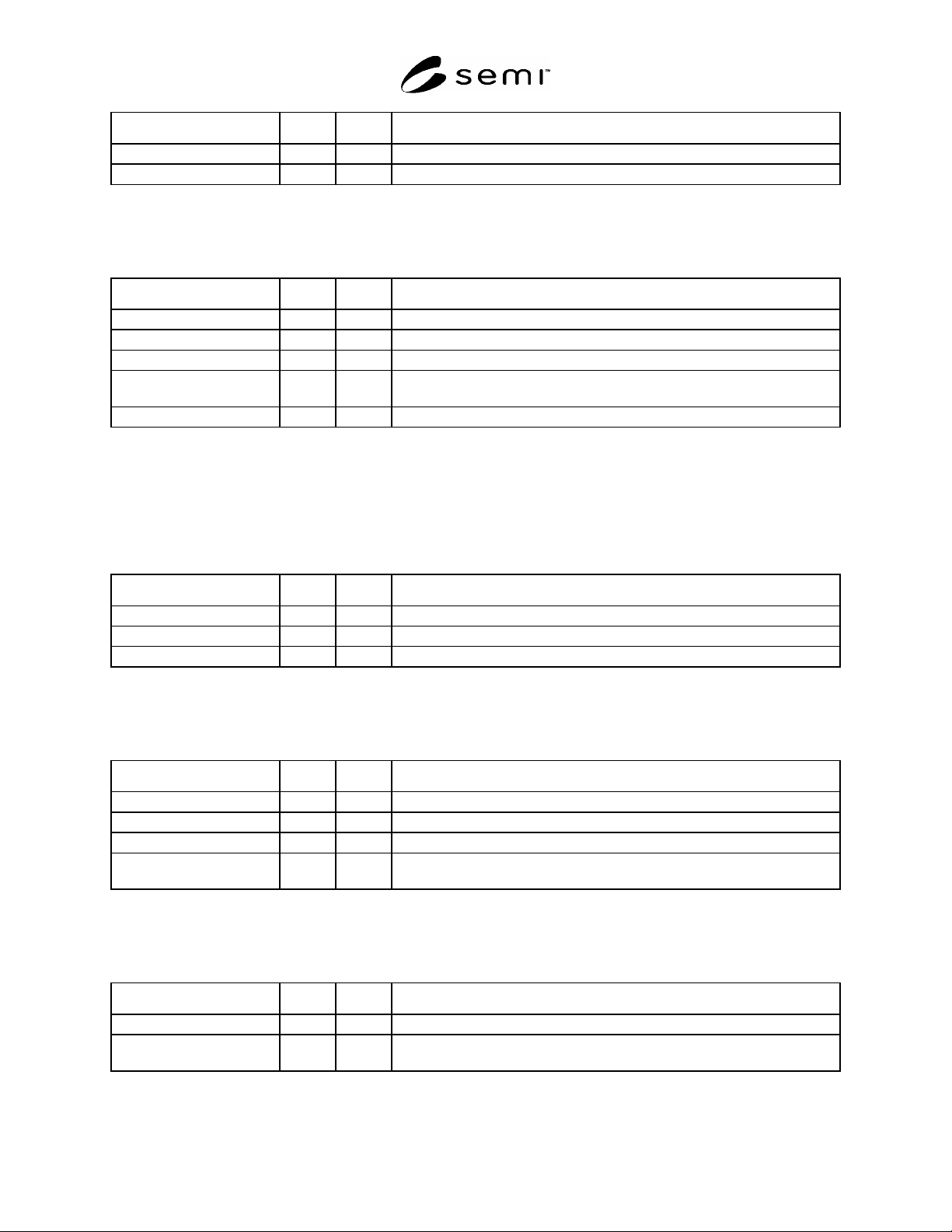
Parameter Req/Ind
R
sp/Con
f
Description
(list of 0+) RetentionRules M — New list of rules, or empty list to clear all rules.
Status — M Status of request.
18.3.7 TransferPathCalibration Service — This service is sent by the Control Client to request a STPO to perform
an automatic calibration. Its parameters are defined in Table 36.
Table 36 TransferPathCalibration Service Parameters
Parameter Req/Ind
R
sp/Con
f
Description
ObjID M M(=) Identifier of the STPO.
OrientationIn C — Expected orientation of substrate loaded.
OrientationOut C — Expected orientation of substrate unloaded.
Deltas M An ordered list of changes in the load plane in the x-, y-, and z-position of the
center of the substrate in millimeters respectively.
Status M Status of request.
18.3.8 XfrCmdListRequest — This service provides the Control Client with an ordered list of necessary micro
commands required during a substrate transfer that effect either a Load or Unload operation. Table 37 defines the
parameters of this service. The individual micro commands are then passed to the STPO in the XfrCommand
service below. These micro commands are proprietary, with the exception of two required micro commands, and
need not be understood by the Control Client but must be used in the order in which they appeared in the list.
Table 37 XfrCmdListRequest Service Parameters
Parameter Req/Ind
R
sp/Con
f
Description
ObjID M M(=) Identifies the SubstrateTransferPath object.
XfrType M M Identifies the request is for either a load or unload operation.
XfrCmdList — M List of 0+ micro commands.
18.3.9 XfrCommand Service Parameters — This service is used to effect an actual substrate transfer with the IMM
object. Parameters for the XfrCommand service are defined in Table 38.
Table 38 XfrCommand Service Parameters
Parameter Req/Ind
R
sp/Con
f
Description
ObjID M — Identifies the STPO.
XfrLink M M(=) Identifies the specific transfer.
XfrCmdName M — Specific micro command to be executed.
XfrStatus — M Reports the success or failure of the micro command. If failure, supplies error
detail.
18.3.10 XfrHalt Service Parameters — The XfrHalt service may be sent by either the Control Client or the IMM to
effect an immediate halt. Parameters for the XfrHalt service are defined in Table 39.
Table 39 XfrHalt Service Parameters
Parameter Req/Ind
R
sp/Con
f
Description
XfrLink M M(=) Identifies the specific transfer.
XfrHaltAccept M M True if halt accepted. May be denied only if the specified transfer does not
exist.