semi合集-English.pdf - 第1440页
SEMI 30.1-0200 © SEMI 1998, 2000 15 Table 4 Varia ble Item Dictionary Variab le Name Type Descripti on Level Class Forma t Comment ActiveLocat ion CV T he current carrier locatio n that has substra tes in the executin g …
SEMI 30.1-0200 © SEMI 1998, 2000 14
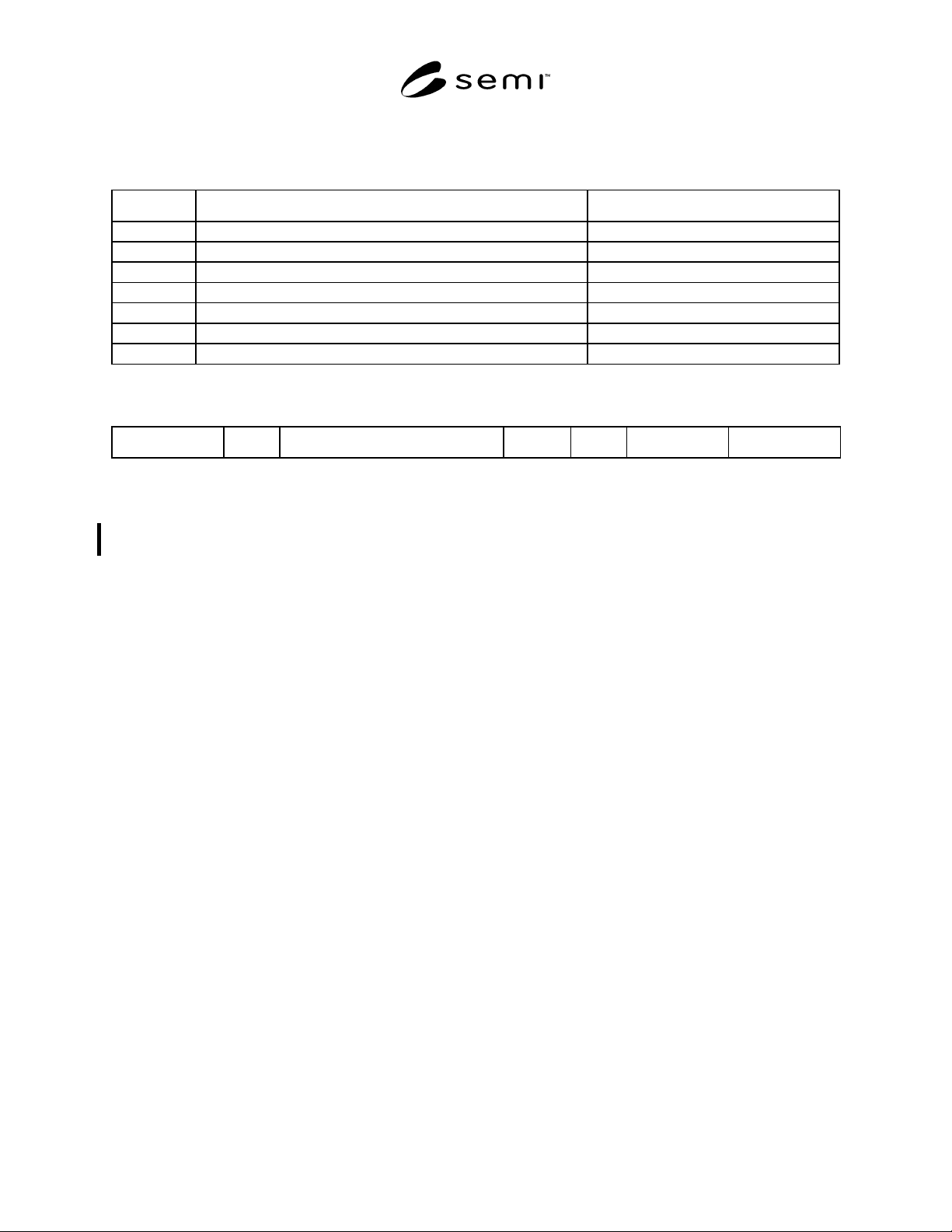
9.2 Variable Items and Reporting Levels — Table 3 defines reporting levels and associated Data Collection Events
for which Variable Items are valid for.
Table 3 Variable Items and Reporting Levels
Level Reporting Level Data Collection Event
R Run RunDataComplete
P ProcessGroup ProcessGroupComplete
S Substrate SubstrateDataComplete
G Group GroupDataComplete
X Region RegionDataComplete
A Anomaly AnomalyDataComplete
ALL Run, Substrate, Group, Region, and Anomaly All of the above.
9.2.1 Variable items are documented in the ISEM Variable Item Dictionary using the following format:
Variable Name Type Description Level Class Format Comments
Where:
Variable Name: A unique name for the variable item (this name is for reference only).
Type: Defined as Common (CV), Inspection (ISV), Review (RSV), or Inspection/Review specific
variables (IRSV).
Description: If class is DVVAL, then the description shall contain a statement of when data is valid in terms of
ISEM events.
Level: The report level at which this variable is used <R| S| G| X| A| ALL> as defined in Table 3. It also
indicates when the variable item is valid.
Class: The data type of the item.
Format: <SECS Message Language (SML) mnemonic> acceptable formats are SEMI E5 lists, ASCII,
floating point, unsigned integer, or signed integer. A description of “ANY” indicates that only the
above formats are acceptable and is left to the tool vendor to decide.
Comments: Any additional information pertinent to the variable name.
9.3 Variable Item Types
9.3.1 Equipment Constants (ECV) — The value can be changed by the host using S2,F15. The operator may have
the ability to change some or all of the values. The value of an equipment constant may be queried at any time by
the host using the S2,F13/14 transaction or Stream 6 reports.
9.3.2 Status Variables (SV) — The values are valid at all times. A SV may not be changed by the host or operator
but may be changed by the equipment. A host or operator command may change an equipment status, thus changing
an SV. The value of status variables may be queried by the host at any time using the S1,F3/4 or Stream 6 reports.
9.3.3 Data Variables (DVVAL) — These are variables which are valid upon the occurrence of a specific collection
event and which may or may not be valid at other times, depending upon the equipment. An attempt to read a
variable item when it is invalid will not result in an error, but the data reported may not have relevant meaning.
9.4 Variable Item Dictionary
9.4.1 Data Validity — The “Level” column in Table 4 defines when the variable item is valid. The entry in this
column corresponds to a reporting level defined in Section 9.2 “Variable Items and Reporting Levels”. For example,
“RunAnomalyCount” is valid at the “RunDataComplete” event, and “AnomalySize” is valid at all reporting level
data collection events.

SEMI 30.1-0200 © SEMI 1998, 200015
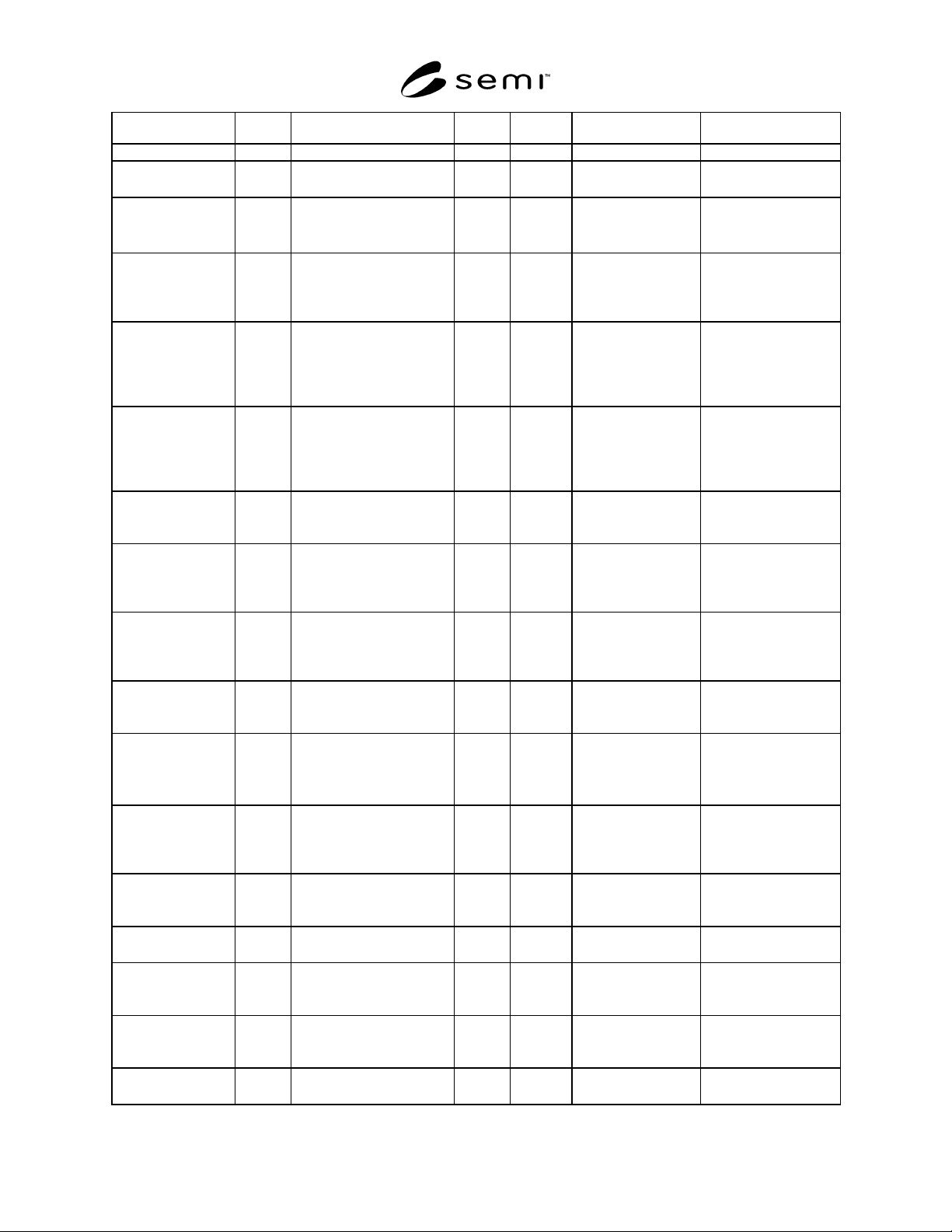
Table 4 Variable Item Dictionary
Variable Name Type Description Level Class Format Comment
ActiveLocation CV The current carrier location
that has substrates in the
executing state of the
processing state model.
ALL SV U2 Valid in all data
collection events as
defined in Table 3.
AlignList CV A list of alignment sites
information being used by
the current active process
program.
ALL DVVAL L,n
1. <AlignName>
:
n.
The order in which the
alignment name appears
in the list is important
and is equipment-
dependent.
AlignName CV Alignment name ALL DVVAL A[1..16] An item in the
AlignList variable.
AnomalyArea CV The area within the bounds
of an anomaly (in units of
micron
2
).
ALL DVVAL F4
Anomaly-Attributes CV Miscellaneous anomaly
information that is
equipment-dependent and
defined by the equipment
supplier.
ALL DVVAL L,n
1. <attribute
1
>
:
n. <attribute
n
>
Mainly used as part of
other anomaly-related
data (list) (i.e.,
AnomalySize).
Anomaly-Comment RSV Operator-generated
comment associated with
the anomaly.
A DVVAL A[1..80]
AnomalyData2D CV Coordinate data for an
anomaly.
A DVVAL L,5
1. <AnomalyID>
2. <CoordSys>
3. <Coord2D>
4. <Anomaly-
Attributes>
AnomalyID CV A unique anomaly
identifier.
A DVVAL A[1..16]
AnomalySize CV The X,Y extent of the
anomaly in microns. The
dimensions of the smallest
rectangle that contains the
anomaly whose sides are
parallel to the X and Y axis.
A DVVAL L,2
1. <XExtent>
2. <YExtent>
XExtent and YExtent
are of Format F4.
AnomalyTable-
Name
CV Name identifier of anomaly
table.
ALL SV A[1..80]
AnomalyTable-Type CV Type of anomaly table.
(See Section 11.)
ALL SV A[1..20] “TABLE-AREA-DEF”,
“TABLE-ALIGN-
DEF”, “TABLE-
ANOMALY-DEF”,
“TABLE-M21-
ANOMALY-DEF”
BatchID CV The batch identification of
the current material
inspected/reviewed.
ALL DVVAL A[1..16]
CarrierBuild CV ID of the CARRIERBLD
ISEM job that the
inspection/review data is
associated with.
ALL SV A[1..80] See Section 14.
CarrierID CV Physical identification of
the current material
inspected/reviewed.
ALL DVVAL A[1..16]
CarrierNumber CV Used to identify carriers in ALL DVVAL A[1..16]
SEMI 30.1-0200 © SEMI 1998, 2000 16
Variable Name Type Description Level Class Format Comment
multi-lot runs (batch).
Classification RSV Classification code of an
anomaly.
A DVVAL A[1..80]
Coord2D CV The two-dimensional
coordinate of an anomaly.
ALL DVVAL L,2
1. <CoordX>
2. <CoordY>
CoordSys CV The identification for a
coordinate system
definition. SEMI M20,
M20P, or SEMI M21.
ALL DVVAL A[1..16] “M20”
“M21”
“M20P”
CoordX CV The coordinate in the X
direction of a site (anomaly,
alignment site, or the lower
left-hand of an area or
element).
ALL DVVAL F4
CoordY CV The coordinate in the Y
direction of a site (anomaly,
alignment site, or the lower
left-hand of an area or
element).
ALL DVVAL F4
DefaultPriority CV The default priority given a
material location if none is
assigned.
ALL EC U2
DeltaX CV The X-axis translation of
M20P coordinate system
relative to the SEMI M20
coordinate system.
ALL DVVAL F4
DeltaY CV The Y-axis translation of
M20P coordinate system
relative to the SEMI M20
coordinate system.
ALL DVVAL F4
ElementID CV The SEMI M21 address for
a specific rectangular
element on a substrate.
ALL DVVAL I4[2] May refer to a field or
die.
ElementList CV A list of SEMI M21
elements where processing
can be attempted.
ALL DVVAL L,n
1. <ElementID>
:
n.
Fiducial CV The physical feature used to
associate a fiducial line
used for orientation (i.e.,
flat or notch on a substrate).
ALL DVVAL A[1..16] “FLAT”
“NOTCH”
GroupAnomaly-
Count
CV Anomaly count for the
current or last group (i.e.,
field or die inspected).
G DVVAL U2
GroupArea CV Square Area (microns
2
) of
the last group inspected.
G DVVAL F4
GroupComment RSV Operator-generated
comment associated with
the group.
G DVVAL A[1..80]
GroupID CV Inspection/review group
identification for the current
inspection/review.
ALL DVVAL U2
InspectionPPID CV Process program used on
the inspection/review tool
ALL DVVAL A[1..80]