semi合集-English.pdf - 第4631页
SEMI C3-0699 © SEMI 19 86, 1999 12 11 Gas Use T able (see No tes 1 , 2) Gas Use Tabl e Ammonia Argon Arsine Boron Tric hlori de Boron Trifl uoride Boron-11-Trifluoride Carbon Te trfluor ide Chlorine Dibora ne Dichlorosil…

SEMI C3-0699 © SEMI 1986, 199911
7.2.6.6 Of the three aforementioned techniques,
Atomic Absorption Spectrophotometry, Inductively
Coupled Plasma Emission Spectrometry, and Ion
Chromatography, the most sensitive method of
analyzing for a multitude of elements is, without doubt,
graphite furnace (i.e., flameless) Atomic Absorption
Spectrophotometry. However, this instrumental
technique suffers the disadvantage of being slow and
tedious. Consequently, Inductively Coupled Plasma
Emission Spectrometry is rapidly replacing Atomic
Absorption Spectrophotometry for elemental analyses
of liquids since it is a reasonably fast technique
requiring minimal sample preparation with practical
detection limits being superior to those of standard (i.e.,
flame) Atomic Absorption Spectrophotometry for most
elements and approaching those of graphite furnace
Atomic Absorption Spectrophotometry for many of the
elements. An added attractive feature of Inductively
Coupled Plasma Emission Spectrometry is that
eventually it may be used to analyze for elements
directly in gases. Preliminary work, in fact, is currently
being conducted in this area by several research groups.
Although Ion Chromatography can be used to analyze
for a multitude of non
-
transition metal cations (e.g., Li
+
,
Na
+
, K
+
, Rb
+
, Cs
+
Ba
+2
, Mg
+2
, Ca
+2
, Sr
+2
, etc.) it is
limited by the fact that currently only a few transition
metals (e.g., Ni
+2
, Cu
+2
, Co
+2
, Zn
+2
, Fe
+2
, Fe
+3
, Cd
+2
,
etc.) can be analyzed by this instrumental technique. IC,
however, has the advantage in that it can be used for
analyzing for complex cationic and especially anionic
species directly (e.g., NH
4
+
, NO
2
+
, NO
3
-
, SO
3
-
, SO
4
-2
,
PO
4
-3
, OC1
-
, SCN
-
, CN
-
, CO
3
-2
, etc.) and for different
oxidation states for certain elements (e.g., Fe
+2
and
Fe
+3
), unlike the other techniques, which are strictly
limited to elemental analyses only. Furthermore, IC is
extremely valuable for analyzing ionic species,
particularly anions (e.g., F
-
, Cl
-
, etc.) of many common
elements which otherwise cannot be analyzed directly
by either Atomic Absorption Spectrophotometry or
Inductively Coupled Plasma Emission Spectrometry.
8 Standards
8.1 Certified Standards shall be m ade by weight
traceable to the National Institute of Standards and
Technology.
9 Determination of Precisio n
9.1 To Be Determined.
10 Safety
10.1 Because of the continuing evolution of safety
precautions, it is impossible for this publication to
provide definite statements related to the safe handling
of individual chemicals. The user is referred to product
labels, product data sheets, government regulations, and
other relevant literature.
SEMI C3-0699 © SEMI 1986, 1999 12
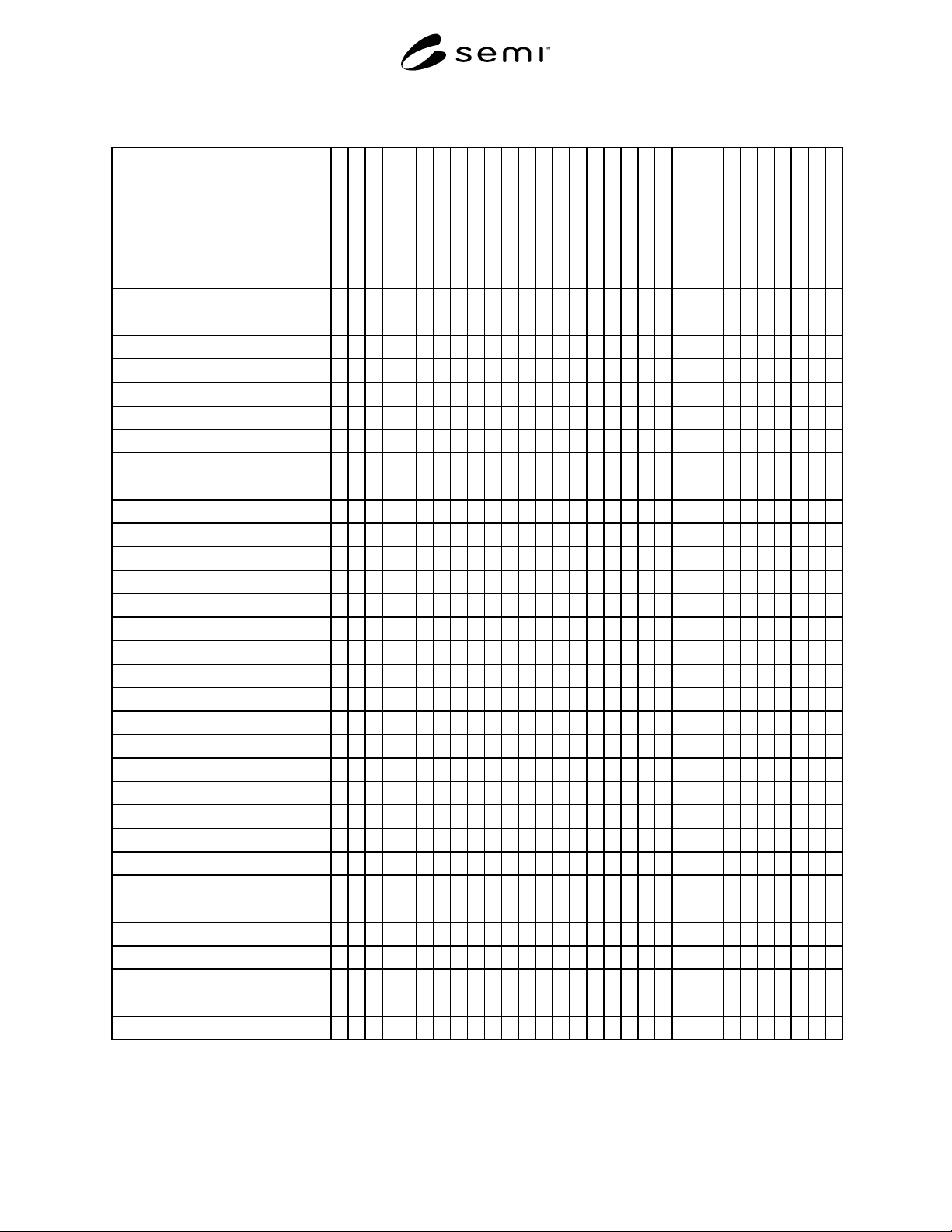
11 Gas Use Table (see Notes 1, 2)
Gas Use Table
Ammonia
Argon
Arsine
Boron Trichloride
Boron Trifluoride
Boron-11-Trifluoride
Carbon Tetrfluoride
Chlorine
Diborane
Dichlorosilane
Disilane
Heliu
m
Hexafluoroethane
Hydrogen
Hydrogen Bromide
Hydrogen Chloride
Hydrogen Fluoride
Methyl Fluoride
Nitrogen
Nitrogen Trifluoride
Nitrous Oxide
Oxygen
Perfluoropropane
Phosphine
Silane
Silicon Tetrachloride
Sulfur Hexafluoride
Trichlorosilane
Trifluoromethane
Tungsten Hexafluoride
Annealing X X
Carrier Gas for Bubblers X X
Chamber Cleans X X X X
CVD Carrier Gas X X
CVD Source X
CVD B Source X
CVD P Source X
CVD Epitaxial X
CVD Nitride X
CVD Oxides X X X X
CVD Polysilicon X X X
CVD Silicides X
Epitaxial Silicon X X X
CVD Silicon Nitride X X X X
CVD Tungsten/Silicide X
Dopants X X
Etching X X X
Metal Etching X X X X X X X X
Nitride Etching X X X X X X X X
Oxide Etching X X X X X X X X X
Silicon Etching X X X X X X X X
Ion Implant X X X X X
Metal Gettering or CVD Tube Cleans X
Nitridation X
Oxide Gettering X X
Oxynitrides X
Plasma Ashing X
Pressurizing Systems X X
Reactive Ion Etch X X
Reducing Gas X
Sputtering X
Inert Gas Blanketing/Purging X X X

SEMI C3-0699 © SEMI 1986, 199913
NOTE 1: This table is intended to identify various gases
described in the SEMI standards and the typical uses for those
gases in semiconductor processes. It is not all-inclusive. As
other uses arise, they should be brought to the attention of the
Gases Committee so that revisions can be made to this table
as needed.
NOTE 2: Performance of a gas in an application may vary
depending on the impurities in the gas. It is the responsibility
of the user to determine the appropriate gas quality for any
specific application.
NOTICE: These standards do not purport to address
safety issues, if any, associated with their use. It is the
responsibility of the user of these standards to establish
appropriate safety and health practices and determine
the applicability of regulatory limitations prior to use.
SEMI makes no warranties or representations as to the
suitability of the standards set forth herein for any
particular application. The determination of the
suitability of the standard is solely the responsibility of
the user. Users are cautioned to refer to manufacturer's
instructions, product labels, product data sheets, and
other relevant literature respecting any materials
mentioned herein. These standards are subject to
change without notice.
The user’s attention is called to the possibility that
compliance with this standard may require use of
copyrighted material or of an invention covered by
patent rights. By publication of this standard, SEMI
takes no position respecting the validity of any patent
rights or copyrights asserted in connection with any
item mentioned in this standard. Users of this standard
are expressly advised that determination of any such
patent rights or copyrights, and the risk of infringement
of such rights, are entirely their own responsibility.
Copyright by SEMI® (Semiconductor Equipment and Materials
International), 3081 Zanker Road, San Jose, CA 95134. Reproduction o
f
the contents in whole or in part is forbidden without express written
consent of SEMI.