semi合集-English.pdf - 第4726页
SEMI C3.55-02 00 © SEMI 2000 2 5.1.4 Oper ating Procedures 5.1.4.1 Inject the calibration stan dard a n d sample as described in Section 6.6 of S EMI C3. T he o rder of elution i s nitrogen, argon , carbon monoxide, m et…
SEMI C3.55-0200 © SEMI 20001
SEMI C3.55-0200
STANDARD FOR SILANE (SiH
4
), BULK
This standard was technically approved by the Global Gases Committee and is the direct responsibility of the
North American Gases Committee. Current edition approved by the North American Regional Standards
Committee on December 15, 1999. Initially available at www.semi.org January 2000; to be published
February 2000.
1 Description
1.1 Silane is a pyrophoric, flammable colorless gas.
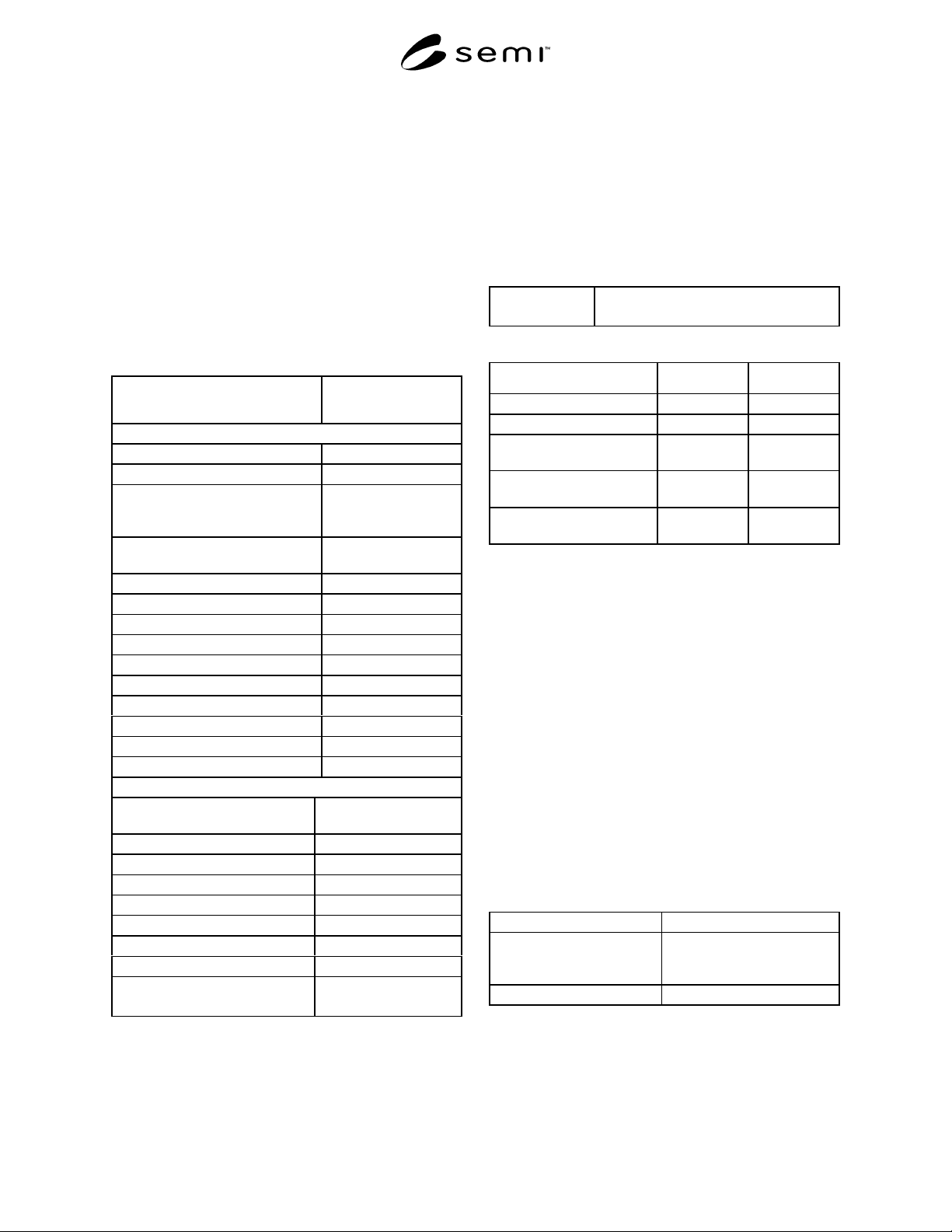
2 Specifications
QUALITY: 99.994%
Impurities Maximum Acceptable
Level (ppm)
Gas Phase
Carbon Monoxide (CO) 0.1
Carbon Dioxide (CO
2
)0.1
Chlorosilanes (ionizable chlorides)
including HCl, reported as chloride
(Cl
-
)
1
Non-methane Hydrocarbons
(C
2
-C
4
)
0.1 total
Hydrogen (H
2
)50
Methane (CH
4
)0.1
Nitrogen (N
2
)1
Argon (Ar) 1
Disiloxane (H
3
SiOSiH
3
)1
Methyl Silane (SiH
3
-CH
3
)1
Disilane (Si
2
H
6
)1
Water (H
2
O)(vol/vol) 1
Particles (See NOTE 1.)
Total Specified Impurities 57.4
Deposited Layer
Carbon (C) 0.5 ppma
(See NOTE 2.)
Oxygen (O) 1 ppma (See NOTE 2.)
Aluminum (Al) 0.2 ppba (See NOTE 2.)
Antimony (Sb) 0.2 ppba (See NOTE 3.)
Arsenic (As) 0.2 ppba (See NOTE 3.)
Boron (B) 0.2 ppba (See NOTE 3.)
Gallium (Ga) 0.2 ppba (See NOTE 3.)
Phosphorus (P) 0.2 ppba (See NOTE 3.)
Chromium (Cr)+ Copper (Cu)+
Iron (Fe)+ Nickel (Ni)+ Zinc (Zn)
1.0 ppba
total (See NOTE 3.)
NOTE 1: To be determined between supplier and user.
NOTE 2: ppma is defined to be atoms of impurity per 10
6
atoms of
silicon.
NOTE 3: ppba is defined to be atoms of impurity per 10
9
atoms of
silicon.
3 Electrical Specification
Resistivity greater than 2,000 ohm-cm
(n-type)
4 Physical Constants
Metric Units US Units
Molecular weight 32.112 32.112
Boiling point at 1 atm. -112°C -169°F
Density of gas at 21.1°C
(70°F) and 1 atm.
1.342 kg/m
3
0.0839 lb/ft
3
Specific gravity of gas at
21.1°C and 1 atm (air = 1)
1.114 1.114
Density of liquid at boiling
point
711 kg/m
3
44.39 lb/ft
3
5 Analytical Procedures (se e NOTE 1)
5.1 Carbon Monoxide, Carbon Dioxide, Argon,
Nitrogen and Methane — This procedure is for the
determination of of carbon monoxide, carbon dioxide,
argon, nitrogen and methane in silane using a gas
chromatograph with a discharge ionization detector.
5.1.1 Detection Limit — 30 ppb (mole/mole)
5.1.2 Instrument Parameters
5.1.2.1 Column:
HAYESEP D 60/80, 6.5 m (21.3 ft) by 3.2 mm (1/8 in)
OD by 2.2 mm (0.085 in) ID stainless steel; or
equivalent.
5.1.2.2 Carrier Flow — 25 mL/min helium
5.1.2.3 Sample Volume — 1 mL
5.1.2.4 Temperatures:
Detector 140°C
Column Oven 40°C for 4 min., to 120°C
at 10°C/min., hold 120°C
for 8 min.
Injection Temperature 45°C
5.1.3 Calibration Standards — 1 ppm (mole/mole) for
all components to be tested, balance helium.

SEMI C3.55-0200 © SEMI 2000 2
5.1.4 Operating Procedures
5.1.4.1 Inject the calibration standard and sample as
described in Section 6.6 of SEMI C3. The order of
elution is nitrogen, argon, carbon monoxide, methane,
and carbon dioxide. (See NOTE 2.)
5.1.4.2 Compare the average peak area of the
calibration standard to that of the silane sample being
tested. Calculate the concentrations of the analytes as
described in Section 6.8 of SEMI C3. The result shall
be reported in the unit of concentration needed and to
the number of significant digits of the variable with the
least number of significant digits. This value may not
exceed that specified in Section 2.
5.2 Total Chlorides — This procedure is for the
determination of total chlorides in silane by titration of
a hydrolyzed sample of silane. (See NOTE 1.)
5.2.1 Detection Limit — 0.5 ppm (mole/mole)
5.2.2 Instrument Parameters — See Figure 1.
5.2.2.1 Equipment
5.2.2.1.1 Safety purge regulator with proper fittings.
5.2.2.1.2 Flow meter capable of measuring 0.25
standard liters per minute (0.5 SCF/hour) (Brooks or
equivalent), calibrated for silane.
5.2.2.1.3 One cylinder of nitrogen with regulator.
5.2.2.1.4 One ice bath.
5.2.2.1.5 Three magnetic stirring bars.
5.2.2.1.6 Two 2000 mL heavy-duty sidearm flasks
(Fisher Cat. No. 10-181G or equivalent).
5.2.2.1.7 One #9 one-hole rubber stopper.
5.2.2.1.8 One #9 two-hole rubber stopper.
5.2.2.1.9 Two Pyrex-brand tubes with fritted cylinders
(Fisher Cat. No. 11-138B or equivalent).
5.2.2.1.10 One gas washing bottle with fritted
cylinder, 125 mL cap. (Fisher Cat. No. 03-040A or
equivalent).
5.2.2.1.11 One buret, 50 mL capacity with Teflon
stopcock (Fisher Cat. No. 03-700-22C or equivalent).
5.2.2.1.12 One buret stand (Fisher Cat. No. 14-688 or
equivalent).
5.2.2.1.13 Miscellaneous clamps, support stands, and
rubber hose.
5.2.2.1.14 Two 250 mL Erlenmeyer flasks.
5.2.2.2 Reagents
5.2.2.2.1 Potassium hydroxide flakes, technical (Fisher
Cat. No. P-246 or equivalent).
5.2.2.2.2 Mercuric nitrate crystal (Fisher Cat. No. M-
168 or equivalent).
5.2.2.2.3 Sodium chloride crystal (Fisher Cat. No. S-
271 or equivalent).
5.2.2.2.4 Diphenyl carbazone (Fisher Cat. No. D-86
or equivalent).
5.2.2.2.5 Bromophenol blue (Fisher Cat. No. B-392 or
equivalent).
5.2.2.2.6 Nitric acid (Fisher Cat. No. AA-200 or
equivalent).
5.2.2.2.7 Ethanol, denatured (Fisher Cat. No. AA-407
or equivalent).
5.2.3 Operating Procedure
5.2.3.1 Assemble apparatus as shown in Figure 1 and
purge entire system with nitrogen for 30 minutes.
5.2.3.2 Fill each 2000 mL sidearm flask with about
1700 mL of 15% potassium hydroxide solution (15 g
KOH per each 100 mL water).
5.2.3.3 Fill the gas washing bottle with about 75 mL
of deionized water that has been degassed.
5.2.3.4 Pass exactly one cubic foot of silane through
the system at a rate of 0.5 cubic feet per hour.
5.2.3.5 Stop silane flow and purge system for 30
minutes.
5.2.3.6 Remove gas washing bottle fro m system and
transfer contents quantitatively and with the aid of three
25 mL deionized water washings, to a 250 mL
Erlenmeyer flask.
5.2.3.7 Add a few drops of indicator solution, 5 g
diphenyl carbazone plus 0.5 g bromophenol blue
dissolved in 750 mL ethanol, plus 250 mL deionized
water.
5.2.3.8 Add, in a drop-wise fashion, sufficient 0.2 N
HN0
3
(13 mL concentrated. HN0
3
, diluted to 1 L in
deionized water) in order to just turn the solution to
yellow from purple.
5.2.3.9 Titrate with a solution of mercuric nitrate
Hg(NO
3
)
2
, (diluted to 1000 mL in deionized water; then
50 mL diluted to 500 mL in deionized water) which has
been previously standardized to 5.0 mL of a sodium
chloride solution (approximately 165 ng NaCl,
accurately weighed, dissolved in 100 mL deionized
water).
SEMI C3.55-0200 © SEMI 20003
5.2.4 Calibration
5.2.4.1 Run titration blank consisting of 150 mL
deionized water.
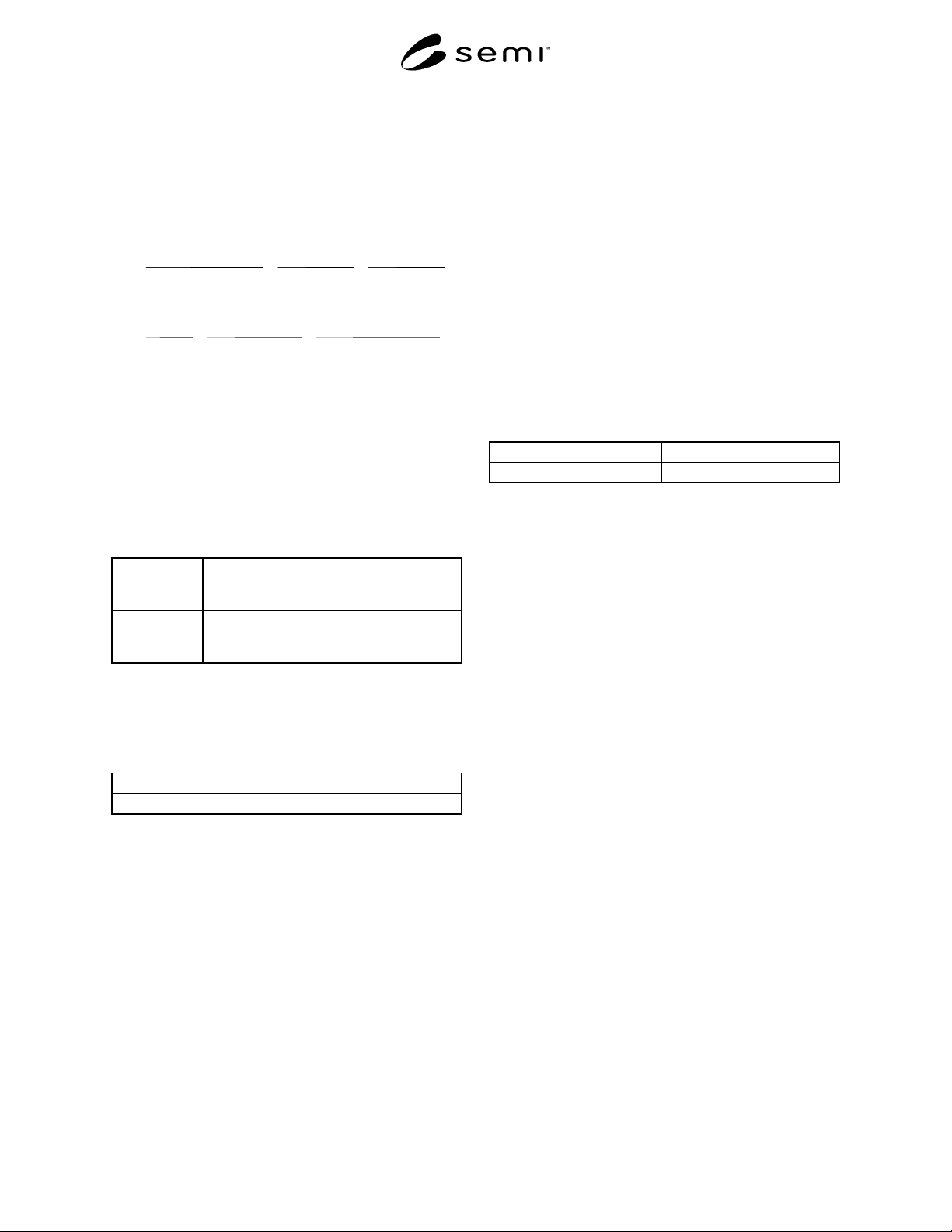
5.2.4.2 Calculate the concentration of chloride, using
the formula below. The result may not exceed the
specification in Section 2 of this standard.
mL mL
mL mL
wt.NaCl(g)
100.0mL
60.66%Cl
100%NaCl
100mL
1L
0.005l
35.453g / mole
0.082atmL/ moleK
28.316L
sample blank
standard
blank
−
−
××
−
×
××
mL mL
mL mL
wt.NaCl(g)
100.0mL
60.66%Cl
100%NaCl
100mL
1L
0.005l
35.453g / mole
0.082atmL/ moleK
28.316L
sample blank
standard
blank
−
−
××
−
×
××
×
1 × 10
6
ppm = ppm Cl-
5.3 Hydrocarbons C
2
– C
4
— This procedure is for the
determination of hydrocarbons (methane, ethane, and
propane) in silane using a gas chromatograph with a
flame ionization detector.
5.3.1 Detection Limit — 50 ppb (mole/mole)
5.3.2 Instrument Parameters
5.3.2.1 Columns:
Column 1: VZ-10, 60/80, 2 m (6.6 ft) by 3.2 mm (1/8
in) OD by 2.2 mm (0.085 in) ID stainless
steel;
Column 2: VZ-10, 60/80, 1 m (3.3 ft) by 3.2 mm (1/8
in) OD by 2.2 mm (0.085 in) ID stainless
steel;
or equivalent.
5.3.2.2 Carrier Flow — 30 mL/min nitrogen
5.3.2.3 Sample Volume — 10 mL
5.3.2.4 Temperatures:
Detector 150°C
Column Oven 45°C
5.3.3 Calibration Standards — 1 ppm (mole/mole) for
all components to be tested, balance helium.
5.3.4 Operating Procedures — (see SEMI C3, Section
6, Gas Chromatography for standard procedures).
5.3.4.1 Inject the calibration standard and sample as
described in Section 6.6 of SEMI C3. The order of
elution is methane, ethane, propane and butane (see
NOTE 2).
5.3.4.2 Compare the average peak area of the methane
peak in the calibration standard to that of the
hydrocarbons found in the silane sample being tested.
Calculate the concentrations of the analytes as
described in Section 6.8 of SEMI C3 based on the
methane response. The result shall be reported in the
unit of concentration needed and to the number of
significant digits of the variable with the least number
of significant digits. This value may not exceed that
specified in Section 2.
5.4
Hydrogen — This procedure is for the
determination of hydrogen in silane using a gas
chromatograph with a thermal conductivity detector.
5.4.1 Detection Limit — 15 ppm (mole/mole)
5.4.2 Instrument Parameters
5.4.2.1 Columns:
Molecular sieve 5A, 2.4 m (8 ft) by 6.4 mm (1/4 in) OD
by 4.7 mm (0.185 in) ID, or equivalent.
5.4.2.2
Carrier Flow — 30 mL/min argon
5.4.2.3 Sample Volume — 1.0 mL
5.4.2.4 Temperatures:
Detector 40°C
Column Oven 40°C
5.4.3 Calibration Standards — 20–100 ppm
(mole/mole), balance argon.
5.4.4 Operating Procedures — (see SEMI C3, Section
6, Gas Chromatography for standard procedures)
5.4.4.1 Inject the calibration standard and sample as
described in Section 6.6 of SEMI C3. (See NOTE 2.)
5.4.4.2 Compare the average peak area of the
hydrogen peak in the calibration standard to that of the
hydrogen found in the silane sample being tested.
Calculate the concentrations of the analytes as
described in Section 6.8 of SEMI C3 based on the
methane response. The result shall be reported in the
unit of concentration needed and to the number of
significant digits of the variable with the least number
of significant digits. This value may not exceed that
specified in Section 2.
5.5
Disiloxane, Disilane and Methyl Silane — This
procedure is for the determination of disiloxane,
disilane and methyl silane in silane using a gas
chromatograph with flame ionization detector.
5.5.1 Detection Limit — 0.1 ppm (mole/mole)
5.5.2 Instrument Parameters
5.5.2.1 Column:
28% DC-200 on Chromosorb PAW, 45/60 mesh, 14 m
(46 ft) SS, or equivalent.
5.5.2.2 Carrier Flow — 30 mL/min helium
5.5.2.3 Sample Volume — 2 mL
5.5.2.4 Temperatures — Column 60°C