semi合集-English.pdf - 第4057页
SEMI F54-1000 © SEMI 2000 2 6 Summary of Method 6.1 The m easurement is performed u s ing aerosol standards consisting of N aCl particl es sus pended in air. Aeros ols are produced by nebulizing a solu tio n of Na Cl in …

SEMI F54-1000 © SEMI 20001
SEMI F54-1000
TEST METHOD FOR MEASURING THE COUNTING EFFICIENCY OF
CONDENSATION NUCLEUS COUNTERS
This test method was technically approved by the Global Facilities Committee and is the direct responsibility
of the North American Facilities Committee. Current edition approved by the North American Regional
Standards Committee on July 13, 2000. Initially available on SEMI OnLine August 2000; to be published
October 2000. Previously published June 2000.
1 Purpose
1.1 Particle specifications for gases require the use of
condensation nucleus counters (CNCs) having specified
counting efficiencies. This document provides the test
method for determining the counting efficiencies of
CNCs.
2 Scope
2.1 This document provides the method for 1)
generating an aerosol standard consisting of sodium
chloride (NaCl) particles having sizes 0.01 micrometer
and larger suspended in air at atmospheric pressure (1 ×
10
5
Pa), 2) controlling the size and concentration of
particles in the aerosol, and 3) using the aerosol to
determine the counting efficiency of a CNC as a
function of particle size. This method is suitable for
CNCs having a lower size sensitivity of 0.01
micrometer or larger.
NOTE
1: Suitable test methods for calibrating optical particle
counters are contained in ASTM F328 and JIS B 9921.
2.2 This standard does not purport to address safety
issues, if any, associated with its use. It is the
responsibility of the users of this standard to establish
appropriate safety and health practices and determine
the applicability of regulatory limitations prior to use.
3 Limitations
3.1 This document does not provid e the method for
adjusting the CNC’s counting efficiency.
3.2 This document does not provid e the method for
determining the CNC
’s background noise level,
maximum concentration limit, or maximum detectable
particle size.
4 Referenced Standards
4.1 ASTM standards
1
ASTM D1193 — Standard Specification for Reagent
Water
1 American Society of Testing and Materials, 1916 Race Street,
Philadelphia, PA 19103, USA
ASTM F328 — Standard Practice for Calibration of an
Airborne Particle Counter Using Monodisperse
Spherical Particles
4.2 JIS standard
2
JIS B 9921 — Japanese Industrial Standard, Light
Scattering Automatic Particle Counter
NOTE 2: As listed or revised, all documents cited shall be the
latest publications of adopted standards.
5 Terminology
5.1 aerosol electrometer — an instrument that
converts the charge flow in an aerosol stream to an
electrical current signal.
5.2 aerosol standard — an aerosol containing particles
of a known size and concentration.
5.3 coincidence error — the inaccuracy in a measured
particle concentration caused by multiple particles in
the optical sensing volume of an instrument.
5.4 concentration limit — the maximum concentration
of particles in an aerosol to avoid a coincidence error of
10% or greater in an instrument.
5.5 counting efficiency — the ratio of the
concentration of particles reported by the CNC to that
reported simultaneously from the same aerosol by a
reference instrument.
5.6 lower size sensitivity — the particle size
corresponding to 50% counting efficiency for the CNC.
5.7 monodisperse aerosol — an ae rosol having a
narrow distribution of particle sizes. The maximum
band width of a monodisperse aerosol is defined in
Section 8.7.
5.8 particle concentration — the number of particles
per unit volume in a gas.
5.9 polydisperse aerosol — an aerosol having a wide
distribution of particle sizes.
NOTE 3: Additional terminology is contained in ASTM F328
and JIS B 9921.
2 Japanese Standards Association, 1-24, Akasaka 4-chome, Minato-
ku, Tokyo 107, Japan

SEMI F54-1000 © SEMI 2000 2
6 Summary of Method
6.1 The measurement is performed using aerosol
standards consisting of NaCl particles suspended in air.
Aerosols are produced by nebulizing a solution of NaCl
in water. After drying and charge neutralization,
particles of the required size are extracted from the
aerosol using an electrostatic classifier (EC). The
concentration of particles in the resulting monodisperse
aerosol is then recorded by the CNC and compared to
that measured simultaneously by a reference
instrument. Examples of suitable reference instruments
are described in Section 8.8.
NOTE 4: This method has been shown to provide repeatable
results in tests performed in separate laboratories on similar
CNCs. Examples of these tests are found in Agarwal and
Sem
3
and Bartz, et al
4
.
7 Requirements
7.1 The reference instrument must have a proven
counting efficiency
of not less than 95% over the entire
range of particle sizes tested. Low counting efficiency
in the reference instrument results in an error in the
measured particle concentration. The counting
efficiency for the reference instrument must be checked
by the manufacturer against a calibrated standard, such
as a calibrated aerosol electrometer.
7.2 Coincidence error in either the CNC or the
reference instrument causes inaccuracy in the measured
particle concentration. The concentration limit for each
instrument must be obtained from the manufacturer’s
specifications. The particle concentration in the aerosol
standard must be kept below both concentration limits.
7.3 When an aerosol electrometer is used as the
reference instrument, the minimum detectable particle
concentration must be obtained from the manufacturer’s
specifications. A particle concentration below the
minimum detectable value will cause inaccurate results.
The particle concentration in the aerosol standard must
be kept above the minimum detectable particle
concentration.
7.4 The transport loss of particles from the EC to the
CNC, and from the EC to the reference instrument must
be checked. Any disparity in particle transport loss to
the two instruments will cause erroneous results. The
method for calculating the transport loss of particles in
3 Agarwal, J. K. and Sem, G. J. Continuous Flow, Single-Particle-
Counting Condensation Nucleus Counter. Journal of Aerosol
Science, 11: 343-357 (1980)
4 Bartz, H., Fissan, H., Helsper, C., Kousaka, Y., Okuyama, K.,
Fukushima, N., Keady, P. B., Kerrigan, S., Fruin, S. A., McMurry, P.
H., Pui, D. Y. H. and Stolzenburg, M. R. Response Characteristics for
Four Different Condensation Nucleus Counters to Particles in the 3-
50 nm Diameter Range. Journal of Aerosol Science, 16 (5): 443-456
(1985)
sample lines is found in Pui, et al
5
. The transport loss
must be calculated for each particle size tested. Record
all transport loss calculations.
7.5 When an aerosol electrometer is used as the
reference instrument, a correction must be made for
multiple charging of particles in the aerosol standard.
Multiple charging can cause substantial error when
measuring particles larger than 0.06 micrometer. The
correction factor for multiple charging must be obtained
from the manufacturer of the EC. An example of the
method for calculating the correction factor is found in
Liu and Pui
6
.
8 Apparatus
8.1 Atomizer — A sub-micrometer aerosol generator
capable of nebulizing a liquid solution. The atomizer
must be capable of producing a stable aerosol
containing particles as small as 0.01 micrometer after
drying.
8.2 Liquid Trap — A device which allows free
passage of an aerosol stream containing sub-micrometer
particles, but which removes the entrained liquid phase
by gravitational settling into a reservoir.
8.3 Diffusion Drier — A device which allows free
passage of an aerosol stream containing sub-micrometer
particles, but which dries the aerosol by diffusion of
water vapor into a surrounding desiccant medium. The
design flow rate of the diffusion drier must at least
match the output flow rate of the atomizer.
8.4 Aerosol Neutralizer — A bipolar charging device
which neutralizes aerosols by producing both positive
and negative air ions. The neutralizer must reduce the
charge on the particles to the Boltzmann equilibrium
level. The design flow rate of the neutralizer must at
least match the output flow rate of the atomizer.
8.5 Bypass Filter — A high efficie ncy point of use gas
filter. The design flow rate of the bypass filter must at
least match the output flow rate of the atomizer.
8.6 Mixing Vessel — A device which disperses
particles in a flowing aerosol by inducing turbulence.
8.7 Electrostatic Classifier (EC) — A device which
extracts particles from a polydisperse aerosol according
to their electrical mobility. The electrical mobility of a
particle depends upon its size and charge. The
EC must
extract a monodisperse aerosol standard having a
5 Pui, D. Y. H, Ye, Y. and Liu, B. Y. H. Sampling, Transport, and
Deposition of Particles in High Purity Gas Supply System.
Proceedings 9th ICCCS: 287-293, (1988)
6 Liu, B. Y. H. and Pui, D. Y. H. A Submicron Aerosol Standard and
the Primary, Absolute Calibration of the Condensation Nuclei
Counter. Journal of Colloid and Interface Science, 47 (1): 155-171
(1974)
SEMI F54-1000 © SEMI 20003
narrow band width. The mobility band width of the
extracted aerosol must be no greater than 20% of the
mean particle mobility. The method for calculating
electrical mobility and mobility band width are found in
Liu and Pui
6
.
8.8 Reference Instrument — An instrument which can
measure the concentration of particles in an aerosol.
The calibration of the reference instrument must have
been checked against a calibrated standard within the
past 12 months. Calibration and maintenance records
for the reference instrument must be maintained.
Suitable reference instruments include aerosol
electrometers and CNCs having lower size sensitivities
below 0.01 micrometer.
8.9 Condensation Nucleus Counter (CNC) or
Condensation Particle Counter (CPC) — The particle
counter to be used in process gas particle
measurements, and for which the calibration check is
required. The CNC detects sub-micrometer particles
using nucleation and droplet growth of a super-
saturated working fluid.
8.10 Tubing — In order to minimize particle losses, all
tubing used to transport charged aerosol particles must
be constructed from electrically conductive materials
(e.g., stainless steel) and grounded.
9 Reagents and Materials
9.1 De-ionized or distilled water in accordance with
ASTM D1193, Type 1 is required to dissolve NaCl for
aerosol generation.
9.2 NaCl is required for aerosol generation.
9.3 A supply of dry, oil-free compressed air is
required to generate and transport aerosols in the
apparatus.
10 Preparation of Apparatus
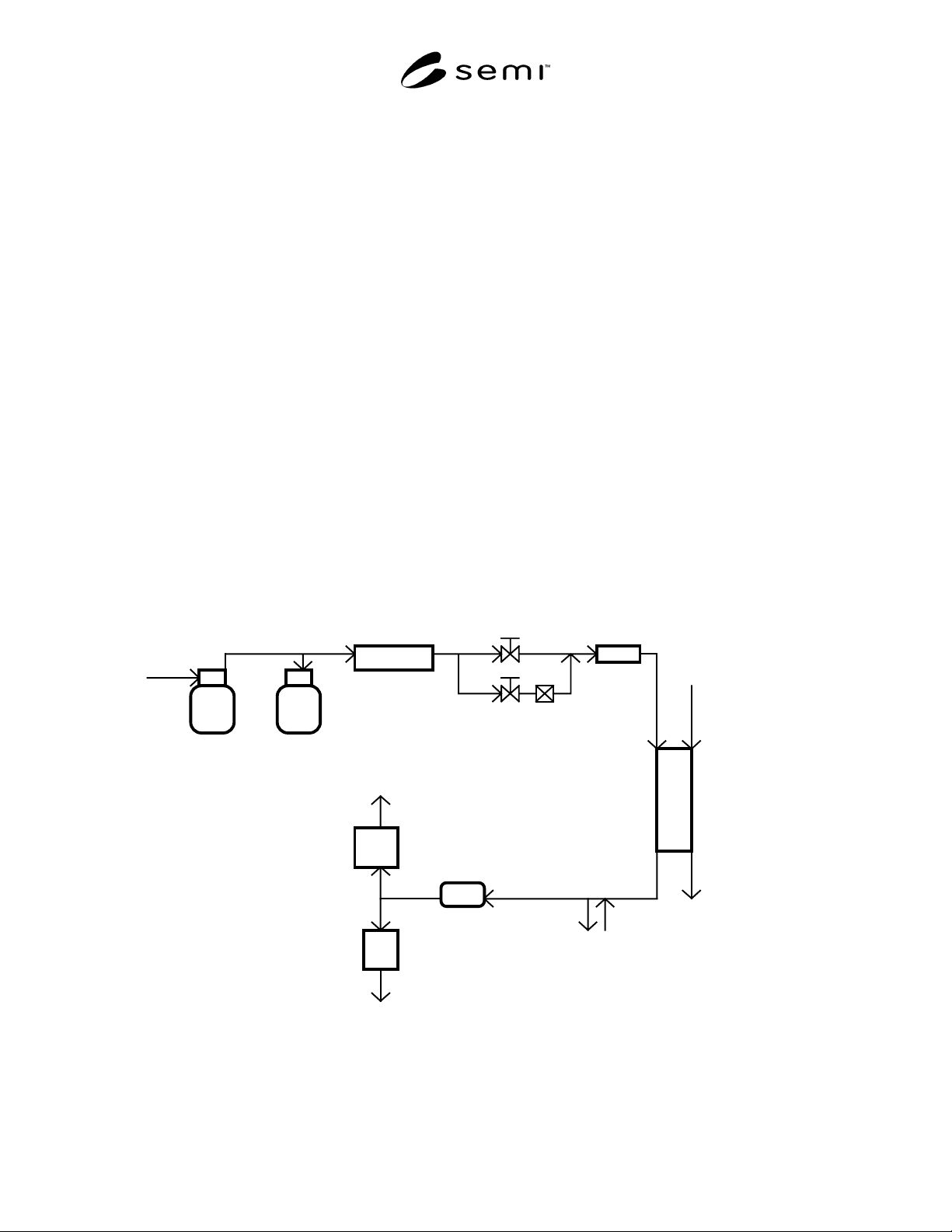
10.1 The test apparatus is shown in Figure 1. The
particle concentration in the aerosol is controlled using
a bypass filter. If the flow rate of the monodisperse
aerosol from the EC is insufficient to supply the CNC
and reference instrument simultaneously, filtered air
must be added to the stream. The air must be added to
the aerosol upstream of a mixing vessel. If the flow
rate of the monodisperse aerosol from the EC is greater
than that required to supply the CNC and reference
instrument simultaneously, the excess aerosol must be
vented.
Compressed
Air
Liquid
Trap
Diffusion
Drier
Bypass Filter
for Dilution
A
erosol
Neutralizer
A
tomizer
Sheath Air
Excess Air Vent
Electrostatic
Classifier
Monodisperse
Reference
Instrument
Nucleus
Counter
Filtered
Filtered
Mixing
Vessel
Filtered Make-Up Air
or Excess Aerosol Vent
A
erosol Standard
Condensation
Vent
V
ent
(CNC)
(EC)
Figure 1
Schematic Diagram of Test Apparatus