semi合集-English.pdf - 第5908页
SEMI P39-0304 E2 © SEMI 2004 11 7.7.8 EXCEPTION HANDLING — A point-list type outside the range of 0 to 5 sh ould be treated as a fatal error. For po int-list types 0-1, successiv e coincident points and/ or adjacent coli…
SEMI P39-0304
E2
© SEMI 2004 10
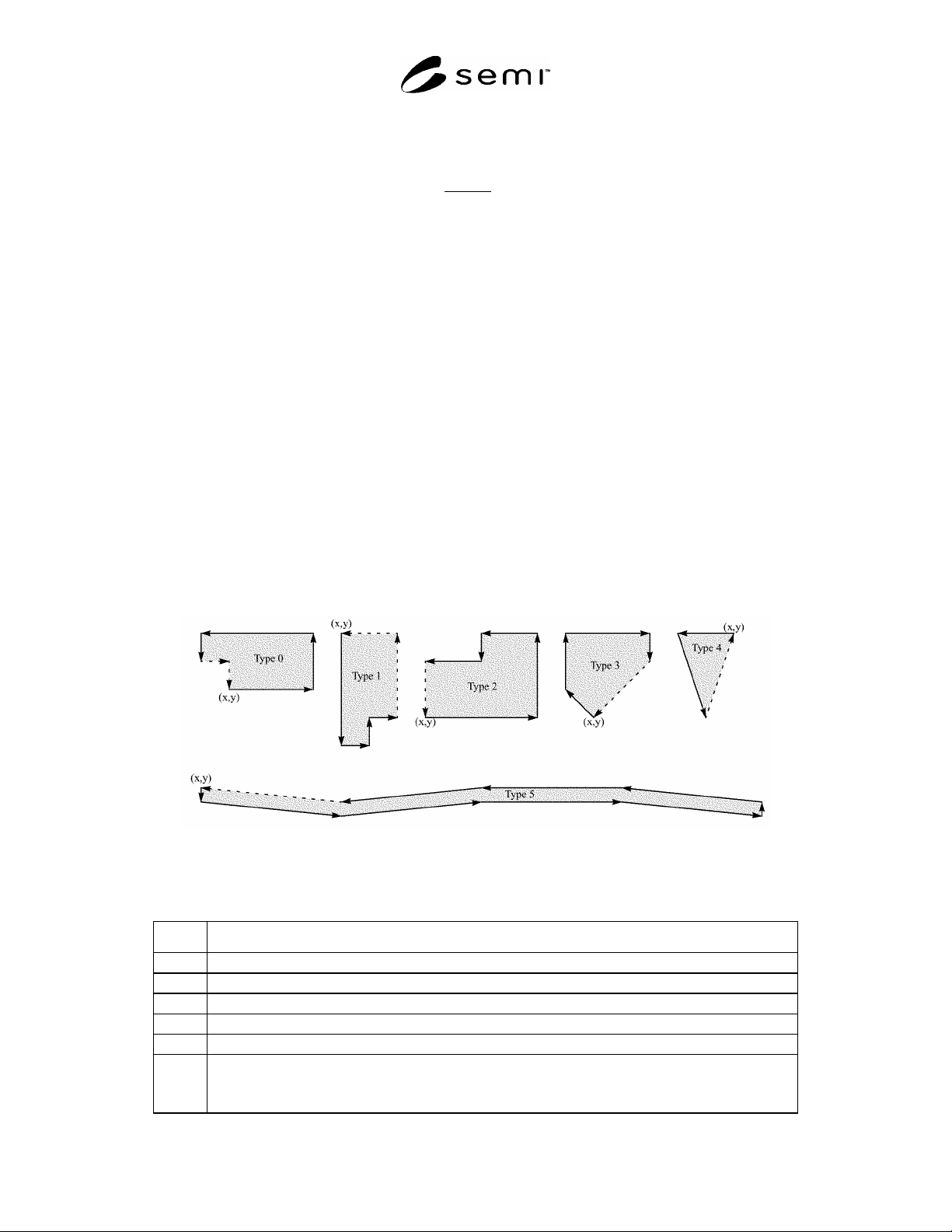
edge, and the starting point. When describing a polygon, vertex-count must be an even number greater than or equal
to 2.
7.7.3 A point-list of type 1 consists of a list of 1-deltas, representing alternating vertical and horizontal relative
displacements, with the first displacement implicitly vertical
. When describing a polygon point-list in this form, the
final two displacements are omitted, since they can be unambiguously implied from the current point, the last edge,
and the starting point. When describing a polygon, vertex-count must be an even number greater than or equal to 2.
7.7.4 A point-list of type 2 consists of a list of 2-deltas, representing a series of manhattan relative displacements.
When describing a polygon point-list in this form, the final displacement is omitted, since the polygon is assumed to
be implicitly closed, but this final implicit displacement must be a manhattan displacement, with either x = 0 or
y = 0.
7.7.5 A point-list of type 3 consists of a list of 3-deltas, representing a series of octangular relative displacements.
When describing a polygon point-list in this form, the final displacement is omitted, since the polygon is assumed to
be implicitly closed, but this final implicit displacement must be an octangular displacement at an angle that is an
integral multiple of 45°.
7.7.6 A point-list of type 4 consists of a list of g-deltas, representing a series of any-angle relative displacements.
When describing a polygon point-list in this form, the final displacement is omitted, since the polygon is assumed to
be implicitly closed.
7.7.7 A point-list of type 5 consists of a list of g-deltas, representing a series of adjustments to a relative
displacement vector, with the initial vector set to (x = 0, y = 0). To calculate the coordinates of each successive
point, the x and y components of each successive g-delta are added to the relative displacement vector, which in turn
describes the relative displacement from the current point to the next point. When describing a polygon point-list in
this form, the final displacement is omitted, since the polygon is assumed to be implicitly closed. This form of point-
list is intended to allow more compact representation of polygons and paths which are approximations of large-field
curvilinear figures on a fine grid, where the curvature is not extreme.
Figure 6
Point List Describing Polygons
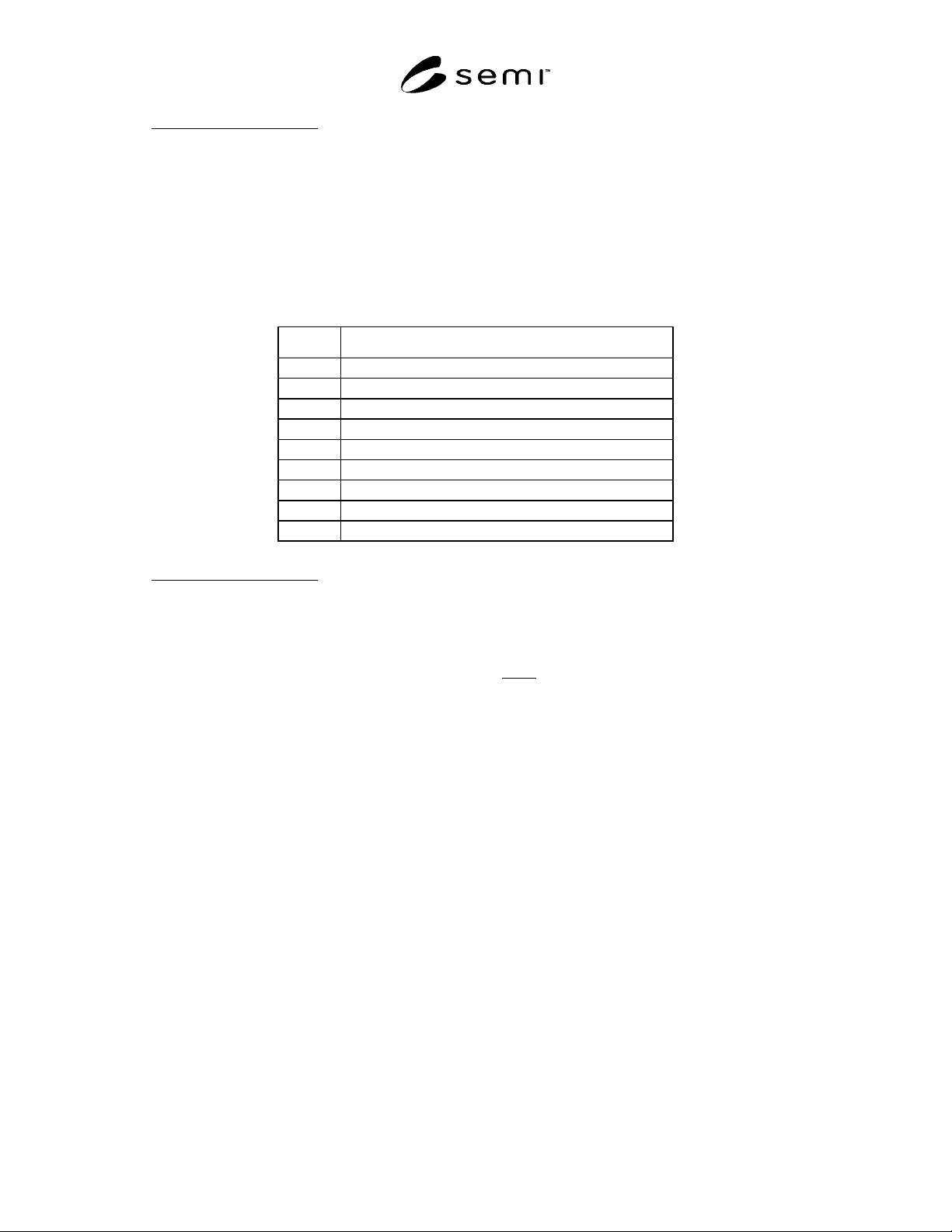
Table 8 Polygon Point List for Figure 6
Type Bit Pattern
0 00000000 00000100 00001100 00001000 00010001 00000101
1 00000001 00000100 00010001 00000100 00000100 00000100
2 00000010 00000101 00100000 00011001 00010010 00001011 00010010
3 00000011 00000100 00010101 00100001 00110000 00010011
4 00000100 00000010 01000100 00001001 00001101
5 00000101 00001001 00000001 00000011 00101001 00000000 00000001 00000100
00000001 00000011 00000001 00000011 00101011 00000100 00101011 00000000
00000001 00000011 00000001 00000011
SEMI P39-0304
E2
© SEMI 2004 11
7.7.8 EXCEPTION HANDLING — A point-list type outside the range of 0 to 5 should be treated as a fatal error.
For point-list types 0-1, successive coincident points and/or adjacent colinear edges are not permitted. A non-
manhattan implicit closing vector for a polygon using point-list type 2, or a non-octangular implicit closing vector
for a polygon using point-list type 3 should be treated as a fatal error. For polygons using point-list types 0-1, a
vertex count which is odd or less than 2 should be treated as a fatal error.
7.8 Property Values
7.8.1 A property-value stores one element of a property value list. It consists of an unsigned-integer which encodes
its type, followed by either the value itself or a reference number. Types 0-7 are reals which conform to the scheme
described in Table 3 on page 5.
Table 9 Property Value Types
Type Format
0-7 real (see Table 3)
8
unsigned-integer
9
signed-integer
10
a-string
11
b-string
12
n-string
13 propstring-reference-number (implied a-string)
14 propstring-reference-number (implied b-string)
15 propstring-reference-number (implied n-string)
7.8.2 EXCEPTION HANDLING
— A property-value type outside the range of 0 to 15 should be treated as a fatal
error. Use of a propstring-reference-number for which there is no corresponding PROPSTRING record within
the same OASIS file should be treated as a fatal error.
8 CELL Referencing
8.1 As in GDSII Stream, cells in OASIS are identified by name
. The CELL record not only introduces a cell
definition but also defines its name. PLACEMENT records refer by name to the cell being placed. As in GDSII
Stream, there are no “anonymous” cells in OASIS.
9 Layers, Datatypes, and Texttypes
9.1 As in GDSII Stream, every <geometry> has associated with it a layer number and a datatype number and every
text element has associated with it a textlayer number and a texttype number.
10 Modal Variables
10.1 For compaction purposes, selected data elements in many OASIS records may be implicitly specified through
the use of modal variables or stored state. At the beginning of the file, and whenever a CELL or <name> record is
encountered, all modal variables with the exception of placement-x, placement-y, geometry-x, geometry-y, text-x,
and text-y, are set to a state of undefined; the exceptions just mentioned are set to 0. As various elements appear in
the cell’s description, modal variables related to those elements are set from the elements’ definitions. These modal
variables can then be used implicitly by successive elements. A modal variable may hold a single value such as
geometry-w, or a multi-variable structure such as a repetition.
SEMI P39-0304
E2
© SEMI 2004 12
Table 10 Modal Variables
Modal Variables Related Records
repetition
PLACEMENT, TEXT, POLYGON, PATH,
RECTANGLE, TRAPEZOID, CTRAPEZOID,
CIRCLE, XGEOMETRY
placement-x, placement-y, placement-cell
PLACEMENT
layer, datatype POLYGON, PATH, RECTANGLE, TRAPEZOID,
CTRAPEZOID, CIRCLE, XGEOMETRY
textlayer, texttype, text-x, text-y, text-string
TEXT
geometry-x, geometry-y
POLYGON, PATH, RECTANGLE, TRAPEZOID
CTRAPEZOID, CIRCLE, XGEOMETRY
xy-mode
PLACEMENT, TEXT, POLYGON, PATH,
RECTANGLE, TRAPEZOID, CTRAPEZOID,
CIRCLE, XGEOMETRY, XYABSOLUTE,
XYRELATIVE
geometry-w, geometry-h
RECTANGLE, TRAPEZOID, CTRAPEZOID
polygon-point-list
POLYGON
path-halfwidth, path-point-list, path-start-extension,
path-end-extension
PATH
ctrapezoid-type
CTRAPEZOID
circle-radius
CIRCLE
last-property-name, last-value-list
PROPERTY
10.2 Modal variable xy-mode governs the interpretation of the x and y fields for those related record types indicated
in Table 10. Two interpretation modes are provided: absolute and relative. See Section 21 on page 17 for a
discussion of how these two modes work.
10.3 EXCEPTION HANDLING
— An OASIS record which implicitly references a modal variable which is in the
undefined state should be treated as a fatal error.
11 Records
11.1 The basic unit of information in an OASIS file is a record. A record consists of a single unsigned-integer
which encodes the record-ID, followed by the remainder of the record’s descriptive data. In this specification,
record-ID values are displayed as decimal numbers enclosed in apostrophes.
11.2 The CBLOCK record is a special case since it encapsulates a series of ordinary records in byte-compressed
form. When a CBLOCK record is encountered while reading an OASIS file, it is first necessary to decompress its
data, which will produce one or more ordinary records, which can in turn be decoded. For more information on
CBLOCK records refer to Section 35 on page 26.
11.3 Most records have an implicit length—the record must be parsed and decoded in order to determine its length.
The XNAME, XELEMENT, and XGEOMETRY records are exceptions to this. They encapsulate all of their user-
defined data in a single variable-length b-string, so they can be used for prototyping new record types, hiding
embedded proprietary data, supporting local non-interoperable extensions, etc. without rendering an OASIS file
illegible to older readers, which can simply note the string length and skip over the record.
11.4 EXCEPTION HANDLING
— OASIS processors should treat the nesting of a CBLOCK record within another
CBLOCK record as a fatal error.
12 PAD Record
12.1 A PAD record provides a simple way to reserve space within an OASIS file. It has the following format:
‘0’