semi合集-English.pdf - 第2765页
SEMI E98-1102 © SEMI 2000, 2002 30 10.5.7.1 Abort 10.5.7.1.1 On receipt of an Abort reque st from the user, the module shall stop all of its curren t activity as soon as it is safe to do so. It should remove any material…
SEMI E98-1102 © SEMI 2000, 2002 29
10.5.6 AbstractEquipmentModule Attributes
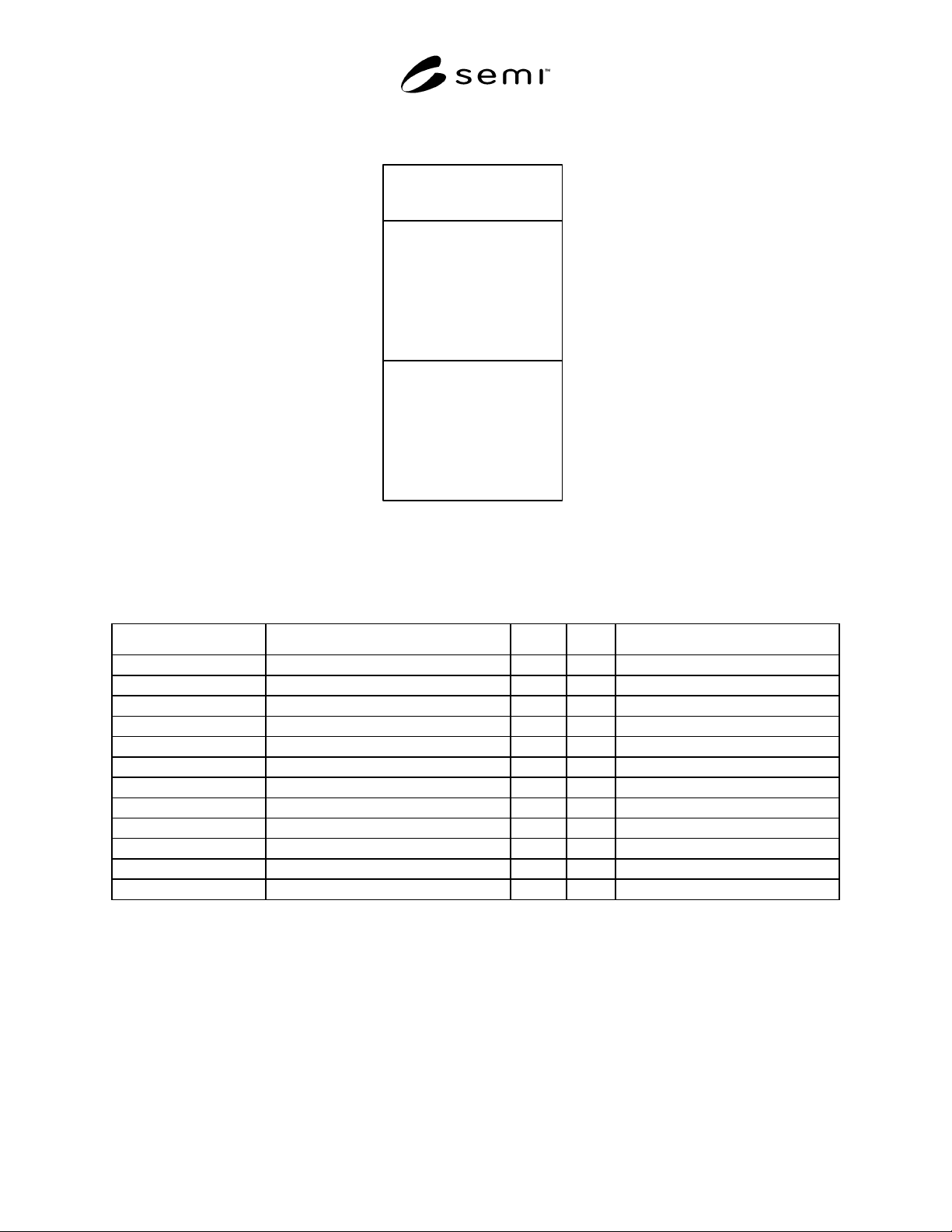
10.5.6.1 The AbstractEquipmentModule Object is shown in Figure 19.
Model
ModelRevision
Nickname
BehaviorState
PreviousBehaviorState
ProcessSetup
ProcessType
ProcessCapabilitiesList
SoftwareVersions
AbstractEquipment
Module
Abort
AddProcessCapability
Pause
RemoveProcessCapability
Resume
Shutdown
Start
Startup
Stop
Figure 19
AbstractEquipmentModule Object Type
10.5.6.2 Attributes of the AbstractEquipmentModule are defined in Table 13.
Table 13 AbstractEquipmentModule Attribute Definition
Attribute Name Definition Access Reqd Form
ObjType Object type RO Y Text=“AbstractEquipmentModule”
ObjID Object identifier RO Y Text
Nickname User-assigned name RW Y Text
Model Model designator RO Y Text
ModelRevision Model Revision RO Y Text
BehaviorState Current substate of BEHAVIOR RO Y Enumerated
ProcessType Characterization of processes for user RW Y Text
ProcessCapabilityList One or more specific process capabilities RO Y List of text
PreviousBehaviorState The previous operations state RO Y Enumerated
ProcessSetup Name of current setup. RW Y Text
SoftwareVersions The set of software versions installed RO Y Ordered list of text
Units Type of material held RO Y Text
NOTE 1: Required if the AbstractEquipmentModule provides recipe execution services.
10.5.7 AbstractEquipmentModule Services — The AbstractEquipmentModule has one or more automated activities,
including its normal process (its intended function). The user shall be able to start, stop, abort, and resume the
activities of the module.
NOTE 4: Changing the operational state of an individual AbstractEquipmentModule within a multi-process Equipment during
automatic processing will affect both upstream and downstream operations. The Equipment is responsible for determining the
impact on other AbstractEquipmentModules.
NOTE 5: Directly changing the operational state of the AbstractEquipmentModule is not the same as changing the state of a job
or as changing the operational state of the Equipment. The equipment supplier shall document the relationships between the
operational state of the Equipment, the AbstractEquipmentModule, and the different job types that it supports.
SEMI E98-1102 © SEMI 2000, 2002 30
10.5.7.1 Abort
10.5.7.1.1 On receipt of an Abort request from the
user, the module shall stop all of its current activity as
soon as it is safe to do so. It should remove any
material in process within the module whenever
possible to do so safely.
10.5.7.1.2 A module may also self-abort when it
detects a dangerous condition.
10.5.7.1.3 In the Behavior State Model, the module
shall transition from ACTIVE SERVICE to
ABORTING when an abort occurs. When all activity
has ceased other than normal background activities for
environmental control, the module transitions to
ABORTED. The module shall not start a new activity
until it is instructed to do so by the user or the user
instructs it to return to IDLE.
10.5.7.2 Add Process Capability — ProcessCapabil-
ityList is an attribute of the equipment module and con-
sists of a list of text strings representing process capa-
bilities that are meaningful to the user. Individual capa-
bilities are added by the factory to recognize the type of
processes the equipment module may be able to run.
10.5.7.3 Pause
10.5.7.3.1 On receipt of a Pause request from the user,
the module shall suspend its activity at the next logical
point in the process from which it will be able to
resume activities at a later time and which will prevent
unintended change to the product. It shall not accept
new work while it is in this state.
10.5.7.3.2 In many cases, to avoid unintended change
to the product, the AbstractEquipmentModule should
wait until the current product has been removed and
then pause, preventing new product from entering.
10.5.7.4 Remove Process Capability — This allows the
factory to remove from the ProcessCapabilityList a
capability that is no longer required or one that can not
be performed by the equipment due to environment or
actual physical changes in the equipment.
10.5.7.5 Resume — When a Resume request is received
during a PAUSE state, the module shall resume its
activity from the point where it was paused.
10.5.7.6 Shutdown — The Shutdown request is used to
put an AbstractEquipmentModule in a state where it is
safe to turn off its power and remove it from the
equipment. The specific operations shall be
documented by the supplier.
10.5.7.7 Start
10.5.7.7.1 Some activities may require specific Start
instructions.
10.5.7.7.2 The user may issue a Start Activity request
to a specific AbstractEquipmentModule.
10.5.7.8 Startup — The Startup request is used when
an AbstractEquipmentModule has been shutdown. The
specific activities that result shall be documented by the
supplier.
10.5.7.9 Stop
10.5.7.9.1 On receipt of a Stop request from the user,
the module shall stop its current activity in an orderly
fashion as soon as it is safe to do so, with all product
material returned as would be expected had the activity
completed normally.
10.5.7.9.2 In the Behavior State Model, the module
shall transition from ACTIVE SERVICE to STOPPING
when a stop operation begins. When all activity has
ceased other than normal background activities for
environmental control, the module transitions to
STOPPED. The module shall not start a new activity
until it is instructed to do so by the user.
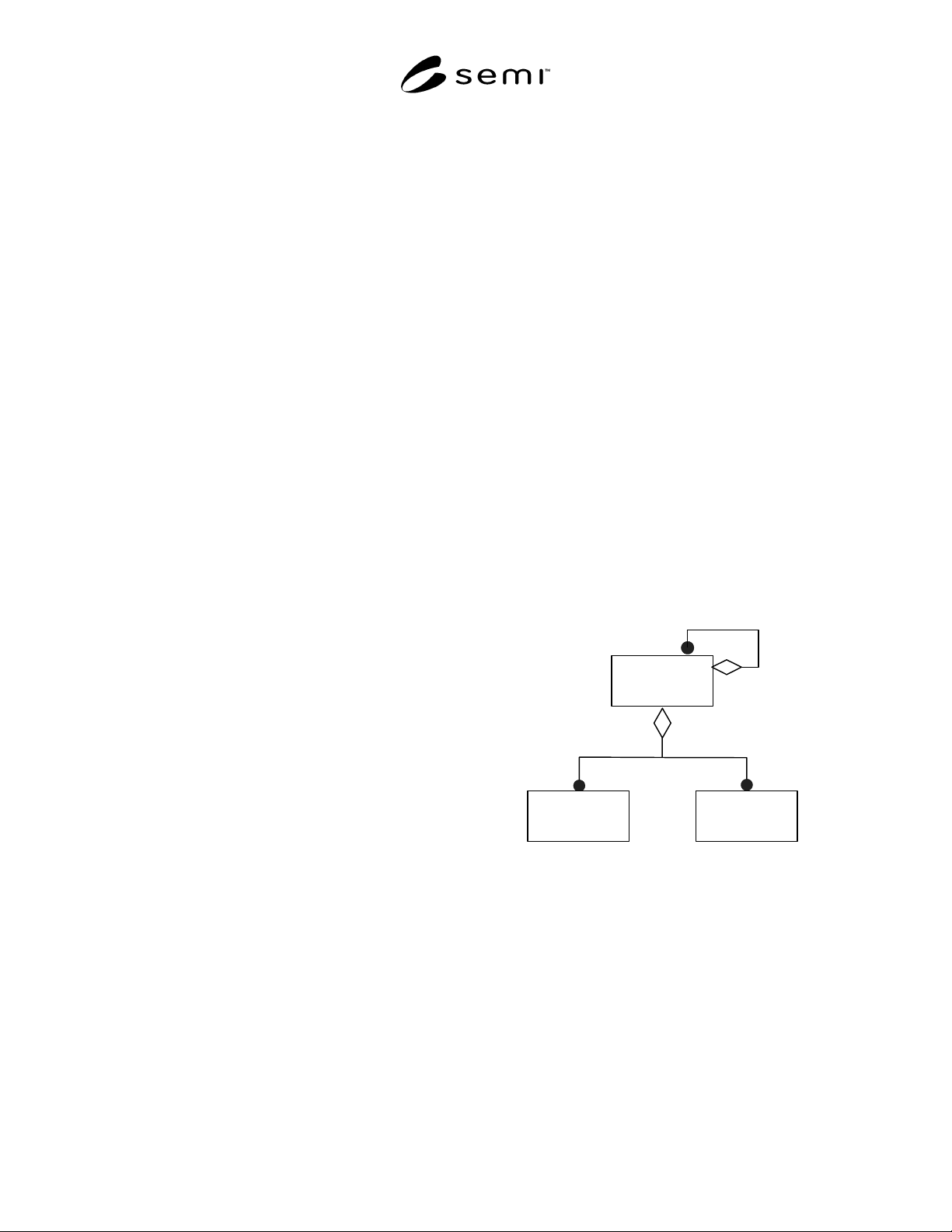
10.5.8 EquipmentModule Object — The Equipment-
Module is a type of AbstractEquipmentModule and
inherits all of its attributes, state models, relations, and
services. As shown in Figure 20, the Equipment-
Module may be an aggregate of EquipmentIODevice,
EquipmentSubsystem, and other EquipmentModule
objects.
Equipment
Module
M
PN
M + N + P >= 1
Equipment
I/ODevice
Equipment
Subsystem
Figure 20
EquipmentModule Aggregation
10.6 Equipment Object
10.6.1 The Equipment is a type of AbstractEquipment-
Module and supports all of the attributes, state models,
and services defined for the AbstractEquipmentModule.
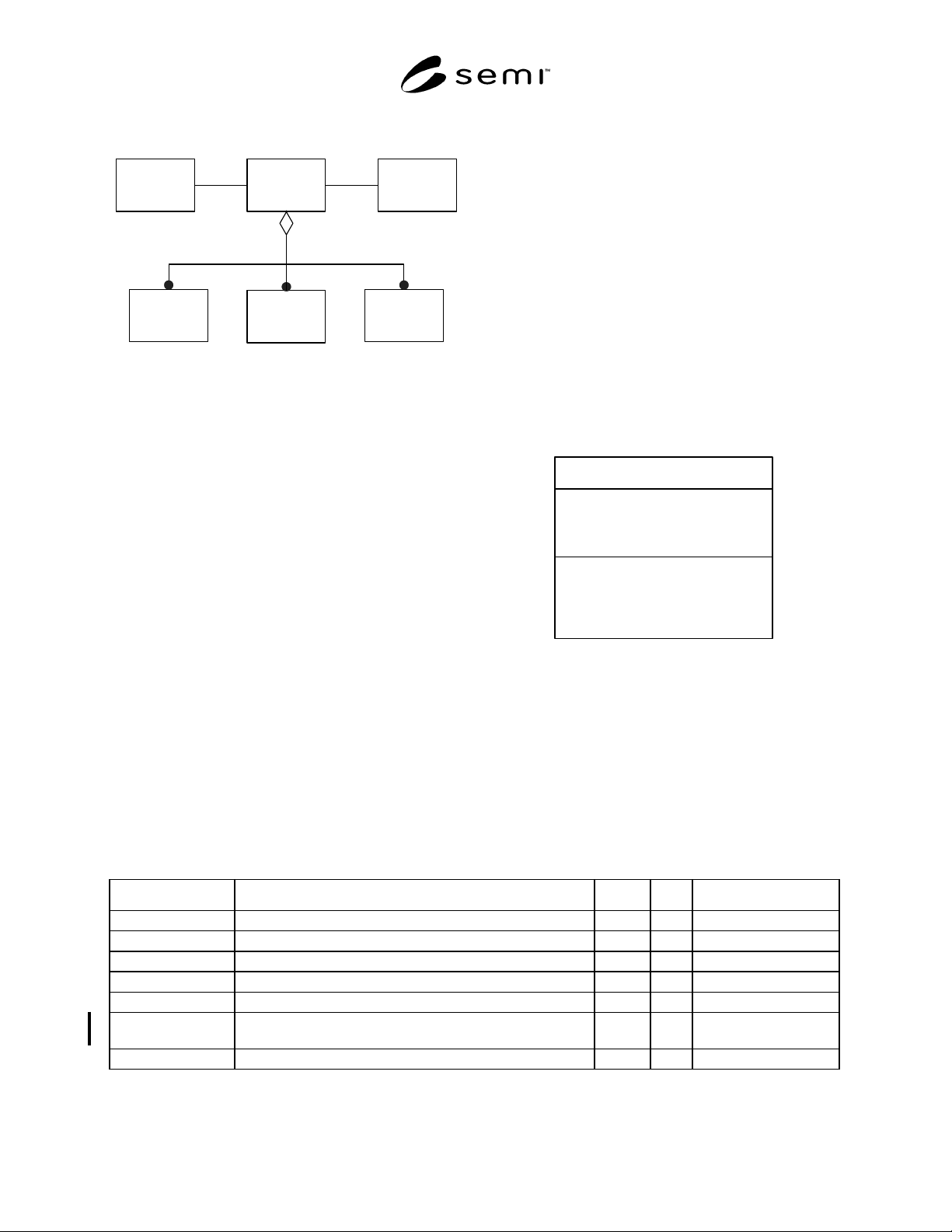
10.6.2 Equipment is an aggregation of Equipment-
Modules, EquipmentSubsystems, and EquipmentIO-
Devices objects and owns all the objects of which it is
SEMI E98-1102 © SEMI 2000, 2002 31
made. Figure 21 shows the relationships of the
Equipment.
Equipment
Access
Manager
Equipment
I/ODevice
Equipment
Module
Clock
Equipment
Subsystem
M
N
P
M + N + P >= 1
Figure 21
Equipment Object Relationships
10.6.3 Equipment Requirements — All equipment shall
satisfy the following requirements:
• The Equipment provides the interface to the factory
and shall not be made up of other Equipment.
• Equipment is the root object within the equipment
hierarchy.
• Equipment may not be a component of any other
AbstractEquipmentElement or any of its subtypes.
• Equipment may be made up of any standardized
objects except for other Equipment objects.
• Equipment is required to have a Clock.
• Equipment is required to have at least one
CarrierPort. Exceptions to this requirement may be
made for testers and for exposure equipment in a
linked litho cell that have separate communications
with the factory systems.
• Equipment is responsible for (owns) all of its
components
10.6.4 Clock Object
10.6.4.1 Clock represents current real-time date and
time of day information. This information may be
provided by a physical real-time clock or by other
methods of calculating time. The Clock is used to
timestamp data and events.
10.6.4.2 Requirements include:
• The user shall be able to read the current date and
time at any time.
• Equipment shall be capable of using both factory
network time services and user interface services to
set current date and time.
• Clock resolution shall be 0.01 seconds or smaller.
• Date shall maintain a four-digit year.
Clock
- DateTime
- UseNet
- TimestampFormat
- GMTDelta
- UseDelta
setDate&Time
getDate&Time
setFormattedDate&Time
getFormattedDate&Time
synchDate&Time
Figure 22
Clock Object
10.6.4.3 All calculations based on, or related to, date
and time shall be fault-free in both the twentieth and
twenty-first centuries.
10.6.4.4 Table 14 defines the attributes of Clock.
Table 14 Clock Attribute Definitions
Attribute Name Definition Access Reqd Form
ObjType Object type RO Y Text = “Clock”
ObjID Object identifier RO Y Text
DateTime Current date and time RO Y Protocol specific
UseNet Enable/disable network time synchronization RW Y Boolean
TimestampFormat Date and time format used to timestamp events RW Y Enumerated
GMTDelta Difference, in minutes, between the current time and
Greenwich Mean Time (GMT)
RO Y Integer
UseDelta Enable/disable showing current GMTDelta on timestamps RW Y Boolean