semi合集-English.pdf - 第221页
SEMI E31-93 © SEM I 1993 3 APPE NDIX Examples of Wire Conne ction of Power Supply in Japan Examples of Wire Conne ction of Power Supply in United States (Refer ence) Note s: White w ire co nnecte d at the grounde d side.…
SEMI E31-93 © SEMI 1993 2
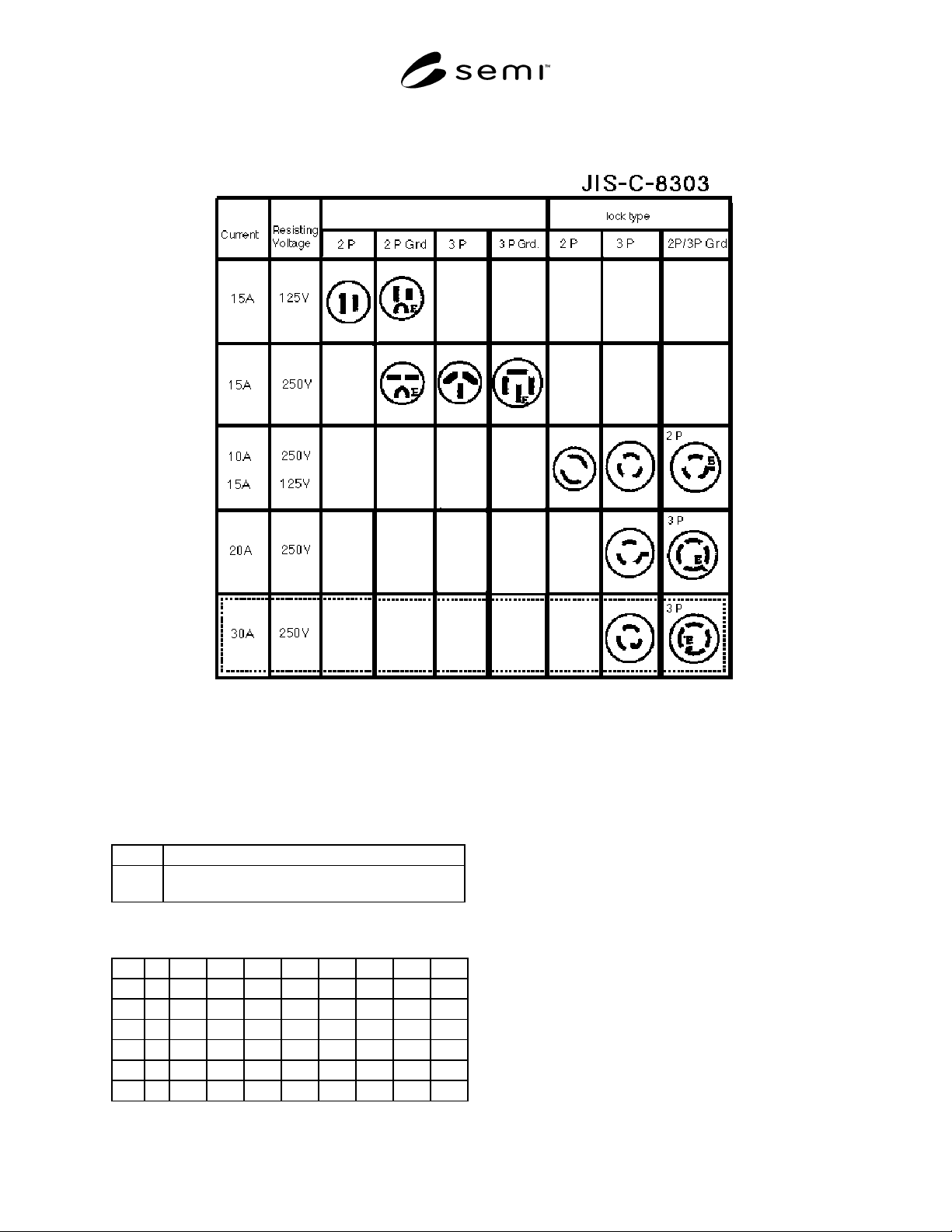
4 Electrical Connectors (sh own as receptacle)
Note: Direct terminal connections are used for most fixed facilities and loads, which require higher current than the value
specified above. 30A/250V shows at reference which is specified by the NEMA standards L6-30R and L15-30R.
5 Cable Current Tolerances
Key:
VV Vinyl insulation, vinyl sheathed cable
CV Construction polyethylene insulation, vinyl sheathed
cable
JCS 168C-73 Unit (A)
1.0Ø 2.0Ø 2sq 3.5sq 5.5sq 8sq 14sq 22sq
VV*1114192838476791
** 10 12 18 25 33 42 60 79
*** 9 10 15 22 29 37 53 70
CV*162333465974105135
** 17 20 28 40 52 66 94 125
***14172434455679105
* Single Conductor Three Cables
** Twin Conductors One Cable
*** Three Conductors One Cable
Note: The above specification is for cable in conduit in air.
Current tolerance of CV is different than that of VV due to the
difference in temperature tolerances (VV/60°C and
CV/90°C).
Ø: Diameter of Conductor (mm)
Sq: Cross-Sectional Area of Conductor (mm2)
SEMI E31-93 © SEMI 19933
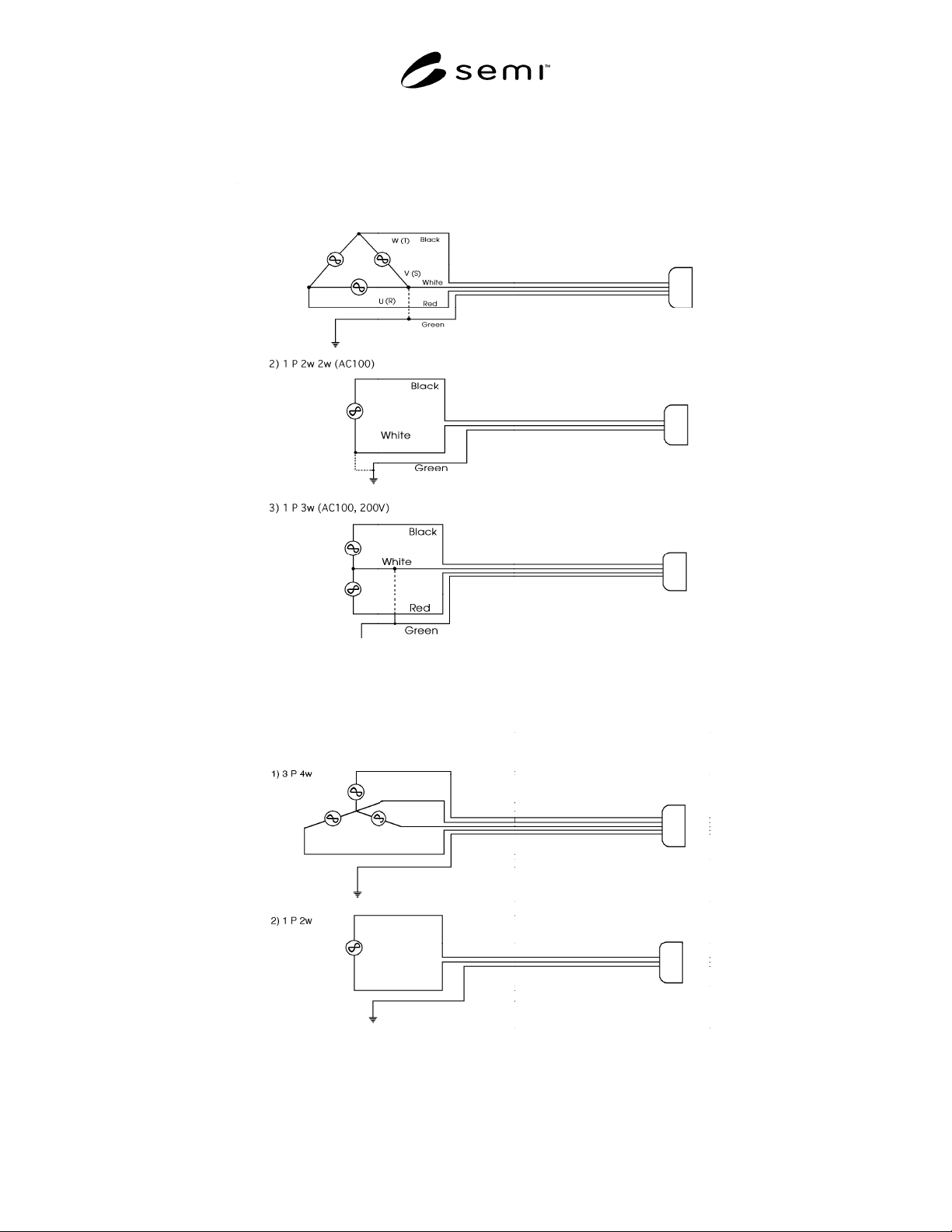
APPENDIX
Examples of Wire Connection of Power Supply in Japan
Examples of Wire Connection of Power Supply in United States (Reference)
Notes: White wire connected at the grounded side. [White is also used for a neutral line (grounded side) in the U.S.] A single green wire other
than a cable is typically used for ground. In the case of a single wire, sometimes a black wire is substituted for blue. - - - - indicates that the wires
are normally grounded, with some exceptions. There are no special rules regarding colors of wires except a wire used for ground (green).
However, the figure shows common examples in Japan.

SEMI E31-93 © SEMI 1993 4
NOTICE: These standards do not purport to address
safety issues, if any, associated with their use. It is the
responsibility of the user of these standards to establish
appropriate safety and health practices and determine
the applicability of regulatory limitations prior to use.
SEMI makes no warranties or representations as to the
suitability of the standards set forth herein for any
particular application. The determination of the
suitability of the standard is solely the responsibility of
the user. Users are cautioned to refer to manufacturer’s
instructions, product labels, product data sheets, and
other relevant literature respecting any materials
mentioned herein. These standards are subject to
change without notice.
The user’s attention is called to the possibility that
compliance with this standard may require use of
copyrighted material or of an invention covered by
patent rights. By publication of this standard, SEMI
takes no position respecting the validity of any patent
rights or copyrights asserted in connection with any
item mentioned in this standard. Users of this standard
are expressly advised that determination of any such
patent rights or copyrights, and the risk of infringement
of such rights, are entirely their own responsibility.
Copyright by SEMI® (Semiconductor Equipment and Materials
International), 3081 Zanker Road, San Jose, CA 95134. Reproduction o
f
the contents in whole or in part is forbidden without express written
consent of SEMI.