semi合集-English.pdf - 第5904页
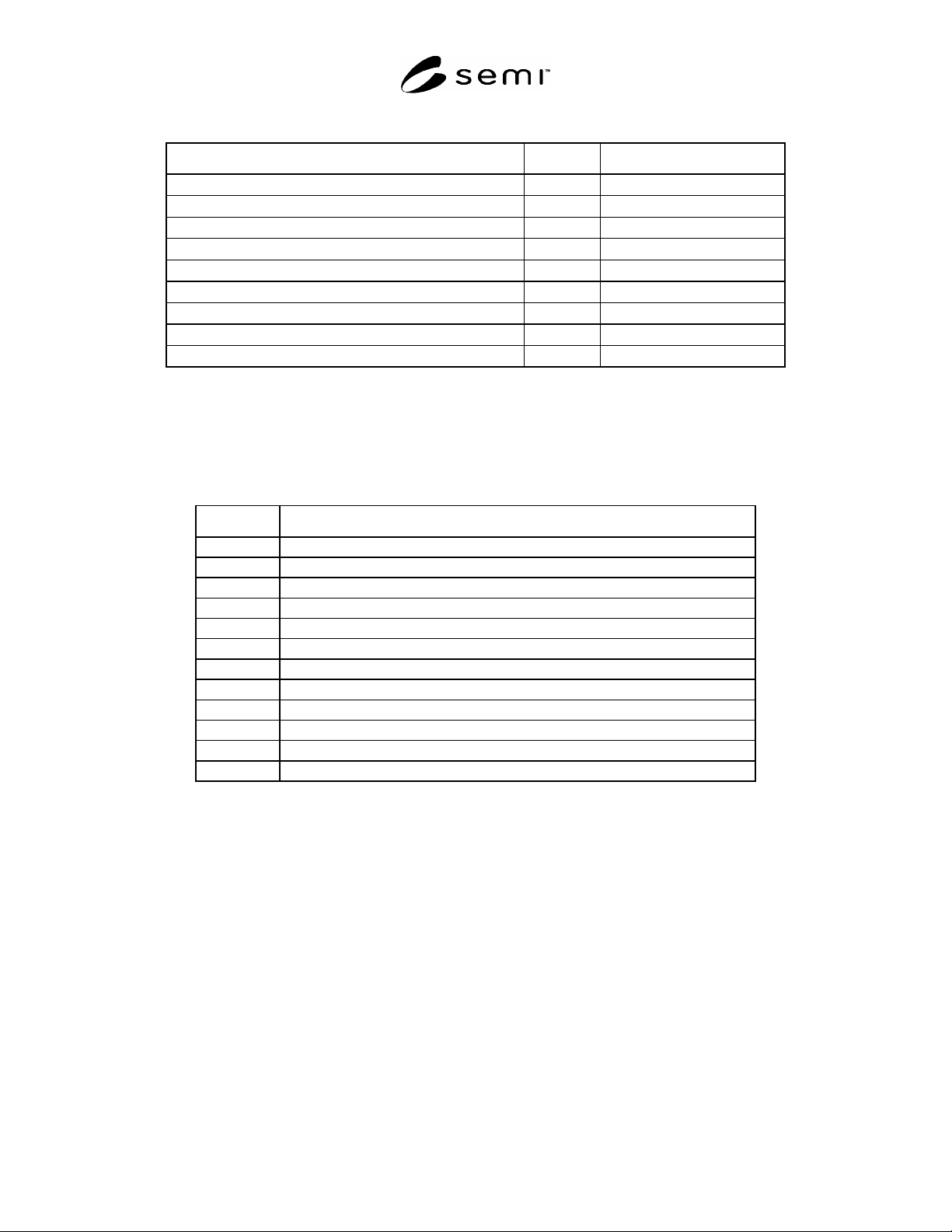
SEMI P39-0304 E2 © SEMI 2004 7 Table 5 Delta Examples Bit Pattern Type Meaning 11111001 00100011 1-delta = -2300 11111000 00100011 1-delta = +2300 10011000 00101010 2-delta x = +1350 10011011 00101010 2-delta …
SEMI P39-0304
E2
© SEMI 2004 6
7.4.2 The set of printable ASCII characters consists of hexadecimal character codes 21-7E. In ascending order of
character code, we have:
!"#$%&’()*+,-./0123456789:;<=>?@ [21-40]
ABCDEFGHIJKLMNOPQRSTUVWXYZ[\]^_‘ [41-60]
abcdefghijklmnopqrstuvwxyz{|}~ [61-7E]
This excludes space (SP), tabs (HT, VT), and all other control characters.
7.4.3 EXCEPTION HANDLING
— OASIS processors should treat illegal characters in a-strings or n-strings as
fatal errors. Zero-length n-strings should also be treated as fatal errors.
7.5 Deltas
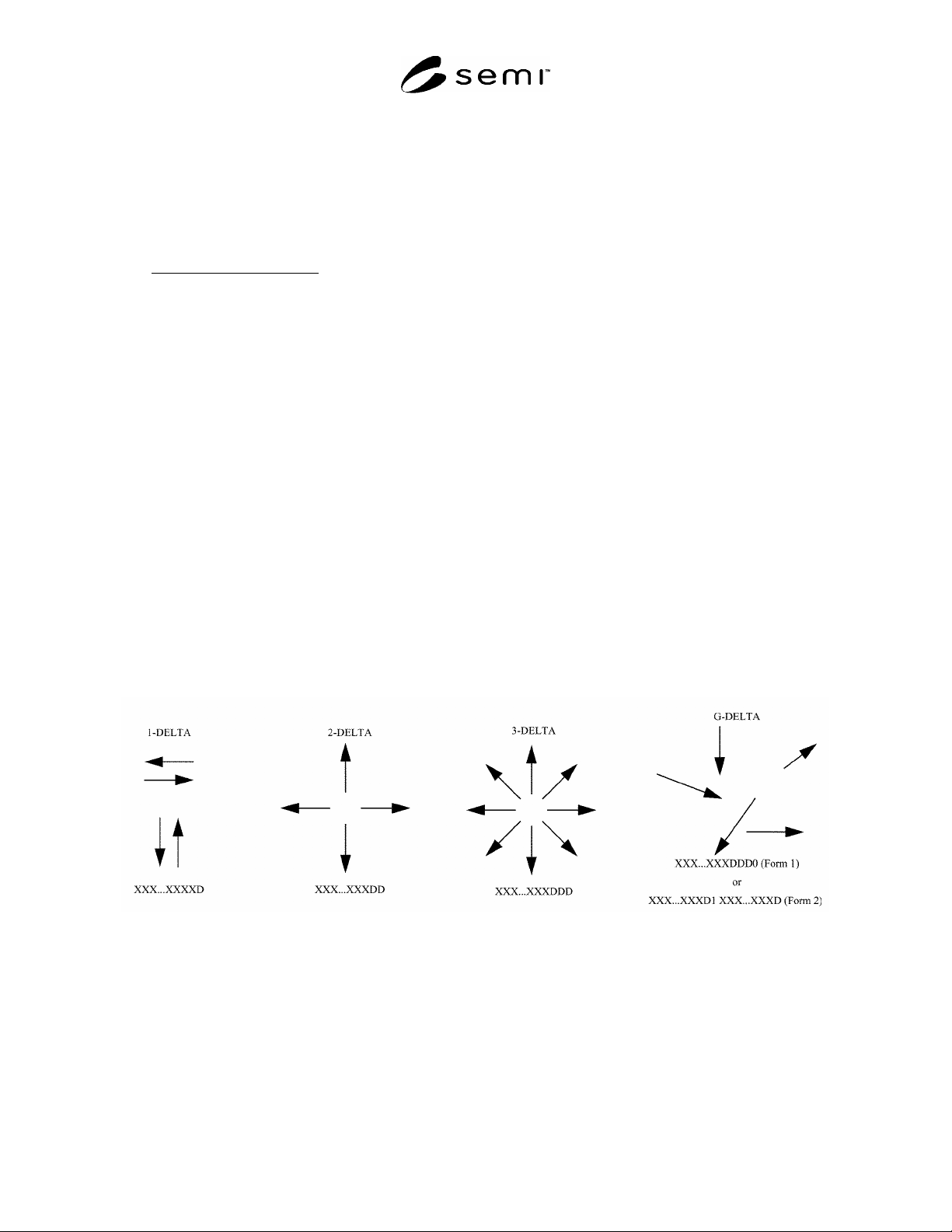
7.5.1 A delta represents geometric data (coordinates, vectors, planar offsets, etc.).
7.5.2 A 1-delta is stored as a signed-integer and represents a horizontal or vertical displacement. Bit 0 encodes
direction: 0 for east or north, 1 for west or south. The remaining bits are the magnitude. Horizontal or vertical
alignment is implied by context.
7.5.3 A 2-delta is stored as an unsigned-integer and represents a horizontal or vertical displacement. Bits 0-1
encode direction: 0 for east, 1 for north, 2 for west, and 3 for south. The remaining bits are the magnitude.
7.5.4 A 3-delta is stored as an unsigned-integer and represents a horizontal, vertical, or 45-degree diagonal
displacement. Bits 0-2 encode direction: 0 for east, 1 for north, 2 for west, 3 for south, 4 for northeast, 5 for
northwest, 6 for southwest, and 7 for southeast. The remaining bits are the magnitude (for horizontal and vertical
deltas) or the magnitude of the projection onto the x- or y-axis (for 45-degree deltas).
7.5.5 A g-delta has two alternative forms and is stored either as a single unsigned-integer or as a pair of unsigned-
integers. The first form is indicated when bit 0 is zero, and represents a horizontal, vertical, or 45-degree diagonal
displacement, with bits 1-3 encoding direction, and the remaining bits storing the magnitude, in the same fashion as
a 3-delta. The second form represents a general (x,y) displacement and is a pair of unsigned-integers. Bit 0 of the
first integer is 1. Bit 1 of the first integer is the x-direction (0 for east, 1 for west). The remaining bits of the first
integer represent the magnitude in the x-direction. Bit 0 of the second integer is the y-direction (0 for north, 1 for
south). The remaining bits of the second integer represent the magnitude in the y-direction. Both forms may appear
in a list of g-deltas.
Figure 4
Delta Types
SEMI P39-0304
E2
© SEMI 2004 7
Table 5 Delta Examples
Bit Pattern Type Meaning
11111001 00100011 1-delta
= -2300
11111000 00100011 1-delta
= +2300
10011000 00101010 2-delta
x = +1350
10011011 00101010 2-delta
y = -1350
11001101 00000001 3-delta
x = -25, y = +25
11010111 00000111 3-delta
x = +122, y = -122
11101001 00000011 01111010 g-delta
2
x = +122, y = +61
11101100 00000101 g-delta
1
x = -46, y = -46
10111011 00000001 10110111 00001111 g-delta
2
x = -46, y = -987
7.6 Repetitions
7.6.1 A repetition represents an “array” of cell placements, geometries, or text elements. The repetition is part of
the PLACEMENT, <geometry>, or TEXT record itself. A repetition consists of an unsigned-integer which
encodes the type, followed by any related repetition parameters:
Table 6 Repetition Types
TYPE
Format
0
re-use the previous repetition definition
1 x-dimension y-dimension x-space y-space
2 x-dimension x-space
3 y-dimension y-space
4
x-dimension x-space
1
... x-space
N-1
5
x-dimension grid x-space
1
... x-space
N-1
6
y-dimension y-space
1
... y-space
M-1
7
y-dimension grid y-space
1
... y-space
M-1
8 n-dimension m-dimension n-displacement m-displacement
9 dimension displacement
10
dimension displacement
1
... displacement
P-1
11
dimension grid displacement
1
... displacement
P-1
7.6.1.1 x-dimension, y-dimension, x-space, y-space, dimension, n-dimension, m-dimension, and grid are all
unsigned-integers. displacement, n-displacement, and m-displacement are g-deltas.
7.6.2 TYPE 0 indicates that the previous repetition description, stored in modal variable repetition, is to be re-used.
(See Section 10 on page 11.) No additional values are stored with this type.
7.6.3 TYPE 1 is an N-column (N > 1) by M-row (M > 1) matrix with uniform horizontal and vertical spacing
between the elements. x-dimension is N - 2 and y-dimension is M - 2. The (x-offset, y-offset) (cumulative spacing
in the (horizontal,vertical) direction) of element (i,j) of the repetition (i = 0, ..., N-1 and j = 0, ..., M-1) is
(i * x-space, j * y-space).
7.6.4 TYPE 2 is an N-column (N > 1) by 1-row vector with uniform horizontal spacing between the elements. x-
dimension is N - 2. The (x-offset, y-offset) (cumulative spacing in the (horizontal,vertical) direction) of element i of
the repetition (i = 0, ..., N-1) is (i * x-space, 0).
7.6.5 TYPE 3 is a 1-column by M-row (M > 1) vector with uniform vertical spacing between the elements. y-
dimension is M - 2. The (x-offset, y-offset) (cumulative spacing in the (horizontal,vertical) direction) of element j of
the repetition (j = 0, ..., M-1) is (0, j * y-space).

SEMI P39-0304
E2
© SEMI 2004 8
7.6.6 TYPE 4 is an N-column (N > 1) by 1-row vector with (potentially) non-uniform horizontal spacing between
the elements. x-dimension is N - 2. The (x-offset, y-offset) (cumulative spacing in the (horizontal,vertical) direction)
of element i of the repetition (i = 0, ..., N-1) is (x-space
0
+ ... + x-space
i
, 0), with x-space
0
= 0.
7.6.7 TYPE 5 is identical to TYPE 4, except that all offset values must be multiplied by grid during expansion of
the repetition.
7.6.8 TYPE 6 is a 1-column by M-row (M > 1) vector with (potentially) non-uniform vertical spacing between the
elements. y-dimension is M - 2. The (x-offset, y-offset) (cumulative spacing in the (horizontal,vertical) direction) of
element j of the repetition (j = 0, ..., M-1) is (0, y-space
0
+ ... + y-space
j
), with y-space
0
= 0.
7.6.9 TYPE 7 is identical to TYPE 6, except that all offset values must be multiplied by grid during expansion of
the repetition.
7.6.10 TYPE 8 is an N (N > 1) by M (M > 1) repetition with uniform and (potentially) diagonal displacements
between the elements. n-dimension is N - 2 and m-dimension is M - 2. Defining n-displacement in terms of its
components nx-space and ny-space (and similarly for m-displacement), the (x-offset, y-offset) (cumulative spacing
in the (horizontal,vertical) direction) of element (i,j) of the repetition (i = 0, ..., N-1 and j = 0, ..., M-1) is
(i * nx-space + j * mx-space, i * ny-space + j * my-space).
7.6.11 TYPE 9 is a P-element (P > 1) repetition with uniform and (potentially) diagonal displacements between the
elements. dimension is P - 2. Defining displacement in terms of its components x-space and y-space, the (x-offset,
y-offset) (cumulative spacing in the (horizontal,vertical) direction) of element k of the repetition (k = 0, ..., P-1) is
(k * x-space, k * y-space).
7.6.12 TYPE 10 is a P-element (P > 1) repetition with (potentially) non-uniform and arbitrary two-dimensional
displacements between the elements. dimension is P - 2. Defining displacement
k
in terms of its components x-
space
k
and y-space
k
, the (x-offset, y-offset) (cumulative spacing in the (horizontal,vertical) direction) of element k
of the repetition (k = 0, ..., P-1) is (x-space
0
+ ... + x-space
k
, y-space
0
+ ... + y-space
k
) with x-space
0
= y-space
0
=
0).
7.6.13 TYPE 11 is identical to TYPE 10, except that all offset values must be multiplied by grid during expansion
of the repetition.