semi合集-English.pdf - 第2311页
SEMI E82-0705 © SEMI 1999, 2005 7 H* H* Not Active Queued Tran sferring Paus ed Acti ve W aiting Aborti ng Canceling 1 2 3 4 5 6 7 8 9 10 11 12 13 Figure 3 Generic IBSEM TRANSFER Command State Model Diagram 7.3.3 TRANSFE…

SEMI E82-0705 © SEMI 1999, 2005 6
7.2.4 TSC State Transition Table
Table 1 TSC State Transition Table
Transition # Previous State Trigger New State Actions Comments
1 None TSC Initiation. TSC INIT S6F11
TSCAutoInitiated
System runs through its
startup sequence.
2 TSC INIT System started up
successfully. All loads
and unloads are complete.
PAUSED S6F11
TSCPaused
System ready.
3 PAUSED TSC is resumed. AUTO S6F11
TSCAutoCompleted
System will now perform
all commands. Stopped
Vehicles will resume
normal motion.
4 AUTO TSC is requested to
pause.
PAUSING S6F11
TSCPauseInitiated
Vehicles that are stopped
stay stopped. Vehicles that
are moving stop at the next
logical point without
proceeding.
5 PAUSING TSC is resumed. AUTO S6F11
TSCAutoCompleted
System will now perform
all commands. Stopped
Vehicles will resume
normal motion.
6 PAUSING All carrier loads and
unloads are completed.
No new acquires or
deposits will occur.
Outstanding acquires and
deposits will complete.
PAUSED S6F11
TSCPauseCompleted
System will accept and
queue new commands but
will not execute them.
7 NO ALARMS Alarm Set. ALARMS S6F11
AlarmSet
System can process
normally for transport
components that are
unaffected by the alarm.
8 ALARMS Last remaining alarm
cleared.
NO ALARMS S6F11
AlarmCleared
9 ALARMS Alarm Set. ALARMS S6F11
AlarmSet
Alarm occurs when there is
already an outstanding
alarm.
7.3 TRANSFER Command State Model
7.3.1 TRANSFER Command State Model Requirements
7.3.1.1 The TRANSFER command state model serves as the SEMI E30 Processing State Model. The purpose of
the TRANSFER command state model is to provide information to the host regarding the control of the TRANSFER
command. The TRANSFER command allows the host to manage interbay or intrabay delivery and scheduling. The
control of each TRANSFER command must independently support the TRANSFER command state model.
7.3.2 TRANSFER Command State Model Diagram
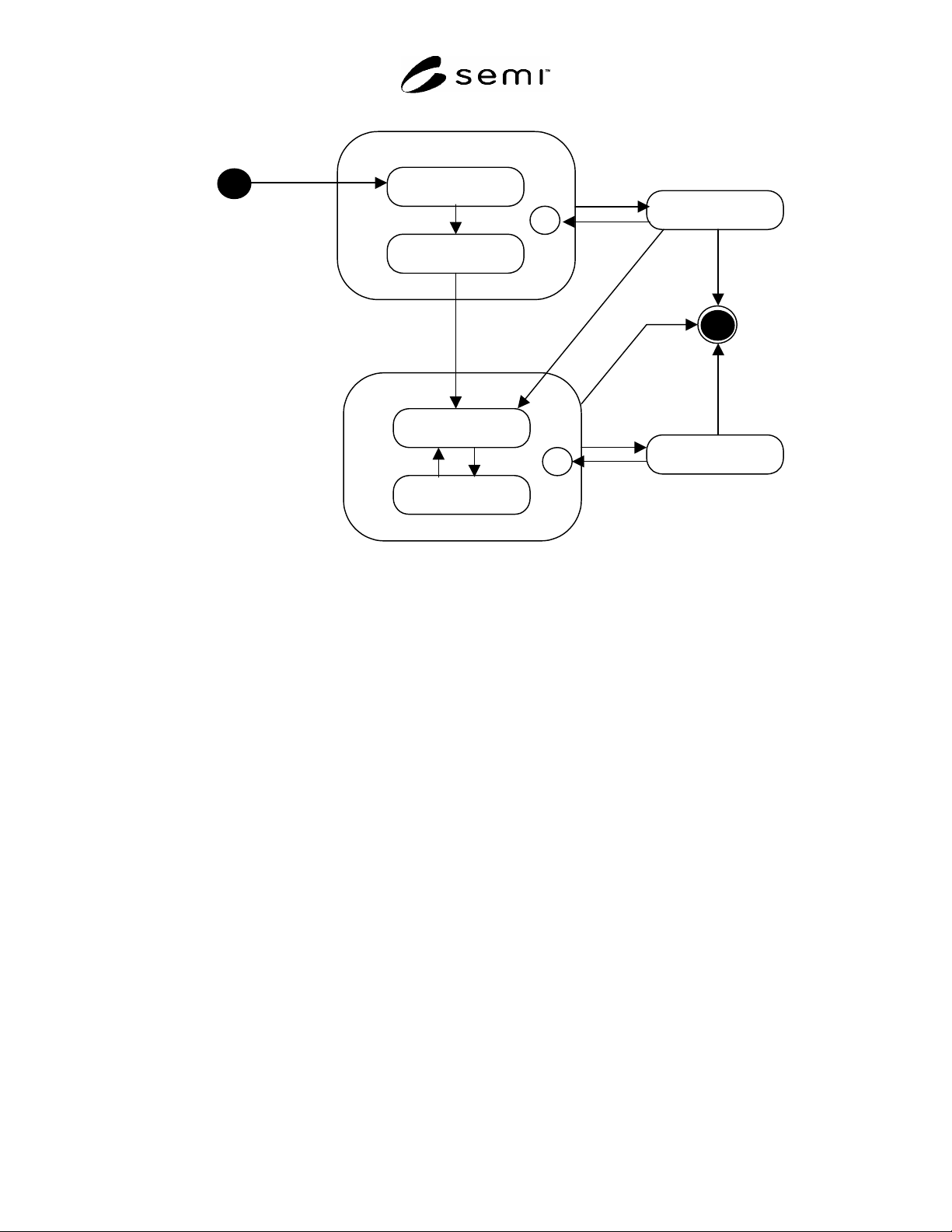
7.3.2.1 The TRANSFER command state model is detailed for IBSEM equipment in Figure 3.
SEMI E82-0705 © SEMI 1999, 2005 7
H*
H*
Not Active
Queued
Transferring
Paused
Active
Waiting
Aborting
Canceling
1
2
3
4
5
6
78
9
10
11
12
13
Figure 3
Generic IBSEM TRANSFER Command State Model Diagram
7.3.3 TRANSFER Command State Definitions
7.3.3.1 NOT ACTIVE — The transfer unit is not involved in the physical aspect of the TRANSFER command. It is
denoted by the time spanned by the queuing of the TRANSFER command to the moment just prior to the acquire of
the first carrier in the transfer unit.
7.3.3.2 QUEUED (NOT ACTIVE sub-state) — TSC has acknowledged and queued the TRANSFER command.
TRANSFER command has not been initiated.
7.3.3.3 WAITING (NOT ACTIVE sub-state) — TRANSFER command has been initiated. A vehicle is on its way to
the source location to acquire the transfer unit.
7.3.3.4 ACTIVE — The transfer unit is involved in the physical aspect of the TRANSFER command. It is denoted
by the time spanned by the acquire of the first carrier in the transfer unit to the deposit of the last carrier in the
transfer unit.
7.3.3.5 TRANSFERRING (ACTIVE sub-state) — The transfer command is actively being executed by the transport
equipment.
7.3.3.6 PAUSED (ACTIVE sub-state) — The transfer command is not actively being executed by the transport
equipment.
7.3.3.7 CANCELING — The TRANSFER command cancel procedure is being performed to terminate a transfer
command which never entered the ACTIVE state (either QUEUED or WAITING). This state is entered via a
CANCEL remote command.
7.3.3.8 ABORTING — The TRANSFER command abort procedure is being performed to terminate a transfer
command which has entered the ACTIVE state. This state can only be entered via an ABORT remote command.

SEMI E82-0705 © SEMI 1999, 2005 8
7.3.4 TRANSFER Command State Transition Table
Table 2 Transfer Command State Transition Table
Transition # Previous State Trigger New State Actions Comments
1 None The Host generated
TRANSFER command
is successfully
acknowledged by the
TSC.
QUEUED
2 QUEUED The TRANSFER
command has been
initiated by the TSC.
WAITING S6F11 Transfer-
Initiated
Transport vehicle is
dispatched to acquire the
transfer unit.
3 WAITING The acquire of the first
carrier of the transfer
unit begins.
TRANSFERRING S6F11
Transferring
4 NOT ACTIVE Host issued cancel for
the TRANSFER
command is accepted by
the TSC.
CANCELING S6F11
TransferCancel-
Initiated
A CANCEL remote
command was issued to
terminate a TRANSFER
command that has not
entered the physical aspect o
f
the command.
5 CANCELING Transport system is
unable to cancel the
TRANSFER command.
Previous NOT
ACTIVE sub-state
S6F11
TransferCancel-
Failed
The ability of the equipment
to successfully complete a
cancel of the TRANSFER
command is specific to the
IBSEM equipment supplier.
6 CANCELING The cancel procedure
for the TRANSFER
command has
completed by the
transport system and
TSC.
None S6F11
TransferCancel-
Completed
The transfer unit will still be
situated at the transfer source
location. The carriers in the
transfer unit may now be
included in a future transfer
(either AMHS or PGV
based).
7 TRANSFERRING The TSC pauses
execution of the
TRANSFER command
due to an anomaly
condition.
PAUSED S6F11
TransferPaused
It is an important distinction
to make that the TRANSFER
command is paused even
though the vehicle may not
be.
8 PAUSED The TSC resumes
execution of the
TRANSFER command
since the anomaly
condition has been
cleared.
TRANSFERRING S6F11
Transfer-Resumed
9 ACTIVE Host initiates an abort
of a TRANSFER
command.
ABORTING S6F11
TransferAbort-
Initiated
An ABORT remote
command was issued to
terminate a TRANSFER
command.
10 ABORTING The abort procedure for
the TRANSFER
command has
completed by the
transport system and
TSC.
None S6F11
TransferAbort-
Completed
Transfer unit could be
located at any location or
p
ort located along the path of
the ACTIVE transfer. The
location of the carrier(s)
associated with the aborted
transfer command must be
legal SourcePort(s) for
issuing a new TRANSFER
command.