semi合集-English.pdf - 第6586页
SEMI C1-0705 © SEMI 1978, 2005 12 Degrees of Free dom t-statisti c 13 1.350 14 1.345 15 1.341 16 1.337 17 1.333 18 1.330 19 1.328 20 1.325 6.1.9 Example: Assay With Only a Stated Lower Specification Limit — Suppose that …
SEMI C1-0705 © SEMI 1978, 2005 11
Figure of Merit Criteria for Successful Method
Method Detection Limit Not illustrated in this example, an example is provided with SEMI
C10. The Method Detection Limit must be less than or equal to
the specification.
Interference Checks
List as necessary.
6.1.8 Example: Assay With Stated Upper and Lower Specification Limits — Suppose that the liquid chemical in
question has a target specification of 28% with a lower specification limit of 27% and an upper specification limit of
29%. The specification width is 2% = 29% 27%. Suppose the following data was available all as percentages:
Historical Sample A: 28.9, 29.1, 29.9
Historical Sample B: 27.8, 27.6, 27.6, 27.7
Current Sample: 28.1
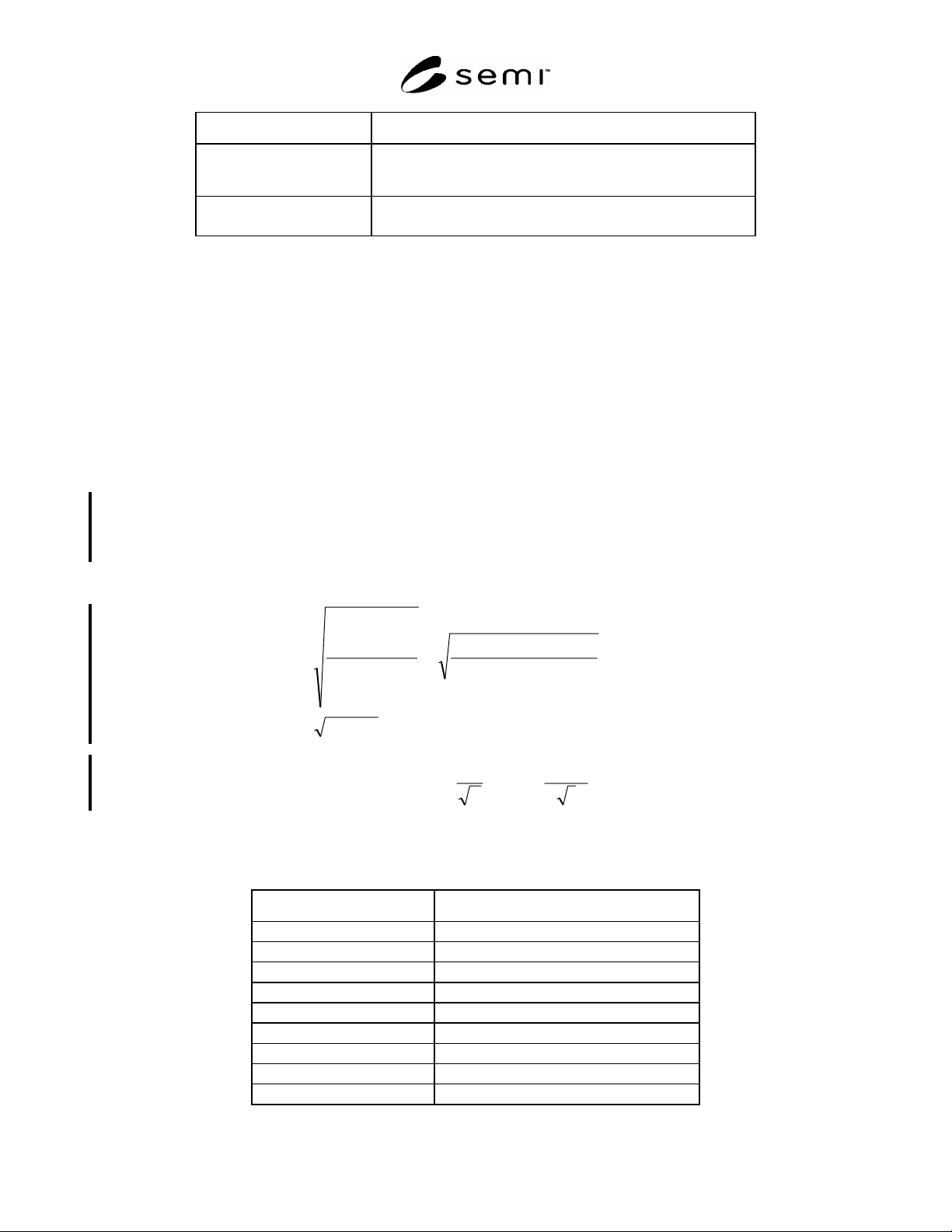
For purposes of calculating the degrees of freedom and the pooled standard deviation as per Table 7:
009.0 ,4 ,280.0 ,3
2
22
2
11
snsn
,
Where
2
22
1
29.9) 29.1, (28.9, dev. std. )52915.0(280.0 s
2
2
2
27.7) 27.6, 27.6, (27.8, dev. std. 009.0 s
The degrees of freedom = 5 = (3-1) + (4-1) exceeds the minimum requirement of 4 and the pooled standard
deviation is calculated as:
343.01174.0s
32
)009.0(3)280.0(2
1n
s1n
s
p
N
1i
i
N
1i
2
ii
p
The 90% UCL is calculated as: 506.0
1
343.0
476.1 UCL%90
10.0,
n
s
t
p
df
Where n = 1 = number of current meas. taken on sample and the t statistic is from Table 7. Since the 90% UCL /
spec. width = 0.506/2 = 25.3% < 30% method validation is established.
Table 7 t-statistics for Assay
Degrees of Freedom t-statistic
4 1.533
5 1.476
6 1.440
7 1.415
8 1.397
9 1.383
10 1.372
11 1.363
12 1.356
SEMI C1-0705 © SEMI 1978, 2005 12
Degrees of Freedom t-statistic
13 1.350
14 1.345
15 1.341
16 1.337
17 1.333
18 1.330
19 1.328
20 1.325
6.1.9 Example: Assay With Only a Stated Lower Specification Limit — Suppose that the liquid chemical in question
has a minimum purity level of 99.5%; i.e., a lower specification limit of 99.5% with an unstated upper specification
limit of 100%. The specification width is 0.5% = 100% - 99.5%. Suppose the following data was available all as
percentages:
Historical Sample A: 99.65, 99.63, 99.60 99.63
Current Sample: 99.58, 99.62
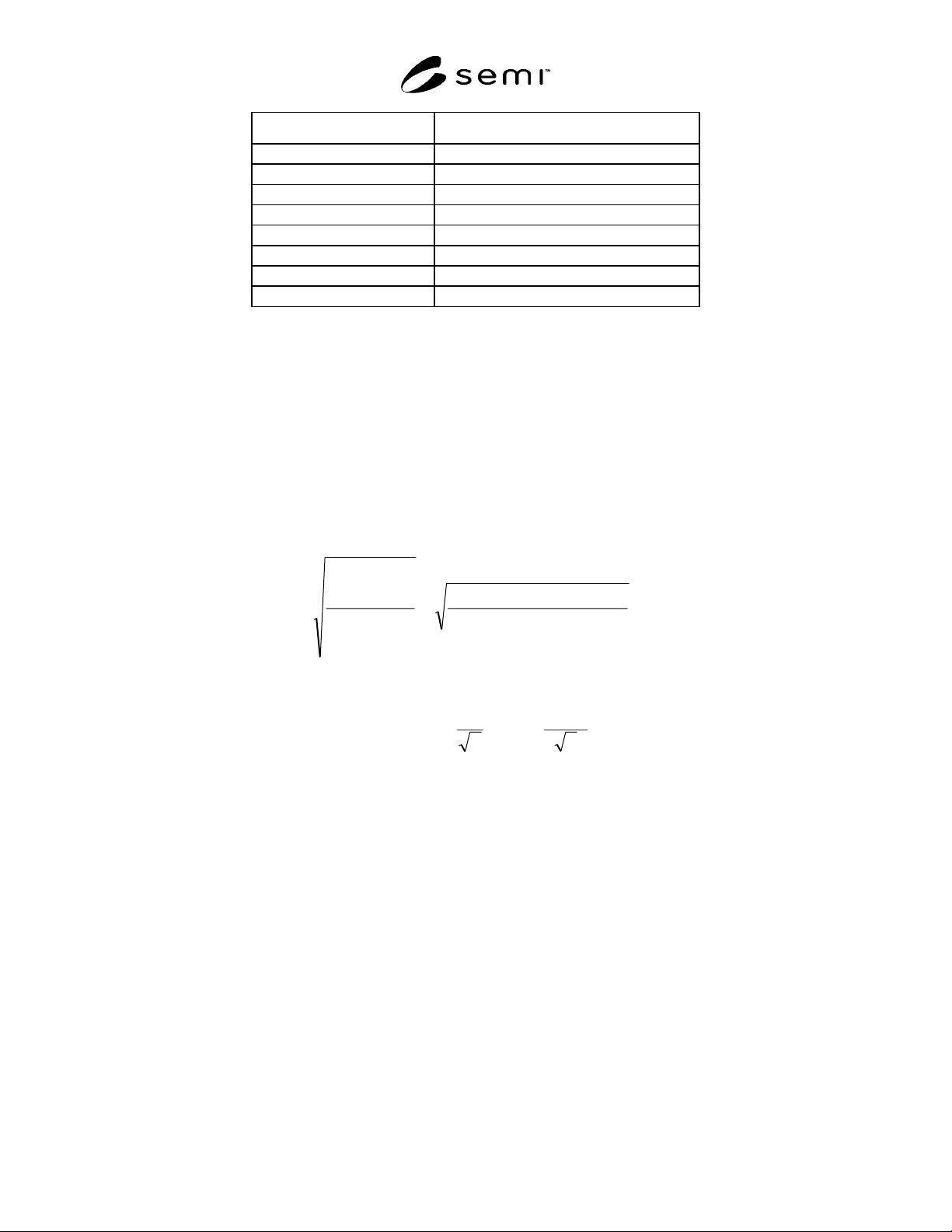
For purposes of calculating the degrees of freedom and the pooled standard deviation as per Table 3:
0008.0 ,2 ,000425.0 ,4
2
22
2
11
snsn
The degrees of freedom = 4 = (4-1) + (2-1) meets the minimum requirement of 4 and the pooled standard
deviation is calculated as:
023.0
13
)0008.0(1)000425.0(3
1
1
1
1
2
p
N
i
i
N
i
ii
p
s
n
sn
s
The 90% UCL is calculated as: 0249.0
2
023.0
533.1 UCL%90
10.0,
n
s
t
p
df
Where n = 2 = number of current meas. taken on the sample and the t statistic is from Table 7. Since the 90% UCL
/ spec. width = 0.0249/0.5 = 5.0% < 30% method validation is established.
7 Analytical Procedures
7.1 Acidity and Alkalinity
7.1.1 In the acidity test, usually a stated volume of water (commonly 25 mL) is shaken in a glass-stoppered flask
with a stated volume of sample (commonly 10 mL). Then 0.1 mL of phenolphthalein indicator solution is added and
0.01 N sodium hydroxide until a slight pink color persists after shaking for 30 seconds. Next, a stated amount of
sample is added and mixed, and a titration is performed with 0.01 N sodium hydroxide until the pink color is
reproduced; the volume of titrant required is recorded.
7.1.2 In the alkalinity test, a stated amount of sample is mixed with a stated volume of water (commonly 25 mL).
Now 0.05 mL of methyl red indicator solution is added and the mixture is titrated with 0.01 N hydrochloric acid
until a slight pink color is reached; the volume of titrant required is recorded.
7.1.3 The result of such tests has often been expressed qualitatively as “passes test” or quantitatively as the content
of an acid (or base) known or assumed to be present. In this guide, the maximum specification limit shall be
expressed in micro equivalents of acid (or base) per gram of sample (µeq/g). The maximum allowed volume of
titrant in a test procedure shall correspond to that specification limit.
SEMI C1-0705 © SEMI 1978, 2005 13
7.2 Assay by Wide Bore Column Gas Chromatography — The theory of gas chromatography is given in many
documents, reviews, etc. The purpose here is to delineate some practical aspects for the assessment of volatile
organic reagents by gas chromatography. A complete detailed procedure for the gas chromatographic assay is not
given since available instruments vary from laboratory to laboratory. However, the use of wide bore capillary
columns is recommended to replace conventional packed columns. Capillary columns, constructed of fused silica
onto which is bonded a liquid phase, have greater resolving power and liquid chemical inertness.
7.2.1 Equipment — A gas chromatograph equipped with capillary wide bore column adaptors of isothermal and
multi-step linear and temperature-programmed operation is recommended.
7.2.2 Sample — Direct flash vaporization or on-column injection of the sample with standard gauge needles can be
used with wide bore columns. On column injection can minimize sample degradation while increasing the
reproducibility of results. On column injection is ideal to use with very volatile materials such as the reagents
assayed in this guide.
7.2.3 Columns — Many types of columns exist and can be used. Until recently, packed columns in which a liquid
phase is coated on a porous solid support were extensively used for assay of reagents. The introduction of wide bore
capillary columns having an i.d. of typically 530 micrometers and a thick film of liquid phase from 1 to 5
micrometers allows a laboratory to use a packed column instrument and conditions, while gaining the advantages of
capillary technology. Columns can be used either in the high resolution capillary mode (low carrier gas flow rates)
to achieve optimum resolution of sample components, or at higher flow rates (20–30 mL/min) where they will
perform packed column-like separations in a shorter time. Packed columns require a multitude of stationary phases
to accomplish typical separations performed in an analytical laboratory. The increased length of capillary columns
allows for better separation of components so that three columns of low (Type 1, Methyl Silicone), moderate
(Type 2, Mixed Cyano, Phenyl, Methyl Silicone), and high (Type 3, Carbowax) polarity can handle the majority of
analytical requirements. Columns, which have been found acceptable for assay of the reagents in this manual, are
listed in Table 8.
Table 8 Columns for Wide Bore Column Gas Chromatography
Reagent Recommended
#1
Column
Alternate
#2
Column
Acetone III II, I
n-Butyl Acetate I II
Dichloromethane I II
Methanol I
Methyl Ethyl Ketone I
2-Propanol I III
Tetrachloroethylene I
Toluene I III
Trichloroethylene I
Trichlorotrifluoroethane I
Hexamethyldisilizane
#3
I
1-Methyl-2-Pyrrolidone I
1,1,1 Trichloroethane I
Type I Column — Methyl Silicon Bonded Phase
Type II Column — Mixed Cyano, Phenyl, Methyl Silicon Bonded Phase
Type III Column — Carbowax Bonded Phase
#1 Satisfactory for both assay and SEMI-specified impurity determinations.
#2 Column will separate all SEMI-specified impurities from assay component. Elution order will differ from
typical given in individual reagent procedures.
#3 Presilanized column recommended.
7.2.4 Conditions — Appropriate conditions will vary from one gas chromatographic system to another. Conditions,
which have been found acceptable, are listed under each individual standard. When using packed column in the
isothermal mode, the temperature of the column is usually maintained at 10° to 20°C below the boiling point of the