semi合集-English.pdf - 第3113页
SEMI E125-0305 © SEMI 2003, 2005 21 10.5.1.4 ParameterTypeDefinition Asso ciation Definition Tab le Table 31 ParameterT ypeDefinition Association Definition Association Role Name Definition Comments typeInformation The t…
SEMI E125-0305 © SEMI 2003, 2005 20
10.4.11.9.1 If other Parameters are affected by this Parameter’s settings, all such affected Parameters shall have a
corresponding AssociatedParameter instance provided with the Configuration Parameter’s definition. Each such
AssociatedParameter instance shall be accessible via the “affectedParameters” association of this class (inherited
from ReadWrite).
10.4.11.9.2 If non-transient, the values of this Parameter are accessible and meaningful at all times, and can be set
by an external entity under conditions determined by the equipment.
10.4.11.9.3 If transient, the values of this Parameter are not guaranteed to be meaningful or settable at all times. If
the Parameter represents an attribute of an SEMI E39 ObjType, the Parameter will only be settable when the
corresponding ObjType has at least one active instance. This class defines no attributes or associations.
10.5 Parameter Types
10.5.1 Parameter Type Definitions
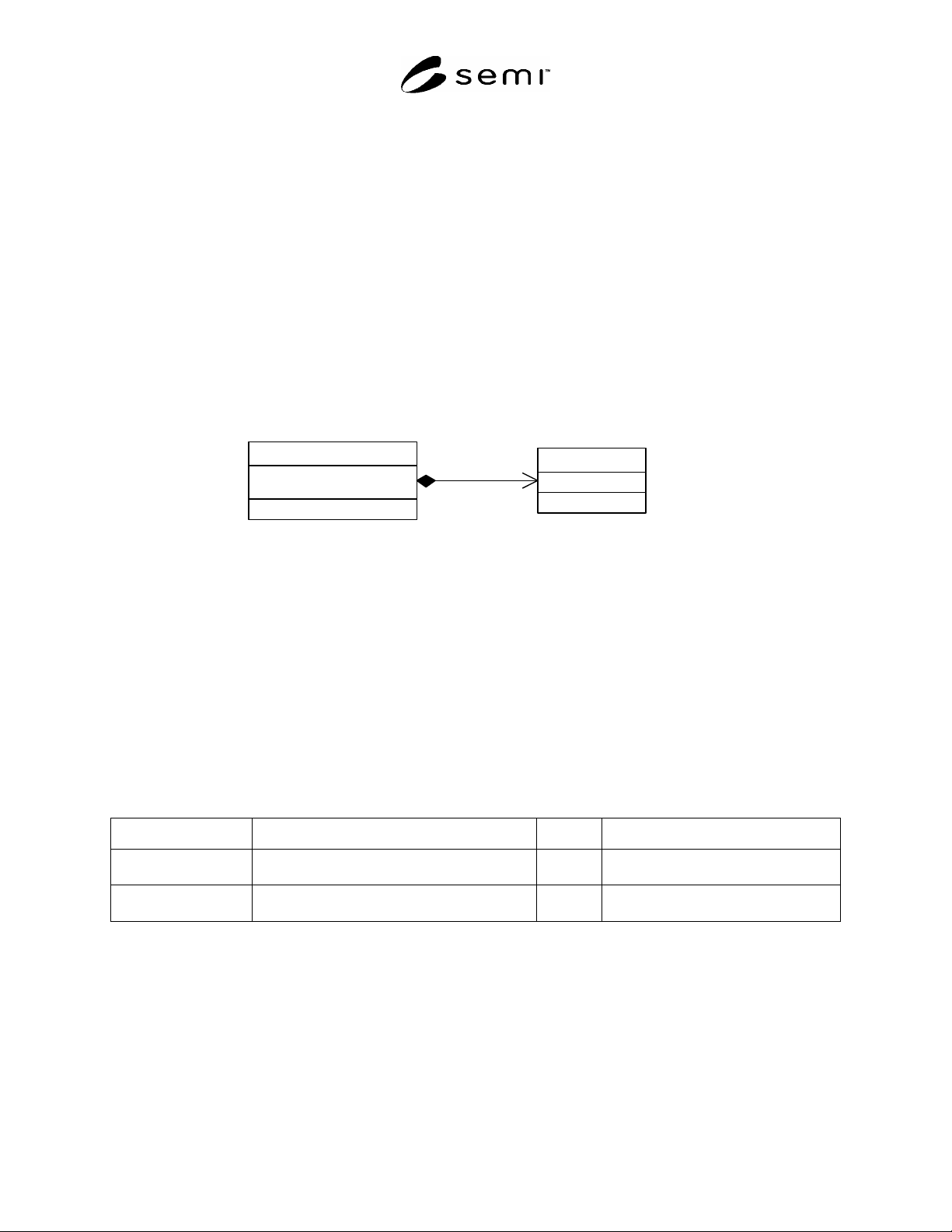
10.5.1.1 Figure 11 shows a class that can be used to describe re-usable Parameter data types. Parameter type
definitions can be re-used elsewhere in the metadata wherever a Parameter’s type can be declared. See Related
Information Section R5-1 for some examples using the ParameterTypeDefinition class.
ParameterType
name
des cription
ParameterTypeDefinition
typeInformation
11
Figure 11
Describing Type Definitions
10.5.1.2 Parameter TypeDefinition — Serves as a class for naming and providing a re-usable description of a
primitive or composite type. For example, a Parameter TypeDefinition could define a re-usable Parameter type
named “KelvinTemperature” of type RealType, with Kelvin units and 4 digits of precision. A composite parameter
TypeDefinition can be a named Array, Enumeration, or Structure. Each kind of primitive and composite Parameter
type is described fully in subsequent sections of this document. ParameterTypeDefinition can be re-used in the
definition of other ParameterTypeDefinitions, recursively within the same ParameterTypeDefinition, and in the
definition of Parameters (see Section 10.4 ).
10.5.1.3 The primitive Parameter type description classes are defined in Section 10.5.2 ; composite type description
classes are defined in Section 10.5.3 .
10.5.1.3.1 ParameterTypeDefinition Attribute Definition Table
Table 30 ParameterTypeDefinition Attribute Definition
Attribute Name Definition Required Form
name The name for the re-usable type definition. Y Text, must be unique across all
ParameterTypeDefinitions.
description A description of the meaning or purpose of the
type definition.
Y Text.
SEMI E125-0305 © SEMI 2003, 2005 21
10.5.1.4 ParameterTypeDefinition Association Definition Table
Table 31 ParameterTypeDefinition Association Definition
Association Role Name Definition Comments
typeInformation The type description. One and only one element of any type description
class derived from ParameterType.
10.5.1.5 ParameterType — An abstract base class from which all type description classes are derived. This class
has no attributes or associations.
10.5.2 Primitive Parameter Type Descriptions
10.5.2.1 Metadata describing types must include a mechanism for describing primitive or single-valued, types such
as integers and strings in the type system being used. The specific simple or primitive types that should be provided
are typically determined by the implementation technology that will be used to communicate values of the declared
type (for example, SECS-II, XML, OMG IDL, etc.). The primitive types described here should be considered a
minimum set that could be refined and extended to work best with the type system in use. Any specification that
translates these types into a specific type system shall define how it has mapped these primitive types into the
technology-specific type system, and shall fully specify any additional primitive type description classes beyond
those defined here.
ParameterType
IntegerType
digitsOfPrecision
RealT ype
language
maxCharacters
StringType BooleanType BinaryType
Unit
units
0..* 1
units
0..*1
UnitConfig
units1
2..*
units1
2..*
{XOR}
{XOR}
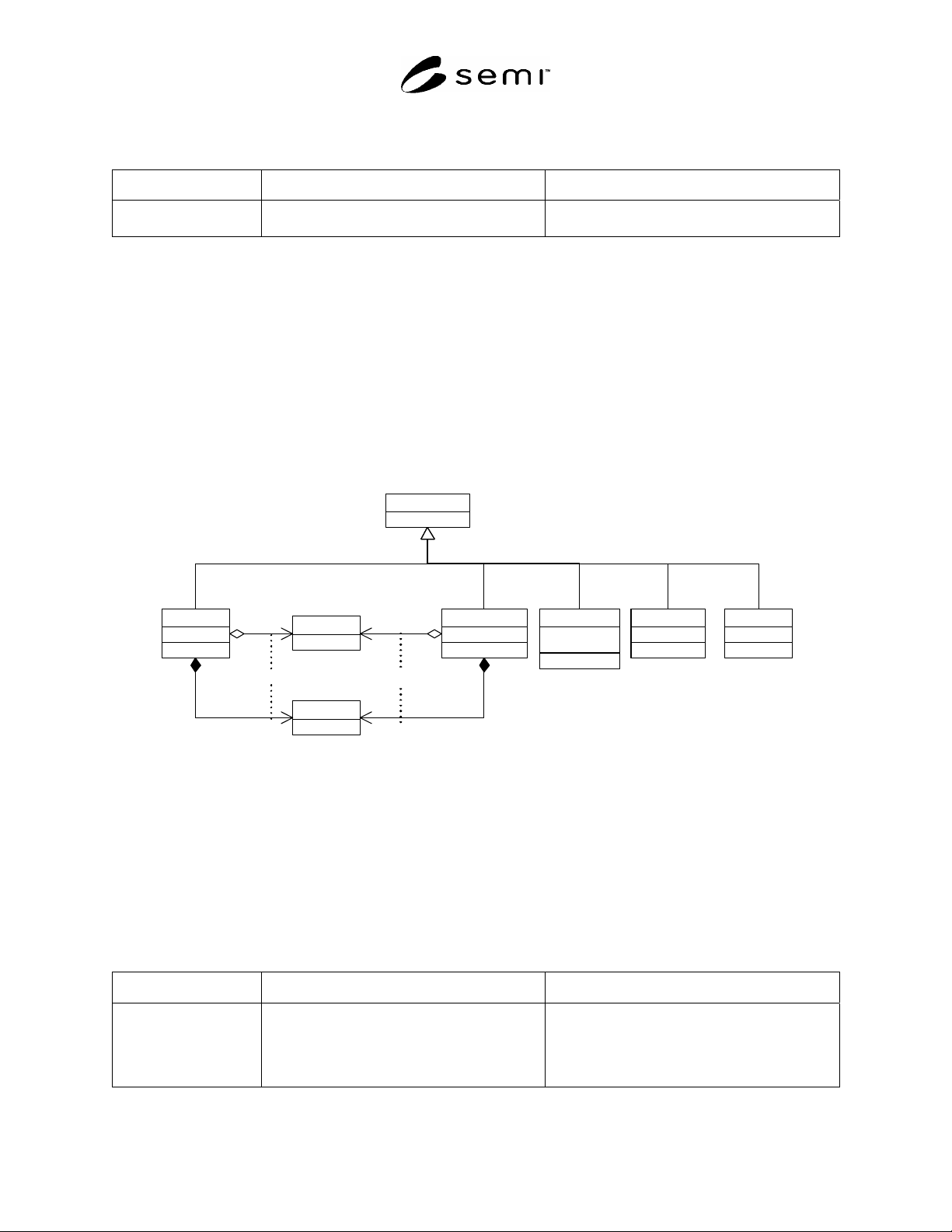
Figure 12
Describing Primitive Parameter Types
10.5.2.2 Figure 12 shows a basic set of classes that can be used to describe primitive Parameter types. The numeric
classes representing integer and real numbers can specify their associated units, and real number types can specify
the number of digits of precision. Strings can describe the associated language and a maximum number of
characters, if applicable.
10.5.2.3 IntegerType — Represents an integer type, and associated units.
10.5.2.4 IntegerType Association Definition Table
Table 32 IntegerType Association Definition
Association Role Name Definition Comments
units The available units specified for this type. Either:
One and only one element of type Unit
or:
Two or more elements of type UnitConfig, if the
type supports configurable units.
SEMI E125-0305 © SEMI 2003, 2005 22
10.5.2.5 RealType — Represents a real (for example, floating point) number type, and associated units.
10.5.2.6 RealType Attribute Definition Table
Table 33 RealType Attribute Definition
Attribute Name Definition Required Form
digitsOfPrecision The maximum number of digits that can be
provided after the decimal point by variables of
this type.
N Integer 0. If 0, there is no
restriction on the number of digits of
precision.
10.5.2.7 RealType Association Definition Table
Table 34 RealType Association Definition
Association Role Name Definition Comments
units The available units specified for this type. Either:
One and only one element of type Unit
or:
Two or more elements of type UnitConfig, if the
type supports configurable units.
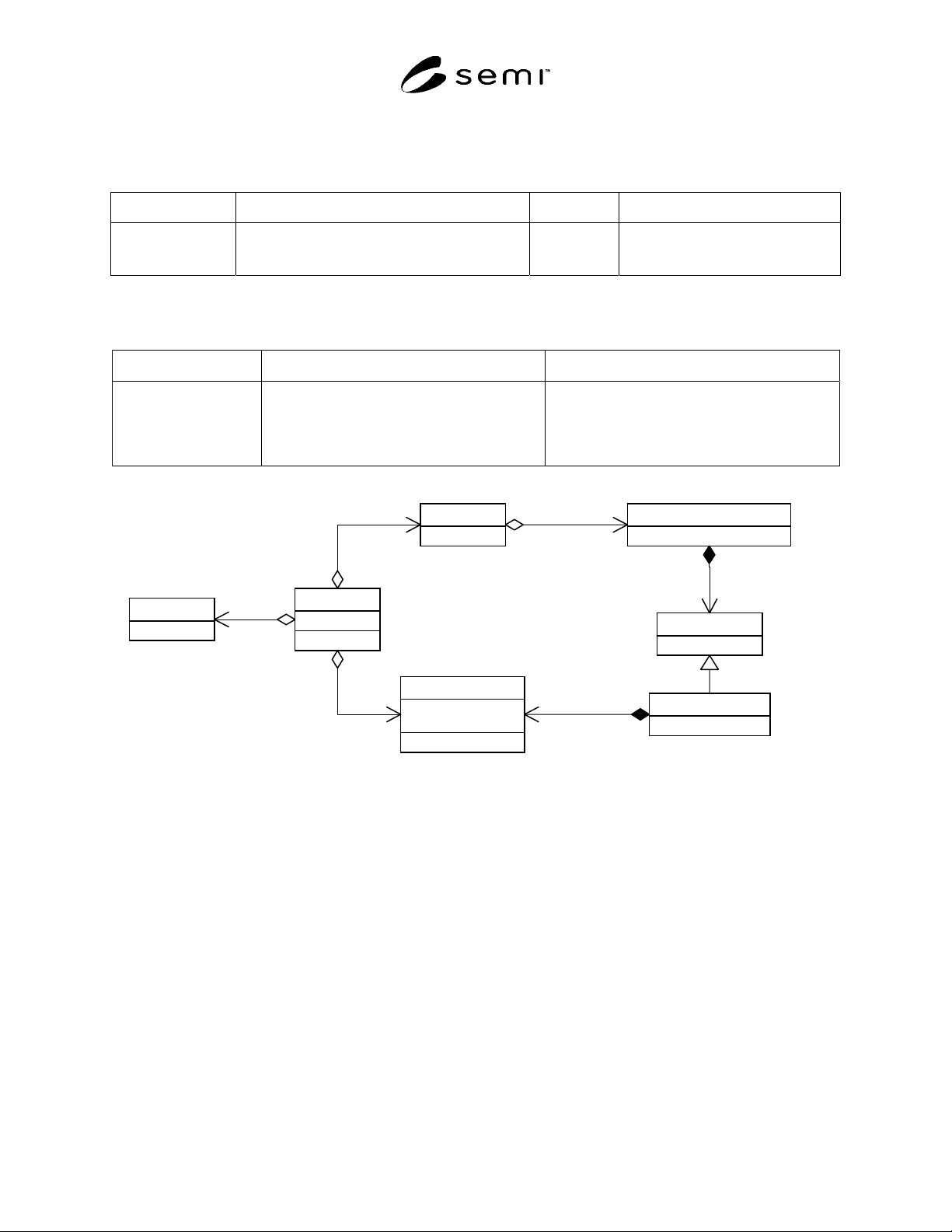
Figure 13
Describing Configurable Units
10.5.2.8 Some equipment may support the ability to provide Parameter values in more than one set of units. For
each independently configurable set of units available, the equipment shall support one non-transient unit
configuration Parameter to control which units are used when communicating the values of such Parameters. The
ParameterType of such unit configuration Parameters shall be a string-based enumeration (see Section 10.5.4.1.3 ).
Each value in the enumeration shall correspond to a different unit configuration. Figure 13 shows the classes used
to describe configurable units. Not all associations and attributes of the Unit, Parameter, ParameterTypeDefinition,
ParameterType, and EnumerationType classes are shown for clarity.
NOTE 2: The equipment is not required to support configurable units in order to comply with E125; however if the equipment
does support configurable units, it shall describe the available units and their configuration using the classes defined in this
section.
10.5.2.9 The UnitConfig class (shown in Figure 13) is used to provide a mapping from each possible unit choice for
a given numeric ParameterType to the enumeration Parameter setting that selects that unit. For example, the
equipment may provide a single unit configuration Parameter to select between meter-kilogram-seconds (mks),
centimeter-gram-seconds (cgs), and English units. In that case, every numeric type with configurable units
appearing in a ParameterTypeDefinition would provide 3 UnitConfig instances – one for each of the 3 possible
enumeration settings available from the unit configuration Parameter.
1
1
1
Unit
1
0..1
unit
configParameter
UnitConfig
0..1 setting
EnumeratedString
value
description
0..1
1
Parameter
0..*
1..*
values
1
1
typeInformation
ParameterTypeDefinition
typeInformation
ParameterType
EnumerationType