semi合集-English.pdf - 第875页
SEMI E116-0705 © SEMI 2002, 2005 7 No BLOCKE D EPT modules preve nt an EPT m odule from starting a new task, and There is no EP T module in the BUSY state with a task type of 1, 2, 3, 4 or 5. 9.4.1.3 Fo r both the eq…
SEMI E116-0705 © SEMI 2002, 2005 6
EPT module idle.
9.2.2 The equipment shall maintain an EPT state model for each major module (e.g., process stations and chambers,
wafer handling systems, etc.) through which a unit passes throughout the entire equipment from removal of units
from the carrier to the return of units to the carrier.
9.2.3 The equipment shall maintain an EPT state model for any major component of the equipment that impacts
processing and throughput.
9.2.4 The equipment shall maintain its own EPT state model for the overall equipment.
9.2.5 The equipment is responsible for communicating all EPT state transitions.
9.2.6 The EPT state model can be applied to the Equipment Front-End Module (EFEM).
9.2.7 There are two types of EPT Modules: (1) Production EPT modules, and (2) EFEM/LoadPort EPT modules.
Both types have a module-level EPT State Machine.
9.3 EPT State Model Diagram
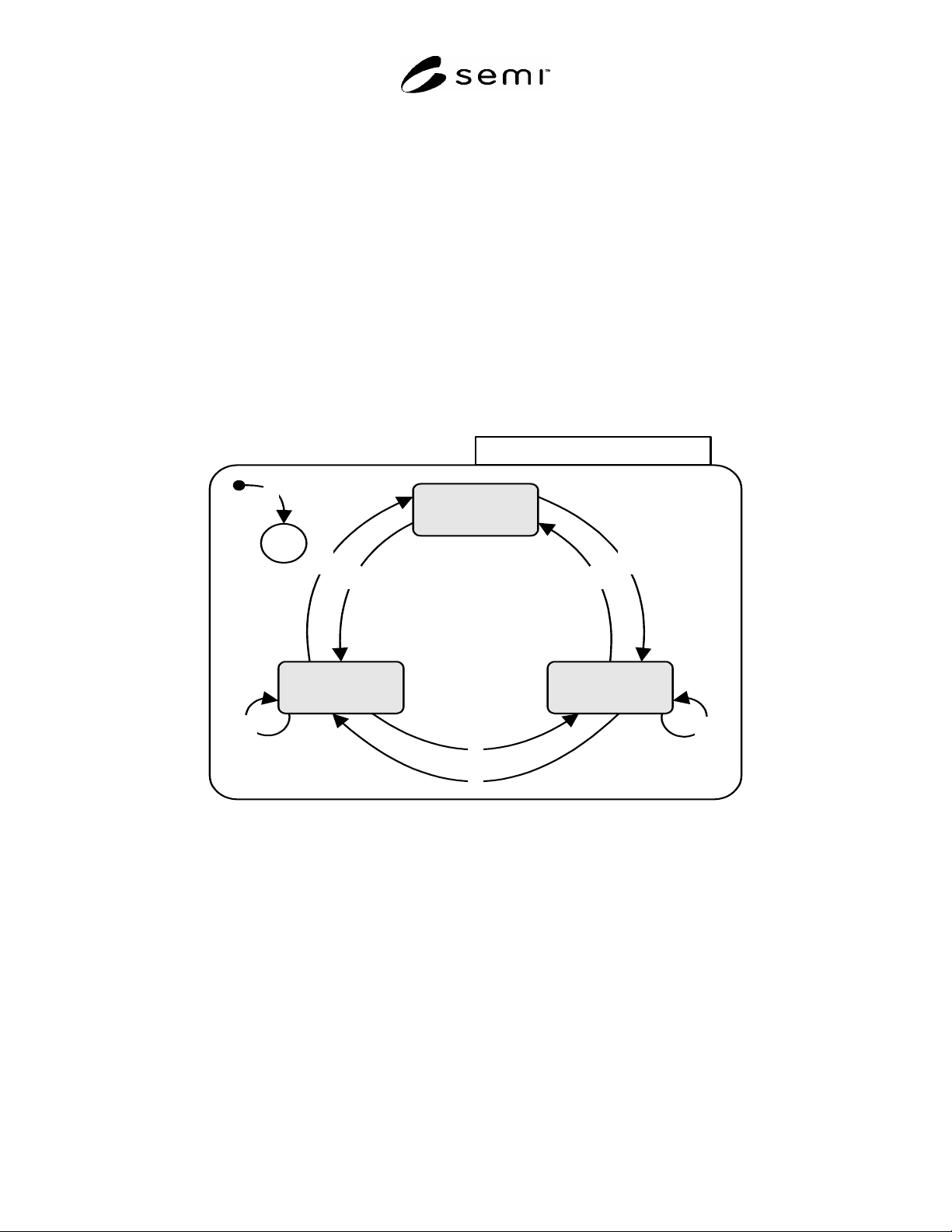
9.3.1 Figure 1 shows the EPT state module diagram.
1
9
4
2
3
7
8
5
6
IDLE
BLOCKED BUSY
EPT State Model
C
Figure 1
Equipment Performance Tracking State Model
9.4 EPT State Definitions
This section describes the EPT states.
9.4.1 IDLE
9.4.1.1 EPT Module — The following conditions are required for the module to be in the IDLE state:
No material is present in the module and
The module is not executing a task and
No fault condition exists in the module that prevents it from starting a new task.
9.4.1.2 Equipment — The following conditions are required for the equipment to be in the IDLE state:

SEMI E116-0705 © SEMI 2002, 2005 7
No BLOCKED EPT modules prevent an EPT module from starting a new task, and
There is no EPT module in the BUSY state with a task type of 1, 2, 3, 4 or 5.
9.4.1.3 For both the equipment and modules the following conditions may
exist in the IDLE State:
The equipment or module is maintaining and monitoring environmental requirements (e.g., background
temperature, particle monitoring, etc).
9.4.2 BUSY
9.4.2.1 EPT Module — The following conditions are required for the module to be in the BUSY state:
The module is executing a task and
No fault condition exists in the module that prevents the execution of a task.
9.4.2.2 Equipment — The following condition is required for the equipment to be in the BUSY state:
At least one EPT module is BUSY with a task type of 1, 2, 3, 4, or 5.
9.4.2.3 For both the equipment and modules the following conditions may
exist in the BUSY State:
Material is present.
9.4.3 BLOCKED
9.4.3.1 EPT Module — One or more of the following conditions are required for the module to be in the
BLOCKED state:
Conditions exist that do not allow the EPT module to continue or start execution of a task:
A fault condition(s) exists that prevents the EPT module from completing its task.
A fault condition(s) exists that prevents the EPT module from starting a new task.
The EPT module is pausing (or aborting) as the result of a pause (or abort) directive.
The EPT module has paused its task and is awaiting a resume directive.
The EPT module fails to initialize upon start-up.
9.4.3.2 Equipment — The following condition is required for the EPT equipment to be in the BLOCKED state:
No EPT module is BUSY with task type of 1, 2, 3, 4 or 5, and
At least one BLOCKED EPT module prevents any EPT module from starting a new task or completing a
current task.
9.4.3.3 For both the EPT equipment and modules the following conditions may
exist in the BLOCKED State:
Material is present.
9.5 EPT State Transition Table – Module Level
9.5.1 This section defines the state transitions for the EPT modules within the equipment.
9.5.2 For each status variable updated with the event change, the corresponding event variable shall also be updated
(see Table 4).

SEMI E116-0705 © SEMI 2002, 2005 8
Table 1 Basic EPT State Transitions – Module Level
# PREVIOUS
STATE
TRIGGER
NEW STATE ACTIONS COMMENTS
1 (No state) EPT Module
i
initialization
completed.
IDLE
[OR]
BLOCKED
No EPT event is triggered
EPTState
i
= IDLE or
BLOCKED
PreviousEPTState
i
= NoState
PreviousTaskName
i
= “No
Task”
PreviousTaskType
i
= 0
EPTStateTime
i
= 0
If no Fault
conditions exist
and no material is
present, transition
to IDLE
If Fault conditions
exist, or EPT
module cannot be
initialized, then
transition to
BLOCKED
If Material is
present, then
transition to
BLOCKED
2 IDLE EPT Module
i
starts
execution of a new task.
BUSY
EPTStateChange
i
event is
triggered
EPTStateTime
i
is calculated
EPTState
i
= BUSY
PreviousEPTState
i
=IDLE
TaskName
i
is set
TaskType
i
is set
3 BUSY EPT Module
i
completes
execution of task.
[AND]
Material is removed from
the EPT Module
i
.
IDLE
EPTStateChange
i
event is
triggered
EPTStateTime
i
is calculated
EPTState
i
= IDLE
PreviousEPTState
i
=BUSY
TaskName
i
= “No Task”
TaskType
i
= 0
PreviousTaskName
i
is set
PrevoiusTaskType
i
is set
4 BUSY EPT Module
i
starts
execution of a new task
upon the normal completion
of the previous task.
BUSY
EPTStateChange
i
event is
triggered
TaskName
i
is set
TaskType
i
is set
EPTStateTime
i
does not
change. Thus when the
module transitions out
of BUSY state, the
value of EPTStateTime
i
will reflect the total
time the module was
BUSY.
PreviousEPTState
i
does
not change. Thus,
PreviousEPTState
i
will
continue to reflect the
state of the module
before it was BUSY.