semi合集-English.pdf - 第4653页
SEMI C2.27-1102 © SEMI 1984, 2002 6 and compared to a curve pre p ared from standard sulfate solutions. 8.5.1 Method Capabilities — The range of the method is 7-70 ppm . NOTE 3: Color or suspended matter in large amounts…

SEMI C3.27-1102 © SEMI 1984, 2002 5
(NH
4
)
6
MO
7
O
24
4H
2
O, in water and dilute to 500 mL.
Store in a plastic bottle. Prepare fresh weekly.
8.4.3.4 Sulfuric acid, 5N, H
2
SO
4
— Carefully pour 35
mL of concentrated sulfuric acid into about 150 mL of
water in an ice bath. Cool to room temperature, dilute to
250 mL and mix. Store in a plastic bottle.
8.4.3.5 Tartaric acid solution, 40% — Dissolve 80 g of
tartaric acid in 140 mL of water. Dilute to 200 mL and
mix. Store in a plastic bottle. Prepare fresh weekly.
8.4.3.6 l-Amino-2-naphthol-4 sulfonic acid solution,
2.5 g/L — Dissolve 30 g of sodium bisulfite in 100 mL
of water in a 250-mL beaker. In a 100-mL beaker,
dissolve 1 g of sodium sulfite in 25 mL of water and
add 0.5 g of 1-amino-2-naphthol-4-sulfonic acid. Mix
the two solutions and dilute to 200 mL. Store in a
plastic bottle and filter before using. Prepare fresh
weekly.
8.4.3.7 Sodium silicate standard solution, 1 mL = 10
micrograms Si — Dissolve 1.012 g sodium silicate
(meta), Na
2
SiO
3
9H
2
O, in water in a 100-mL plastic
volumetric flask and dilute to volume. Pipet 10.00 mL
of this solution, using a polyethylene pipet, into a 1-liter
plastic volumetric flask and dilute to volume. One mL
of this dilution contains the equivalent of 10
micrograms Si.
8.4.4 Calibration
8.4.4.1 To a series of nine 150-mL plastic beakers,
pipet 0, 1.0, 2.0, 3.0, 4.0, 5.0, 6.0, 8.0, and 10.0 mL of
sodium silicate standard solution. These additions
correspond to 0, 10, 20, 30, 40, 50, 60, 80, and 100
micrograms of Si.
8.4.4.2 Into each beaker, pipet 25.0 mL of boric acid
solution. Dilute to about 60 mL with water and mix.
8.4.4.3 Continue with Procedure Sections 8.4.5.3–
8.4.5.9. Measure the absorption of each standard and
then return to Calibration, Section 8.4.4.4.
8.4.4.4 Subtract the absorbance of the 0 microgram
standard from each of the other standard absorbances
and plot the net absorbance versus the corresponding
micrograms of Si. Draw the best smooth line fitting the
points and passing through the origin.
8.4.5 Procedure (To be run in triplicate)
8.4.5.1 Calculate the amount of sample prepared in
Section 8.1.4 that contains about 0.5 g of BF
3
gas.
Transfer this amount to a polyethylene bottle and weigh
to the nearest 0.0001 g.
8.4.5.2 Wash this solution into a 150-mL plastic
beaker. Add 25 mL of boric acid solution. Dilute to
about 60 mL and mix.
8.4.5.3 Add 5 mL of ammonium molybdate solution
and mix.
8.4.5.4 Adjust the pH to 1.1-1.5 with 5N sulfuric acid.
Allow to stand 10 minutes.
8.4.5.5 Transfer the solution to a 100-mL plastic
volumetric flask and add 10 mL of tartaric acid
solution. Mix well.
8.4.5.6 Add 1 mL of 1-amino-2-naphthol-4-sulfonic
acid solution. Dilute to 100 mL and mix. Allow to stand
30 minutes.
8.4.5.7 Prepare a reagent blank by treating a 50-mL
aliquot of water as directed in Sections 8.4.5.2-8.4.5.6.
8.4.5.8 Set the wavelength of the spectrophotometer to
650 nm.
a. Single Beam Spectrophotometer — Rinse and then
fill a 1-cm absorption cell with water. Place the cell
into the cell holder and adjust the instrument to zero
absorbance.
b. Double Beam Spectrophotometer — Rinse and then
fill two matched 1-cm absorption cells with water
and zero the instrument with water in both beams.
Keep water in the reference beam and use the other
matched cell for the blank, standards and samples.
8.4.5.9 Rinse a second matched 1-cm absorption cell
with the blank solution and measure its absorbance.
Then, using the same cell, measure the absorbance of
each sample solution. Be sure to rinse the cell
completely with the solution to be measured before
each measurement. Recheck the instrument zero before
each measurement.
8.4.5.10 Subtract the blank absorbance from the
absorbance of the sample. Determine the corresponding
micrograms of Si from the standard curve.
8.4.6 Calculations
ppm SiF
4
=
Micrograms of Si× 3.706 × 1,000, 000
Weight of sample × 1, 000, 000
where :
3.706 converts Si to SiF
4
1,000, 000 converts ug to g
1,000, 000 converts to ppm.
8.5 Sulfate — This procedure describes the
determination of sulfate in boron trifluoride gas. Sulfate
ion is converted to a barium sulfate suspension under
controlled conditions in such a manner as to form
barium sulfate crystals of uniform size. Solutions are
added to stabilize the suspension and minimize
interferences. The resulting turbidity is determined by a
turbidimeter, filter photometer or spectrophotometer
SEMI C2.27-1102 © SEMI 1984, 2002 6
and compared to a curve prepared from standard sulfate
solutions.
8.5.1 Method Capabilities — The range of the method
is 7-70 ppm.
NOTE 3: Color or suspended matter in large amounts may
interfere with this procedure.
8.5.2 Apparatus
8.5.2.1 Platinum dish, 100-mL capacity.
8.5.2.2 Steam bath (or Argand burner, if available).
8.5.2.3 Photometer: One of the following is required,
with preference in the order given:
a. Turbidimeter
b. Spectrophotometer, for use at 420 nm, providing a
light path of 4 to 5 centimeters.
c. Filter photometer, equipped with a violet filter
having a maximum transmittance near 420 nm and
providing a light path of 4 to 5 centimeters.
d. Fisher Electrophotometer, using a #525 Green Filter
and 23-mm cells.
8.5.2.4 Stopwatch.
8.5.3 Reagents — All reagents used are reagent grade
unless otherwise specified.
8.5.3.1 Water — All water used in the preparation of
reagents and in the procedure is either distilled or
deionized.
8.5.3.2 Sodium carbonate, Na
2
CO
3
.
8.5.3.3 Hydrochloric acid, concentrated, HC
l
.
8.5.3.4 Barium chloride, BaCl
2
2H
2
O.
8.5.3.5 Sodium chloride solution, 10% in water —
Dissolve 10 grams sodium chloride in 100 mL water.
8.5.3.6 Gum Arabic Solution — Dissolve 0.5 gram gum
arabic (acacia) in 100 mL of water, heat if necessary to
dissolve, filter before using. Conditioning Reagent (may
be used in place of gum arabic solution): Mix 50 mL
glycerol with a solution containing 30 mL concentrated
hydrochloric acid, 300 mL water, 100 mL 95% ethyl
alcohol or isopropyl alcohol and 75 grams sodium
chloride.
8.5.3.7 Standard sulfate solution, 1.00 mL = 0.100 mg
SO
4
-2
— Dissolve 0.1479 grams anhydrous sodium
sulfate in 4 water and dilute to 1 L.
8.5.3.8 Sodium hydroxide, 1N, NaOH; dissolve 40 g of
sodium hydroxide pellets in water and dilute to 1 L.
8.5.3.9 Nitric acid, concentrated, HNO
3
.
8.5.4 Calibration
8.5.4.1 Calibrate the photometer according to the
manufacturer’s instructions.
8.5.4.2 Pipet 0, 1.0, 3.0, 3.0, 4.0, 5.0, 10.0 and 20.0 mL
of the 0.100 mg SO
4
-2
standard into each of eight
separate 150-mL beakers. These additions correspond to
0, 0.1, 0.2, 0.3, 0.4, 0.5, 1.0, and 2.0 mg SO
4
-2
.
8.5.4.3 Follow the Procedure described in Sections
8.5.5.5-8.5.5.7.
8.5.4.4 Plot, on linear graph paper, the sulfate ion in
grams against the corresponding photometer reading
and draw the best smooth line through the points.
NOTE 4: A specific calibration curve must be prepared for
each photometer. A new curve must be prepared if the
instruments cell, lamp, or filter are changed, or if any other
significant change in instrument or reagents is made.
8.5.5 Procedure
8.5.5.1 Weigh a clean platinum dish to 0.0001 g;
weight = A.
8.5.5.2 Calculate the amount of sample prepared in
Section 8.1.4 that contains about 50 grams of BF
3
gas;
transfer this amount to the platinum dish, then weigh
the dish to the nearest 0.0001 g; weight = B.
8.5.5.3 Add about 0.1 gram of sodium carbonate and
10 mL of hydrochloric acid to the dish. Evaporate to
dryness over a steam bath or an Argand burner. Repeat
the evaporation 4 more times with 10-mL portions of
hydrochloric acid.
8.5.5.4 Add 1 mL of hydrochloric acid and 5 mL of
water to the dish; warm to dissolve any residue. Filter
through Fisher G4 or equivalent filter paper in a 55-mm
Buchner funnel, then transfer the filtrate to a 150-mL
beaker. Wash the filter with water and transfer washings
to the same 150-mL beaker.
8.5.5.5 Dilute to approximately 90 mL. Add 1 mL of
10% sodium chloride solution, 1.5 mL of freshly
filtered gum arabic solution and mix. Adjust the pH to
1.75 with 1:10 hydrochloric acid or sodium hydroxide
(1N). Dilute to 100 mL.
NOTE 5: The conditioning reagent may be substituted for the
gum arabic solution. In this case Procedure, Step 8.5.5.5
reads: Add 5.0 mL of conditioning reagent, then dilute to 100
mL with water. Proceed to Step 8.5.5.6.
8.5.5.6 Place the beaker on a magnetic stirrer and while
the solution is being stirred add 1 gram of barium
chloride (BaCl
2
2H
2
O) crystals. Begin timing
immediately and stir for exactly 1 minute at a constant
speed.
NOTE 6: It is recommended that a timer be used to permit the
magnetic stirrer to operate exactly one minute with a constant
SEMI C3.27-1102 © SEMI 1984, 2002 7
stirring speed. The important point is the speed of stirring and
time should be constant for the standards and the samples.
8.5.5.7 Immediately after the stirring is completed,
pour some of the solution into the absorption cell of the
photometer. Record the measured turbidity after 4
minutes.
NOTE 7: If the reading is off the calibration curve, prepare a
new curve with standards in the required range, or take a
smaller portion of sample.
8.5.5.8 Prepare a sample blank using the same
quantities of all reagents except the barium chloride,
which is withheld. Read the blank and obtain the
correction.
8.5.5.9 After proper correction for the blank, determine
the mg of sulfate from the calibration curve.
8.5.6 Calculations
mg SO
4
−
×
1
×
10
6
1000
(B
-
A)
×
F
=
ppm SO
4
−
2
where
:
F is from Section 8.1.4.8
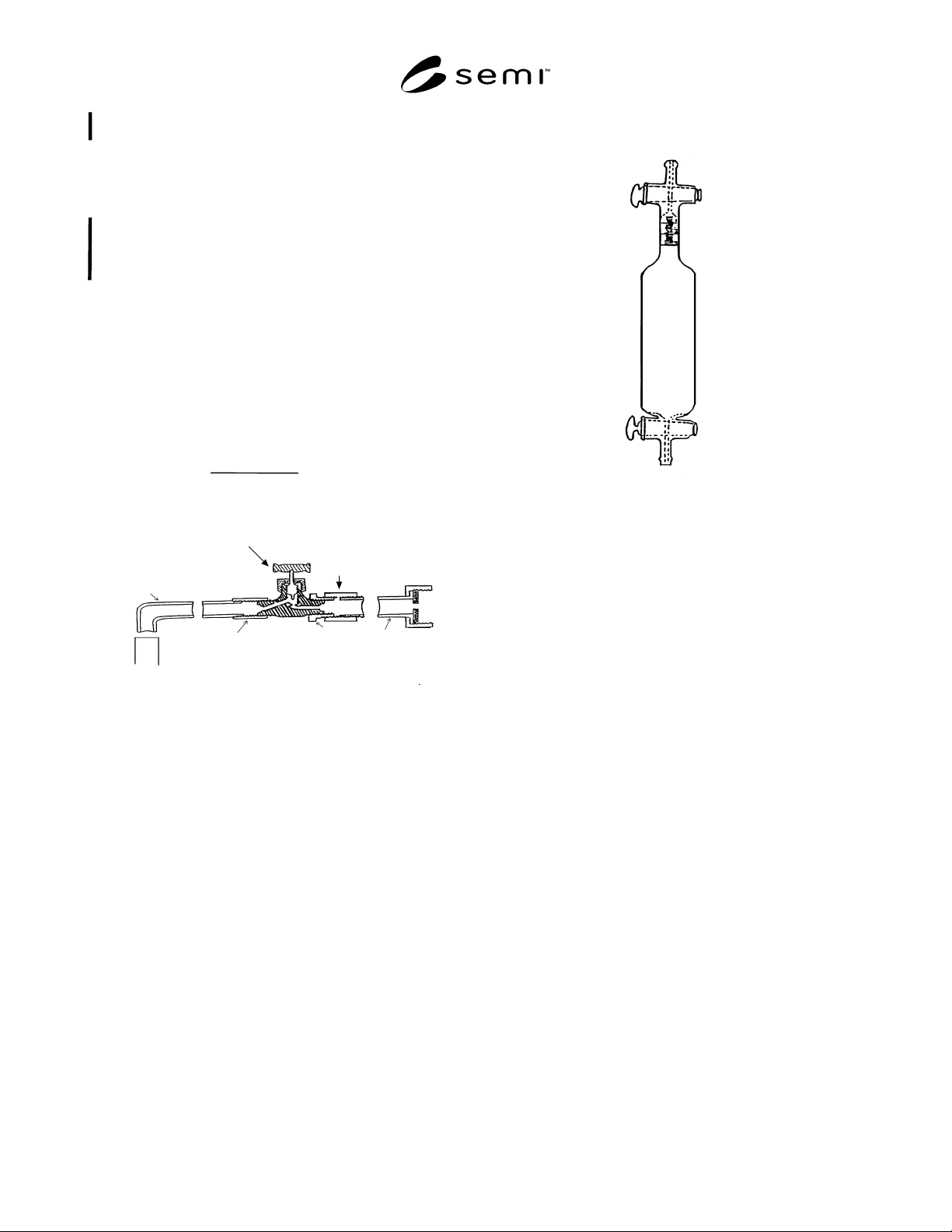
1/8" Steel Pipe
1/8" Steel
Sleeve
1/8" Brass
Needle Valve
Stainless
Steel Needle
1/4" Steel
Coupling
Gas Cylinder
Connection
1/8" to 1/4"
Steel
Bushing
1/4" Steel Pipe
1/4" Tygon Tubing
®
Figure 1
Preparation of Sample Solution in Ice
Figure 2
Modified Gas Collecting Tube
NOTICE: SEMI makes no warranties or
representations as to the suitability of the standards set
forth herein for any particular application. The
determination of the suitability of the standard is solely
the responsibility of the user. Users are cautioned to
refer to manufacturer’s instructions, product labels,
product data sheets, and other relevant literature
respecting any materials mentioned herein. These
standards are subject to change without notice.
The user’s attention is called to the possibility that
compliance with this standard may require use of
copyrighted material or of an invention covered by
patent rights. By publication of this standard, SEMI
takes no position respecting the validity of any patent
rights or copyrights asserted in connection with any
item mentioned in this standard. Users of this standard
are expressly advised that determination of any such
patent rights or copyrights, and the risk of infringement
of such rights, are entirely their own responsibility.
Copyright by SEMI® (Semiconductor Equipment and Materials
International), 3081 Zanker Road, San Jose, CA 95134. Reproduction o
f
the contents in whole or in part is forbidden without express written
consent of SEMI.