semi合集-English.pdf - 第2874页
SEMI E105-0701 © SEMI 2000, 2001 25 R3-1.2 Case 1 – Factory Operation decides s torage machine (Refer to Scenarios R2-3 and R 2 -4) Stoc ker 1 Prod ucti on Eq. 1 Stocker 2 Prod uction Eq. 2 Operation 1000 Operatio n 2 00…
SEMI E105-0701 © SEMI 2000, 2001 24
RELATED INFORMATION 3
ASSUMED CASE OF SCHEDULER/DISPATCHER
NOTE: This related information is not an official part of SEMI E105. This related information was approved for publication by
full letter ballot procedures on February 1, 2001.
The assumed two cases of scheduler/dispatcher were used to have an analysis and to make scenarios when the
interfaces defined in SEMI E105 ware developed. This related information describes the assumed two case of
scheduler/dispatcher to make easier for the standard user to understand SEMI E105. SEMI E105 does not limit the
case of Scheduler/Dispatcher to these two assumed scheduler/dispatcher.
R3-1 Dispatch List Based Scheduler/Dispatcher
R3-1.1 Basic Functions
Dispatch List Based Scheduler/Dispatcher has a waiting lots list in each operation and has a capability to prioritize
the existing lots.
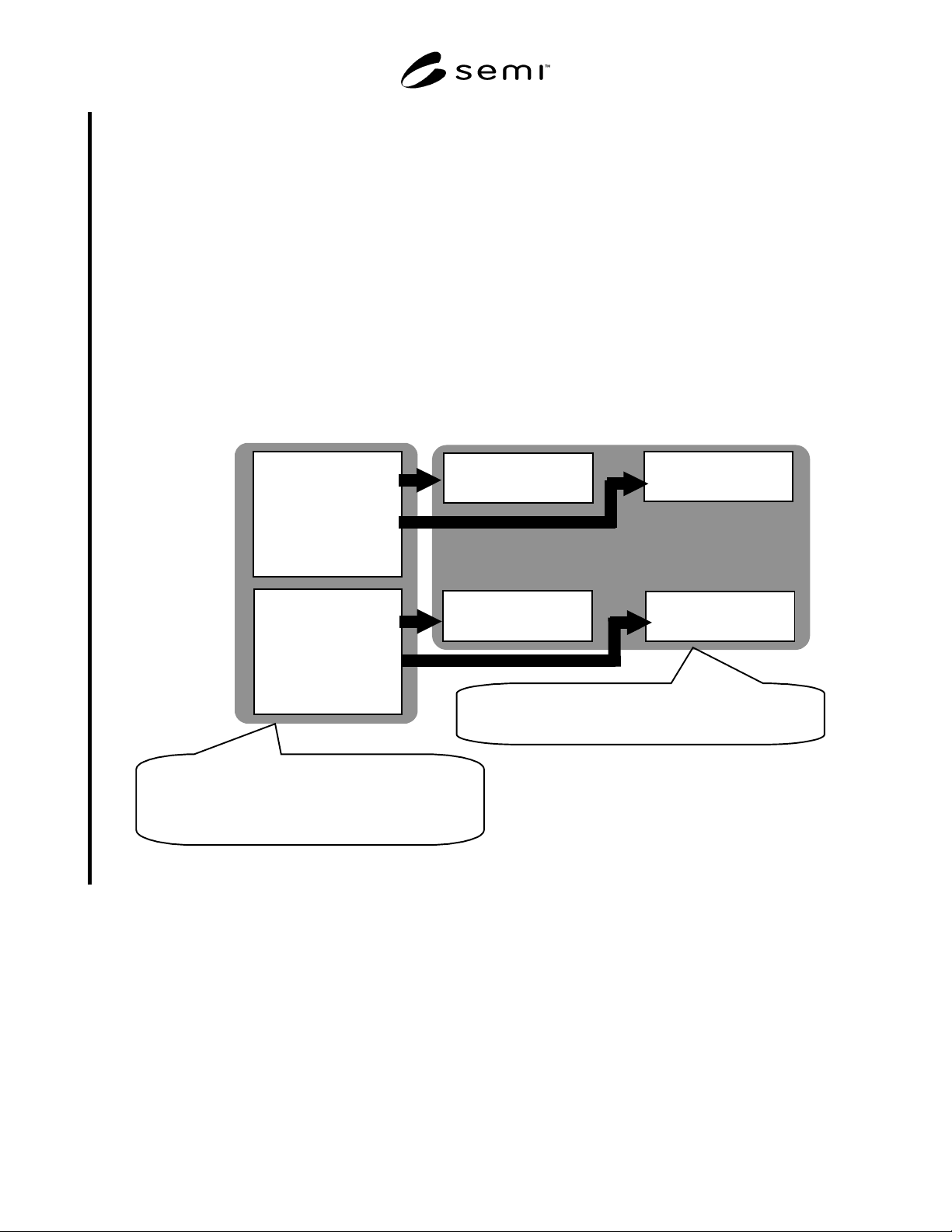
EQ-1
Lot-1
Waiting Lot List
Operation : 1000
1 Lot-1
2 Lot-2
3 NPW-1(EQ1)
EQ-2
Lot-2
At 09:00
At 10:00
Waiting Lot List
Operation : 1000
1 Lot-3
2 NPW-1(EQ1)
3 NPW-2(EQ2)
EQ-1
Lot-3
EQ-2
NPW
-
2
Dispatch List Based S/D keeps the waiting Lot
List on each operation. The waiting Lot List is
the calculated result based on the rule provided by
the supplier
Decision made by Dispatch List Based S/D. Dispatch
List Based S/D sends one Lot (Batch) to FO as a
decision.
Waiting Lots
Dispatch List Based S/D output
Figure R3-1
SEMI E105-0701 © SEMI 2000, 200125
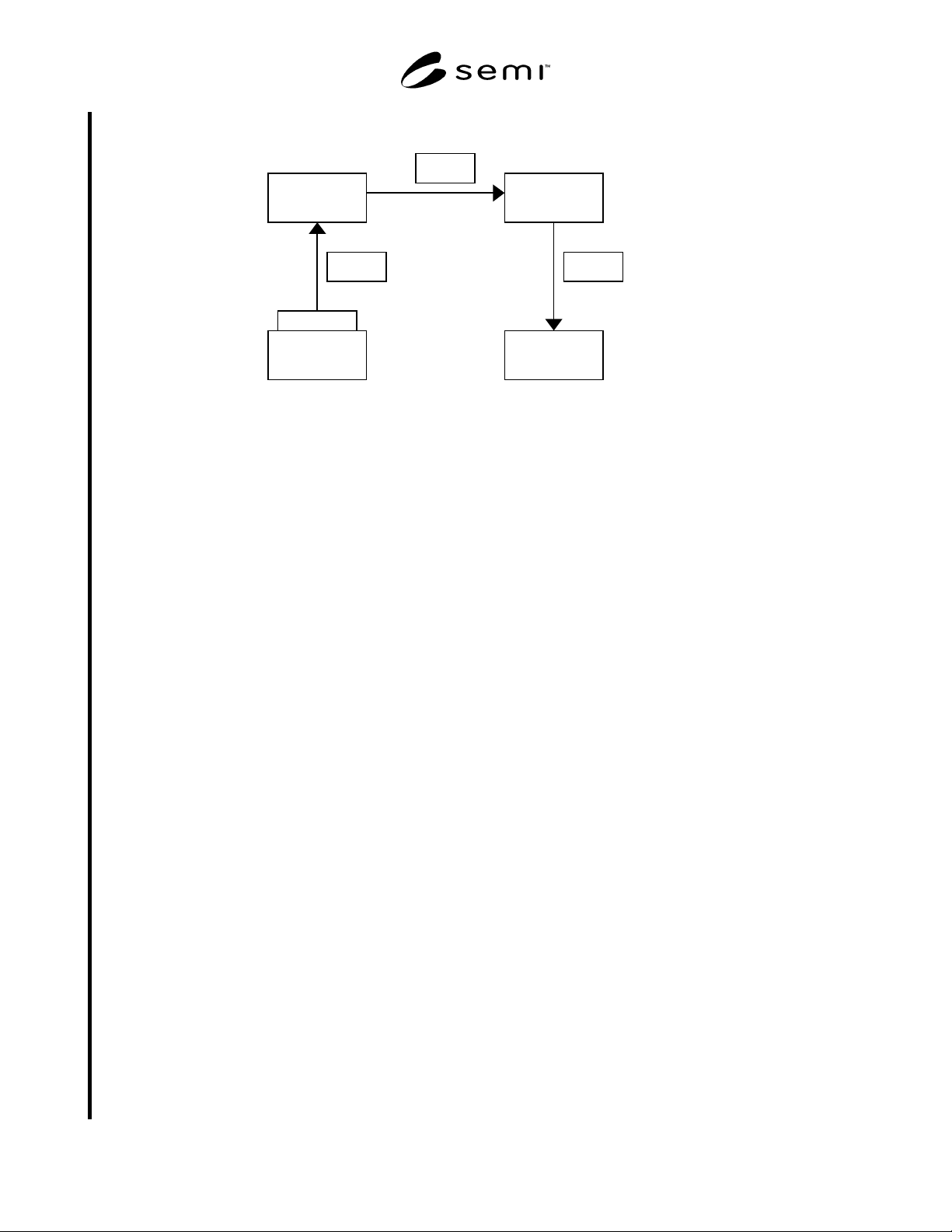
R3-1.2 Case 1 – Factory Operation decides storage machine (Refer to Scenarios R2-3 and R2-4)
Stocker 1
Production
Eq. 1
Stocker 2
Production
Eq. 2
Operation 1000 Operation 2000
Carrier A
AGV 1 OHT 1
OHS 2
Figure R3-2
1. Carrier A processing on Eq.1 (Operation 1000) is finished.
2. Next operation for Carrier A is “2000” and the production equipment in operation “2000”is Eq.2 only.
3. Factory Operation makes the logistic decision .
(1) Transfer Carrier A from Eq.1 to Eq.2
or
(2) Transfer Carrier A from Eq.1 to Stocker 2.
4. Factory Operation uses the following interfaces defined in section 6.1.6. (*1)
• whatNextForResourceByCount
• whatNextForMaterialGroupByCount
• whatNextForDurableByCount
5. Factory Operation dose not use the following interfaces defined in section 6.1.6. (*1)
• whereNextForMaterialGroup
• whereNextForDurable
6. Scheduler / Dispatcher shows the waiting Lot list in operation “2000” (Eq.2) to Factory Operation
R3-1.2 Case 2 – Scheduler / Dispatcher decides storage machine (Refer to Scenarios R2-5 and R2-6)
1. Carrier A processing on Eq.1 (Operation 1000) is finished.
2. Next operation for Carrier A is “2000” and the production equipment in operation “2000”is Eq.2 only.
3. Scheduler / Dispatcher checks the port status of Eq.2 and makes the logistic decision .
(1) Transfer Carrier A from Eq.1 to Eq.2
or
(2) Transfer Carrier A from Eq.1 to Stocker 2.
4. Factory Operation uses the following interfaces defined in section 6.1.6. (*1)
• whatNextForResourceByCount
• whereNextForMaterialGroup
• whereNextForDurable
SEMI E105-0701 © SEMI 2000, 2001 26
5. Factory Operation dose not use the following interfaces defined in section 6.1.6. (*1)
• whatNextForMaterialGroupByCount
• whatNextForDurableByCount
R3-2 Simulator Based Scheduler/Dispatcher (Refer to Scenarios R2-1 and R2-2)
R3-2.1 Basic Functions
Simulator Based Scheduler / Dispatcher has a forecast list for each production equipment and provides the lot list
with forecast time stamp to Factory Operation.
Factory Operation uses “forecastFor…” interfaces defined in section 6.1.6. (*1)
EQ-1 (Operation 1000)
09:00 - 10:00 Lot-1
10:00 - 11:00 Lot-2
11:00 - 12:00 NPW-1
12:00 - 13:00 Maintenance
EQ-2 (Operation 1000)
09:00 - 10:00 NPW-2
10:00 - 11:00 Lot-3
11:00 - 12:00 Maintenance
12:00 - 13:00 Lot-4
Simulator Based S/D output
Figure R3-3
Remarks
In (*1), the conformance of each interfaces to each case of Scheduler/Dispatcher are described. These are only for
reference and are not the requirement to the Scheduler/Dispatcher product. For example, Simulator Based
Scheduler / Dispatcher may support “whatNextFor…” interfaces.
NOTICE: SEMI makes no warranties or representations as to the suitability of the standard set forth herein for any
particular application. The determination of the suitability of the standard is solely the responsibility of the user.
Users are cautioned to refer to manufacturer’s instructions, product labels, product data sheets, and other relevant
literature respecting any materials mentioned herein. These standards are subject to change without notice.
The user’s attention is called to the possibility that compliance with this standard may require use of copyrighted
material or of an invention covered by patent rights. By publication of this standard, SEMI takes no position
respecting the validity of any patent rights or copyrights asserted in connection with any item mentioned in this
standard. Users of this standard are expressly advised that determination of any such patent rights or copyrights, and
the risk of infringement of such rights, are entirely their own responsibility.
Copyright by SEMI® (Semiconductor Equipment and Materials
International), 3081 Zanker Road, San Jose, CA 95134. Reproduction o
f
the contents in whole or in part is forbidden without express written
consent of SEMI.