semi合集-English.pdf - 第322页
SEMI E49.2-1104 © SEMI 1995, 2004 4 7 Utility Recommendations NOTE 3: These are minim um utility recommendations for the media used during qualification of an Assembly. 7.1 Ni trogen Nitrogen qual ity should meet requi…
SEMI E49.2-1104 © SEMI 1995, 2004 3
6 Performance Guidelines
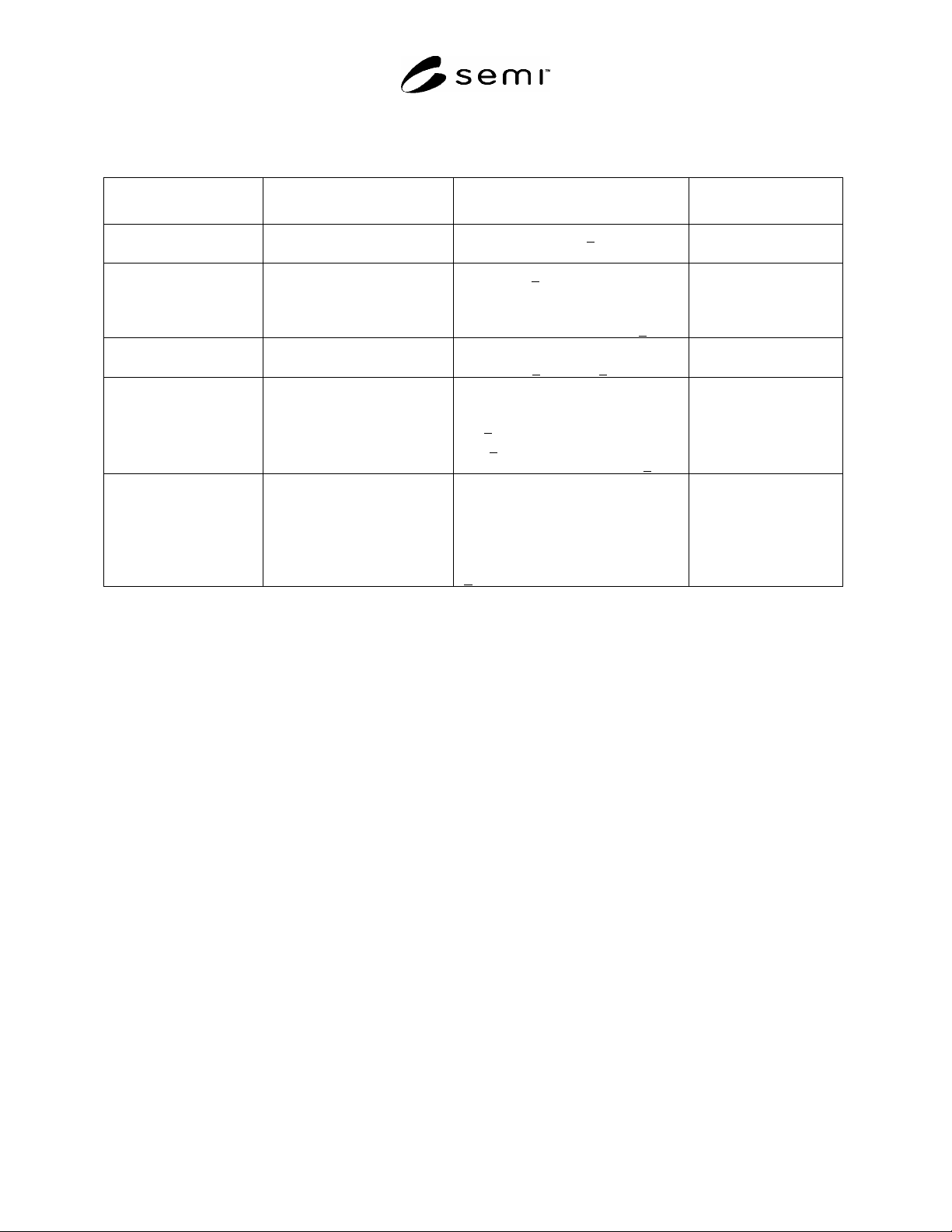
Table 1 Overview of Recommended Tests
Test Frequency Performance Guideline Test Method/Reporting
of Results
Hydrostatic Pressure Every Assembly shipped to
the end user
No visible leakage & < 5% pressure
decay
Section 9.1
Section 9.2
Ultrapure Water Flush Every Assembly shipped to
the end user
Resistivity: > 18 meg ohm-cm @
25°C (77°F)
Allowable TOC adders (ppb): <
7.5
Section 9.1
Section 9.3
Particle Periodic testing – see Section
10.7 and 10.8
Allowable Particle adders
(particles/L >
0.1 µm) : < 120
Section 9.1
Section 9.4
Ionic Contamination Periodic testing – see Sections
10.7 and 10.8
Allowable ionic adders (ppb):
F-: <
7.5
Cl-: <
0.40
NO
2
-, Br-, NO
3
-, HPO
4
=, SO
4
=
<
0.05
Section 9.1
Section 9.5
Metallic Contamination Periodic testing – see Sections
10.7 and 10.8
Allowable metallic adders (ppb):
Al, Ba, B, Ca, Cr, Cu, Fe, Pb, Li, Mg,
Mn, Ni, K, Na, Sr, and Zn:
<
0.02
Section 9.1
Section 9.5
NOTE 2: Table 1 provides an overview of the tests recommended within this document and associated performance criteria. For
detailed explanations of testing frequency, test methods, and some examples of tests, refer to the sections identified within the
table.

SEMI E49.2-1104 © SEMI 1995, 2004 4
7 Utility Recommendations
NOTE 3: These are minimum utility recommendations for
the media used during qualification of an Assembly.
7.1 Nitrogen
Nitrogen quality should meet requirements of
SEMI C59.
Particle filtration should be 99.99999% removal of
.003 micron particles.
7.2 Ultrapure Water
Resistivity 18 Mohm-cm @ 25°C (77°F)
TOC — < 10 ppb
Silica — < 5 ppb
Particles — (>
0.1 µm) < 500 particles/L
Anions (F-, Cl-, NO2-, Br-, NO3-, HPO4-, SO4-) <
0.10 ppb
Metals (Al, Ba, B, Ca, Cr, Cu, Fe, K, Li, Mg, Mn,
Na, Ni, Pb, Sr, Zn) < 0.05 ppb
Bacteria — < 10 colonies/100 milliliter
NOTE 4: If testing requirements dictate, access to higher
quality Ultrapure Water may be appropriate. Additional
information related to Ultrapure Water facility design and
terminology may be obtained in SEMI F61, Guide for
Ultrapure Water System Used in Semiconductor Processing.
7.3 Clean Dry Air (CDA) or Oil Free Air — Uses
include pneumatic control and air actuation. CDA is
not recommended for use on cleaned wetted surfaces.
Nitrogen is recommended for drying cleaned wetted
surfaces because the purity level is clearly defined and
controlled.
8 Related Documents
8.1 International SEMATECH Documents
3
SEMASPEC 92010936B — Provisional Test Method
for Determining Leachable Trace Inorganics in Ultra
Pure Water Distribution System Components
SEMASPEC 92010937B — Provisional Test Method
for the Evaluation of Bulk Polymer Samples of Ultra
Pure Water Distribution System Components
SEMASPEC 92010949B — Provisional Test Method
for Determining Particle Contribution and Retention by
Ultra Pure Water Distribution System Components
3 International SEMATECH, 2706 Montopolis Drive, Austin, TX
78741, USA, Website: www.sematech.org
SEMASPEC 92010955B — Provisional Test Method
for Analyzing Plastic Surface Condition of Ultra Pure
Water Distribution System Components (SEM Method)
8.2 ASTM Documents
ASTM D5173-97 Standard Test Method for On-
Line Monitoring of Carbon Compounds in Water by
Chemical Oxidation, by UV Light Oxidation, by Both,
or by High Temperature Combustion Followed by
NDIR or by Electrolytic Conductivity
9 Sampling and Analysis Methodology
9.1 General Recommendations for all Tests
9.1.1 All test reports should include:
Confidence intervals and detection or reporting
limits,
All units of measure,
As detailed a description as possible of the
Assembly tested including part number and
manufacturing date,
Date of test and initials of person performing test,
Additional information as specified in the specific
test recommendations within this document,
Any and all relevant data collected during testing
should be summarized and included,
Recording of Ultrapure Water and Nitrogen quality
used to perform test, and
For Sections 9.3 through 9.5 inlet and outlet water
quality.
9.1.2 Trained and qualified personnel should perform
all sampling and testing.
9.1.3 All instrumentation shall be calibrated with
standards traceable to NIST or the equivalent national
standard where those standards exist. The type of
instrument(s) manufacturer, model #, serial # or I.D #,
and most recent calibration date should be available.
9.1.4 If using two separate online instruments for inlet
and outlet testing, determine any difference in the two
readings and include that in the final calculations.
9.1.5 Incoming and outgoing water should be sampled
as close as possible to the Assembly’s liquid supply
point and the Assembly’s delivery point respectively.
Where there are multiple inlets and/or outlets for an
Assembly, a single representative inlet and outlet
should be selected for this testing. However, all inlets
and outlets should be flushed in a consistent manner
SEMI E49.2-1104 © SEMI 1995, 2004 5
such that the tests are representative of the Assembly
performance.
9.1.6 For optimum results, the distance between a
sample port and an instrument should be minimized.
It
is recommended that components comply with SEMI
F57 and the assembly and design should be in
accordance with SEMI E49.7.
9.1.7 Operate valves to ensure there is no entrapment
and to displace any air prior to beginning a test.
9.1.8 Filter elements contained within the Assembly
under test should not be included during a test as they
may mask results and will need to be replaced
following the test.
9.1.9 Assemblies
should be dried with Nitrogen and
capped following any testing with ultrapure water and
prior to shipment.
9.2 Hydrostatic Pressure Test – This test is required
for every Assembly shipped directly to an end user.
This test may also be required periodically at other
points in the supply chain.
9.2.1 The intent of this test is to eliminate Assembly
leaks when an assembly is initially exposed to pressure
and temperature (up to and including the
manufacturer’s maximum recommended operating
pressure and temperature) at the end user’s facility.
The user of this test is encouraged to review
“Hydrostatic Pressure and Leak Testing of Polymer
Piping Systems Used in High-purity Water
Applications” (Mayer, Burkhart, Rydzewski) for a
thorough discussion of standards, and how the physical
properties of polymers impact testing practices.
9.2.2 The Hydrostatic Pressure Test conditions are the
manufacturer’s maximum recommended pressure at
ambient temperature. However, it is incumbent upon
the manufacturer to ensure that the assembly will be
leak free when exposed to maximum pressure and
maximum temperature at the end user’s facility. If the
test conditions recommended here do not result in
initial leak free operation for the end user, it is
incumbent upon the end user and manufacturer to agree
on appropriate corrective action(s) to comply with the
intent of this Hydrostatic Pressure Test. This may
include testing at elevated media temperatures.
9.2.3 Test Method
9.2.3.1 Test Media — Ultrapure Water at ambient
temperature.
9.2.3.2 Test Pressure — Manufacturer’s maximum
recommended operating pressure.
9.2.3.3 Test Procedure
Flush system at maximum rated flow to remove
entrapped air.
Keep assembly at constant temperature during test.
Pressurize to the Manufacturer’s maximum
recommended operating pressure and wait 15
minutes.
Repressurize to Manufacturer’s maximum
recommended operating pressure and wait 15
minutes.
Repressurize to Manufacturer’s maximum
recommended operating pressure and wait 30
minutes.
Repressurize to Manufacturer’s maximum
recommended operating pressure.
Monitor the pressure for 15 minutes to ensure
compliance with Table 1 requirement of <
5%
decay in pressure.
Record pressure readings at the beginning and end
of each waiting period.
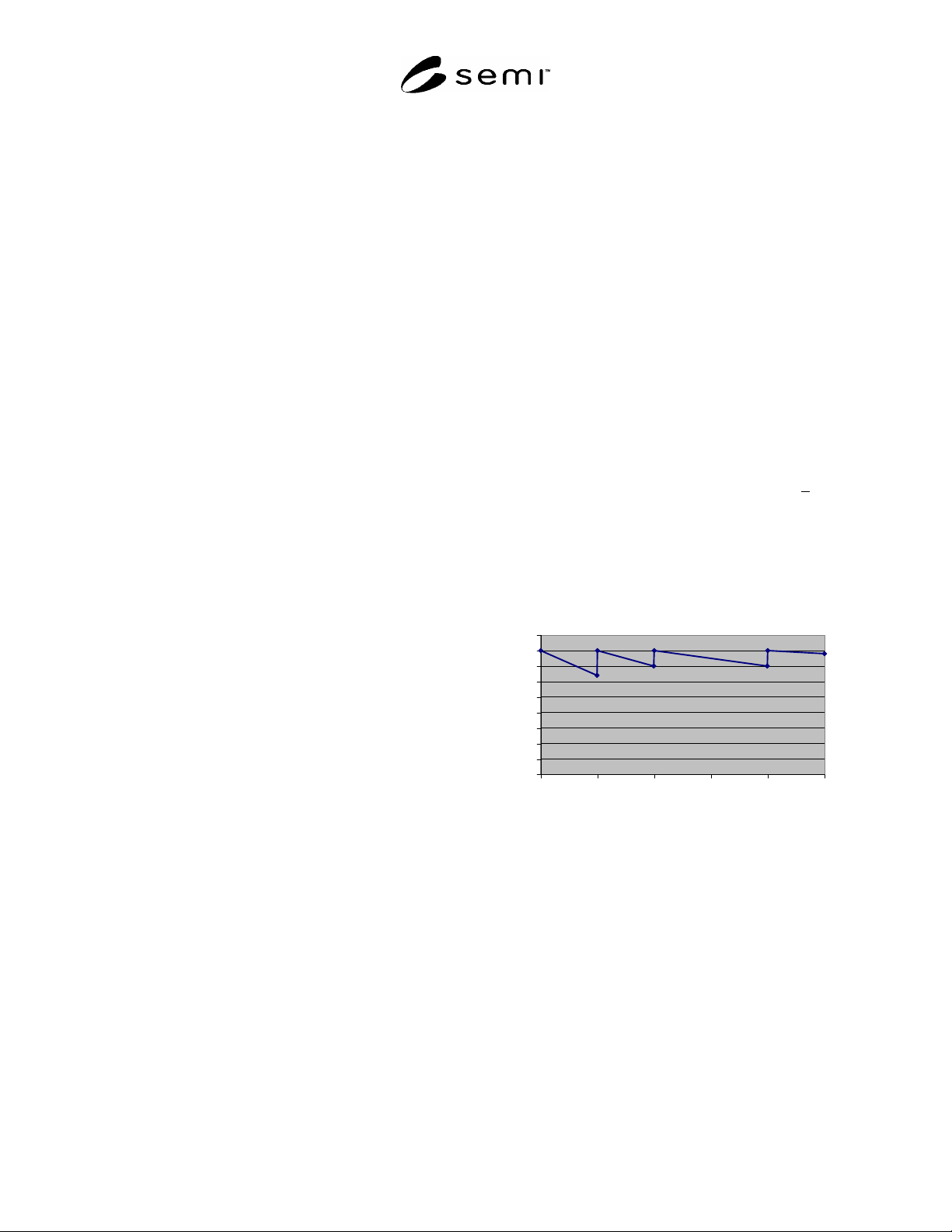
9.2.4 Hydrostatic Pressure Test Example
Hydrostatic Pressure Test Example
0
5
10
15
20
25
30
35
40
45
0 1530456075
Time (minutes)
Pressure (psig)
Figure 1
Hydrostatic Pressure Test Example
Test Media: Ultrapure Water
Test Media Temperature: 20C
Manufacturer’s maximum recommended operating
pressure: 40 psig.
Assembly is pressurized to 40 psig for 15 minutes.
Assembly is repressurized to 40 psig for 15
minutes.
Assembly is repressurized to 40 psig for 30
minutes.