semi合集-English.pdf - 第2496页
SEMI E87-0705 © SEMI 1999, 2005 65 R1-3.7.1 If the object has b een al ready associated with the loadport other than the carrier is delivered; R1-3.7.1.1 Thi s is the case for misl oading to a wr ong loadport. R1-3.7.1 .…
SEMI E87-0705 © SEMI 1999, 2005 64
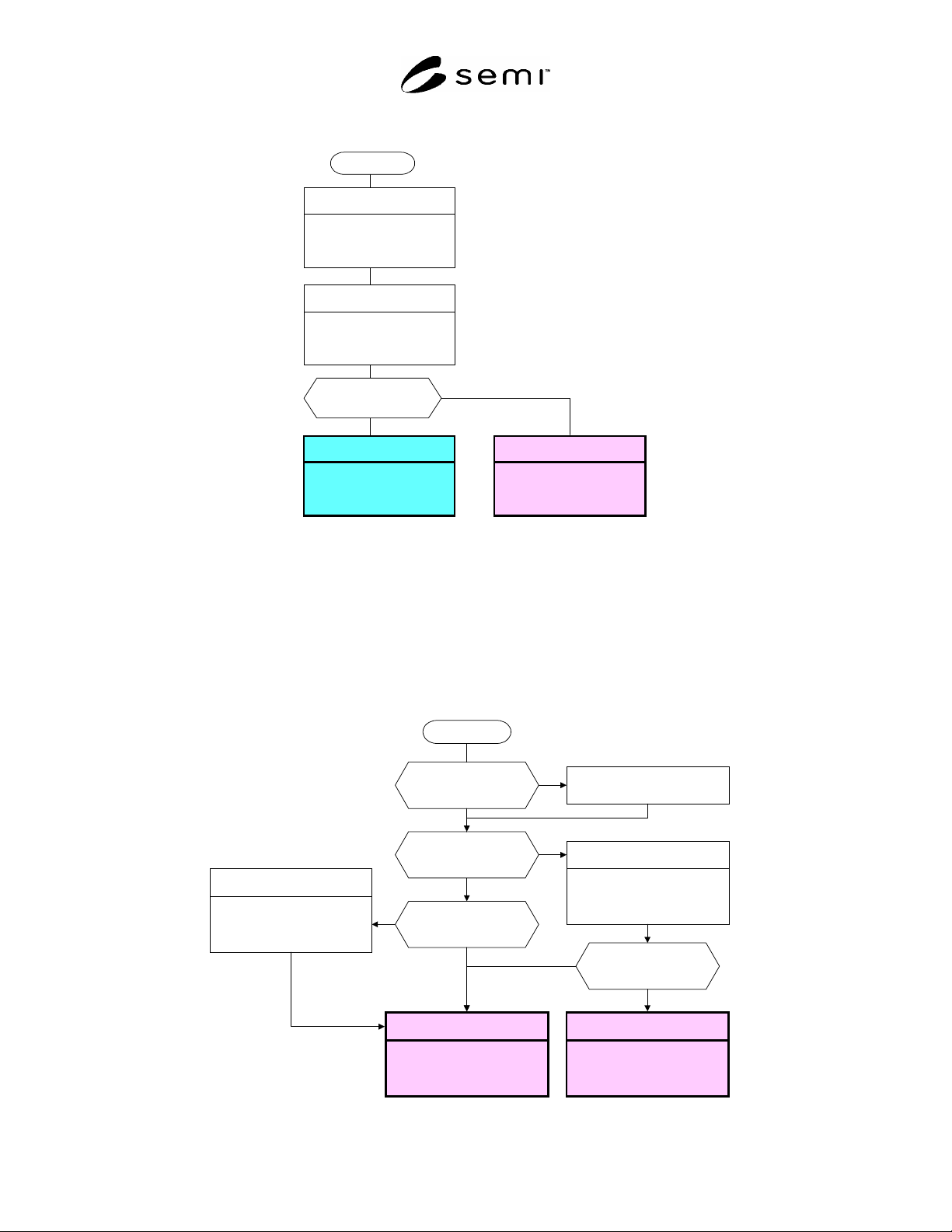
R1-3.6 CREATED
ProceedWithCarrier?
NO
Cancel Carrier
Carrier ID Verification Fail
Ready to Unload
CREATED
YES
PORT ASSOCIATION
Associate created object
with the port on which
the carrier is delivered
Carrier ID Verified
Carrier ID Verification OK
WAIT FOR HOST
Report the carrier ID
and wait for host instruction
R1-3.6.1 Associate the object just created with the loadport on which the carrier is delivered.
R1-3.6.2 Report the carrier ID and wait for host instruction.
R1-3.6.3 If the host requests ProceedWithCarrier service, change the Carrier ID Status to Carrier ID Verification
OK.
R1-3.6.4 If the host requests CancelCarrier service, change the Carrier ID Status to Carrier ID Verification Fail. The
carrier shall be taken to Ready to Unload.
R1-3.7 STORED
Carrier ID Verified
Carrier ID Verification OK
Cancel Carrier
Carrier ID Verification Fail
NO
STORED
YES
YES
YES
NO
NO
ProceedWithCarrier?
Has the loadport
been associated with
another object?
Has the object
been associated with
current port ?
PORT ASSOCIATION
Associate the object
with the port
Cancel the association
Has the object
been associated with
another loadport?
NO
YES
Delete Associated Object
Cancel the association and
delete the associated object
then WAIT FOR HOST

SEMI E87-0705 © SEMI 1999, 2005 65
R1-3.7.1 If the object has been already associated with the loadport other than the carrier is delivered;
R1-3.7.1.1 This is the case for misloading to a wrong loadport.
R1-3.7.1.2 Cancel the association.
R1-3.7.2 And If the loadport on which the carrier has been delivered is associated to another object, then delete the
object associated with the port on which the carrier is delivered.
R1-3.7.2.1 This is the case for equipment base ID VERIFICATION FAIL.
R1-3.7.2.2 Associate the object with the loadport on which the carrier has been delivered.
R1-3.7.2.3 Then enter WAITING FOR HOST.
R1-3.7.2.4 If ProceedWithCarrier is given, then the carrier is verified.
R1-3.7.2.5 If CancelCarrier is given, then the carrier verification is failed.
R1-3.7.3 If the object has been associated with the loadport on which the carrier is delivered, the carrier is verified.
Change the Carrier ID status to Carrier ID Verified.
R1-3.7.4 If no object has been associated with the loadport on which the carrier is delivered, associate the object
with the loadport. This is the case for associating object created by Notify.
NOTICE: SEMI makes no warranties or representations as to the suitability of the standards set forth herein for any
particular application. The determination of the suitability of the standard is solely the responsibility of the user.
Users are cautioned to refer to manufacturer's instructions, product labels, product data sheets, and other relevant
literature, respecting any materials or equipment mentioned herein. These standards are subject to change without
notice.
By publication of this standard, Semiconductor Equipment and Materials International (SEMI) takes no position
respecting the validity of any patent rights or copyrights asserted in connection with any items mentioned in this
standard. Users of this standard are expressly advised that determination of any such patent rights or copyrights, and
the risk of infringement of such rights are entirely their own responsibility.
Copyright by SEMI® (Semiconductor Equipment and Materials
International), 3081 Zanker Road, San Jose, CA 95134. Reproduction of
the contents in whole or in part is forbidden without express written
consent of SEMI.

SEMI E87.1-0702 © SEMI 2000, 2002 1
SEMI E87.1-0702
PROVISIONAL SPECIFICATION FOR SECS-II PROTOCOL FOR
CARRIER MANAGEMENT (CMS)
This provisional specification was technically approved by the Global Information and Control Committee
and is the direct responsibility of the North American Information and Control Committee. Current edition
approved by the North American Regional Standards Committee on April 30 2002. Initially available at
www.semi.org June 2002; to be published July 2002. Originally published February 2000; previously
published March 2002.
1 Purpose
1.1 This document maps the services and data of SEMI
E87 to SECS-II streams and functions, and data
definitions.
2 Scope
2.1 This is a provisional specification covering
equipment supporting automated access to load ports
from the host point-of-view. The provisional status is
required because of the immaturity of implementations
of integrated equipment with AMHS, and additional
specifications may yet be defined. Also, further
exception handling and error recovery scenarios need to
be defined.
2.2 This document applies to all implementations of
SEMI E87 that use the SECS-II message protocol
(SEMI E5). Compliance to this standard requires
compliance to both SEMI E87 and SEMI E5.
2.3 This standard does not purport to address safety
issues, if any, associated with its use. It is the
responsibility of the users of this standard to establish
appropriate safety and health practices and determine
the applicability of regulatory limitations prior to use.
3 Limitations
3.1 This specification applies to semiconductor
equipment with SEMI E15.1 compliant load ports. It
may also be applied to other manufacturing equipment
that supports automated carrier transfer and or contains
an internal buffer.
3.2 This is a provisional specification. The following
areas must be completed before the provisional status is
removed:
1) Any additional services, or changes to existing
services, in Carrier Management must be mapped
to SECS-II messages.
4 Referenced Standards
4.1 SEMI Standards
SEMI E5 — SEMI Equipment Communications
Standard 2 Message Content (SECS-II)
SEMI 15.1 — Provisional Specification for 300 mm
Tool Load Port
SEMI E39.1 — SECS-II Protocol for Object Services
Standard (OSS)
SEMI E87 — Specification for Carrier Management
(CMS)
NOTE 1: Unless otherwise indicated, all documents cited
shall be the latest published versions.
5 Services Mapping
5.1 This section shows the specific SECS-II streams
and functions that shall be used for SECS-II imple-
mentation of the services defined in SEMI E87, as well
as the parameter mapping for data attached to services.
5.2 Services Message Mapping
5.2.1 Table 1 defines the relationships between SEMI
E87 services and SECS-II messages.