semi合集-English.pdf - 第3366页
SEMI E132-0305 © SEMI 2004, 2005 19 13.1.2 Session Establishment — Session establish ment in this specification is achieved by send ing a EstablishSes sion reque st followi ng authentication. Esta blishSessi on include s…
SEMI E132-0305 © SEMI 2004, 2005 18
Table 26 ActiveSession Association Definitions
Association Role Name Definition Comments
sessionEndPoint Addressing information for sending notifications to the
authenticated Principal.
Structured data, of any type derived from
EndPoint, defined in Section 12.3.3.4.1.
12.3.3.4.1 EndPoint — An abstract data type used to describe a communication end point. This specification only
defines end points using the HTTP protocol, although others are possible depending on the communication protocol.
Any implementation of this specification must define requirements for the support of separate endpoint addresses,
and any additional EndPoint subclasses required for the communication protocol used. This class has no attributes
or associations.
12.3.3.4.2 HTTPEndPoint — This class is used to describe addressing information that the equipment is to use for
sending notifications to clients where the communication protocol in use is based on HTTP.
Table 27 HTTPEndPoint Attribute Definitions
Attribute Name Definition Form
url HTTP URL of communication end point. Text, formatted according to the IETF RFC 2396
specification for URL syntax.
12.4 Equipment Console Interfaces
12.4.1 The equipment manufacturer shall provide access to the SecurityAdmin operations from the equipment
console.
13 Session Communications
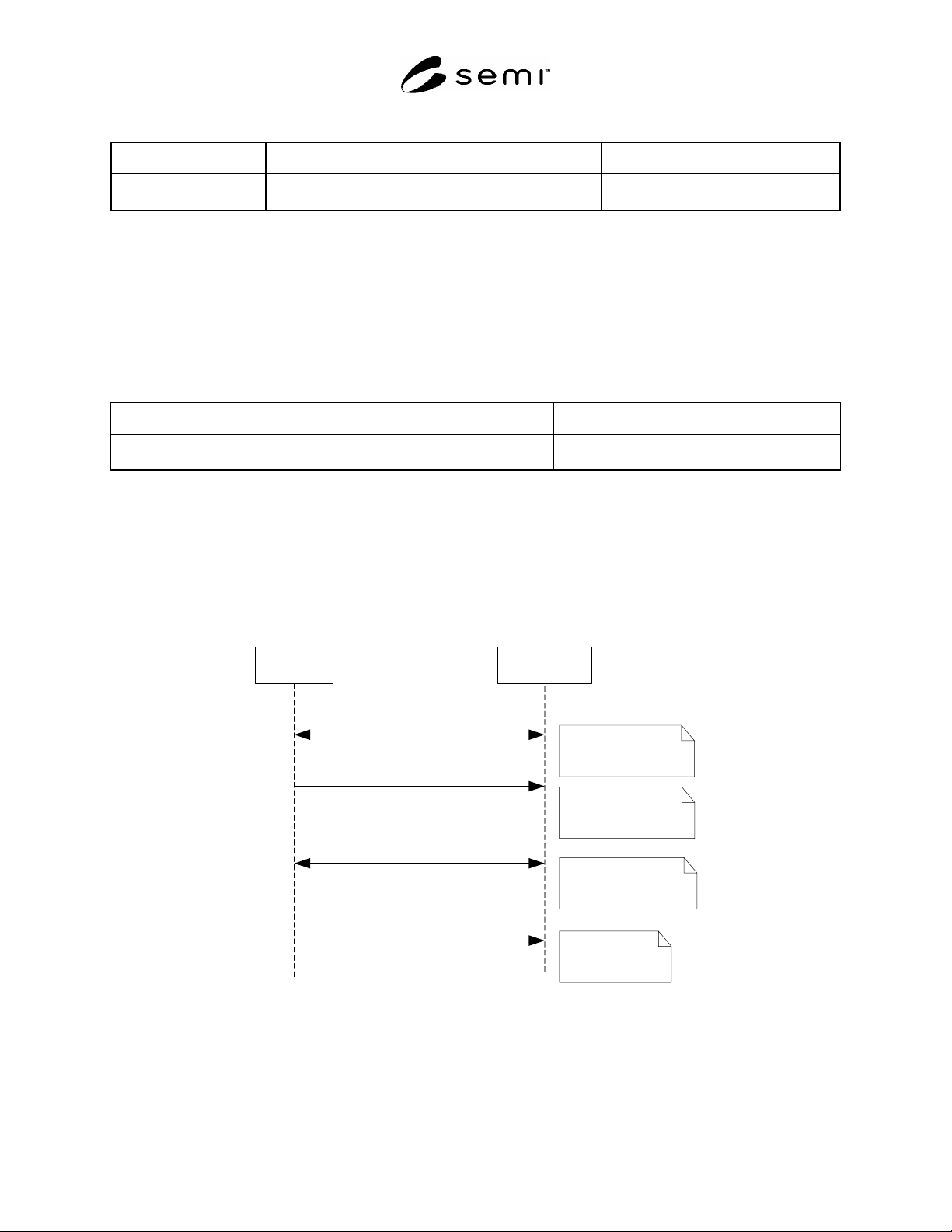
13.1 Session Message Flow — Figure 13 shows an example of a typical message flow for an authenticated
communication session.
Client Equipment
Session Establishment
Service Request/Response
Close Session
Session Closed
Verify Authorizations
Client Authenticated
.
.
Authentication
Session Established
Figure 13
Session Message Flow
13.1.1 Authentication — Authentication message flow as described in Section 10 in which both client and
equipment mutually verify each other’s identity.

SEMI E132-0305 © SEMI 2004, 2005 19
13.1.2 Session Establishment — Session establishment in this specification is achieved by sending a
EstablishSession request following authentication. EstablishSession includes the client’s end point (if necessary) for
equipment notifications (see Section 13.2.6). Upon receiving the request, the equipment determines if the
authenticated client has a corresponding ACLEntry. If so, a new session is created for the client if possible (see
Section 13.2.6), and generates a unique session identifier for it. The session identifier is returned to the client in the
EstablishSession response for use in subsequent requests. Every session established on the equipment has
associated with it a unique session identifier, the client’s id, and end point address. Once established, the session is
granted the Privileges assigned to the client based on the corresponding ACLEntry for that client (Principal).
Changes to the ACL do not affect the Privileges of sessions established prior to the change..
13.1.3 Service Request and Response — Service requests, as defined by any interface specification that requires
authenticated communications and authorization, are made. The unique session identifier required for authorization
is carried in reserved session headers within the implementation protocol (see Section 10.2).
13.1.4 Close Session — Request by a client to terminate an authenticated session. Upon receiving this request, the
equipment clears all context information related to that session, including closing any existing, active connection,
and terminating any activities initiated by the client during the session.
13.2 SessionManager Interface
13.2.1 The equipment shall implement the session management operations defined in this section. These operations
are accessible to any client after an authenticated session is established, including the security admin.
EstablishSession()
PersistSession()
SessionPing()
CloseSession()
«interface»
SessionManager
Figure 14
Generic Session Services
13.2.2 SessionManager Operations
Table 28 SessionManager Operations
Operation Description Type Requestor/
Sender
Responder/
Receiver
PersistSession Requests equipment to persist current session. RR Client Equipment
SessionPing Checks if remote entity is still active. RR Client Equipment
CloseSession Requests to close and terminate current or specified session. RR Client Equipment
EstablishSession Request to establish a new authenticated session and to set
client end point.
RR Client Equipment
13.2.3 PersistSession — Upon receiving this request, if the client is requesting that the session be persisted, the
equipment shall store the client’s current session context including the session identifier, any client endpoint
addressing information, and session privileges to non-volatile memory. Once the session has been persisted, it
remains active across equipment shutdowns, reactivating as soon as the equipment is in a state where it can support
external communications. Persistent sessions can still be terminated if the equipment determines that the client is
unreachable. For further details, see the Session Monitoring state of Session State Model, defined in Section
14.3.2.7. See session state transitions (Table 30) into and out of the Frozen state for required behavior on freezing
and resuming persistent sessions. If the client uses this operation to remove persistence from the session state, the
equipment can remove the client’s session context from non-volatile memory, and shall not re-activate this session
automatically at equipment startup.

SEMI E132-0305 © SEMI 2004, 2005 20
Table 29 PersistSession Parameter Definitions
Parameter Description Kind Form
persist Whether or not the session should be persisted IN Boolean. If the value of this
parameter would not change
the session state (e.g.,
persist=‘true’ when the
current session is already
persistent), the equipment
shall silently ignore the
request.
error Unrecognized session. error Text, equal to unrecognized
session error, including the
bad session id.
13.2.4 SessionPing — Upon receiving this request, the equipment shall reply with its id. Ids are preconfigured and
must be the same one as used during the authentication phase. If equipment ids are not used during authentication,
then this is an identifier that shall be configurable at the equipment. See the Session Monitoring state defined in
Section 14.3.2.7, regarding behavior of established authenticated sessions in the event of ping timeouts.
Table 30 SessionPing Parameter Definitions
Parameter Description Kind Form
equipmentId Id of the equipment responding to the ping message. OUT Text, equal to the equipment
Id used in authentication
phase.
error Unrecognized session. error Text, equal to unrecognized
session error, including the
bad session id.
13.2.5 CloseSession — Upon receiving this request, the equipment shall send the SessionClosed notification (see
Section 15.1.3) to the client whose session is being closed, delete all information related to the client’s session, and
close any active connection to the client if one exists.
13.2.5.1 The established equipment security admin has the privilege to terminate or close any active session via the
CloseSession request. This admin function can be used to cleanup sessions where clients are no longer active or to
force termination of any session even when a client is still active.
Table 31 CloseSession Parameter Definitions
Parameter Description Kind Form
sessionId Identifier of the session to terminate. Only the security admin has
the privilege to terminate sessions other than its own.
IN Text, equal to the id of the
session to be terminated.
error Unrecognized session. error Text, equal to unrecognized
session error, including the
bad session id.
error Operation not authorized. Occurs only when the client has
specified a session id other than its own, and the client is not the
security admin.
error Structured data, of type
UnauthorizedOperationError,
Section 12.3.3.1.
13.2.6 EstablishSession — This operation creates a new authenticated session, sets the end point address to be used
for sending notifications to the client and establishes a session identifier. This must be the first request sent after
authentication is complete in order to create a new session, any other request is rejected with operation cannot be
performed error. The session identifier must be unique for each active session and is valid as long as the session is
not closed. The session identifier must be included in all subsequent requests in a special header defined by the
protocol specification. A client must have an ACLEntry defined in order to establish sessions, else request is