semi合集-English.pdf - 第3546页
SEMI E134.1-0305 © SEMI 2005 33 Figure 23 DeactivatePlanResponse 7.2.16.4.2 DeactivatePlanResponse — This glob al element acts as a top-level container entity represen ting the SOAP body of the r esponse to an SE MI E134…
SEMI E134.1-0305 © SEMI 2005 32
Table 57 DeactivatePlan Operation Binding
SOAPAction
urn:semi-org:ws.E134-1.V0305.DCMEqp-binding:DeactivatePlan
Input Headers (WSDL Message, Required) E132HeaderMessage, required
Output Headers (WSDL Message, Required) E132HeaderMessage, required
7.2.16.2 WSDL Operation
7.2.16.2.1 See the portType operation definition for “DeactivatePlan” in E134-Equipment-PortType.wsdl. Key
information is shown for convenience in the following table.
Table 58 DeactivatePlan PortType Operation
Input Message Name DeactivatePlanRequest
Output Message Name DeactivatePlanResponse
7.2.16.3 WSDL Message(s)
7.2.16.3.1 See the message definitions for “E132HeaderMessage”, “DeactivatePlanRequest”, and
“DeactivatePlanResponse” in E134-Equipment-PortType.wsdl. Key information is shown for convenience in the
following table.
Table 59 DataCollectionManagement Binding
Message Name
Schema
Element Name
E132HeaderMessage auth:E132Header
DeactivatePlanRequest dcm:DeactivatePlanRequestType
DeactivatePlanResponse dcm:DeactivatePlanResponseType
7.2.16.4 XML Schema Types
Figure 22
DeactivatePlanRequest
7.2.16.4.1 DeactivatePlanRequest — This global element acts as a top-level container entity representing the SOAP
body of a DeactivatePlan request. As defined in SEMI E134, this operation has two input arguments: the Plan id that
is being deactivated and terminate specifying if the DCP should be deactivated for all consumers. These arguments
are modeled as a attributes named “PlanId” of simpleType “xsd:string” and “terminate” of simpleType
“xsd:boolean”.
Table 60 Translation Table for Input Arguments for the DeactivatePlan Operation
Argument Name Format XML Element or Attribute XML Name/Type
planId Text Attribute PlanId: xsd:string
terminate Boolean Attribute terminate: xsd:boolean
SEMI E134.1-0305 © SEMI 2005 33
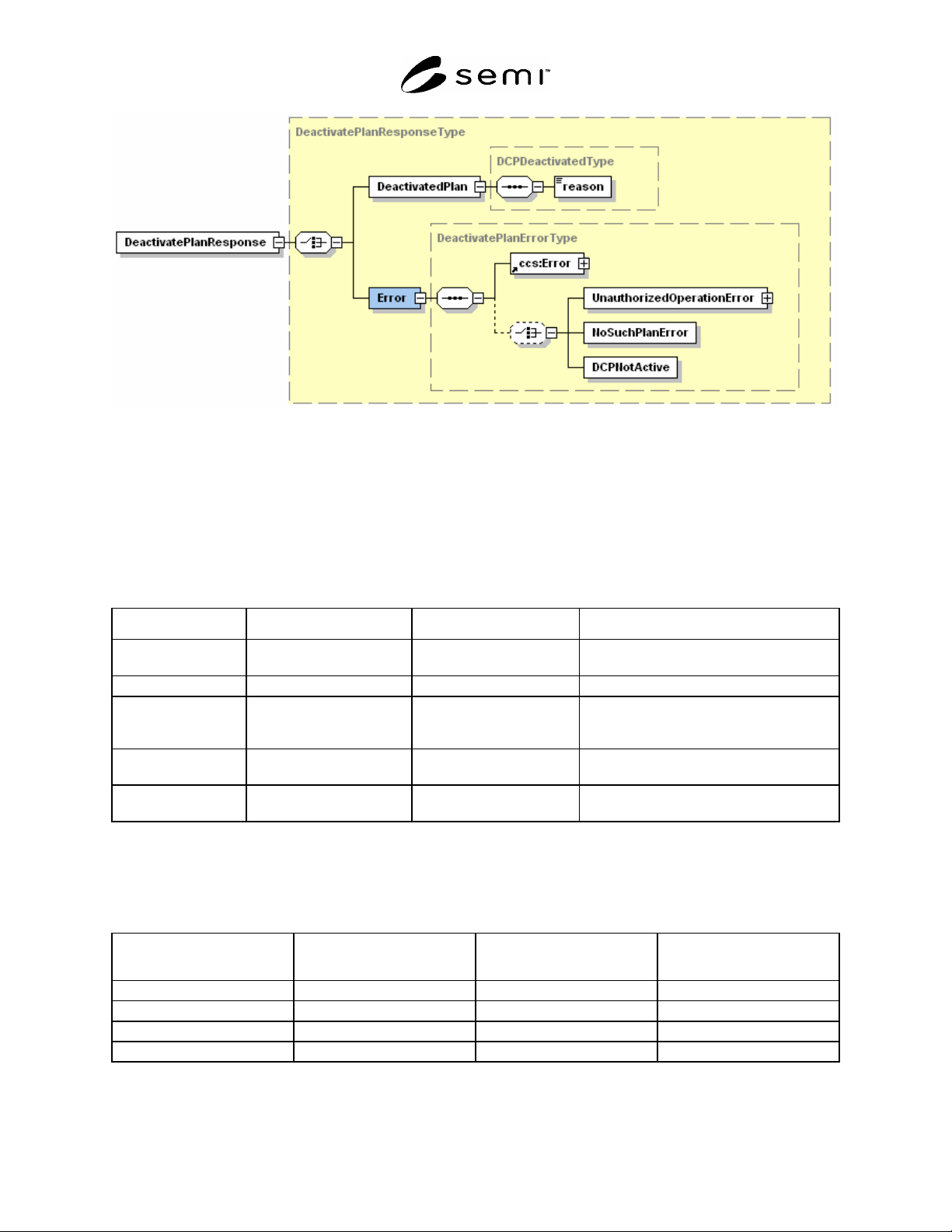
Figure 23
DeactivatePlanResponse
7.2.16.4.2 DeactivatePlanResponse — This global element acts as a top-level container entity representing the
SOAP body of the response to an SEMI E134 DeactivatePlan request. It contains either an element named
“deactivatedPlan” of complexType “DCPDeactivatedType” or an element named “Error” of complexType
“DeactivatePlanErrorType”. DeactivatePlanErrorType contains the Common Components Error class and the ability
to specify specific errors as described in the following table.
Table 61 Translation Table for Output Arguments for the DeactivatePlan Operation
Argument Name Format XML Element or Attribute XML Name/Type
deactivatedPlan Structure, of type
DCPDeactivated
Element DeactivatedPlan: dcm:DCPDeactivatedType
error N/A Element ErrorType: ccs:Error
error Structured data, of type
UnauthorizedOperation
Element UnauthorizedOperationError:
eca:UnauthorizedOperationType, see
¶7.2.11.4.12
error Structured data, of type
NoSuchPlan
Element NoSuchPlanError: dcm: NoSuchPlanType,
see ¶7.2.13.4.3
error Structured data, of type
DCPNotActive
Element DCPNotActive: dcm: DCPNotActiveType
7.2.16.4.3 DCPDeactivatedType — This global complexType is the XML Schema representation of the SEMI E134
DCPDeactivated class. The following table describes the mapping of the UML class to this XML Schema
complexType.
Table 62 Translation Table for DeactivatePlanResponseType
Attribute or Role Name UML Type
XML Element or Attribute
(or Reference)
XML Name/Type
planId Text Attribute planId: xsd:string
timeDeactivated Text Attribute timeDeactivated: xsd:dateTime
deactivatedBy Text Attribute deactivatedBy: xsd:string
reason Text Attribute reason: xsd:string
SEMI E134.1-0305 © SEMI 2005 34
7.2.16.4.4 DCPNotActive — This global complexType is the XML Schema representation of the SEMI E134
DCPNotActive class. The following table describes the mapping of the UML class to this XML Schema
complexType.
Table 63 Translation Table for DCPNotActiveType
Attribute or Role Name UML Type
XML Element or Attribute
(or Reference)
XML Name/Type
planId Text Attribute planId: xsd:string
7.2.17 DeletePlan
7.2.17.1 WSDL Operation Binding
7.2.17.1.1 See the operation binding for “DeletePlan” in E134-Equipment-Binding.wsdl. Key information is shown
for convenience in the following table.
Table 64 DeletePlan Operation Binding
SOAPAction
urn:semi-org:ws.E134-1.V0305.DCMEqp-binding:DeletePlan
Input Headers (WSDL Message, Required) E132HeaderMessage, required
Output Headers (WSDL Message, Required) E132HeaderMessage, required
7.2.17.2 WSDL Operation
7.2.17.2.1 See the portType operation definition for “DeletePlan” in E134-Equipment-PortType.wsdl. Key
information is shown for convenience in the following table.
Table 65 DeletePlan PortType Operation
Input Message Name DeletePlanRequest
Output Message Name DeletePlanResponse
7.2.17.3 WSDL Message(s)
7.2.17.3.1 See the message definitions for “E132HeaderMessage”, “DeletePlanRequest”, and “DeletePlanResponse”
in E134-Equipment-PortType.wsdl. Key information is shown for convenience in the following table.
Table 66 DataCollectionManagement Binding
Message Name
Schema
Element Name
E132HeaderMessage auth:E132Header
DeletePlanRequest dcm:DeletePlanRequestType
DeletePlanResponse dcm:DeletePlanResponseType
7.2.17.4 XML Schema Types
Figure 24
DeletePlanRequest
7.2.17.4.1 DeletePlanRequest — This global element acts as a top-level container entity representing the SOAP
body of a DeletePlan request. As defined in SEMI E134, this operation has one input argument: the Plan id that is
being deleted. This argument is modeled as a attributes named “PlanId” of simpleType “xsd:string”.