semi合集-English.pdf - 第2461页
SEMI E87-0705 © SEMI 1999, 2005 30 Service Name Type Description CancelReservationAtPort R This service shal l cause the equip ment to remove the reservation at the specified Port and to deactivate the vi sible signal. C…
SEMI E87-0705 © SEMI 1999, 2005 29
either the CarrierComplete event (normal) or the CarrierStopped event (abnormal). If the carrier has a door, the
door shall be closed by this point.
15.4 Fixed buffer equipment shall allow the user to select a trigger to unclamp the carrier based on AMHS arrival at
the equipment. If the access mode is MANUAL, the unclamp control trigger has no effect.
15.4.1 UnclampControl trigger set to CARRIERCOMPLETE/CARRIERSTOPPED Triggered Unclamp
— The
equipment automatically unclamps the carrier when the Carrier Status transitions to CARRIERCOMPLETE or
CARRIERSTOPPED.
15.4.2 UnclampControl trigger set to AMHS Triggered Unclamp — The equipment behavior depends upon the
Load Port Access State. If the Loadport Access State is AUTO, the carrier remains clamped, locked, or at the
docked position (it will remain at the docked position only if that is the only position on which the carrier can be
clamped) until AMHS has arrived. The AMHS arrives and begins a PIO unload sequence. The carrier must be at or
moved to the pickup position and any additional clamp mechanisms must be released by the appropriate point of the
sequence.
NOTE 2: It may be necessary to adjust timeouts for the AMHS to allow a few more seconds to move the carrier into the pickup
position.
16 Services
16.1 The purpose of this section is to define the message services required to support CMS functionality.
16.1.1 This message service definition has four parts:
A service description table.
A service parameter table.
A service parameter value table that specifies the type and range of the parameters.
A service state mapping table that defines the states in which each service is valid.
16.2 Service Message Description
16.2.1 There are two types of services:
An initial message and response between the service user and the service provider.
A notification message from the service provider to the service user that does not require a response.
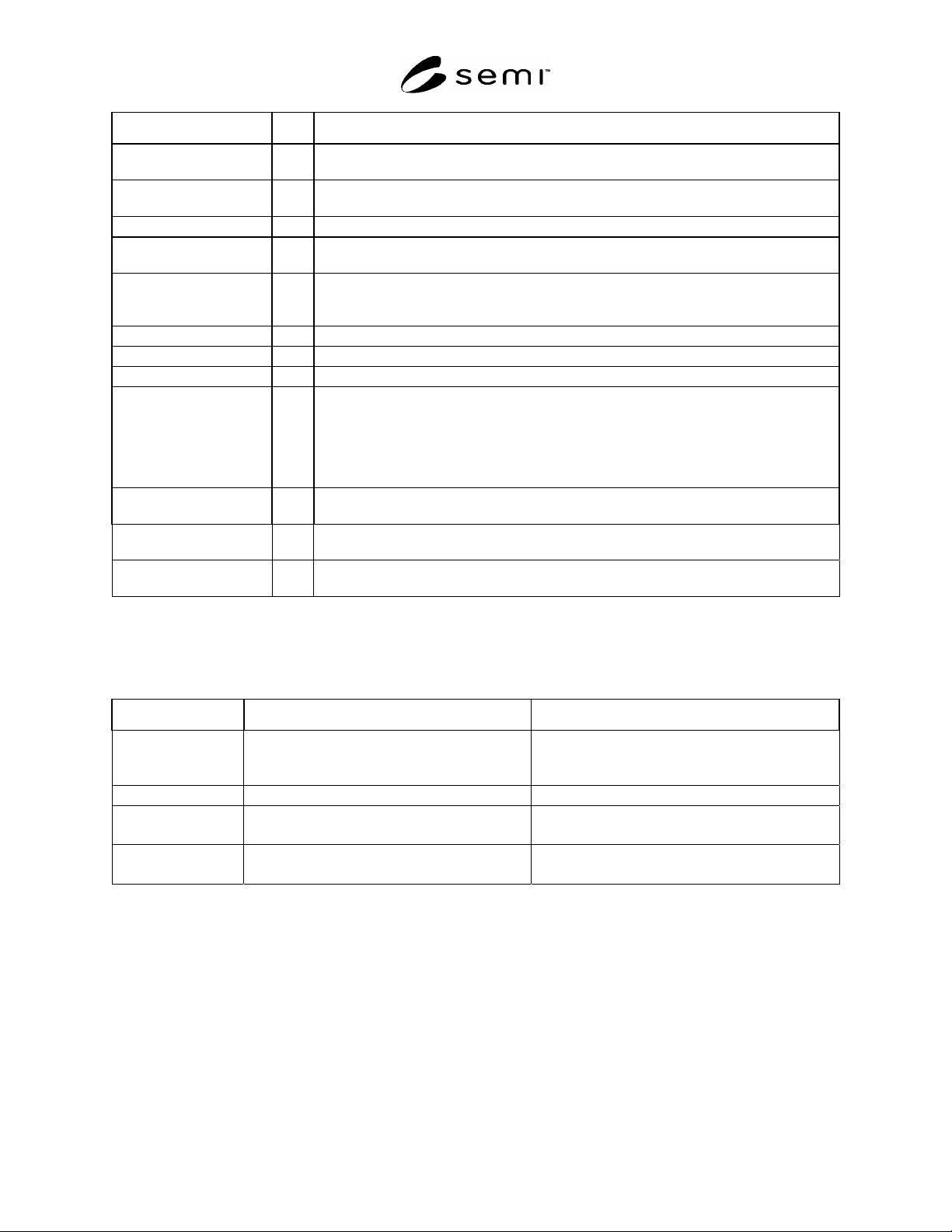
16.2.2 The “TYPE” column in the following table is used to indicate whether the service consists of a
request/response message pair, “R”, or a single notification message, “N”.
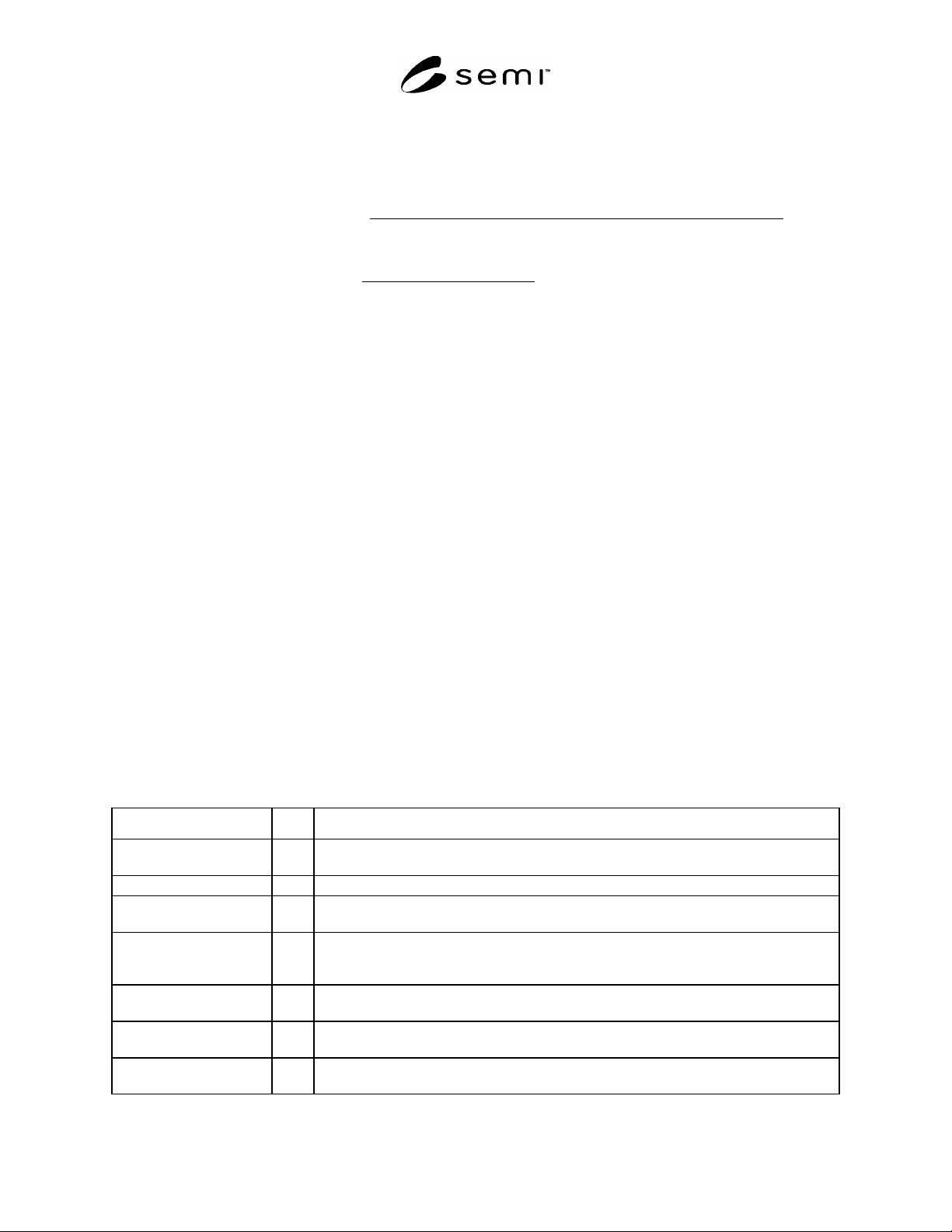
Table 15 Service Message Description
Service Name Type Description
Bind R This service shall associate a CarrierID to a load port and shall cause the load port to
transition to the RESERVED state.
CancelAllCarrierOut R This service shall cause all CarrierOut services to be removed from the queue.
CancelBind R This service cancels a CarrierID to load port association and shall cause the load port to
transition to the NOT RESERVED state.
CancelCarrier R This service shall Cancel the current carrier related action, and the production equipment
shall return the carrier to the unload position of the load port, or an internal buffer position,
depending on the carrier’s position in the production equipment.
CancelCarrierAtPort R This service shall Cancel the current carrier related action, and the production equipment
shall return the carrier to the unload position of the load port.
CancelCarrierNotification R This service shall cause the equipment to destroy a carrier object instantiated through a prior
CarrierNotification.
CancelCarrierOut R This service shall cause a specified CarrierOut service to be removed from the queue by the
production equipment.
SEMI E87-0705 © SEMI 1999, 2005 30
Service Name Type Description
CancelReservationAtPort R This service shall cause the equipment to remove the reservation at the specified Port and to
deactivate the visible signal.
CarrierIn R This service shall cause a carrier to be moved from a load port to an internal buffer location.
Used in anomaly situations.
CarrierNotification R This service shall cause the equipment to instantiate a carrier object.
CarrierOut R This service shall cause a carrier to be moved from the internal buffer to a load port. This
service can be queued by the production equipment.
CarrierReCreate R This service shall cause the carrier object (and consequently, associated state models of the
object) specified by the service to be recreated. This service shall be accepted only if the
load port is in the “Ready to Unload” state.
CarrierRelease R Release the carrier from Carrier Hold
CarrierTagReadData R Read data from carrier ID tag.
CarrierTagWriteData R Write data to the carrier ID tag.
ChangeAccess R This service shall change the access mode of the specified Ports at the production
equipment. If the equipment is unable to change one or more of the specified port(s) to the
specified Access Mode, then the equipment shall accept the command (with appropriate
response acknowledgement), and shall change only the Access Mode of those Port(s)
allowed by the equipment, supplying host with an indication that not all ports were
successfully changed.
ChangeServiceStatus R This service shall change the transfer status of a specified load port at the production
equipment.
ProceedWithCarrier R This service shall instruct the production equipment to proceed with using the specified
carrier.
ReserveAtPort R This service shall cause the equipment to reserve the specified Port and activate a visible
signal. This service is a Transfer boundary.
16.3 Service Message Parameter Definition
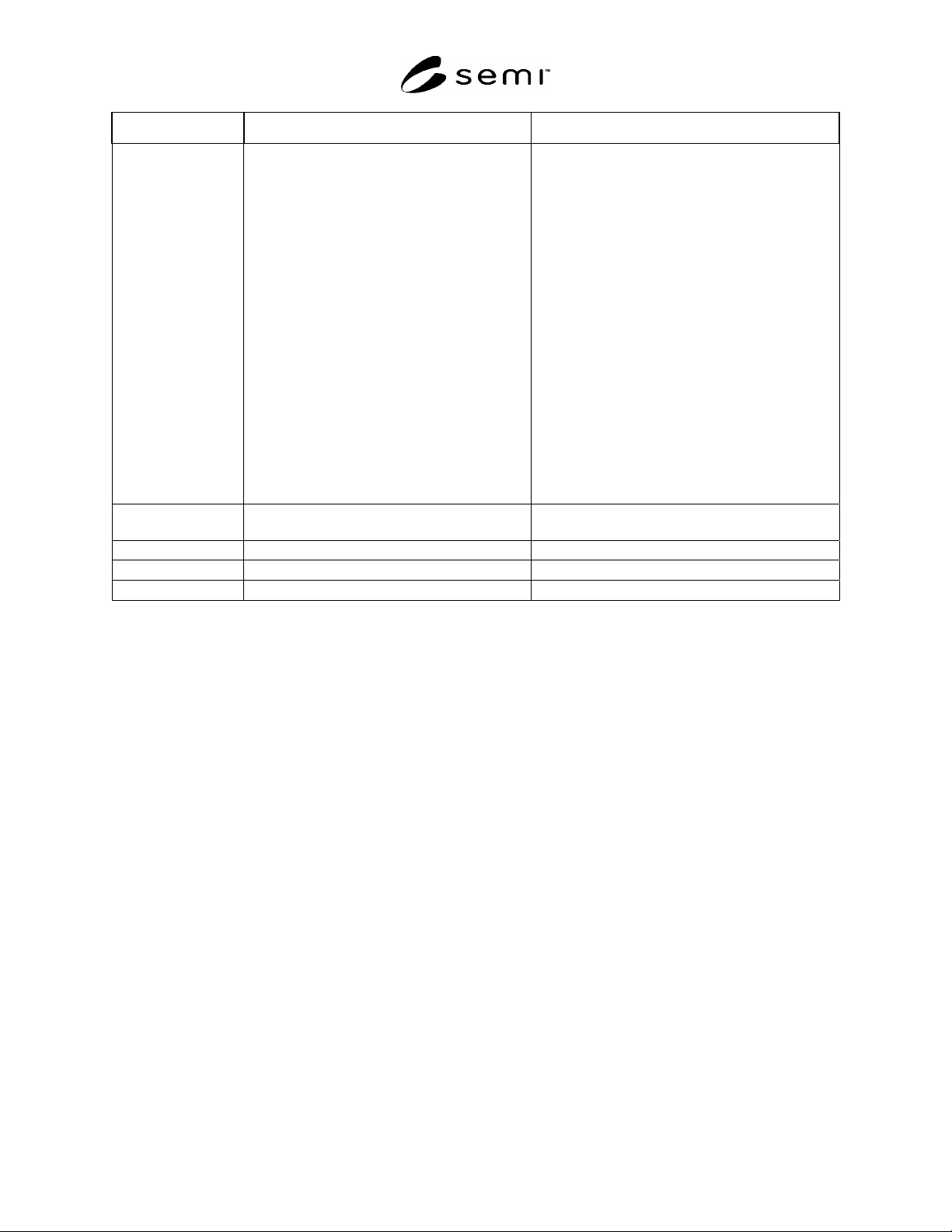
16.3.1 The following is a list of required parameters used in conjunction with service messages.
Table 16 Service Message Parameter Definition
Parameter Name Form Description
AccessMode Enumerated
AUTO,
MANUAL.
The desired access mode of the ports specified.
AttributeData Could be several different data types. The data value associated with AttributeID.
AttributeID Text
1 to 40 characters.
Identifier of the object attribute in the PropertiesList.
CarrierID Text
Conforms to ObjID as defined in SEMI E39.
Identifier of a carrier.
SEMI E87-0705 © SEMI 1999, 2005 31
Parameter Name Form Description
CMAcknowledge Enumerated:
Acknowledge, command has been
performed
Invalid command
Cannot perform now
Invalid data or argument
Acknowledge, request will be performed
with completion signaled later by an event
Rejected, invalid state
Acknowledgement of request.
Some services are commanding a certain task to be
performed. This task is only completed if the
expected end-condition is reached or has failed. A
number of services only have effect on a ‘logical’
level (e.g. Bind, CancelReservationAtPort). Those
services in general can be acknowledged right away
after having performed the task. Other services that
include triggering of physical movements (e.g.
CarrierOut, CancelCarrier) most likely will be
interpreted as “request action to be initiated” rather
than “do action”. The equipment will reply in those
cases the command “is going to be performed”. This
alleviates transaction timeouts for these services that
may take a long time to perform. It is however up to
the supplier to decide if this is applicable. The
completion of the task initiated by the services
commanding some task to be performed (either
acknowledged or going to be performed) must result
in either a state transition or other action that
generates a collection event upon normal / abnormal
completion.
CMStatus A structure consisting of CMAcknowledge and
Status.
Return information for a service.
Data Text. User data.
DataSeg Protocol-specific. Indicates specific section of data to read or write.
DataSize Unsigned integer. Indicates the number of bytes of data to read or write.