semi合集-English.pdf - 第6456页
SEMI G76-0299 © SEMI 1999 12 (3) Measurement As shown in Figure 9, place on a flat surface for more tha n 12 hours and calculate the num ber of points off the flat surface less than 2 mm high. 8.8.4 Ca mber (1) Equipme…

SEMI G76-0299 © SEMI 1999 11
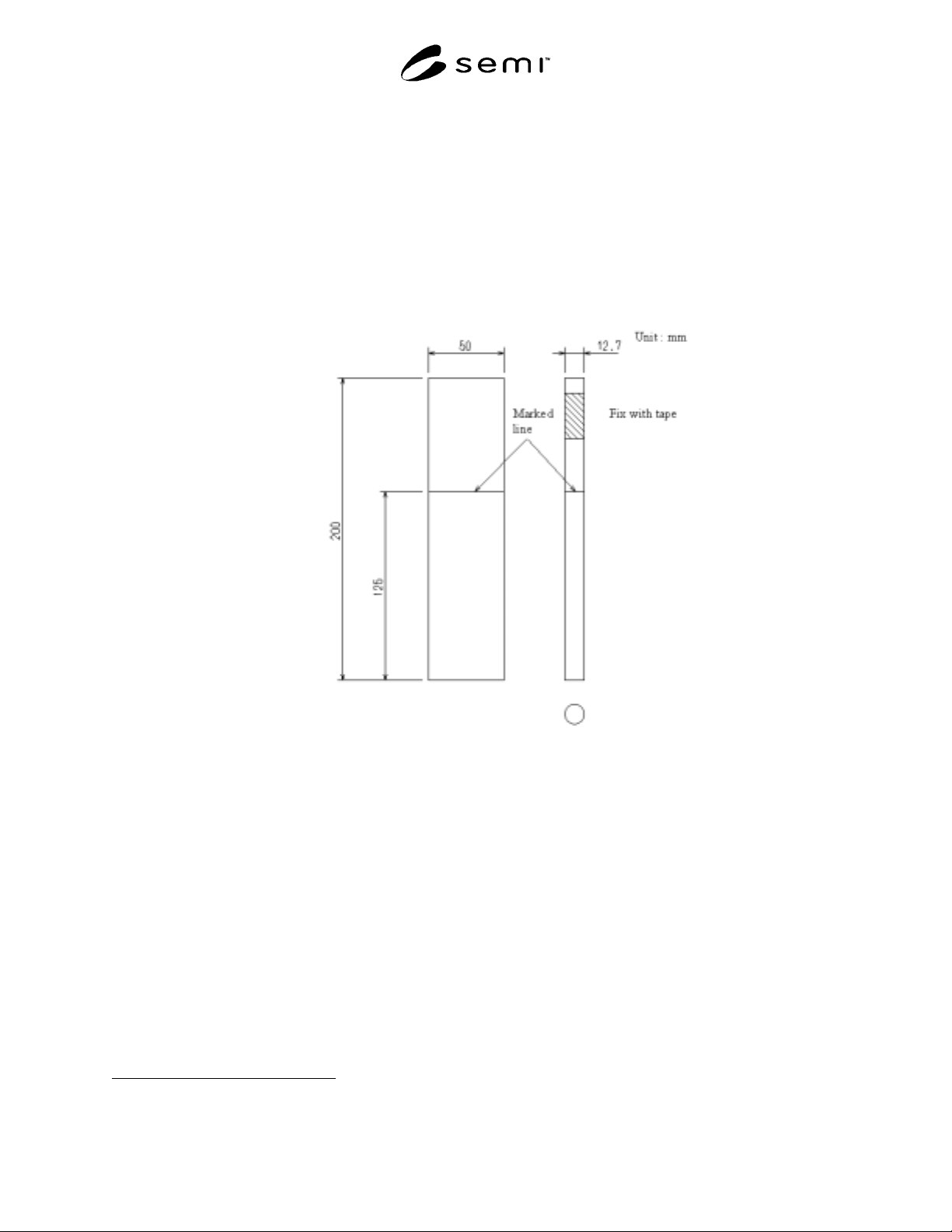
use a sample with a length of 200 mm and
width of 50 mm, and mark a line in the TD
direction at 125 mm from the bottom. With
the mark line facing outward, wrap the
sample around the pole and hold in place
with tape within 76 mm about the mark line.
Remove the pole to leave a tube of the
sample. Prepare 2 groups of 5 pieces each.
(3) Preparation Leave one group of samples
in normal condition for 48 hours. Heat the
other group at 70 ± 1°C for 168 hours, place
them in the dessicator with dehydrated
hydrated calcium and keep for more than 4
hours at 23°C.
(4) Test Perform the following test on the
two groups of samples prepared as described
in Section 8.7.6, (3) above:
(a) As shown in Figure 6, fix the sample
perpendicular in the ring stand with the
clamps, with the tip of the burner 10
mm below the edge of the sample, and
the absorbent cotton placed horizontal
at 300 mm below the edge.
(b) Light the burner away from the sample,
and adjust to a blue flame of 20 ± 1 mm
long. Keeping the length at 20 ± 1 mm,
make sure there is no yellow flame at
the tip.
(c) Apply the flame to the center of the edge
of the sample for 3 seconds. Then
remove the flame to more than 150 mm
away, and record the flaming time.
When the flame burns out, apply the
flame to the edge of the sample for 3
seconds and pull away again. Measure
the flaming time it takes to reach the
clamp as well as the glowing time.
Also, record whether the absorbent
cotton has caught fire or not. When
there are molten particles or burning
material drippings from the sample, it is
acceptable to tip the burner 45° and
move the flame from the bottom edge to
avoid material dripping on the burner.
In this case, the distance from the
bottom edge of the sample to the tip of
the burner should still be 10 mm.
(5) Items to Record
(a) Flaming time after the first and second
application.
(b) Sum of flaming and glowing time after
second application.
(c) Flaming or glowing up to the clamp or mark
line.
(d) Existence of dripping material which caused
the absorbent cotton to burn.
8.8 Test for External Defects
8.8.1 MD Curl
(1) Equipment Use a scale that measures at
least 1 mm increments.
(2) Material Cut a section of more than 30
cm, but less than 100 cm in length of TCP
polyimide adhesive tape as received.
(3) Measurement As shown in Figure 7,
remove the cover film, place on a flat surface
for more than 12 hours and measure the
highest point on the tape from the flat surface
in the MD direction.
8.8.2 TD Curl
(1) Equipment
(a) A scale that measures at least 1 mm
increments.
(b) A square block with a base with a length
of more than 15 cm and width of 2 cm,
and a weight of more than 500 g.
(2) Material Cut a section of more than 15
cm, but less than 30 cm in length of TCP
polyimide adhesive tape as received.
(3) Measurement
(a) Remove the cover film and place on a flat
surface for more than 12 hours.
(b) Use the block to hold down the sample
tape on the edge without adhesive. The
space held down should be more than 2
mm in from the edge, but before the
adhesive material.
(c) As shown in Figure 8, on the opposite side
of the tape for the block, measure the
highest point from the flat surface.
8.8.3 Wakame
(1) Equipment Use a scale that measures at
least 1 mm increments.
(2) Material Cut a section of more than 30
cm, but less than 100 cm in length of TCP
polyimide adhesive tape as received.

SEMI G76-0299 © SEMI 1999 12
(3) Measurement As shown in Figure 9, place
on a flat surface for more than 12 hours and
calculate the number of points off the flat
surface less than 2 mm high.
8.8.4 Camber
(1) Equipment Use a scale that measures at
least 1 mm increments.
(2) Material Cut a section of more than 30
cm, but less than 100 cm in length of TCP
polyimide adhesive tape as received.
(3) Measurement As shown in Figure 10,
connect corners of the tape in a straight line,
and measure the deviation from the line to
the edge of the tape at the center.
8.8.5 Twist
(1) Equipment Use a protractor that measures
at least 1 degree increments.
(2) Material Cut a section of 1 meter in
length of TCP polyimide adhesive tape as
received.
(3) Measurement Hang the tape vertically
and measure the angle of twist of the bottom
edge as opposed to the top edge.
8.8.6 Defects
(1) Equipment Use a 10 power magnifying
glass or naked eye.
(2) Material Use TCP polyimide adhesive
tape as received. The length should be
determined between the user and supplier.
(3) Measurement Perform a check on defects
against a limit sample determined by the
user and supplier. Unless otherwise
specified, the " Admixture Measurement
Table" from the JIS P-8101 standard
(Finance Ministry Printing Press) is
recommended.
9. Product Labeling
Note the following items on the product label:
(1) Type Name
(2) Product Width
(3) Product Length
(4) Lot Number
10. Packing and Package Labeling
10.1 Packing Pack the product with sufficient
packing material to prevent any effects from external
impact, moisture, etc.
10.2 Package Label Note the following items on
the packaging label:
(1) Product Name
(2) Type Name
(3) Manufacturer' s Name
(4) Product Width
(5) Product Length
(6) Lot Number
(7) Storage Conditions
11. Related Documents
11.1 JIS Standards
C-6471 Test Method of Copper-Clad Laminates
Flexible Printed Wiring Boards
K-6911 Testing Methods for Thermosetting Plastics
K-7209 Testing Methods for Water and Boiling
Water Absorption of Plastics
P-8145 Testing Method of Dirt in Paper and
Paperboard
P-8208 Method of Testing Dirt, Sheaves and Specks
of Paper Pulp
11.2 ASTM Standards
2
D-150 Standard Test Methods for A-C Loss
Characteristics and Permittivity (Dielectric Constant) of
Solid Electrical Insulating Materials
D-257 Standard Test Methods for D-C Resistance or
Conductance of Insulating Materials
D-570 Standard Test Methods for Water Absorption
of Plastics
D-638 Test for Tensile Properties of Plastics
D-1825 Standard Practice for Etching and Cleaning
Copper-Clad Electrical Insulating Materials and
Thermosetting Laminates for Electrical Testing
2 American Society for Testing Materials, 100 Barr Harbor Drive,
West Conshohoken, PA 19428-2959
SEMI G76-0299 © SEMI 1999 13
11.3 IEC Standards
3
249-1 Base Materials for Printed Circuits, Part 1: Test Methods
326-2 Printed Boards, Part 2: Test Methods
674-2 Specification for Plastic Films for Electrical Purposes, Part 2: Method of Test
11.4 UL Standard
4
94-1991 Standard for Flammability Tests of Plastic Materials for Parts in Devices and Appliances
Figure 5
Test Specimen for Flammability
3 International Electrotechnical Commission, 3, rue de Varembé, P.O. Box 131, CH-1211 Geneva 20, Switzerland
4 Underwriters Laboratories, 333 Pfingsten Road, Northbrook, IL 60062-2096