semi合集-English.pdf - 第1642页
SEMI E38-1296 © SEMI 1995 , 1996 31 CTMC Event Repo rting Services to attach the data of interest directly to the module collection event. Variable Dat a Coll ection/Stat us Data Collecti on — Again, the cl uster m ust t…

SEMI E38-1296 © SEMI 1995, 1996 30
host communication standards to cluster-based
equipment.
Below, each GEM capability will be addressed
separately, followed by a look at capabilities which
GEM does not cover. The capabilities are taken in
roughly the order given by SEMI E30 (GEM) table of
contents.
Communications State Model/Establish
Communications — The Communications State Model
is related to the ability to communicate. It is
independent of the functionality offered by the
equipment. There is no conflict with the cluster tool
supporting this GEM capability.
Control State Model — The control state model
assumes a single operator interface at the equipment. A
cluster tool is expected to supply such an interface
connected to the cluster controller.
However, there is a potential disconnect with attached
modules which supply user interfaces. Since CTMC
does not provide anything similar to the control state
model at this time, the cluster controller has no control
over access to these separate user interfaces, nor even
any knowledge of what might be happening. In this
situation, the cluster controller cannot guarantee
compliance to the control state model.
To assure GEM compliance, it is recommended that a
module request and receive closure of all control-
related service connections before allowing use of its
local operator interface in a control mode. This assumes
the use of the communication environment as defined in
SEMI E38.1.
Equipment Processing States — GEM specifies that
there be a processing state model. The model given in
the document is only an example, which shows the
approximate depth needed and suggests a form. The
example applies to the classic single chamber, single-
process machine. Thus, it may not be directly
applicable to a cluster tool. The cluster tool is required
to provide a processing state model, but the form should
match the cluster tool's function. The Plasma Etch
Specific Equipment Model (document available from
SEMI) suggested one way to model a multi-chamber,
multi-process job machine.
Data Collection — Data collection is a combination of
several different capabilities. Each will be discussed in
turn.
There is also a high-level issue with data collection.
GEM assumes a flat address space. That is, it assumes
that the smallest granularity of object is “equipment.”
The equipment has attributes. Some attributes are read-
only (Status Variables). Some have read/write access
(Equipment Constants). There are a few read-only
attributes which are valid only at certain times
(DVVALs).
Cluster tools do not fit this model well. The CTMC was
based on a model which includes a hierarchy of objects
which contain (or control) other objects. The CTMC
requirements are a subset of that model and include a
cluster controller (which does not have to be a single
entity), attached modules, transport module, and
specific objects associated with the services. Thus, to
request information about the processing of a wafer in a
process module, the attributes of the process job must
be accessed. The chain then includes Cluster
Controller->Process Module->Process Job->Job
Attribute. It is quite a challenge to present this attribute
as SVID #532678. And yet, this is what must be done.
The cluster controller should provide a flat name space
from which to access critical module data. Object
services with scopeing capabilities may also be
supported through the host interface, but if used, this
would be an extension to the host's GEM interface. The
data collection categories below give more detail on the
challenge and possible solutions.
Event Notification — Many of the events of interest to
the host actually occur at the attached modules (e.g.,
“Etch step complete for wafer x”). The cluster
controller is responsible for assigning each of these
events a unique CEID. There are two challenges: (1) to
assure uniqueness of events from duplicate modules,
and (2) to provide a scheme whereby the host can
determine the source of the event. Embedding a module
number within the CEID is one solution which has been
used to address both challenges. For instance, the
highest order byte of a four-byte integer might contain
the module ID.
Dynamic Event Report Configuration — The host must
be able to attach the information of interest to the event
notifications. The cluster controller is responsible for
providing access to the attributes of the cluster
modules. It is also responsible for assuring that the data
contained in the event reports is representative of the
state of the cluster at the time the event occurred.
There are three sources of data for the event reports.
1. Cluster Controller: Data which is local to the
cluster controller may be accessed directly.
2. Module (not source of collection event): This data
must be polled unless a data trace for the attributes
of interest is in progress.
3. Module (source of collection event): This data
tends to be most closely related to the event and
thus the most time-critical. While polling and data
trace may be used in this case, it is better to use the

SEMI E38-1296 © SEMI 1995, 199631
CTMC Event Reporting Services to attach the data
of interest directly to the module collection event.
Variable Data Collection/Status Data Collection —
Again, the cluster must take measures to present a flat
address space. See various discussions above.
Limits Monitoring — Clearly, most variables which
would be of interest for limits monitoring reside in the
cluster modules. The CTMC does not provide specific
services for configurable limits monitoring. A module
may provide for some limits checking via “limits”
attributes of objects which may be set via object
services. Notification of excursions beyond limits
would be via exceptions and/or collection events. If this
method is not available, the cluster controller would
have to institute a data trace on the attribute of interest
and then itself perform the limits checking activity.
The time period of the trace would be crucial to
assuring that short-term excursions are not missed.
Trace Data Collection — Trace data collection maps
well from GEM to CTMC. In fact, the CTMC services
in this area are a superset of the GEM functionality.
On-Line Identification — At first glance, this seems to
be an easy requirement to meet. However, the model
number and software revision included in the message
are ambiguous on a cluster with separate model
numbers for each module (and the cluster controller
itself) and separate software releases running on each.
The purpose of these data items is to allow the host to
determine when the equipment has been changed in
such a way that it may no longer be compatible with the
host software. At a minimum, the data items should
indicate a change to the cluster controller software (e.g.,
a new revision of the software, or a significant
reconfiguration such as the addition of a new module).
Alarm Management — GEM alarm management is a
subset of the functionality of the CTMC exception
services. Any exception message from a module can,
where desired, be translated into a GEM-compliant
alarm message. The set of CTMC exceptions is a
superset of GEM alarms. GEM alarms are of a serious
nature and expect human intervention to be required.
The CTMC extends this set to include problems which
the controller may be able to solve, and provides for
modules to suggest appropriate recovery actions.
Those CTMC exceptions which fall into the GEM
alarm category should be passed on via the GEM Alarm
capability. Exceptions which are not GEM alarms
should be reported only as events.
Remote Control — Cluster tools need to be able to
handle multiple tasks simultaneously. Most need to
handle multiple lot or batch jobs at once. GEM's
support for (process) job control is minimal. The
implicit assumption in GEM is that only one job at a
time will occur on a machine. It provides for a
“START” command, collection events when the job is
actually started and when it finishes, and also job
control commands (e.g., PAUSE, RESUME, ABORT,
STOP). What GEM lacks is differentiation of one job
from another (e.g., a job ID).
However, the GEM remote command message does
provide for parameters. A cluster tool may be able to
implement a scheme which is similar to that defined by
the Process Management Services. For instance, a “job
ID” parameter may be included in all job-related
messages. Thus, the equipment would set a job ID in
the “Start” or the “PP-Select” message (whichever first
refers to the job), and would then refer to that ID in any
subsequent job control commands. The job ID could
also be available as a data value in collection event
reports. While it might be preferable to have the
equipment assign the job ID, this scheme may be
workable.
Equipment Constants — Again, the flat address space
issue applies. (See the Data Collection section above.)
Process Program Management — The CTMC uses
Recipe Management Services (RMS) to manage recipes
internal to the cluster. GEM's processing services is a
different mechanism. The two can be made to interact,
but the combination is not ideal. It is possible for the
cluster to translate a “recipe” to a “process program”
for communication with the host. However, if a recipe
is created or modified at the host and then downloaded,
the editor at the host must be compatible with RMS
concepts, and care must be taken to maintain the
integrity of the RMS system.
Material Movement — GEM requires only collection
events when material is received or sent. A cluster can
easily satisfy this requirement.
Equipment Terminal Services, Error Messages, and
Spooling — Equipment Terminal Services, Error
Messages, and Spooling are in the domain of the cluster
controller. Cluster modules do not provide these
functions, nor do they contribute to the cluster
controller's delivery of the services.
Clock — A key purpose of clock is to allow the host to
determine ordering of events from an equipment. The
cluster controller should ensure that this need is met.
The cluster should attempt to report consistent time
relative to its modules. Also, when the factory host sets
the time on the cluster, the cluster controller should
resynchronize the time on its modules. There should be
no compatibility problems in this area.
SEMI E38-1296 © SEMI 1995, 1996 32
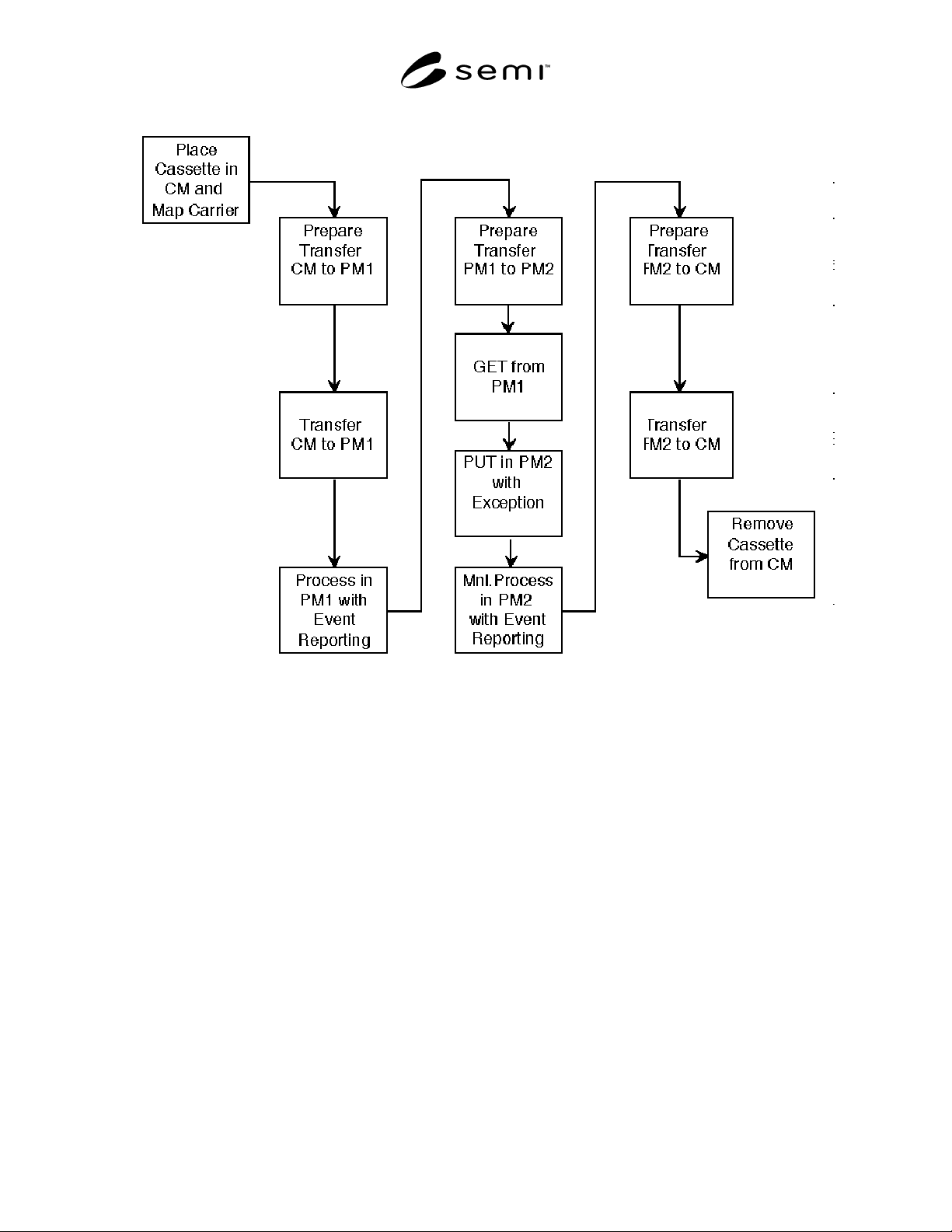
Figure 20
Typical Operating Scenario
A1-2 Typical Operating Scenario
The purpose of this section is to give an example of a
typical operating scenario that will illustrate the various
services being used to perform cluster tool control
functionality. This operating scenario is NOT intended
to be the only scenario to be implemented in a
standards-compliant cluster. The intent is to provide
guidance in navigating the various services standards.
An exhaustive use of Object Services and Exception
Management Services will not be done since these two
areas tend to be very application-specific.
This scenario concentrates on the material processing,
material movement aspects of the cluster-specific
services.
The operating scenario shown in Figure 20 will be
given in the form of a communication timing diagram
with messages being sent between the various cluster
tool components and will be indicated in the following
manner:
ServiceGroup_ServiceName.Request or Response
(Service Parameters)
Example: TRJobCreate.Req(...)
• TR is the service group that contains the service,
the material movement services.
• JobCreate is the service being used to cause
communication to take place between two cluster
tool components. Specifically, this service is the
material movement service that initiates the
transfer of material between modules.
• Req indicates that the service is a Request.
• (...) indicates any other parameters that might be
present with the service definition and will be
service-dependent.
Definitions:
CC = Cluster Controller
CM = Cassette Module