semi合集-English.pdf - 第2911页
SEMI E109-0305 © SEMI 2001, 2005 21 Table 8 Reticle Pod Transfer Boundaries Transfer Type Transfer Method Starting Boundary Ending Boundary MANUAL This starting boundary is specified by the user. Known exampl es of the s…

SEMI E109-0305 © SEMI 2001, 2005 20
# Previous State Trigger New State Actions Comment
29 POD Normal: The reticle pod is
unloaded from the equipment.
Abnormal by service:
CancelBind,
CancelPodNotification, or
CancelReticleTransferJob
service is received prior to pod
load.
Abnormal by equipment: An
equipment-based verification
fails and the equipment
performs a self-initiated
CancelBind service.
(no state) The equipment
destroys the
instance of this
reticle pod object.
Data required to be available for
this event report:
PodID
30 (no state) A Reticle Pod is loaded,
locked, and the id is read on a
load port for which no
previous reticle pod has been
instantiated.
LOCKED Data required to be available for
this event report:
PodID
PortID
#1
Only one collection event report is required when entering the Reticle Pod State Model (instantiating a reticle pod object). This event report
shall include the entry state of the all the substates of Reticle Pod State Model, (including RETICLE POD ID STATUS substate, the RETICLE
POD SLOT MAP STATUS substate, the RETICLE POD ACCESSING STATUS, and the RETICLE POD LOCKING STATUS).
10.4.5 Slot Map Read Details
10.4.5.1 The Slot Map shall be read on all production equipment prior to removal of reticles from the reticle pod.
10.4.6 Pod Read Failure — A pod read failure occurs when the PodID reader is present, in service, and reports that
it is unable to read the ID of a pod. This represents a transient random failure rather than a steady condition.
10.4.7 Bypass Read ID — A PodID reader may be unavailable: either out of service, not installed, or otherwise
malfunctioning and unable to execute a read operation. This represents a steady condition that often is known in
advance. The equipment shall provide a user-configurable variable BypassReadID that the user is able to set to
specify the action to take when a pod is received to an ASSOCIATED load port. In this case, the reticle pod object
is instantiated in the ID NOT READ state, and when the reticle pod is received, the state model transitions to either
WAITING FOR HOST or ID VERIFICATION OK, depending upon whether BypassReadID is FALSE (the default
value) or TRUE. When TRUE, then the PodID received in the Bind is used automatically. Otherwise, the pod
transitions to WAITING FOR HOST and waits for the host to send a ProceedWithPod. The ID used will be the ID
included with the ProceedWithPod.
11 Access Mode
11.1 Access Mode State Model
11.1.1 The Access Mode State Model defines the host view of equipment access mode, as well as the host
interactions with the equipment necessary to switch the access mode. Each Reticle Load Port has its own Access
Mode State Model. There are two access mode states. These are defined in ¶11.3.3.
11.1.2 The access mode for a reticle pod load port may be switched at anytime by the host or the operator, except
when the Reticle Load Port Reservation State Model for that Reticle Pod Load Port is in the RESERVED state or
during reticle pod transfer. Reticle pod transfer boundaries, for determining when access mode may be changed, are
designated by Table 8, Reticle Pod Transfer Boundaries.
SEMI E109-0305 © SEMI 2001, 2005 21
Table 8 Reticle Pod Transfer Boundaries
Transfer Type Transfer Method Starting Boundary Ending Boundary
MANUAL This starting boundary is specified by the
user. Known examples of the starting
boundary include but are not limited to the
p
lacement sensor detecting a pod, a pod load
port operator access door opening, input to
the equipment by the operator through a
switch at the load port or the equipment
console.
This ending boundary is specified by the
user. Known examples of the ending
boundary include but are not limited to a
preset configurable time following
p
lacement sensor detecting a pod, a pod load
p
ort operator access door closing, or input to
the equipment by the operator through a
switch at the load port or the equipment
console or a service message.
LOAD
AUTO The PIO Ready signal is active for load. The PIO signals a transfer complete.
MANUAL This starting boundary is specified by the
user. Examples of the starting boundary
include but are not limited to placement
sensor no longer detecting a pod, a pod load
port operator access door opening, or input
to the equipment by the operator through a
switch at the load port or the equipment
console or a service message.
This ending boundary is specified by the
user. Examples of the ending boundary
include but are not limited to a preset
configurable time following placement
sensor no longer detecting a pod, a pod load
port operator access door closing, or input to
the equipment by the operator through a
switch at the load port or the equipment
console or a service message.
UNLOAD
AUTO The PIO Ready signal is active for unload. The PIO signals a transfer complete.
11.2 Manual Pod Transfer Confirmation Trigger
11.2.1 For a manual transfer completion confirmation, the production equipment supplier must implement a
software or hardware mechanism for an operator to inform the equipment that the pod transfer is complete, but also
support methods such as timers that allow equipment to consider a manual transfer complete without operator input.
11.3 Access Mode Initial Value
11.3.1 Also, when equipment re-initialization occurs, the access mode(s) must be remembered, and used as the
initial value when initializing. Since the access mode is remembered through re-initializations, the initial value that
is used the very first time the software is ever loaded is not important. The equipment supplier is free to set this
default value.
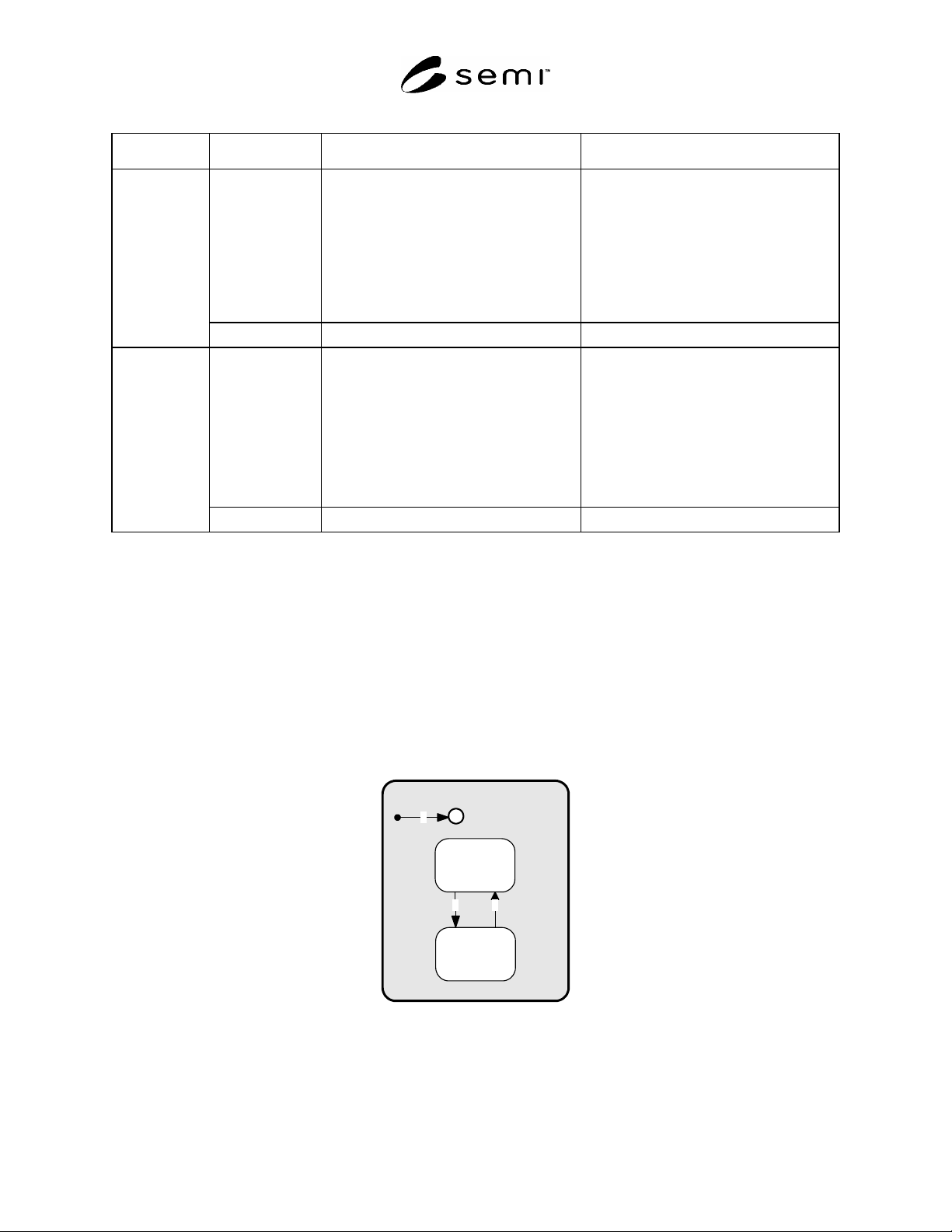
11.3.2 Access Mode State Model Diagram
ACCESS MODE
MANUAL
AUTO
1
2 3
H
Figure 3
Access Mode State Model Diagram

SEMI E109-0305 © SEMI 2001, 2005 22
11.3.3 Access Mode State Definitions
11.3.3.1 ACCESS MODE — The parent state for the MANUAL and AUTO sub-states.
11.3.3.2 MANUAL — A sub-state of ACCESS MODE. When the production equipment or specified reticle pod
load port is in this mode, only manual (non-AMHS) pod transfers are allowed. The production equipment shall have
the capability of generating an alarm if an automated (AMHS) delivery is attempted.
11.3.3.3 AUTO — A sub-state of ACCESS MODE. When the production equipment or specified reticle pod load
ports are in this mode, only automated (AMHS) pod transfers are allowed. The production equipment shall have the
capability of generating an alarm if a manual delivery is attempted.
11.3.4 Access Mode State Transition Table
11.3.4.1 Table 9 defines the transitions for the Access Mode State Model.
Table 9 Access Mode State Transition Definitions
# Previous State Trigger New state Actions Comments
1 (no state) System restart. MANUAL
or
AUTO
(History)
The access mode
returns to the
mode it was
previous to the
system reset.
Data required to be available for this
event report:
PortID
2 MANUAL The host or operator has
executed a Change-
Access service with the
value of AUTO. This
trigger can happen at
anytime, except during a
reticle pod transfer.
AUTO Manual deliveries are not allowed after
this state transition. The operator may
also trigger this transaction from the
production equipment console.
Data required to be available for this
event report:
PortID
3 AUTO The host or operator has
executed a
ChangeAccess service
with the value of
MANUAL. This trigger
can happen at anytime,
except during pod
transfer.
MANUAL The operator may also trigger this
transaction from the production
equipment console or a manual switch at
the reticle load port. Automated transfers
are not allowed after this state transition.
Data required to be available for this
event report:
PortID
12 Reservation State Model
12.1 The purpose of the Reticle Load Port Reservation State Model is to define the host view of future activity at a
specific reticle load port.
12.1.1 The Reticle Load Port Reservation State Model, the ReserveAtPort service and CancelReserveAtPort enable
the following items:
1. They enable the host to inform the equipment of a future reticle pod delivery without specifying the reticle
PodID and at the same time allow host based verification. (Equipment based verification is enabled via the
Load Port/Pod Association State Model, the Bind service, ReticleTransferJob, and the PodNotification service
detailed in §13, ¶¶18.4.2, 18.5.19, and 18.4.11.)
2. They enable the equipment to send a state change event to the host if the operator (either local or remote)
informs the equipment of a future pod delivery to a reticle load port without specifying the reticle PodID. Thus
the host knows that the operator expects to use that reticle load port for something the host did not request for
AMHS based delivery.