semi合集-English.pdf - 第3217页
SEMI E127-0705 © SEMI 2003, 2005 18 12 Substrate Transfer Path Object 12.1 Description 12.1.1 The Substrate Transfer Path object (STPO) manages the spatial envel ope used for loading (receiving) and unloading (s ending) …
SEMI E127-0705 © SEMI 2003, 2005 17
initialization or runtime. In either case, the alarm condition shall be cleared before processing continues. See
¶11.4.1.4 for further detail.
11.5.2.2 Unexpected Substrate Alarm — This alarm is set during system initialization when substrates have been
detected, and the actual substrate count exceeds the number expected. See ¶11.4.1.4 for further detail.
11.5.3 SubstrateListUpdate — The SubstrateList attribute is a list of the ObjIDs for all substrates currently present
within the IMM module. Whenever a Substrate Object is created or deleted, this attribute is updated and an event
message is sent with the ObjID of the Substrate Object associated with the change.and whether it was added or
removed.
11.5.4 Table Storage Capacity Warning — A notification sent to the client when table capacity decreases below
TableStorageAlert and each time the storage further decreases.
11.5.5 Table Storage Capacity Overflow — Tables have been removed due to capacity overflow. Note: This is a
trigger for Transition 6 in the IMM Data Table state model, ¶14.2.
11.5.6 Event Variables — Certain variables shall be provided that are associated with certain events and contain the
values that were valid at the time the event occurred. For the IMM object, these variables are specified in Table 4.
The names of variables as specified shall be implemented exactly as text strings.
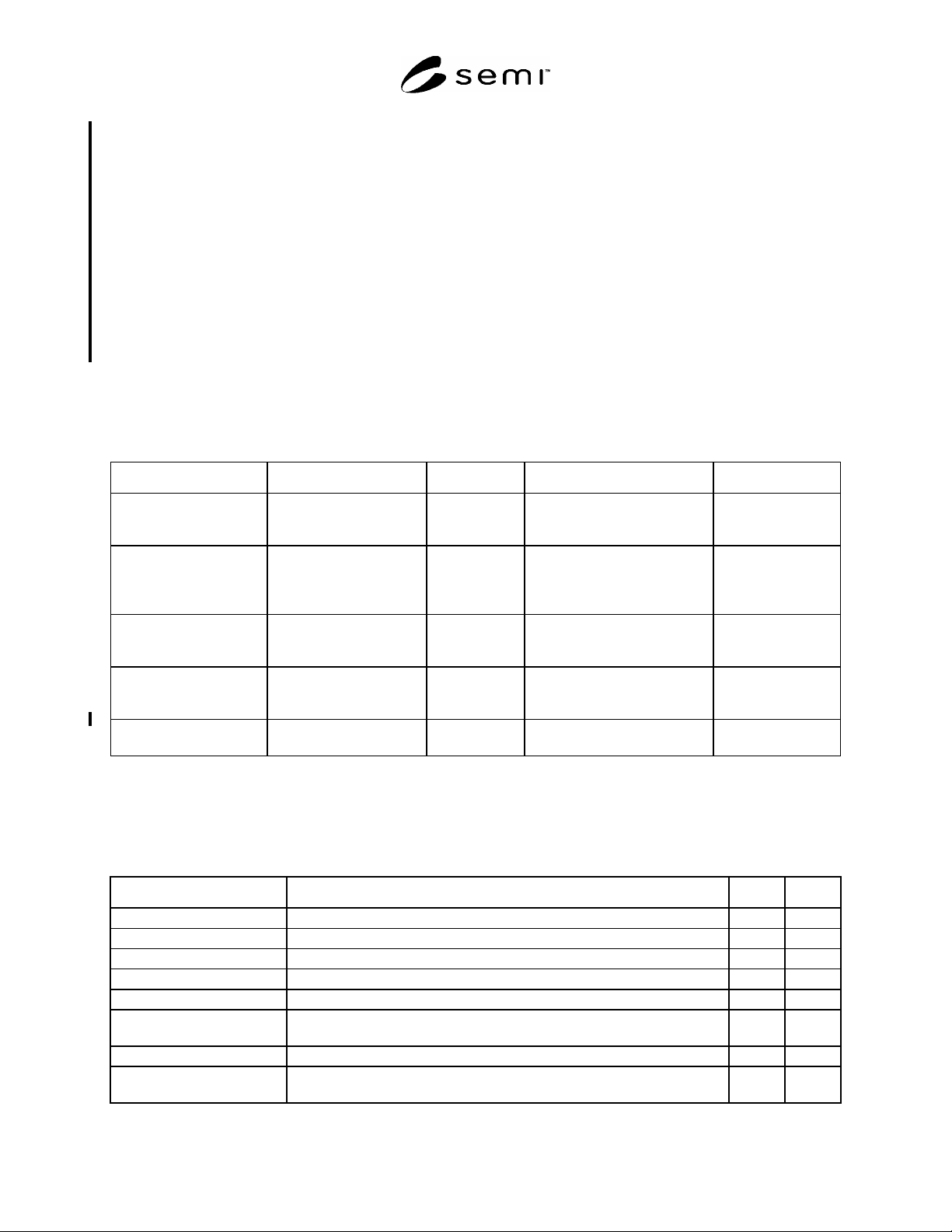
Table 4 Event Variables for IMM Object
Variable Name Description Type Event Comment
DateTime The date and time that the
event occurred.
Conforms to the
clock format in
SEMI E98.
All
Service Current state of Service
State Model.
Enumerated
IN SERVICE
OUT OF
SERVICE
All
SubstrateListChangeType Indicates the type of
change: addition or
deletion.
Enumerated
Addition
Deletion
SubstrateListUpdate
SubstrateID The last SubstrateID added
to or removed from the
SubstrateList attribute.
Text. SubstrateListUpdate
TableCount The number of tables
currently stored.
Integer. TableStorageCapacityWarning,
TableStorageCapacityOverflow
11.6 IMM Object Services
11.6.1 Table 5 defines the services specific to the Integrated Measurement Module. Message details are defined in
§19.
Table 5 IMM Object Services
Message Service Name Description Type Reqd
ChangeService Set the IMM in service or out of service. R Y
ClientConnect A request to become a Control Client or Data Client. R Y
ClientDisconnect A request to terminate the Client role. R Y
RequestRetentionConditions A request to send the rules and retention time for this client. R Y
SetAutoTableSend A request to set AutoTableSend on or off for this client. R Y
SetRetentionConditions The client sends a one or two level list of 0+ Retention Rules and an optional
minimum retention time.
R Y
TableRequest The client requests a specific table, or table subset. R Y
TableSend Used by the client to send a table or delete an existing table. Used by the
IMM to request to send a table to the client by the AutoTableSend capability.
R Y
SEMI E127-0705 © SEMI 2003, 2005 18
12 Substrate Transfer Path Object
12.1 Description
12.1.1 The Substrate Transfer Path object (STPO) manages the spatial envelope used for loading (receiving) and
unloading (sending) a substrate, along with all mechanisms used in effecting a physical transfer. It has one or more
Equipment Substrate Location objects for holding substrates after they are received and before they are sent. Each
Substrate Location can hold exactly one substrate when it is occupied. Substrate and Substrate Location objects are
defined in SEMI E90.
12.1.2 If substrates can be loaded into, and/or unloaded from, more than one substrate location, then each of these
locations shall be represented by a separate STPO object. This allows the Control Client to specify where it intends
to load or unload.
12.1.3 The STPO object allows the IMM to interact with an external substrate handler to transfer substrates to and
from a Substrate Port (a substrate location together with any necessary mechanisms), and also to exchange
properties of the Substrate Object being transferred.
12.1.4 A Substrate Transfer has two required parts, which may occur in either order: the substrate transfer and the
substrate information transfer. The transfer procedure consists of the messages and physical actions necessary to
effect the loading or unloading of a substrate to or from the Substrate Transfer Location. The exchange is not
complete until both parts have been successfully completed.
12.1.5 The minimum information required for processing is SubstrateID. Additional information is used to store as
context data in the IMM Data Table Objects discussed in §13. The method provided for obtaining the additional
information is the same as the method for providing SubstrateID.
12.1.6 The STPO shall provide two ordered lists of the sequence of text micro commands that are needed for
loading and for unloading a substrate to and from the Substrate Transfer Location. The Control Client may obtain
these lists on demand through the service XfrCmdListRequest. These micro commands are to be returned by the
Control Client in the XfrCommand service, one at a time, in the same order given, to effect a load or unload hand-
off. Micro commands are defined by the IMM supplier except for two that are required. Examples of micro
commands are given in the Load and Unload scenarios in ¶12.11. The two required micro commands are “Confirm
presence” and “Confirm Absence”, as specified in ¶12.11.2.3 and ¶12.11.3.3 respectively.
12.2 Object State Model
12.2.1 This section defines the Substrate Transfer State Model, which shows the behavior required for coordinating
the loading of a substrate to, and unloading from, the substrate location accessed by an external substrate handling
mechanism.
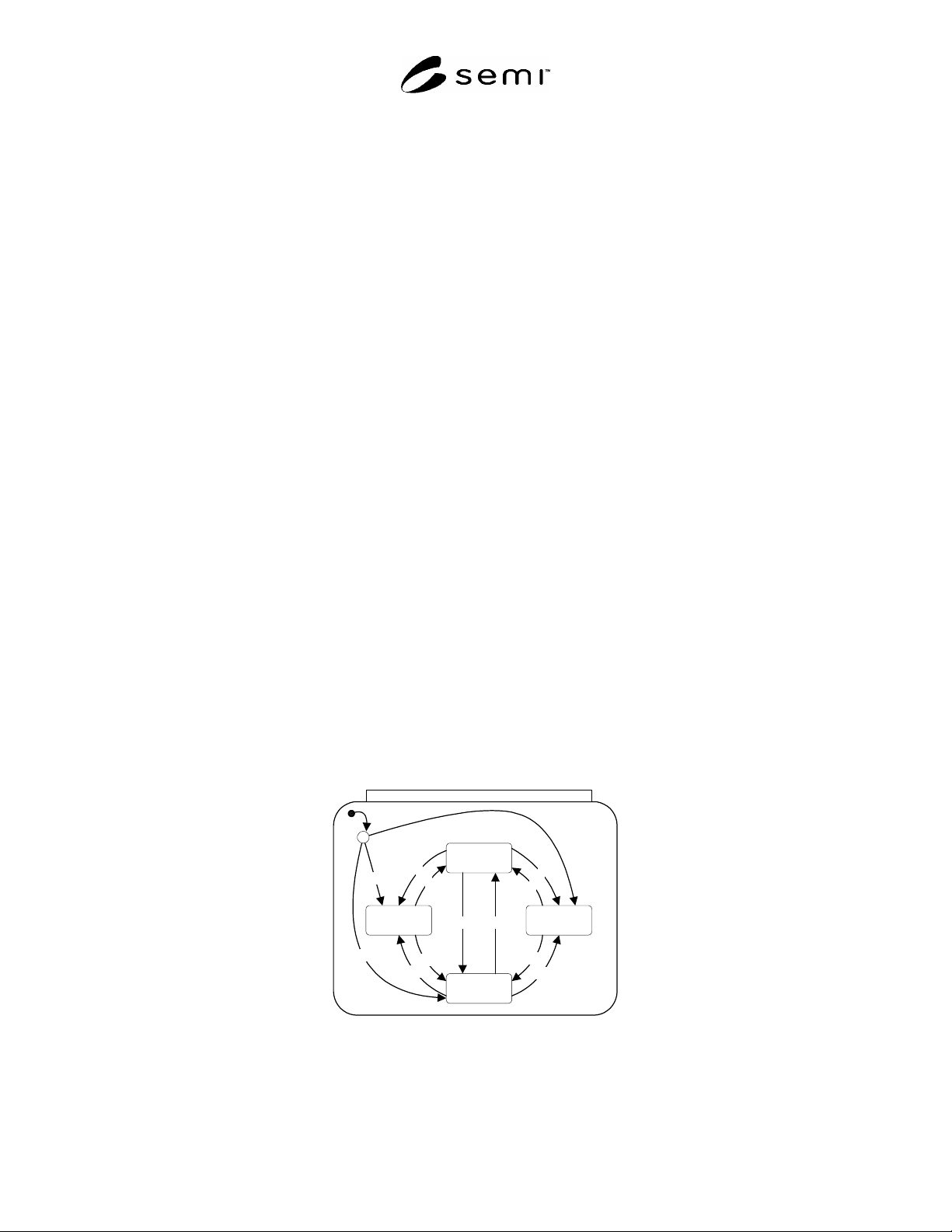
12.2.2 Figure 4 shows the diagram for the Substrate Transfer Path State Model.
SUBSTRATE TRANSFER PATH
READY TO
LOAD
READY TO
UNLOAD
1
2
ASSIGNED
BLOCKED
10
4
13
6
7
11
5
12
8 9
3
C
Figure 4
Substrate Transfer Path State Model

SEMI E127-0705 © SEMI 2003, 2005 19
12.2.3 Substrate Transfer States
12.2.3.1 ASSIGNED — A substrate transfer operation, or normal operations (e.g., measurement) or conditions (e.g.,
calibration required or being performed) prevent substrate transfers to or from the module.
12.2.3.2 BLOCKED — Abnormal operations (e.g., abort) or conditions (e.g., faults) prevent substrate transfer to or
from the module.
12.2.3.3 READY TO LOAD — A substrate is not present on the Substrate Location, and that location is available to
be loaded with a substrate in this state. This is the only state in which substrate loads may be initiated.
12.2.3.4 READY TO UNLOAD — A substrate is present on the Substrate Location, and the substrate is available to
be unloaded from that location in this state. This is the only state in which substrate unloads may be initiated.
12.2.3.5 SUBSTRATE TRANSFER PATH — The parent state of the Substrate Transfer Path State Model. This state
has four substates, READY TO LOAD, READY TO UNLOAD, ASSIGNED and BLOCKED.
12.2.4 Table 6 defines the transitions of the STPO State Model.
Table 6 Substrate Transfer Path State Model Transitions
# Previous State Trigger New State Comment
1 (no state) IMM initialization complete
AND
All conditions allow a substrate to be
loaded.
READY TO
LOAD
2 (no state) IMM initialization complete
AND
A substrate is present in the Substrate
Location that may be unloaded.
READY TO
UNLOAD
3 (no state) IMM initialization complete
AND
The substrate transfer location is either
configured to be out of service, or a
fault condition exists that does not
allow substrate transfers.
BLOCKED
4 READY TO
LOAD
A substrate transfer is completed
without error.
ASSIGNED The STPO remains ASSIGNED until the
Substrate is either no longer within the STPO
and/or measurements have been completed and
the substrate can be removed.
5 ASSIGNED Conditions make the STPO available
for a substrate unload operation.
READY TO
UNLOAD
The substrate is at an unload location and is
ready for removal.
6 READY TO
UNLOAD
Normal conditions make the STPO
unavailable for substrate unload.
ASSIGNED Conditions that prevent a substrate unload
operation include the termination of an unload
operaton, another substrate transfer operation, or
another measurement of the same substrate is
now required. Note that no direct transition is
provided betwen the READY TO LOAD and
READY TO UNLOAD states.
7 ASSIGNED Conditions make the IMM module
available for a substrate load operation.
READY TO
LOAD
For example, a substrate has moved to a location
outside of the STPO, or a substrate removal has
been successfully completed.
8 ASSIGNED A fault condition occurred that prevents
substrate transfers.
BLOCKED
9 BLOCKED All fault conditions are cleared. ASSIGNED
10 READY TO
LOAD
A fault condition occurred that prevents
substrate transfers.
BLOCKED