semi合集-English.pdf - 第1760页
SEMI E42-0704 © SEMI 1995, 2004 29 Figure 4.1 Recipe Namespace Model All operations performed on a recipe thro ugh Recipe Management services are performed within the namespace by, or under the s upervision of, the names…

SEMI E42-0704 © SEMI 1995, 2004 28
3.5 Execution Recipes — The type of recipe handled by
a recipe executor is called an execution recipe. This
type of recipe has attributes and a body but does not
have an agent-specific dataset. Most of the generic
attributes of the managed recipe, and certain of the
agent-specific attributes, are also attributes of the
execution recipe, while in other cases, a generic
attribute and an agent-specific attribute are merged and
placed in a new execution recipe attribute.
A managed recipe is converted to an execution recipe
when the recipe is downloaded to the recipe executor,
and correspondingly, an execution recipe is converted
to a managed recipe when uploaded from the recipe
executor.
The execution recipe is defined in detail in Section 6.3.
4 Recipe Namespace
This section defines the basic conceptual model for the
recipe namespace, a logical domain for recipe storage
and management, within which the identifier of a recipe
is guaranteed to be unique. The model in the current
section is applicable to implementations with
centralized storage. Section 5 defines an extension of
the basic model for a distributed recipe namespace.
In general, the term "namespace" refers to a domain of
unique identifiers. The issue of namespace boundaries
exists for all object types, particularly in a distributed
environment, and is not unique to recipes. However,
within the context of RMS, namespace is used as a
synonym for recipe namespace.
4.1 Motivations — A recipe's identifier may not be
unique across different namespaces or throughout a
factory. (That is, a given identifier may be used by
internally different recipes except within a single
namespace.) A primary role of a namespace is to define
an area within which the uniqueness of any given recipe
identifier may be guaranteed.
The requirements for Recipe Management that are
addressed in this section include:
• to define the boundaries of specific areas where
recipes may be uniquely identified, stored, and
retrieved,
• to define the attributes and operations for the
management domain of recipes, including recipe
protection and recipe operations,
• to allow control of removable media,
• to allow stand-alone equipment to execute recipes,
• to facilitate smooth integration of stand-alone
equipment into on-line factory systems,
• to allow integrated equipment to continue to
execute recipes when communications have been
lost, and
• to provide the basis for the distributed model in
Section 5, which allows a supervisor to use and
manage the storage capacity of its subordinate
agents.
4.2 Namespace Model — The namespace model serves
two major purposes. First, it provides a common set of
management rules. Second, it allows a set of recipes to
be shared among a group of executing agents that have
a common process type, common functionality, and a
common recipe language.
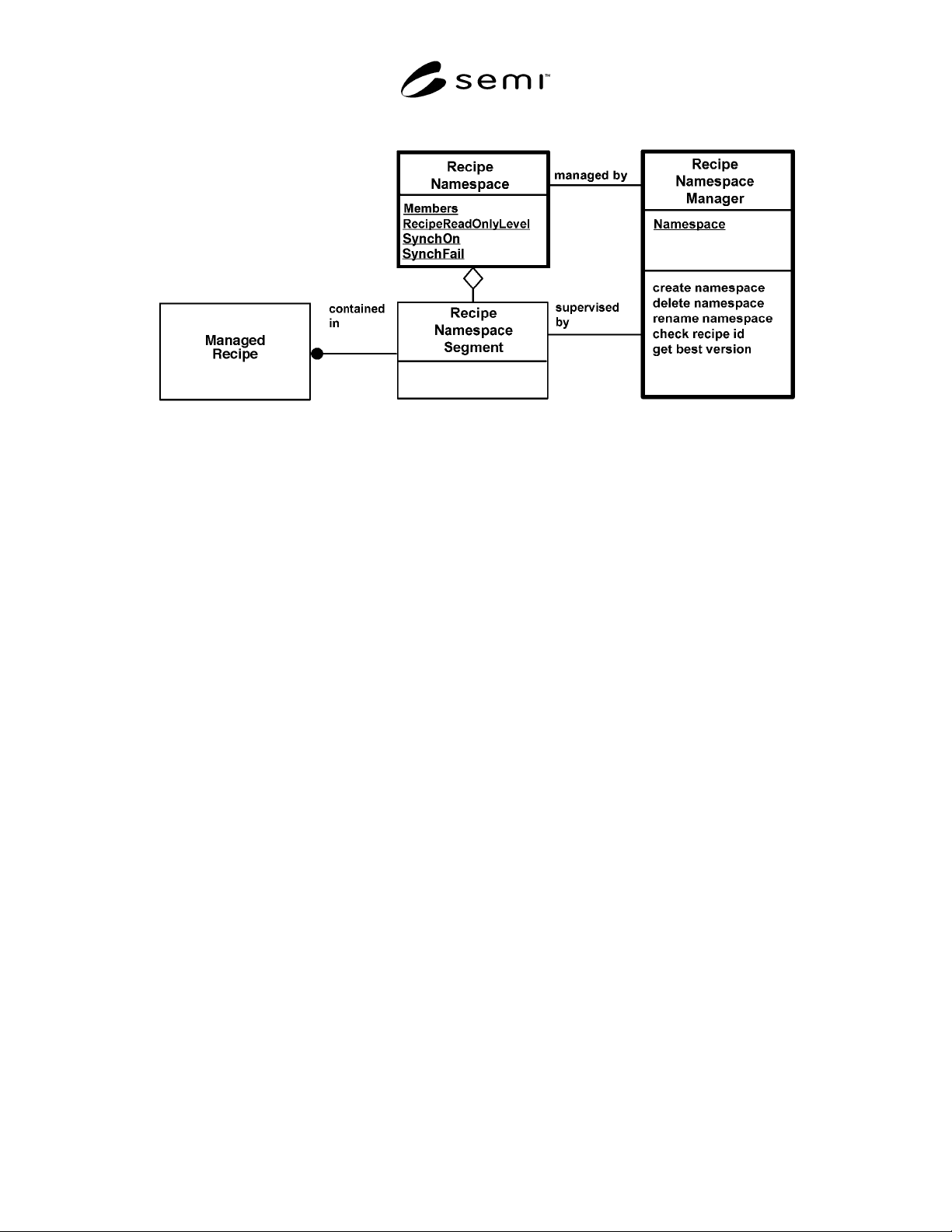
Figure 4.1 shows the basic namespace model with four
objects: the recipe, the namespace itself, a namespace
component called recipe namespace segment, and a
recipe namespace manager.
The recipe namespace manager (or manager)
represents the interface for the namespace to the
external world and the internal decision authority
within the namespace. All services for the namespace
and its recipes are provided by the manager. The
namespace itself is passive. While it has important
attributes, the namespace has no operations, and it
provides no services.
The recipe namespace segment (or segment)
represents both the internal storage element and the
actual manipulation of recipes within the namespace,
under the supervision of the manager. In the basic
model, it also provides no public services. The
relationship between the segment and the manager in
this model is presumed to be internal to an application.
Figure 4.1 represents a namespace with centralized
storage. However, it can easily be extended to the
distributed recipe namespace, which may have
multiple segments, each provided by a different external
agent. For that case, the manager and segment must
provide public services for one another.
SEMI E42-0704 © SEMI 1995, 2004 29
Figure 4.1
Recipe Namespace Model
All operations performed on a recipe through Recipe Management services are performed within the namespace by,
or under the supervision of, the namespace manager, with two exceptions. A namespace manager is not required to
understand the syntax of the recipe languages. For this reason, recipe editing (modifying a recipe's body) is not part
of the namespace definition, and verification shall be provided by a recipe executor of an appropriate executing
agent (see Section 6). These two activities require an in-depth understanding of the particular recipe languages used.
Their separation from the other activities allows generic namespace capabilities to be provided.
4.3 Namespace Specifications — The combination of the recipe namespace, its segment component, and its
manager provides storage, retrieval, and management of recipes conforming to RMS.
A namespace manager is responsible for maintaining the integrity of the namespace, the integrity of the recipes
within the namespace, and the integrity of the recipe identifiers. It understands the rules regarding recipes, their
attributes, and their components, and it is responsible for enforcing those rules. It will not allow a read-only recipe
to be changed or deleted, for example. Therefore, it will not accept a recipe with an identifier already used by a
read-only recipe.
A namespace has no restrictions on the read access of a recipe as a whole or of its attributes, nor is it concerned
with the uses to which they might be put outside the namespace. The ability for multiple agents to share the same
recipes is determined solely by the ability of the agents to access the same namespace. Issues of security and
authentication are beyond the scope of RMS.
The term recipe namespace, or namespace, is used inclusively to refer to those attributes, operations, and other
requirements common to both the namespace described in this section and to its distributed subtype. The term
centralized namespace is used in references to an instance (implementation) of the basic model and to clarify
statements that do not apply to instances of the distributed subtype.
A centralized namespace is analogous to a single directory of files, where duplicate file names are not allowed. It
may exist in several different configurations that are incidental to namespace requirements.
It is possible to provide a namespace that uses removable media for its physical storage. Recipes may then be
transferred to and from this namespace to any other namespace.
In no case shall it be possible to transfer recipes into a namespace except according to the requirements for
namespace management. For example, a read-only recipe may not be replaced.
The centralized namespace may be applied several ways. An agent with execution capabilities that may be operated
in stand-alone mode shall provide itself with a centralized namespace to be used when operating in stand-alone
mode. Other agents, such as diskless process modules in a cluster, may expect to rely upon the namespace
capabilities provided by the cluster supervisor.
SEMI E42-0704 © SEMI 1995, 2004 30
4.4 Member Agents — A namespace that contains
recipes used by multiple agents is called shared.
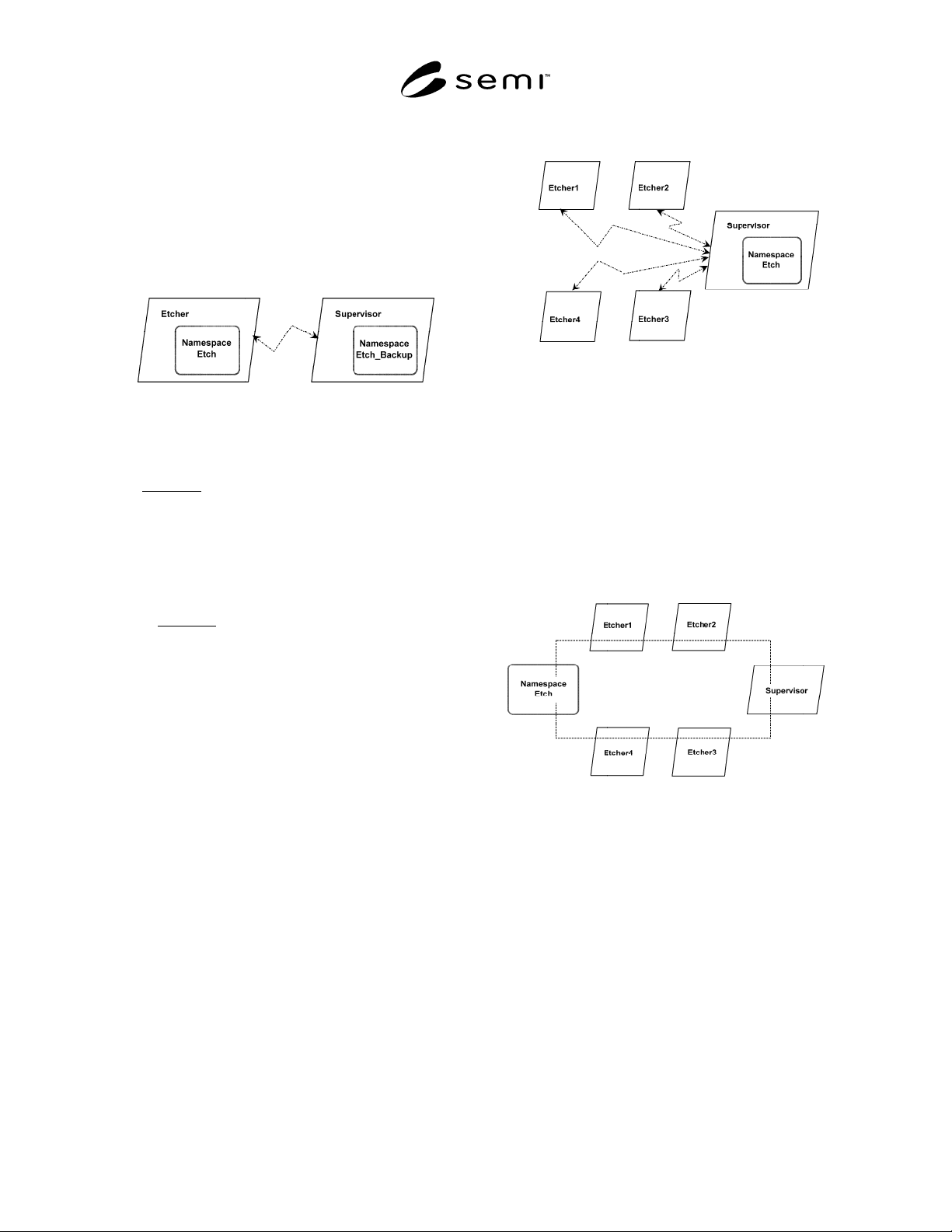
Otherwise, it is called dedicated or non-shared. Figure
4.2 illustrates two dedicated namespaces, one provided
by an etcher and one by its host. This terminology is
introduced for clarification and descriptive purposes
only.
Figure 4.2
Host Backup of Equipment Namespace
The Members
attribute of the namespace contains the
names (object identifiers) of the agents that use the
recipes in the namespace, and these agents are called
member agents (members) of the namespace. The
namespace manager uses this information as it may
require assistance from a member agent to verify a
recipe.
If the Members
attribute of the namespace contains
multiple agent names, then the namespace is shared.
Otherwise, it may be non-shared or not yet completely
set up. If it is empty (null), the namespace has not been
completely set up and is not fully functional, as certain
operations, including recipe verification, require it to
have content.
4.5 Illustrations — This section provides illustrations
of several possible configurations of a centralized
namespace.
Figure 4.2 illustrates an etcher that has its own local
namespace and that communicates with its supervisor
over an RS-232 line. The supervisor in this example
maintains a separate namespace, providing backup for
recipes of particular significance.
Figure 4.3 illustrates a supervisor with four diskless
subordinates. In this configuration, the supervisor
provides recipes for all four subordinates from a
centralized namespace.
Figure 4.3
Namespace Provided by Supervisor
Figure 4.4 illustrates four executing agents on a
common network with a supervisory agent and a sixth
agent providing a centralized namespace. Each
executing agent is able to access the namespace
independently of the supervisor.
Figure 4.4
Shared Network Access
Figures 4.3 and 4.4 both represent examples of shared
centralized namespaces.
4.6 Attribute Definition Tables — Table 4.1 defines the
attributes of the recipe namespace.