semi合集-English.pdf - 第4687页
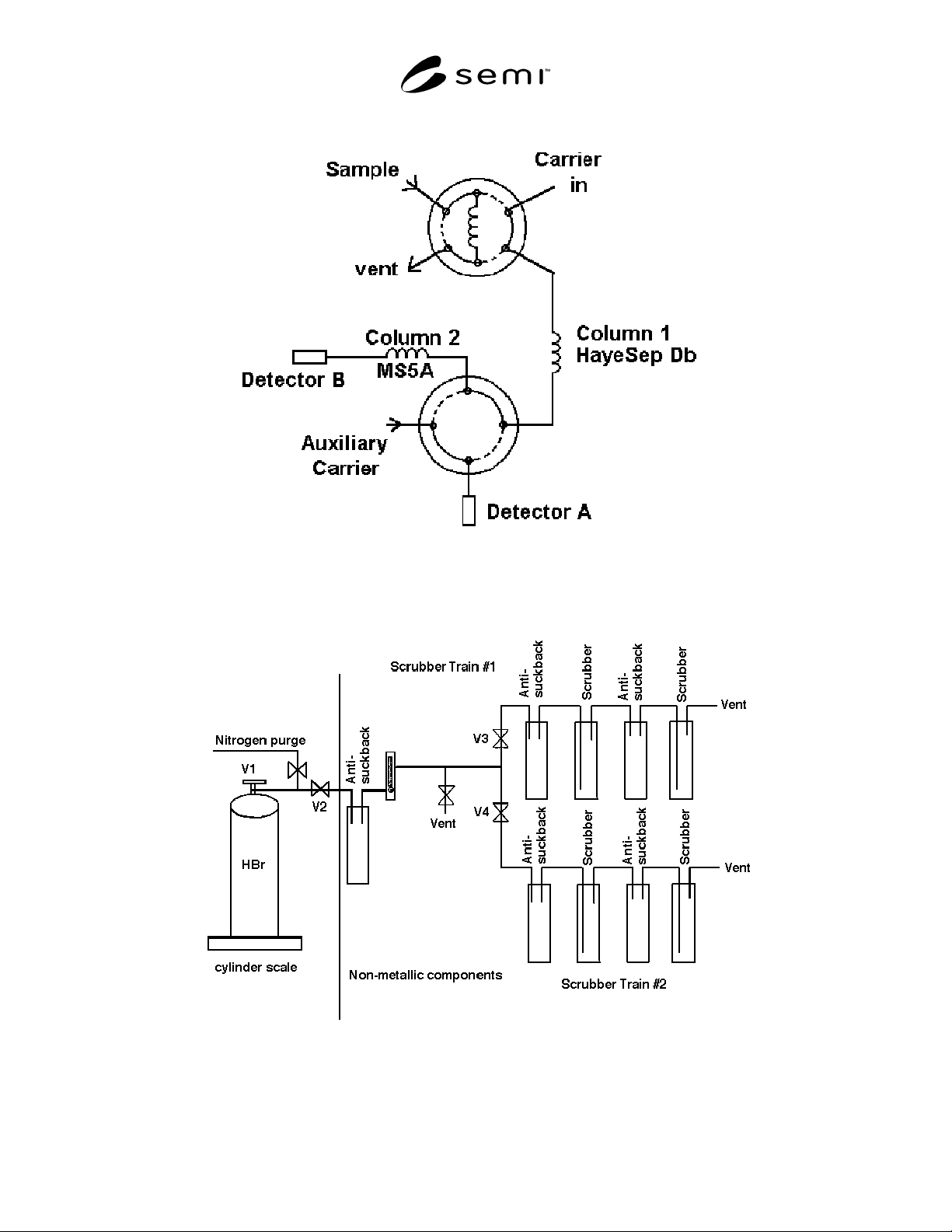
SEMI C3.47-11 01 © SEMI 1993 , 2001 4 Figure 1 Column Configuration fo r the Analysis of CO, CO 2 , and Hydro carbons Figure 2 Iron Analysis Sampling Appara tus
SEMI C3.47-1101 © SEMI 1993, 20013
4.3.4 Sampling Gaseous Hydrogen Bromide
4.3.4.1 Assemble sampling apparatus in laboratory
hood for safety.
4.3.4.2 Fill gas washing bottles (scrubbers) with 75 mL
18 megaohm-cm DI water.
4.3.4.3
Start nitrogen purge to remove air from system
and to check for leaks.
4.3.4.4 Close V4 and nitrogen purge.
4.3.4.5 Close V2.
4.3.4.6 Open V1 and V3.
4.3.4.7 Open V2 and controlling flow rate at 1 L/min
taking care not to over-pressurize system.
4.3.4.8 Continue flow through scrubber train #1 until
scale shows that approximately 100 grams of HBr have
been purged.
4.3.4.9
Open V4 and close V3. Record the weight of
HBr cylinder.
4.3.4.10
Collect 100 grams of HBr in scrubber train #2.
Close V1 and record weight of HBr sampled.
4.3.4.11 Open nitrogen purge and purge lines, scrubber
train #1 and scrubber train #2, before disconnecting
scrubbers.
4.3.5
Sample Preparation
4.3.5.1 For each scrubber train, quantitatively wash
with DI water and add to 250 mL volumetric.
4.3.5.2 Wash associated tubing of each scrubber train
with DI water and add to the 250 mL volumetric.
4.3.5.3 Make up reagent blank of water from the same
lot of DI water used in the sampling.
4.3.6
Calibration — Make calibration standards by
serial dilution of standard iron solution which is matrix
matched traceable to NIST.
4.3.7
Instrument Parameters — Perform analysis on an
inductively coupled plasma spectrometer or equivalent
technique employing operating procedures suggested
by manufacturer. Correct result to ppm (ppmw) basis
on HBr used.
4.4
Chloride Ion — This procedure is for the
determination of chloride ion in gaseous hydrogen
bromide using ion chromatography.
4.4.1
Detection Limit — 5 ppb wt/vol.
4.4.2 Sample was prepared as in Section 4.3.5. The 250
mL aqueous sample was diluted further 500 to 1, by
diluting one milliliter of 250 mL aqueous sample with
DI water in a 500 mL volumetric flask.
4.4.3
Instrument Parameters
4.4.3.1 Flow:
• Eluent l0 mM NaOH at 1 cc/min.
• Regenerate 25 mM H
2
SO
4
at 7 psi.
4.4.3.2 Column — AS5A with AG5A guard column
4.4.3.3 Sample Size — 25 microliters.
4.4.3.4 Program — Boost eluent concentration to 100
mM NaOH after elution of chloride peak (4.3 min).
Continue 100 mM eluent flow for 7 minutes to elute
bromide peak. Return to 10 mM NaOH at 12 minutes.
Allow to equilibrate for 6 minutes.
4.4.4
Calibration — A multi-point calibration curve is
constructed in the range of 10 ppb to 250 ppb (wt/vol)
employing standards traceable to NIST.
4.4.5
Use procedures provided by manufacturer of ion
chromatograph. Correct results and calculate them to
pure HBr on a weight/weight basis.
SEMI C3.47-1101 © SEMI 1993, 2001 4
Figure 1
Column Configuration for the Analysis of CO, CO
2
, and Hydrocarbons
Figure 2
Iron Analysis Sampling Apparatus

SEMI C3.47-1101 © SEMI 1993, 20015
NOTICE: These standards do not purport to address safety issues, if any, associated with their use. It is the
responsibility of the user of these standards to establish appropriate safety and health practices and determine the
applicability of regulatory limitations prior to use. SEMI makes no warranties or representations as to the suitability
of the standards set forth herein for any particular application. The determination of the suitability of the standard is
solely the responsibility of the user. Users are cautioned to refer to manufacturer’s instructions, product labels,
product data sheets, and other relevant literature respecting any materials mentioned herein. These standards are
subject to change without notice.
The user’s attention is called to the possibility that compliance with this standard may require use of copyrighted
material or of an invention covered by patent rights. By publication of this standard, SEMI takes no position
respecting the validity of any patent rights or copyrights asserted in connection with any item mentioned in this
standard. Users of this standard are expressly advised that determination of any such patent rights or copyrights, and
the risk of infringement of such rights, are entirely their own responsibility.
Copyright by SEMI® (Semiconductor Equipment and Materials
International), 3081 Zanker Road, San Jose, CA 95134. Reproduction o
f
the contents in whole or in part is forbidden without express written
consent of SEMI.